600+ Types of Flowers A To Z (With Names and Pictures)
Types Of Flowers By Names (A-Z) Types Of Flowers By Color Types Of Flowers By Season Types Of Flowers By Blooming Time 600+ Types of Flowers No. Flower Name No.…

The Tagetes patula, a member of the Asteraceae family and Marigold genus, is an annual herbaceous plant. It features an upright stem with diagonal branches. Its leaves are pinnately divided, and its inflorescence is solitary.
The corolla of its tubular flowers is yellow, and it bears slender, linear achenes. It flowers from July to September.
Native to Mexico, it can be found in Sichuan, Guizhou, Yunnan and other places, growing in meadows and forests on slopes at altitudes of 750-1600 meters or cultivated in gardens. It has medicinal value.
The entire plant can be used in medicine, harvested in summer or autumn, and used fresh or dried. It has a bitter taste and neutral properties. It is known to clear heat, benefit dampness, and stop coughs.
It is used for coughs, dysentery, acute coughs, toothache, and red and painful eyes due to wind-heat. It is also applied externally for mumps and mastitis.
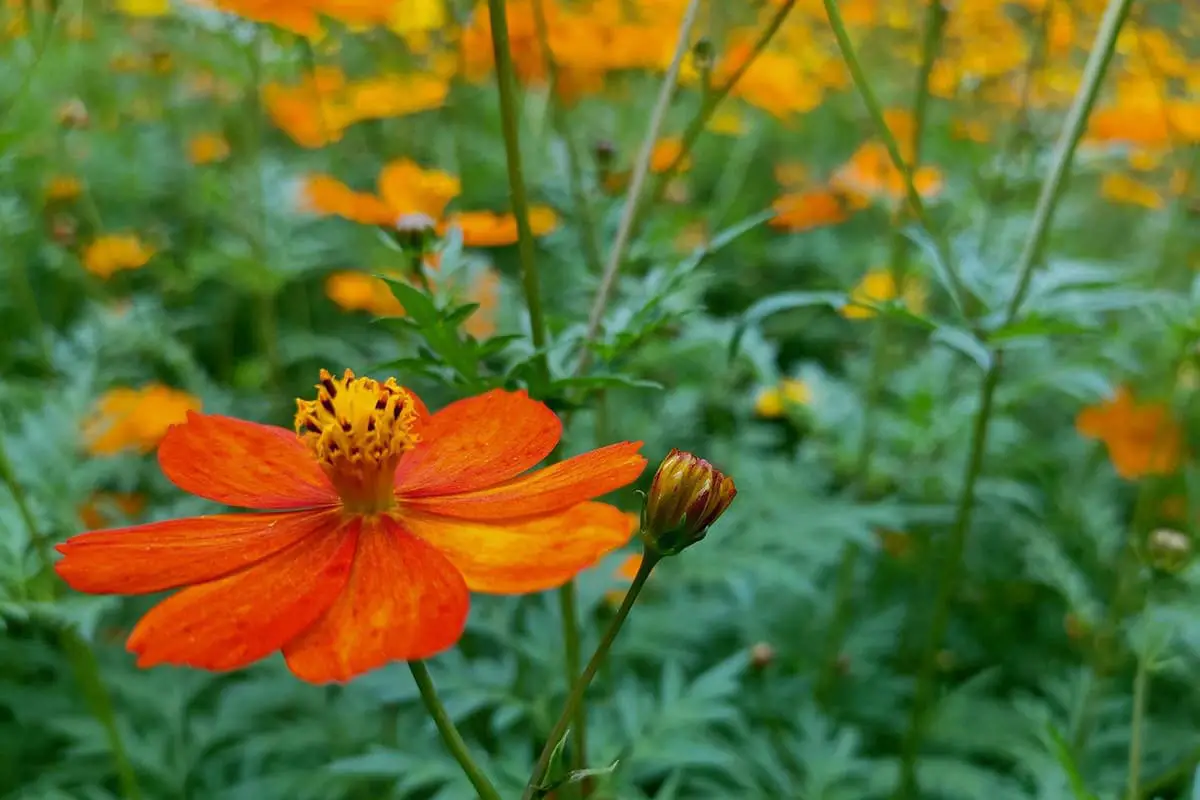
The French Marigold is an annual herb that grows 30-100 cm tall. The stem is upright, usually branching near the base, with diagonal branches. The leaves are pinnately divided, 2-9 cm long and 1.5-3 cm wide.
The lobes are linear-lanceolate with serrated edges, often with a long thin awn at the apex of the tooth, and usually a gland at the base of the tooth.
The solitary inflorescence is 3.5-4 cm in diameter. The peduncle is 5-6.5 cm long, slightly thickened at the top. The involucre is 1.5 cm long and 0.7 cm wide, ellipsoid, with sharp teeth at the top and glandular points.
The ray florets are golden or orange with red spots, and the ligules are nearly round, 8-10 mm long and 6-7 mm wide, slightly concave at the top. The corolla of the tubular flowers is yellow, 10-14 mm long, the same length as the pappus, with 5 toothed lobes.
The achene is linear, tapering at the base, 8-12 mm long, black, covered with short soft hairs. The pappus scales are lanceolate, with 1-2 long awns and 2-3 short and blunt ones. It flowers from July to September.

It grows in meadows and forests on slopes at altitudes of 750-1600 meters, or it can be cultivated in gardens. It enjoys sunlight but can also flower in semi-shade. It is not demanding about the soil conditions.
It tolerates transplantation well, grows quickly, and is easy to manage. Seeds scattered on the ground can grow on their own under suitable temperature and humidity conditions, making it a very adaptable flower.
Native to Mexico, it is commonly cultivated in gardens all over China.

Medicinal Source: This refers to the entire plant of the Asteraceae family, known as the Peacock herb.
Harvest and Storage: The herb is harvested in the summer and autumn seasons, and can be used fresh or dried in the sun.
Taste and properties: It has a bitter taste and cooling properties.
Main functions: It helps to clear heat and detoxify, and alleviate coughs. It is primarily used to treat common colds induced by wind and heat, coughs, dysentery, costochondritis, mastitis, furuncles, toothaches, oral inflammation, and red, swollen, painful eyes.
Usage and dosage: For internal use – decoct in water, 9-15g, or grind into powder. For external use – use an appropriate amount, grind into powder and mix with vinegar for application, or crush the fresh plant for application.
3-5 qian, decoct in water or grind into powder and administer with boiling water several times; for external use, mix with an appropriate amount of heavy building and honeysuckle powder, and apply to the affected area with aged vinegar.

The flowers and leaves of the peacock grass can be used in medicine, with the functions of clearing heat and resolving phlegm, nourishing blood and promoting menstruation. It can treat whooping cough, tracheitis, and colds. Residents of the Caucasus region in Russia often consume peacock grass, which is believed to prolong life.
Since the plant known as “One Red String” cannot withstand the low temperatures of May Day, nor the early frost of October National Day, the intense heat of midsummer can leave most plants in a semi-dead state.
Therefore, Peacock Grass has gradually become the primary flower in flower beds and courtyards. Its orange and yellow flowers are extremely eye-catching.

Peggie was once a high school mathematics teacher, but she set aside her chalkboard and textbooks to follow her lifelong passion for flowers. After years of dedication and learning, she not only established a thriving flower shop but also founded this blog, “Flowers Library”. If you have any questions or wish to learn more about flowers, feel free to contact Peggie.
 English
  العربية
  Bahasa Indonesia
  Deutsch
  Français
  Italiano
  Nederlands
  Português
  Русский
  日本語
日本語