600+ Types of Flowers A To Z (With Names and Pictures)
Types Of Flowers By Names (A-Z) Types Of Flowers By Color Types Of Flowers By Season Types Of Flowers By Blooming Time 600+ Types of Flowers No. Flower Name No.…

Saussurea japonica: This plant features an erect, robust stem with longitudinal ridges, sparsely covered with fine hairs and glandular trichomes. The basal leaves have long petioles, and the blades are elliptical, often deeply pinnately lobed.
The terminal lobe is an elongated oval-lanceolate shape, while the stem leaves gradually decrease in size from bottom to top, ranging from elliptical to linear-lanceolate, either pinnately lobed or entire, with bases sometimes extending downward as wing-like structures.
The flower heads are densely packed in a corymbiform arrangement; the involucre is cylindric, with spiderweb-like hairs on the outside.
The outer bracts are short and blunt, while the middle and inner bracts are linear, each with a membranous, circular appendage at the tip, usually purplish-red on the back and apex.
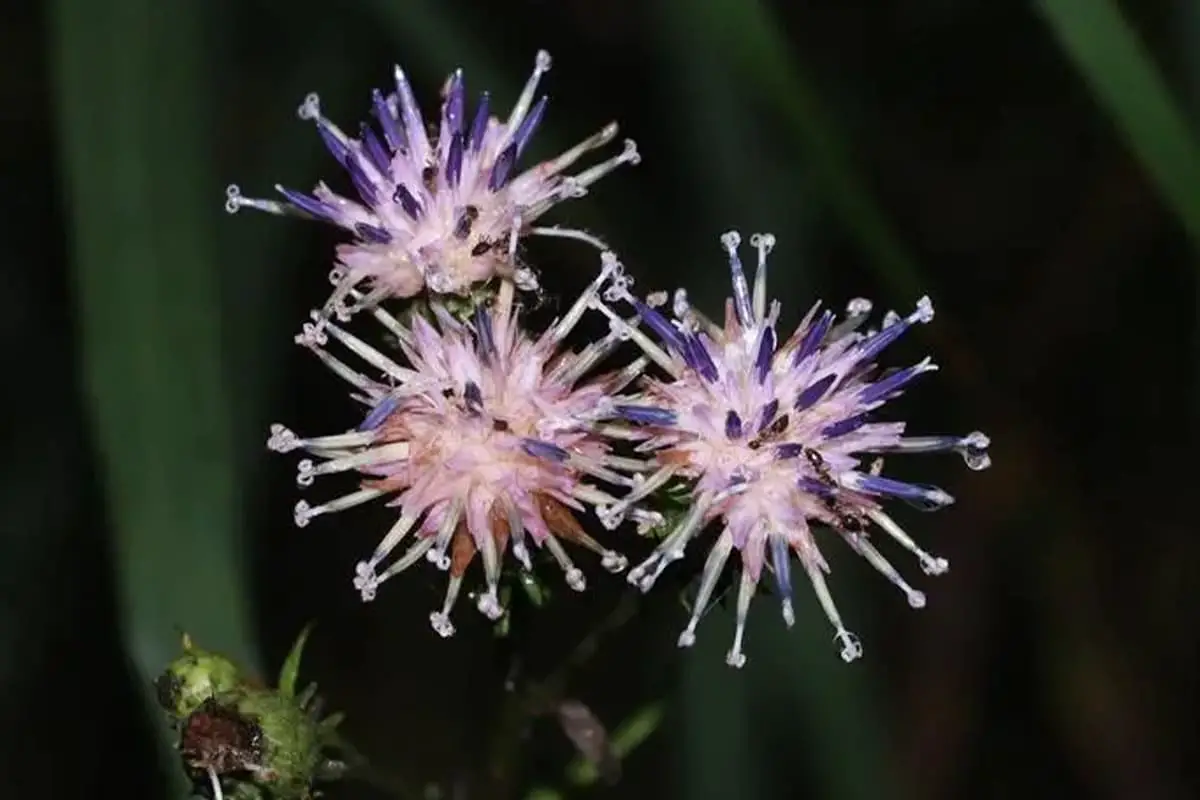
The flowers are tubular, purplish-red, and five-lobed at the apex. The fruit is an elongated ellipse, with the outer layer being short and rough-haired, and the inner layer feather-like. The flowering period is from June to August.
The Saussurea japonica is a biennial herb, growing 50-150 (200) cm tall. The root is inversely conical or spindle-shaped, dark brown, with numerous fibrous roots.
The stem is upright, about 1 cm in diameter at the base, usually wingless, rarely winged, and sparsely covered with short, soft hairs and golden yellow glandular spots. The basal and lower stem leaves have petioles, which are 3-3.5 (6) cm long, with narrow wings.
The leaf blades are elliptical, long elliptical, or lanceolate, 7-22 cm long and 3.5-9 cm wide, deeply pinnate-lobed, with 7-8 pairs of lateral lobes that are elliptical, obliquely triangular, linear-lanceolate, or linear.
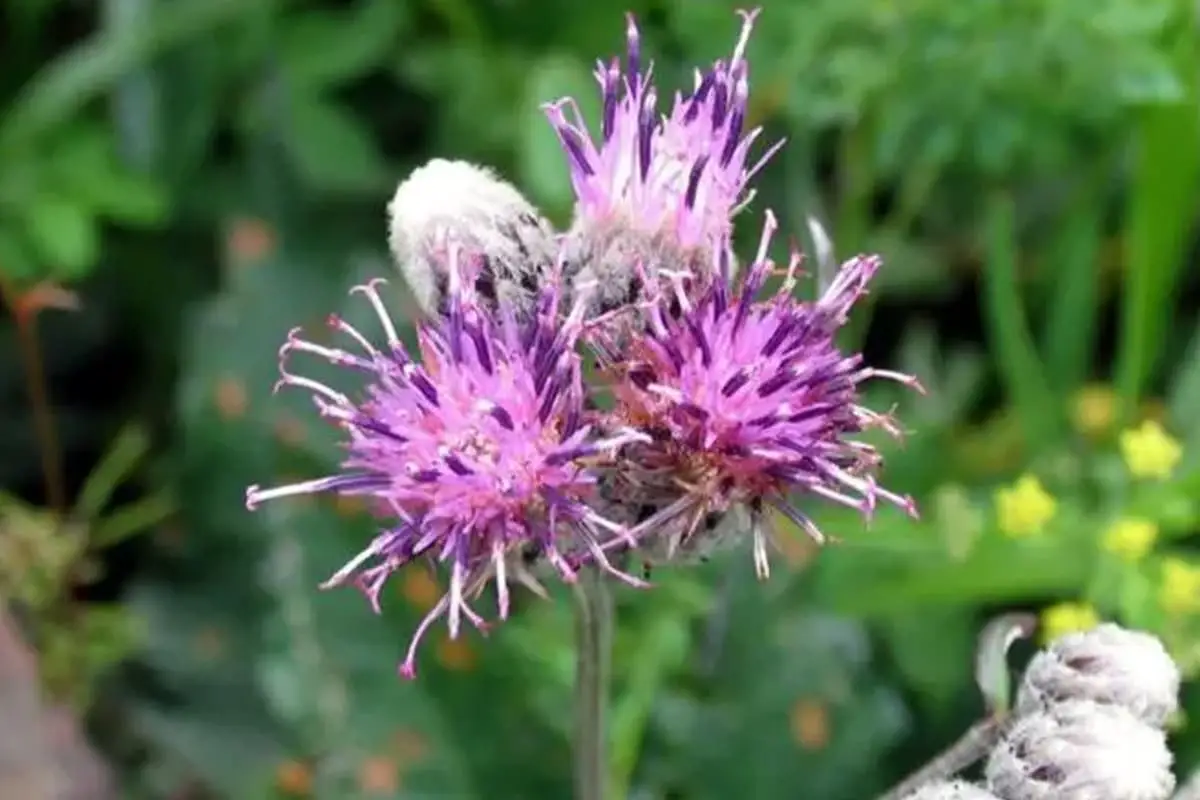
The central lateral lobes are larger, with the others gradually reducing in size towards the ends. All lobes have blunt or rounded tips, with the margins being entire or rarely with a few large serrations.
The terminal lobe is lanceolate or linear-lanceolate, longer than the others, and occasionally the basal leaves are unlobed, lanceolate or linear-lanceolate, with entire or serrated margins.
The middle stem leaves are similar in shape and lobing to the basal and lower stem leaves but progressively smaller, with short petioles.
The upper stem leaves and those on the inflorescence branches are even smaller, shallowly pinnate-lobed or entire, and sessile; they are the same color on both sides, green, paler beneath, and densely speckled with pale yellow glandular spots.
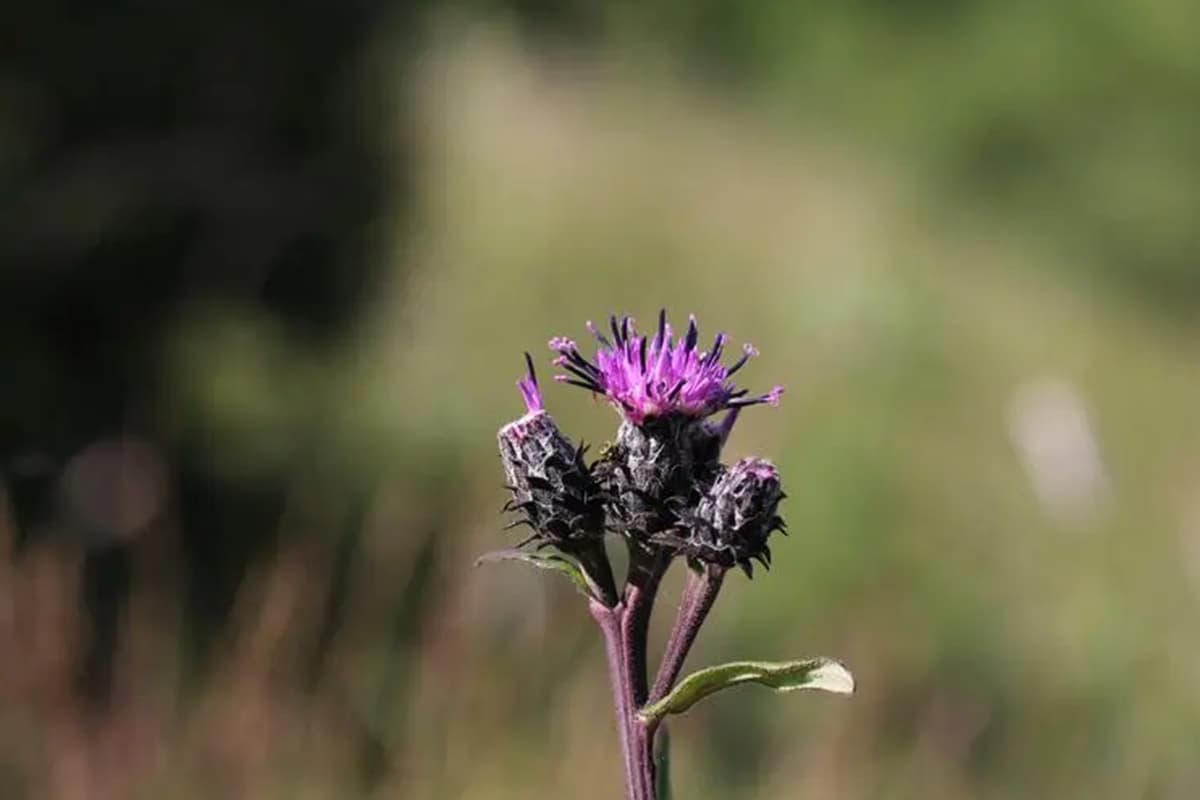
Numerous capitula are arranged in a corymbiform or corymbiform-paniculate inflorescence at the ends of the stem branches, each with a pedicel.
The involucre is cylindrical, 5-8 mm in diameter, with white, sparse, spiderweb-like hairs. There are six layers of bracts; the outer layer is ovate, 2.8 mm long, nearly 1 mm wide, with a slightly expanded purplish-red apex.
The middle and inner layers are inverted lanceolate or linear, 4-9 mm long, 0.8-1 mm wide, with a flattened, circular, purplish-red membranous appendage at the tip, the appendage’s edge serrated.
The flowers are purple, 10-12 mm long, with the tube portion being 6 mm long and the limb 4-6 mm long. The fruit is dark brown, cylindrical, 4-5 mm long.
The pappus is white, bi-layered, with the outer layer being short, rough-haired, 2 mm long, and the inner layer long, feather-like, 8 mm long. The flowering and fruiting period is from June to November.
Saussurea japonica thrives in a variety of environments including dry riverbeds in grasslands, alpine areas, meadow edges, roadside ditches, shrublands, valley meadows, wastelands, alkali meadow ditches, forest edges, inside forests, moving sand dunes, roadsides, sandy areas, rocky mountain valleys, mountain slopes, mountainous grasslands, shrubby slopes, roadsides on slopes, moist meadows on slopes, and stream banks.
It is found at altitudes of 200-2800 meters.
It is distributed in Korea and Japan.
The Saussurea japonica is propagated through sowing and division.
Using Saussurea japonica as the subject, the relationship between the inflorescence, seed size, and quantity was studied under varying conditions of light and nutrition.
The findings indicate that light and nutrition treatments had no significant impact on the number of inflorescences, but significantly affected the size of the flowers, as well as the size and number of seeds.
The relationship between size and quantity was also influenced by the treatment conditions: under control and low-nutrient treatments, there was a significant positive correlation between the size and number of inflorescences and seeds.
However, under low-light and combined low-light and low-nutrient treatments, this relationship turned into a significant negative correlation, revealing a trade-off between size and quantity.
Environmental stressors, such as limited soil nutrients and reduced light, intensified this trade-off.
The environmentally dependent trade-off relationship between the size and quantity of Japanese Saw-wort’s inflorescences and seeds allows the plant to respond to changes in external conditions. This reproductive strategy enhances its fitness in various environments.

Peggie was once a high school mathematics teacher, but she set aside her chalkboard and textbooks to follow her lifelong passion for flowers. After years of dedication and learning, she not only established a thriving flower shop but also founded this blog, “Flowers Library”. If you have any questions or wish to learn more about flowers, feel free to contact Peggie.
 English
  العربية
  Bahasa Indonesia
  Deutsch
  Français
  Italiano
  Nederlands
  Português
  Русский
  日本語
日本語