600+ Types of Flowers A To Z (With Names and Pictures)
Types Of Flowers By Names (A-Z) Types Of Flowers By Color Types Of Flowers By Season Types Of Flowers By Blooming Time 600+ Types of Flowers No. Flower Name No.…

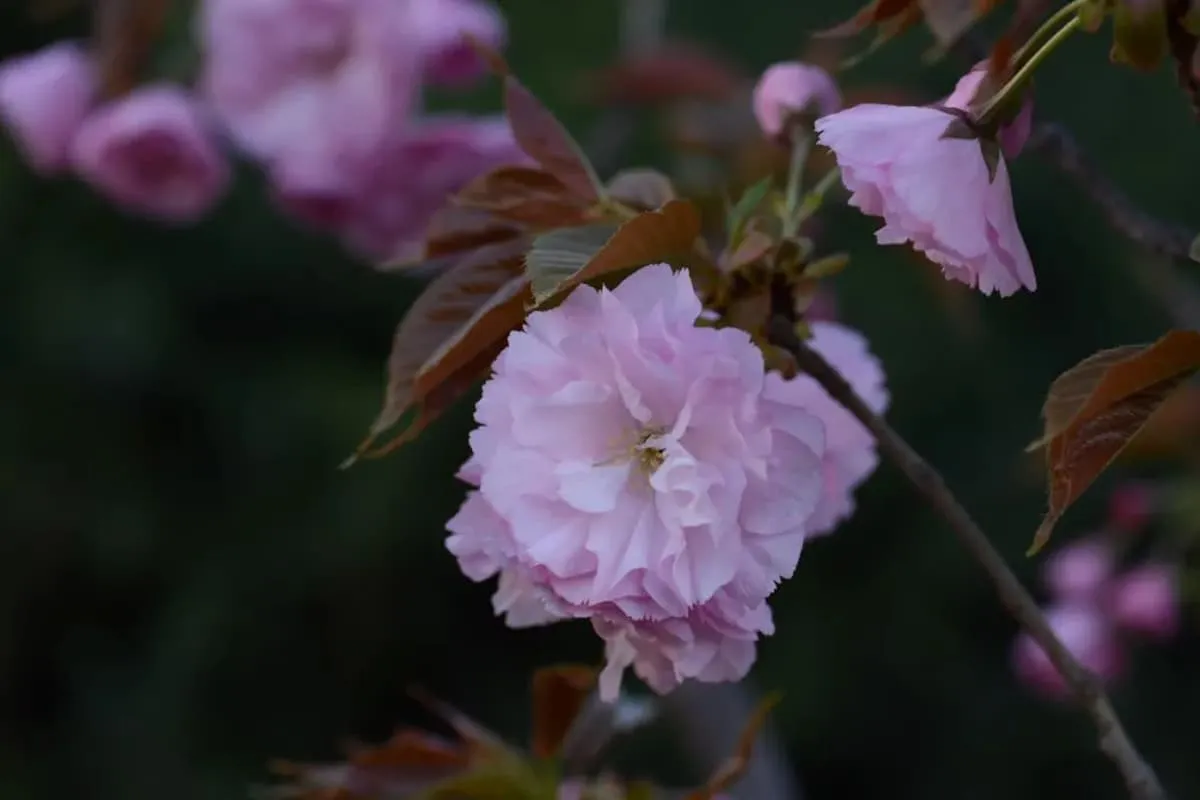
The Samantabadhra Cherry is a delicate ornamental cherry tree species. During the bud stage, it exhibits an old red hue, and when the flowers bloom, the petals on the outer edge are light red, while the middle part is almost white.
The two female stamens are bent, protruding like elephant tusks, earning its name for resembling the elephant that Samantabhadra Bodhisattva rides. The flowers and leaves bloom together, and the young leaves are reddish-brown.
Initially, the flowers are light red, but they later turn almost white. The tree bears 21 to 50 petals and usually two female stamens. Its flowering period is late March or early April.
The Samantabadhra Cherry (scientific name: Samantabadry jako wisienka) is a tree with branches that slightly extend downward. It is native to Japan and mainly grows there. It was introduced to China in 2009 and is cultivated in both the northern and southern parts of the country.
As previously mentioned, the Samantabadhra Cherry tree exhibits unique flowering characteristics. The lower part of the tree tends to leaf out, and its flowering period is in mid to late April.
The Samantabadhra Cherry likes sunlight and can withstand cold. It can overwinter outdoors in Beijing. It is adaptable to transplantation, poor soil, drought, wind, environmental pollution, and has a strong ability to sprout new shoots.
Thus, it is an ideal variety for urban greening and park green spaces, and it is particularly suitable for large-scale cultivation.
Transplantation can be carried out in spring and autumn. Grafted seedlings should be left in the bed for one year before transplantation. One-year-old grafted seedlings can be transplanted bare root, while seedlings that are two years or older should be transplanted with a soil ball.
If long-distance transportation is needed, the root of the bare-root seedlings should be coated with thin mud and tightly wrapped in a plastic bag.
Before planting, the seedlings should be pruned to remove diseased branches, dead branches, split branches, inner cavity branches, excessively long branches, and the main root.
One-year-old grafted seedlings should retain the main branches, and the main root should be moderately pruned.
The transplantation density and plant row spacing should be determined based on the specifications of the seedlings and the planned planting years. Before transplanting, the hole should be dug according to the planned transplantation density.
For bare-root seedlings, the root system should be spread out, and after planting, the hole soil should be compacted and enough water should be given to establish the roots; when transplanting with a soil ball, the diameter of the hole should be 10cm to 20cm larger than the soil ball, and a little base fertilizer should be applied at the bottom of the hole and covered with 2cm to 3cm of soil.
After planting, compact the hole soil and give enough water to establish the roots.
The Samantabadhra Cherry is a delicate ornamental tree species with many diseases and pests, including broom disease, perforated brown spot disease, leaf blight, gall disease, scale insects, small transparent wing moths, June beetles, gold flowers, mulberry thorn moths, etc.
Timely prevention and control should be paid attention to.

Peggie was once a high school mathematics teacher, but she set aside her chalkboard and textbooks to follow her lifelong passion for flowers. After years of dedication and learning, she not only established a thriving flower shop but also founded this blog, “Flowers Library”. If you have any questions or wish to learn more about flowers, feel free to contact Peggie.
 English
  العربية
  Bahasa Indonesia
  Deutsch
  Français
  Italiano
  Nederlands
  Português
  Русский
  日本語
日本語