600+ Types of Flowers A To Z (With Names and Pictures)
Types Of Flowers By Names (A-Z) Types Of Flowers By Color Types Of Flowers By Season Types Of Flowers By Blooming Time 600+ Types of Flowers No. Flower Name No.…

The Rhipsalidopsis gaertneri, is a parasitic succulent from the cactaceae family. Its stem is flat and thick, dark green in color with a slight hint of purple on the edges. Small spikes with short white hairs and a few yellow bristles are found on its shallow, round teeth.
The flowers bloom at the ends of the stems, showcasing a deep, radiant red color. The petals are wide and needle-like. The stamens are attached to the inside wall of the short flower tube, and the red pistil extends into a milky yellow stigma. The fruit is red in color.
The Easter Cactus is native to the tropics of South America, thriving in warm, humid environments. It does not tolerate direct sunlight and prefers loose, fertile, humus-rich, well-drained, slightly acidic sandy soil. Propagation is mainly through cuttings and grafting.
The Easter Cactus has an appealing shape and dense flowers, making it ideal for potting on balconies, window sills, and desks. It can also be grown on snake wood columns or boards. It is a popular indoor potted plant in Europe and America.
Being a plant that follows the Crassulacean Acid Metabolism pathway, it releases oxygen and increases the freshness of the air. The Easter Cactus is also known as the “Resurrection Cactus”.
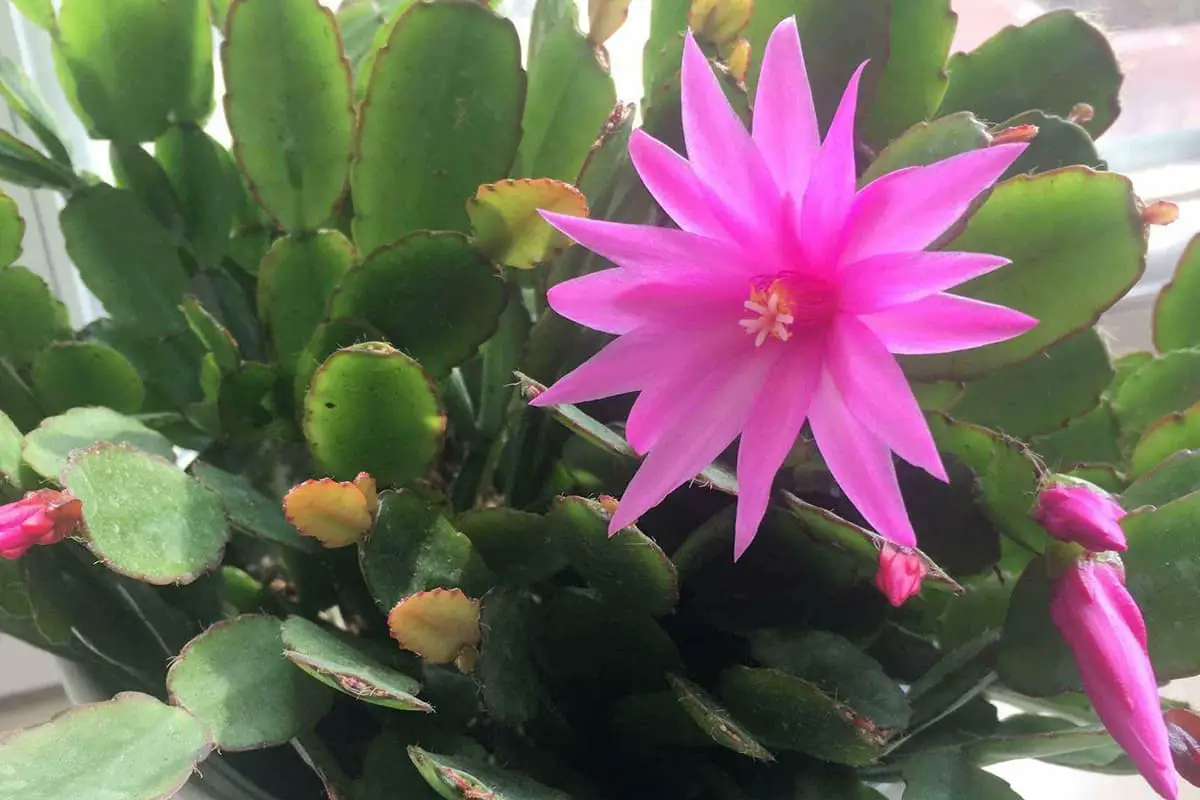
This parasitic succulent of the cactaceae family grows in a drooping form. The main stem is nearly round or flat, presenting a light gray-green color and prone to becoming woody. Its branches are segmented and abundant.
The leaf-like stems are flat and elliptical, approximately 4 cm long and 2 cm wide, usually green in color. The stem segments are flat, with rounded teeth on the edges. The flesh is thick and dark green, with a slight hint of purple on the edges.
As the plant matures, it gradually becomes green, with deep red edges. New stem segments have slightly reddish edges, with small net-like patterns and shallow round teeth with short white hairs and a few yellow bristles.
The flowers bloom at the ends of the stem segments, with about 10 petals each shaped like bamboo leaves. When the flower opens, a light yellow hexagonal stamen can be seen. Usually single, flowers are large, with neatly arranged, deep red, radiant petals.
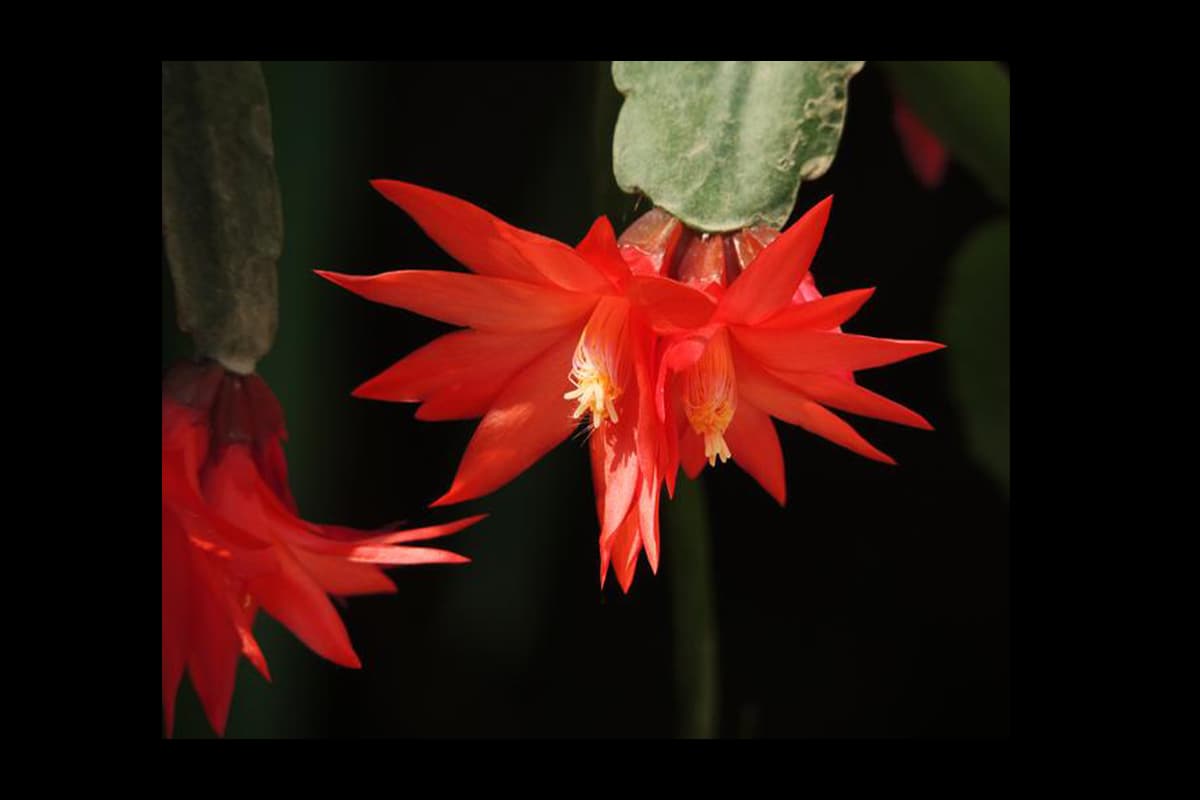
The petals are thin and straight, spreading evenly in all directions when the flower opens, resembling an opened umbrella. The stamens are attached to the inside wall of the short flower tube, with a red pistil extending into a milky yellow stigma.
The flower tube is short, and the flower is usually pure red or peach red. The flower opens during the day, closes at night, and reopens the next day. A single flower lasts 7-10 days, and the entire plant blooms for 20-30 days.
The fruit is red. Mature plants can produce hundreds of flowers between March and May. The Easter Cactus is also known as the “Resurrection Cactus”.
The Orchid Cactus, Epiphyllum, False Kalanchoe, and Falling Dance are all varieties of epiphytic cacti, with stem-shaped plant bodies. The tender “leaves” (i.e., new stem sections) and flower buds sprout from the top of the stem sections.
They bloom in winter and spring, presenting a beautiful spectacle and making them popular indoor potted plants.
Since they are all types of epiphytic cacti, they all have stem-shaped branches, and because the “leaf” shapes of these flowers are similar, they are often mistaken for the same variety of flower, collectively referred to as Orchid Cactus.
We can distinguish these flowers in the following ways:
Differences in stem sections (leaves):
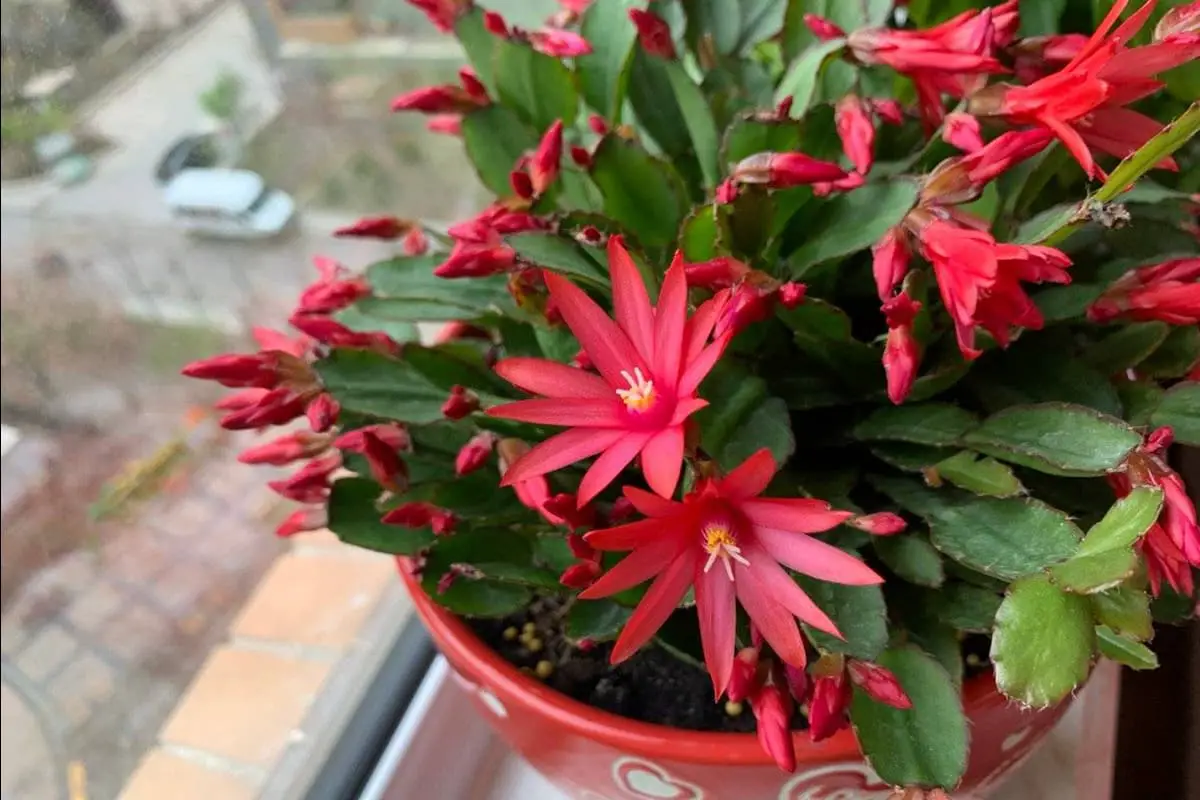
The Orchid Cactus’s stem sections (leaves) are flat with sharp edges, resembling a crab’s claw, hence its name. The stem sections of the Epiphyllum are flat and ovate, with no sharp edges, instead appearing wavy.
The False Kalanchoe’s stem sections are flat and elliptical, with smooth edges in a purplish-red color. The Falling Dance’s stem sections are angular, typically three or four angles, never exceeding five, with also purplish-red edges. Under grafting conditions, thicker flat stem sections can occur.
Differences in flower shape:
The Orchid Cactus has a long and curved flower tube, multiple layered petals, lower petals curling upwards, and irregular, unaligned petals. The pistil is red and the stamen is white, both are quite long and extend outside the flower tube.
The flower colors include yellow, white, orange, pink, red, purple, and snowy blue, in addition to multicolor varieties. Based on petal shape, there are sharp, blunt, and round petals. There are over 200 horticultural varieties.
The Epiphyllum has multiple layered and regularly aligned petals. The pistil is red and the stamen is white, both are quite long and extend outside the flower tube, similar to the Orchid Cactus. The flower color is rose red.
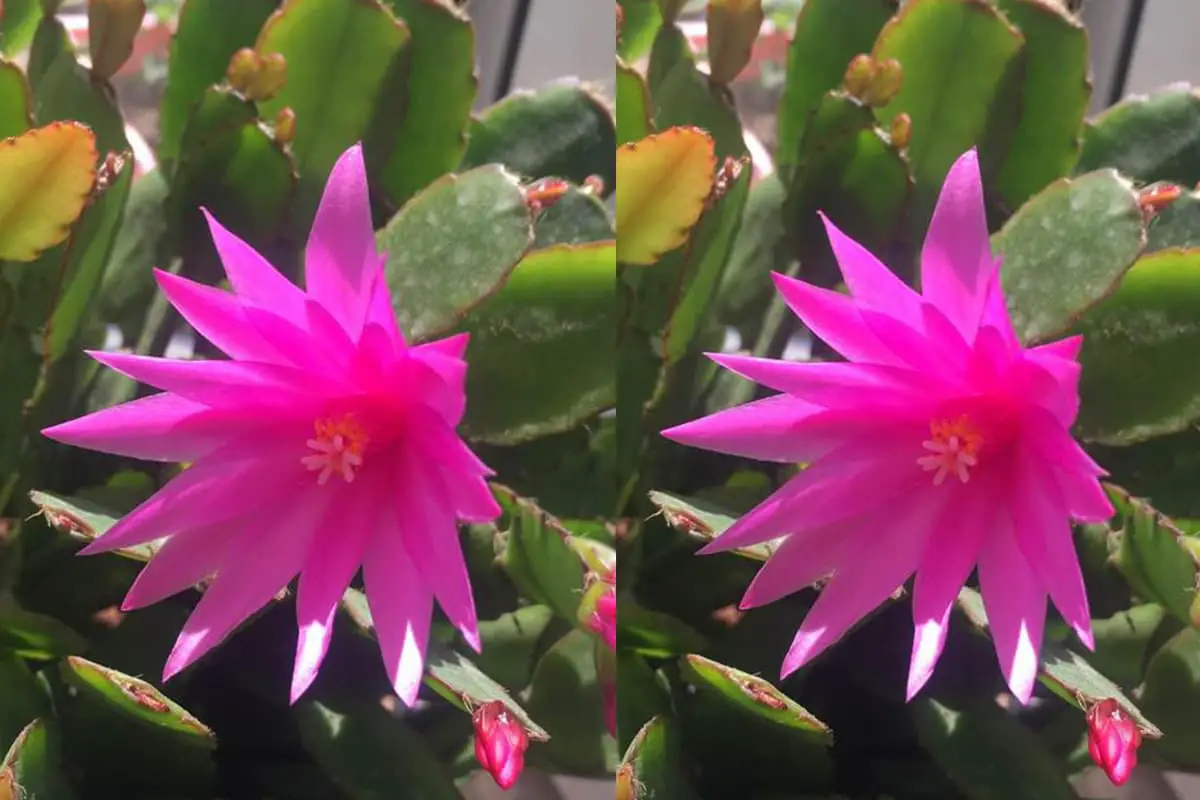
The False Kalanchoe has a shorter flower tube, and compared to the Orchid Cactus and Epiphyllum, it has a single layer of regular and aligned petals. The flowers are either pure red or pink.
The Falling Dance has a shorter flower tube and a single layer of regularly aligned petals. The flowers are pink, very similar to the False Kalanchoe, making them hard to distinguish. The most accurate way to tell them apart is by looking at the stem sections.
The blooming periods are also different:
The Orchid Cactus blooms from November to January; the Epiphyllum usually blooms around New Year’s Day; the False Kalanchoe blooms in April; and the Falling Dance blooms a little later, around April to May. Due to differences in local climates and varying levels of care, the blooming time can vary.
The False Kalanchoe is native to the tropics of South America and is cultivated worldwide. It is also grown in Guangzhou, China. It grows on large tree branches and rocks in tropical and subtropical forests.
During the growth period, it should be kept in a well-lit place, away from direct sunlight, such as a shaded shed or under trees. The formation of flower buds is closely related to temperature and daylight hours.
At around 10°C and under short daylight conditions, flower buds can form in 50 days. However, at temperatures above 15°C and long daylight conditions, the formation of flower buds can be inhibited. It is difficult for flower buds to form at temperatures above 20°C.
This plant thrives in warm, humid semi-shaded environments. It dislikes waterlogging and is not frost-resistant. Direct sunlight is harmful, and it requires high air humidity.
It prefers loose and fertile soil, rich in organic matter, with good drainage and slightly acidic properties.
The primary modes of reproduction for this plant are cutting and grafting. Cutting is usually done during the growing season, using robust and full stems. After drying for 1-2 days, they are planted in sandy soil or vermiculite.
The soil is kept moist, and roots should form within 20-30 days. Grafting is also done during the growing season. The rootstock can be sturdy cacti like the trigona or the plump cactus, and grafting is done through inlaying.
Temperature: This plant prefers warm, humid, semi-shaded environments and is not frost-resistant. The optimal temperature for growth is 15-25°C, and it cannot survive temperatures below 5°C during winter.
Lighting: Semi-shaded environments are ideal. During summer, it should be shaded to 50%-60% and placed in a cool, well-ventilated area. More sunlight is beneficial during spring, autumn, and winter.
Ventilation: In dry and poorly ventilated environments, the plant is susceptible to red spider mites, causing the stems to fall off. During cultivation, a well-ventilated environment should be maintained, with insecticides sprayed regularly during the growing season.
Soil: This plant prefers fertile, loose soil with good drainage. For potting, a mixture of 2 parts peat, 1 part coarse sand, and 1 part perlite can be used. Re-potting should be done every 1-2 years.
Watering: The plant requires plenty of water during its growth and flowering stages. The soil should be kept moist but not waterlogged. Overwatering can cause flowers to fall off.
After the flowering period, there is a 2-3 week dormancy period during which watering should be gradually reduced. Watering should be increased gradually after the dormancy period.
Fertilizing: During the growing season, a diluted organic liquid fertilizer or a nitrogen-phosphorus mix should be applied every half a month. More phosphorus and potassium should be applied during the bud differentiation period, and nitrogen should be stopped.
After flowering, the plant has a short dormancy period during which the soil should be kept slightly dry and no fertilizer should be applied. Weak and overcrowded stems can be pruned at this time.
The plant is susceptible to leaf spot and wilt diseases. At early stages, a 1000-fold solution of 50% mancozeb can be sprayed. Red spider mites may cause stems to fall off, often due to poor ventilation and hot, dry conditions.
To prevent this, improving the growing environment is crucial. If infestation occurs, a 1000-fold solution of 40% malathion can be sprayed.
This plant is aesthetically pleasing with its dense flowers, making it suitable for indoor decoration. Its blooms are vibrant and beautiful, making it a common choice for home decoration. It can be potted on balconies, window ledges, or tables, and is a popular indoor potted plant in Western countries.
Being a part of the Crassulacean acid metabolism pathway, it also releases oxygen, enhancing fresh air.
Flower Language: The beauty of a moment, the eternity of an instant.

Peggie was once a high school mathematics teacher, but she set aside her chalkboard and textbooks to follow her lifelong passion for flowers. After years of dedication and learning, she not only established a thriving flower shop but also founded this blog, “Flowers Library”. If you have any questions or wish to learn more about flowers, feel free to contact Peggie.
 English
  العربية
  Bahasa Indonesia
  Deutsch
  Français
  Italiano
  Nederlands
  Português
  Русский
  日本語
日本語