600+ Types of Flowers A To Z (With Names and Pictures)
Types Of Flowers By Names (A-Z) Types Of Flowers By Color Types Of Flowers By Season Types Of Flowers By Blooming Time 600+ Types of Flowers No. Flower Name No.…

Quisqualis indica, also known as Rangoon creeper, is a climbing shrub in the family Combretaceae. It can grow up to 2-8 meters tall, with small branches covered in short, yellow-brown hairs.
The leaves are opposite or nearly opposite, membranous, ovate or elliptic in shape, with a short acuminate apex and a rounded base.
The upper surface of the leaves is hairless, while the lower surface may be sparsely covered in brown hairs, especially when young. The plant produces terminal umbel-like inflorescences with ovate to linear-lanceolate bracts, which are hairy.
The calyx tube is 5-9 centimeters long, covered in yellow hairs, and has five small, spreading, outwardly curved calyx lobes. The petals are five in number, measuring 1.8-2.4 centimeters in length and 4-10 millimeters in width, with a blunt rounded apex.
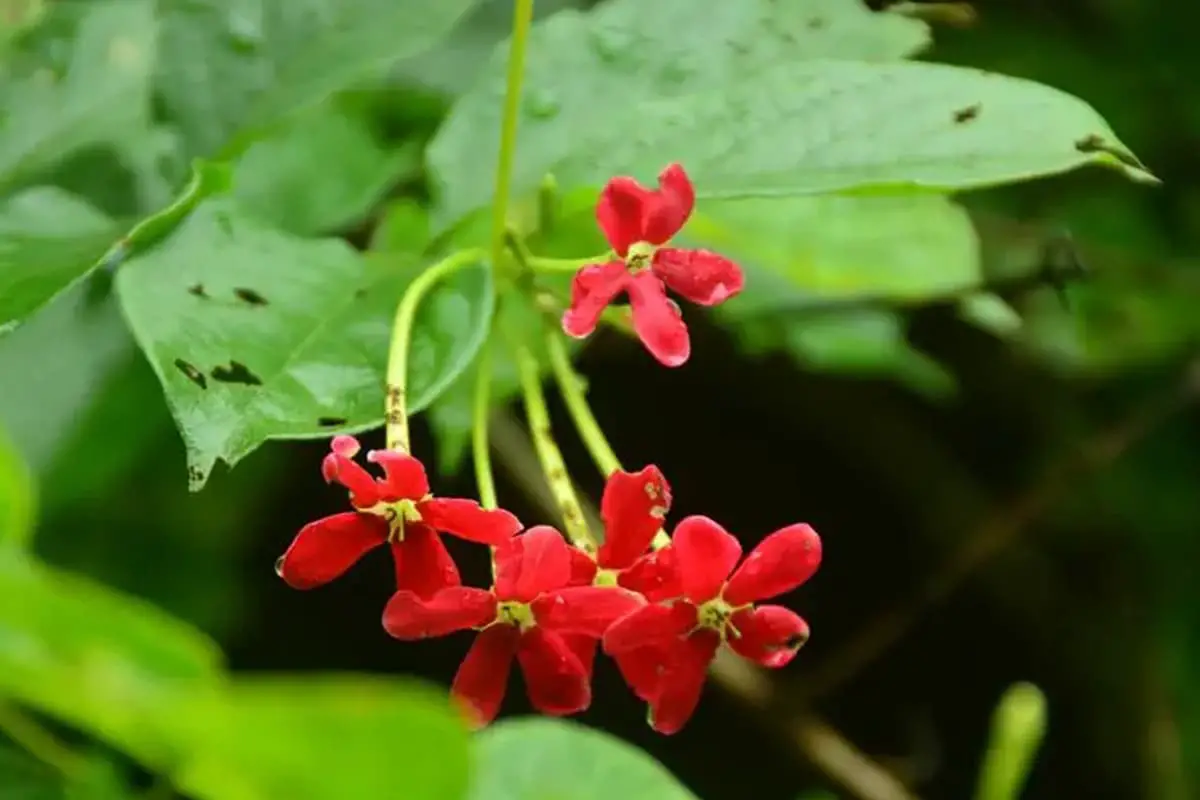
They start off white and later turn pale red. The plant has ten stamens, which are not exserted beyond the corolla. The outer whorl of stamens arises from the base of the corolla, while the inner whorl arises from the middle of the calyx tube.
The anthers are about 1.5 millimeters long. The ovary is inferior with three ovules. The fruit is ovoid, short-pointed, measuring 2.7-4 centimeters in length and 1.2-2.3 centimeters in diameter.
It is hairless and has five distinct, sharp ridges. When mature, the outer fruit skin becomes thin and brittle, appearing dark green or chestnut in color.
There is one white seed, measuring 2.5 centimeters in length and approximately 1 centimeter in diameter, with a cylindrical spindle shape. The plant flowers in early summer and bears fruit in late autumn.
Rangoon creeper is one of the most effective anthelmintic herbs in traditional Chinese medicine, particularly for treating parasitic worm infections in children.

It is a climbing shrub, growing 2-8 meters tall, with small branches covered in short, yellow-brown hairs. The leaves are opposite or nearly opposite, membranous, ovate or elliptic in shape, measuring 5-11 centimeters in length and 2.5-5.5 centimeters in width.
They have a short acuminate apex and a rounded base, with a hairless upper surface and occasionally sparsely covered brown hairs on the lower surface.
There are 7 or 8 pairs of lateral veins. The leaf stalk is 5-8 millimeters long, without joints, and covered in rusty-colored hairs when young.
The plant produces terminal umbel-like inflorescences. The bracts are ovate to linear-lanceolate and hairy. The calyx tube is 5-9 centimeters long, covered in yellow hairs, and has five small, spreading, outwardly curved lobes.
The petals are five in number, measuring 1.8-2.4 centimeters in length and 4-10 millimeters in width, with a blunt rounded apex. They start off white and later turn pale red. There are ten stamens, which are not exserted beyond the corolla.
The outer whorl of stamens arises from the base of the corolla, while the inner whorl arises from the middle of the calyx tube. The anthers are about 1.5 millimeters long. The ovary is inferior with three ovules.
The fruit is ovoid and short-pointed, measuring 2.7-4 centimeters in length and 1.2-2.3 centimeters in diameter. It is hairless and has five distinct, sharp ridges.
When mature, the outer fruit skin becomes thin and brittle, appearing dark green or chestnut in color.
There is one white seed, measuring 2.5 centimeters in length and approximately 1 centimeter in diameter, with a cylindrical spindle shape. The plant flowers in early summer and bears fruit in late autumn.
It prefers bright light and can tolerate partial shade, but flowering is more abundant with ample sunlight. It thrives in warm and humid climates and is not tolerant of cold or drought. It grows best in fertile, sandy loam soil rich in organic matter.
It is distributed from India and Myanmar to the Philippines.
Peggie was once a high school mathematics teacher, but she set aside her chalkboard and textbooks to follow her lifelong passion for flowers. After years of dedication and learning, she not only established a thriving flower shop but also founded this blog, “Flowers Library”. If you have any questions or wish to learn more about flowers, feel free to contact Peggie.
 English
  العربية
  Bahasa Indonesia
  Deutsch
  Français
  Italiano
  Nederlands
  Português
  Русский
  日本語
日本語