600+ Types of Flowers A To Z (With Names and Pictures)
Types Of Flowers By Names (A-Z) Types Of Flowers By Color Types Of Flowers By Season Types Of Flowers By Blooming Time 600+ Types of Flowers No. Flower Name No.…

The Periploca sepium, also known as Chinese silk vine, goat’s milk, northern five-flavor berry peel, goat horn peach, and goat peach, is a deciduous, climbing shrub belonging to the family Apocynaceae.
It thrives in sunlight, is drought-resistant, cold-hardy, and tolerant of saline-alkali soils. This plant has a deep root system and tends to grow in clumps.
Initially, it grows upright, but later sprawls or twines; its inflorescence stems and pedicels are slender. The sepals are ovate, measuring 3 mm in length and 2 mm in width, with blunt tips and 10 tiny glands at the base inside.

The corolla is purplish-red, radiate, with an open diameter of 1.5 cm; the corolla tube is short, about 3 mm long.
The lobes are lanceolate to oblong, 8 mm long and 4 mm wide, thickened in the middle to a spindle shape, reflexed, with long soft hairs inside and hairless outside. Blooming occurs from May to June, with the fruiting period from July to September.
The plant has strong rhizome growth, quickly forming dense clusters when cultivated individually, and is highly adaptable, making it an excellent species for sand fixation and soil erosion control. Medically, it can be used for analgesic purposes and to relieve rheumatism.
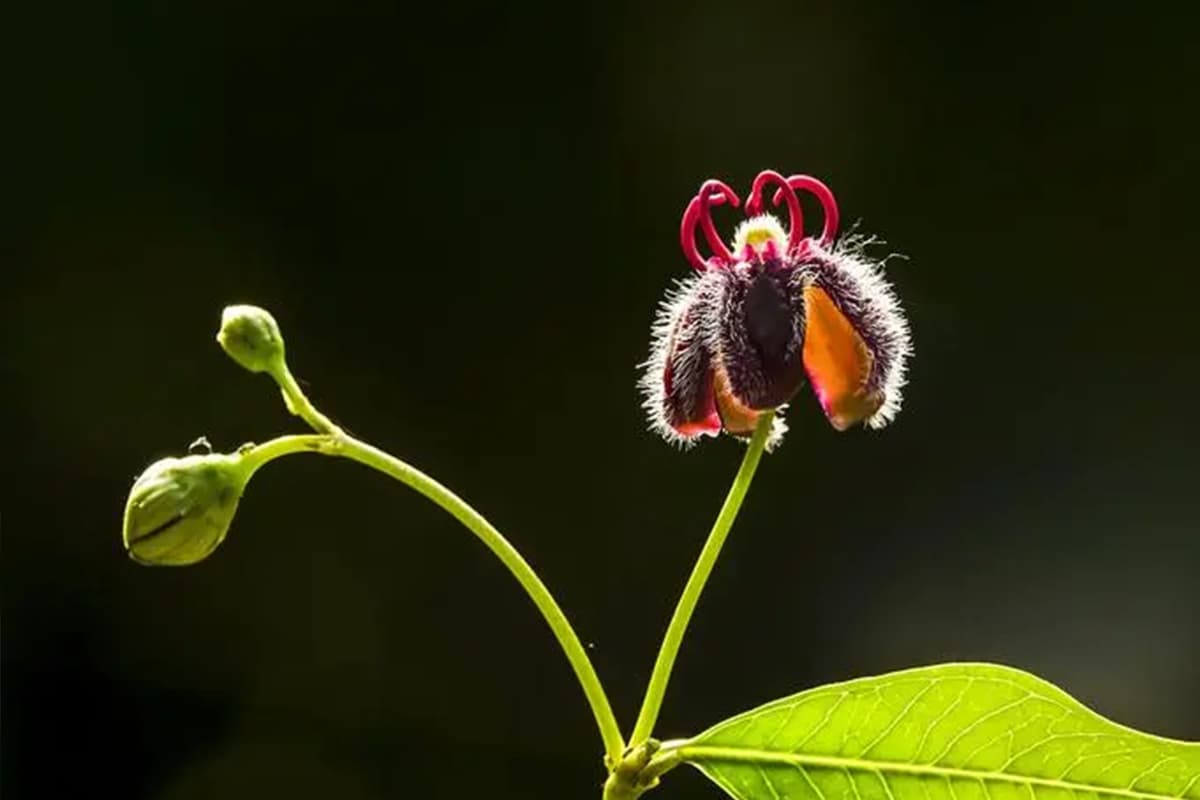
A deciduous climbing shrub, it can grow up to 1.5 meters tall. The main root is cylindrical, with a gray-brown outer bark and a light yellow inner bark.
The plant contains milky latex and is hairless except for the flowers. The stem bark is gray-brown, and the twigs are usually opposite with fine striations and lenticels.
The leaves are ovate to oblong, 5-9 cm long and 1.5-2.5 cm wide, tapering to a point at the tip, wedge-shaped at the base, dark green on the upper surface, and pale green on the underside.
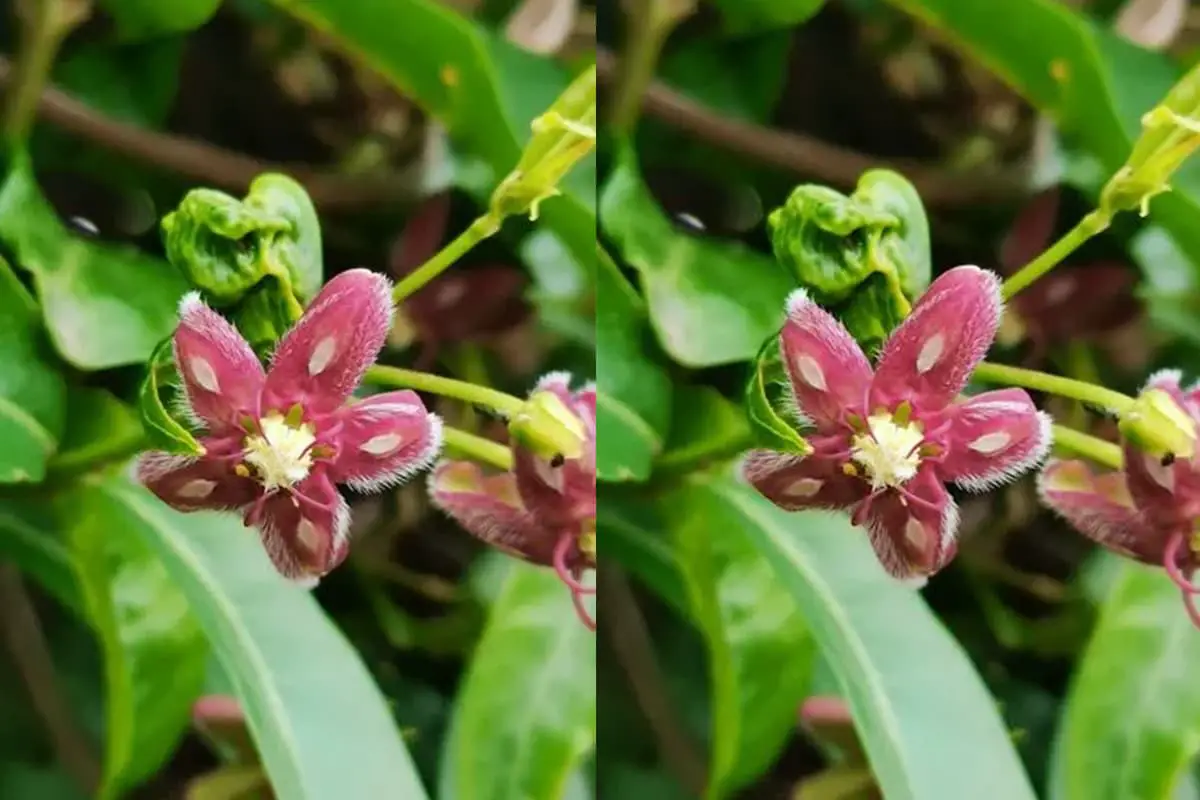
The midrib is flat on the leaf surface and slightly raised on the back, with delicate side veins that are flat on both sides, 20-25 on each margin; the petiole is about 3 mm long.
The cymes are axillary with several flowers; the sepals are ovate, 3 mm long and 2 mm wide, with blunt tips and 10 small glands at the base on the inside. The corolla is purplish-red, radiate, with an open diameter of 1.5 cm.
The corolla tube is short, about 3 mm long, with the lobes being lanceolate to oblong, 8 mm long and 4 mm wide, spindle-shaped and thickened in the middle, reflexed, with long soft hairs on the inside and hairless on the outside.
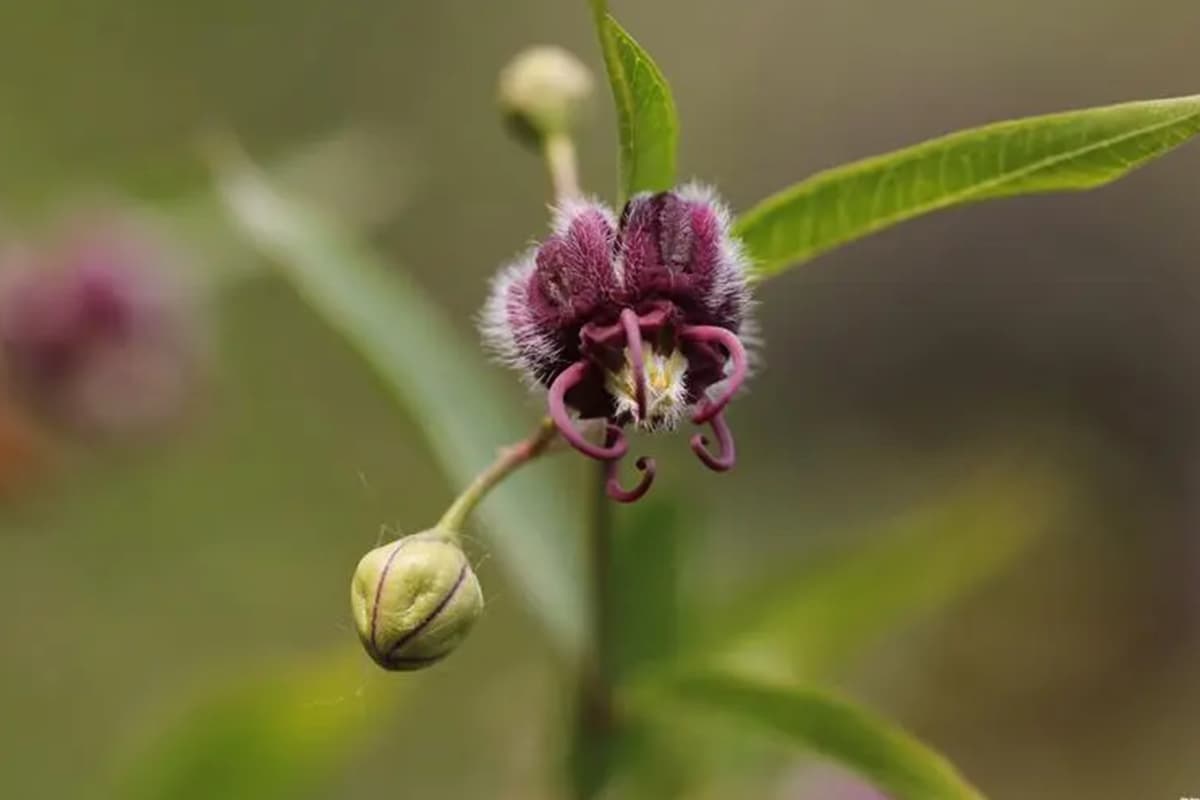
The corona is ring-shaped with 10 segments, five of which extend into filaments covered with short soft hairs, curving inward at the tips.
The stamens are attached to the inner surface of the corona, adhering to each other and enveloping the style head, with long soft hairs on the back.
The carpels are separate and hairless, each with many ovules, and the style head is disc-shaped and raised.
The pollen sacs are spoon-shaped, with the pollinia containing four pollen masses enclosed within the pollinators, adhering to the style head with a sticky disk.
The follicles are cylindrical, 7-12 cm long, about 5 mm in diameter, hairless, with longitudinal stripes; the seeds are oblong, about 7 mm long, 1 mm wide, dark brown, with a white silky tuft at the tip; the comas are 3 cm long.
The flowering period is May to June, with fruiting from July to September.
The Chinese silk vine grows on dry hillsides, ditch edges, stabilized sand areas, shrublands, riversides, riverine sands, valley terraces, riverbanks, wastelands, loess hills, forest edges, woods, roadsides, plains, hillside forests, sandy soils, valleys, slopes, and by fields, on both stabilized and semi-stabilized dunes.
The plant prefers full sun, tolerates shade, cold, drought, and poor soils. It adapts well to various soil types and has strong resistance to wind erosion and sand burial.
The Chinese silk vine is native to the Ussuri region in the Russian Far East.
Periploca sepium can be propagated through seeds, division, and cuttings. Division is mainly used for cultivating planting resources, but this method is slow.
Cuttings involve a complicated process and have a low survival rate, thus are generally not recommended. Seed propagation is the primary method used for large-scale nursery cultivation of Periploca sepium.
Therapeutic Functions
It dispels rheumatism and strengthens tendons and bones. It is used to treat rheumatoid arthritis; weakness in tendons and bones in children, delayed walking due to flaccidity of the legs; and edema with difficult urination.
Pharmacological Effects
① Cardiotonic Effects
Preparations from Periploca sepium bark (water-soluble substances extracted with ether and ethanol) can induce the heart of a frog to stop in systole, increase blood pressure in a cat’s heart, enhance myocardial contractility, and increase the output of a failing cat heart on a heart-lung machine.
The bark extracts (chloroform and ethanol extracts) have shown cardiotonic glycoside effects in in situ cat heart and electrocardiogram experiments.
Glycosides such as periplocin and periplocymarin, extracted from Periploca sepium root bark, act quickly, have a short duration, and weak accumulative effect.
② Sedative Effects
The ethanolic extract of Periploca sepium bark does not have a sedative effect on mice. Periploca sepium tincture and solution both exhibit central nervous system stimulation, possibly due to their volatile components.
③ Anti-inflammatory Effects
Pregnane glycosides, such as periplocoside E (PSE) from Periploca sepium, show significant immunosuppressive effects both in vivo and in vitro.
They can inhibit the proliferation of spleen cells induced by concanavalin A and mixed lymphocyte culture reaction at non-cytotoxic concentrations (<5μm), demonstrating dose-dependency.
This suggests that Periploca sepium bark can inhibit T cell activation both in vivo and in vitro and could provide a basis for its clinical use in treating autoimmune diseases and rheumatoid arthritis, which are T-cell mediated functional disorders.
④ Nerve Growth Factor Potentiating Effects
Steroidal glycosides isolated from Periploca sepium, such as Glyocoside K, H1, H2, promote nerve fiber growth in the tissue culture of chicken embryo sympathetic ganglia mediated by nerve growth factor. Among them, glyocoside H2 is the most effective.
⑤ Inducers of Cell Differentiation
Pharmacological research on the methanolic extract from the stem bark of Periploca sepium indicates that it has cell differentiation-inducing activities.
Nine monomeric compounds obtained from this extract all exhibit activity, with cardiac glycosides having weaker inducing activity than C21 steroidal glycosides.
⑥ Anticancer Effects
Research indicates that periplogenin from Periploca sepium has a strong inhibitory effect on the MCF-7 breast cancer cell line.
Studies have shown that extracts from Periploca sepium have a broad-spectrum cytotoxic effect on tumor cells derived from various human tissues, with the alcohol extract showing a notably stronger antitumor activity compared to the aqueous extract.
The mechanism of its antitumor effects may be related to blocking the tumor cell cycle and inducing apoptosis.
Further studies have demonstrated that Periploca sepium water extract significantly inhibits the proliferation of various human tumor cell lines in vitro (P<0.05), including K562 (chronic myeloid leukemia), BGC-823 (gastric cancer), TE-13 (esophageal cancer), SMMC-7721 (liver cancer), MCF-7 (breast cancer), and HeLa (cervical cancer), with a clear dose-response relationship for K562, BGC-823, and TE-13 (correlation coefficients of 0.89, 0.71, and 0.72, respectively, P<0.05).
The results show that periplogenin has significant cytotoxic effects on various tumor cell lines cultured in vitro, with half-maximal inhibitory concentrations ranging between 0.46-1.50mg/L, which are more effective than low-purity periplogenin.
Its in vitro antitumor activity is clearly time- and dose-dependent. Additionally, in vivo experiments on tumor-bearing animals show that periplogenin can significantly prolong the survival time of mice with ascitic tumors and inhibit the growth of solid tumors.
Its effects are comparable to those of the clinically used antitumor drug fluorouracil (Fu) injection, confirming its significant therapeutic efficacy.

Peggie was once a high school mathematics teacher, but she set aside her chalkboard and textbooks to follow her lifelong passion for flowers. After years of dedication and learning, she not only established a thriving flower shop but also founded this blog, “Flowers Library”. If you have any questions or wish to learn more about flowers, feel free to contact Peggie.
 English
  العربية
  Bahasa Indonesia
  Deutsch
  Français
  Italiano
  Nederlands
  Português
  Русский
  日本語
日本語