600+ Types of Flowers A To Z (With Names and Pictures)
Types Of Flowers By Names (A-Z) Types Of Flowers By Color Types Of Flowers By Season Types Of Flowers By Blooming Time 600+ Types of Flowers No. Flower Name No.…

The Pachystachys lutea, commonly known as the Golden Shrimp Plant, Yellow Shrimp Flower, Coral Lollipop, or Golden Candle, is an evergreen subshrub in the Acanthaceae family.
It ranges from 30 to 50 centimeters in height with swollen stem nodes and opposite, elongated oval leaves prominently veined.
Named for its shrimp-like appearance, the plant boasts a yellow, spike-like inflorescence at its tip, with bracts stacked layer upon layer, from which emerge delicate white flowers.
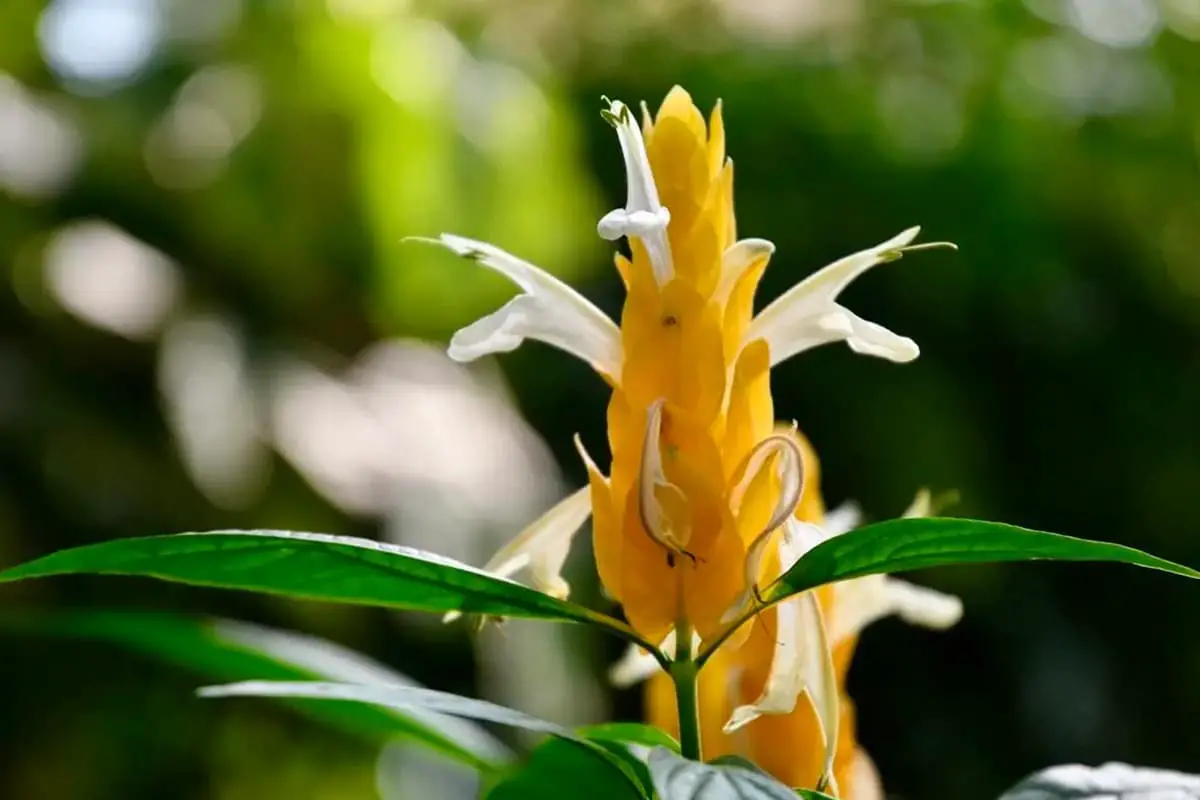
The golden-yellow bracts primarily serve a protective role, while the white bilabiate petals that sit atop are the true flowers. Blooming in spring and autumn, the plant’s unique flower structure is a visual delight.
Native to the tropical Americas, deciduous broadleaf forests, and the evergreen broadleaf woodlands of South Asia, it has become a beloved ornamental plant since its introduction in the 1980s.
With its tidy clusters, bright yellow hue, and extended blooming period, the Golden Shrimp Plant is ideal for decorating venues, halls, living spaces, and balconies. It’s also used to adorn flowerbeds in the South.
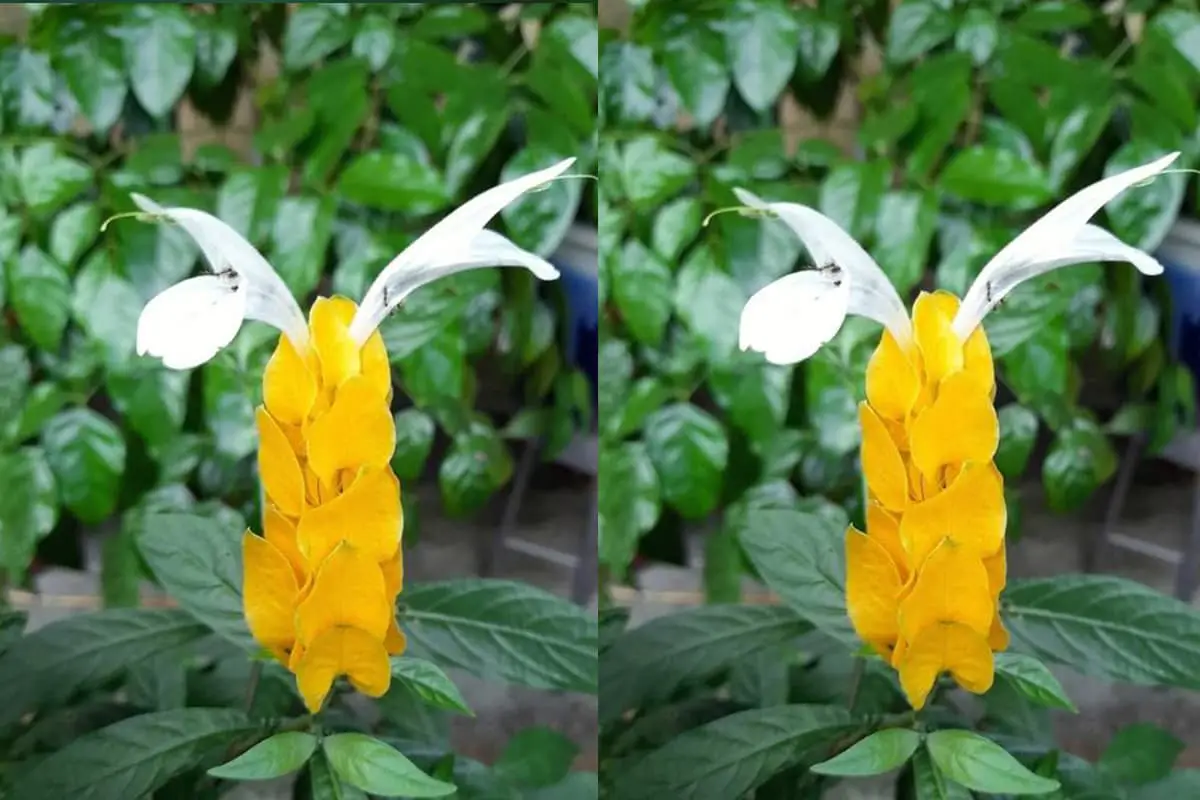
Also known as the Yellow Shrimp Flower, the Golden Shrimp Plant is a perennial evergreen herb belonging to the Acanthaceae family, with a height of 30 to 50 centimeters.
The plant has multiple branches with oval, bright green, distinctly veined leaves.
Typically, each branch tip produces a large inflorescence resembling a golden pagoda or shrimp, comprised of numerous, densely packed golden bracts and pure white flowers enveloped by these golden bracts.
In temperatures above 15°C (59°F), new inflorescences continuously bloom at the tips of new shoots, providing year-round aesthetic appeal.

Native to Peru and Mexico, the Golden Shrimp Plant thrives in warm, humid, and well-lit environments. It tolerates shade well and prefers temperatures between 16-28°C (61-82°F).
To overwinter safely, temperatures must remain above 5°C (41°F). It grows best in fertile, well-drained sandy loam soil.
The Golden Shrimp Plant is indigenous to tropical regions of the Americas and the deciduous and evergreen broadleaf forests of South Asia.
The Golden Shrimp Plant is prized for its orderly clusters, vibrant yellow color, and lengthy blooming period. It is perfect for decorating various spaces, including meeting halls, living rooms, and balconies, and for creating flowerbeds in warm climates.
In cooler regions, it is cultivated as a potted plant for greenhouses, making it an excellent choice for indoor decoration.
The Golden Shrimp Plant is primarily propagated through cuttings, which can be done throughout the growing season. The optimal time for cuttings is in April, using 8-10 cm long semi-woody softwood shoots without flower buds from a mature plant.
Place the cuttings in sand or perlite, maintaining a temperature above 21°C and about 80% humidity. Roots typically form within half a month.
However, if cuttings are taken in June, they can root within a week; water propagation is also an option.
When potting the young cuttings, a mixture of two parts pond mud to one part rice husk ash should be used, supplemented with soybean meal powder or chicken manure as a base fertilizer.
Gradually expose the seedlings to sunlight a week after potting. For the established seedlings, pinching back is necessary.
Pinch after 1-2 nodes the first time, and then after 2-3 pairs of leaves have grown on the new shoots, leaving a pair of leaves each time. Stop pinching back, and flowers should bloom within 2-3 months.
To prevent the plant from becoming too tall and leggy after ceasing to pinch back, drench the soil with 2000 ppm of paclobutrazol or 500 ppm of uniconazole.
Newly rooted Golden Shrimp Plant seedlings require pinching back when they reach about 6 cm in height and again when the branches grow to about 4 cm to encourage bushiness.
About a month after pinching, the plant should be ready to bud and bloom on the new branches. Pruning should be done in spring, in conjunction with repotting, typically cutting back about half the plant’s height.
This not only controls the height and encourages branching but also prevents the lower leaves from becoming sparse and unsightly.
For rapid propagation of this plant, stem tip and axillary bud tissue culture can also be employed.
The Golden Shrimp Plant is mainly threatened by leaf spot, anthracnose, powdery mildew, red spider mites, scale, aphids, and mealybugs.
To ensure healthy growth, monthly foliar application of a mixture of 1000-fold diluted Lesbon and 800-fold diluted methyl tobramycin is effective against these pests and diseases.
Red spider mites, which are particularly harmful to leaves and are more severe during hot and dry seasons, cause leaves to fall off and affect growth.
Control methods include spraying with a 3-5 degree Baumé lime sulfur mixture before bud break in early spring to eliminate overwintering adults, and applying 40% dimethoate emulsion diluted to 800 times during the infestation period.
Aphids feed on the sap of young shoots and tender leaves with their piercing mouthparts, causing spots, curled and withered leaves, and can also secrete honeydew which leads to sooty mold.
Control methods include spraying with 400-600 times diluted speed kill solution to poison newly hatched eggs in the spring when temperatures rise, and using aphid control products every 7-10 days during the high incidence season from April to October.
Common diseases include powdery mildew and sooty mold.
Powdery mildew primarily affects leaves, tender buds, and stems. Infected leaves develop white circular patches that grow into irregular large spots; these can be wiped off to reveal a white powdery substance.
If the infection is severe, it can cause new leaves to deform and old leaves to shrivel. Control methods include removing and burning fallen leaves in winter, and spraying with either 70% sulfur WP at 800-1000 times dilution or 25% triadimefon WP at the same dilution.
Apply every 7-10 days, and repeat 2-3 times for effective control.
Sooty mold usually appears as small black fungal spots on leaves and shoots, which can expand and cover the entire surface with a black mold layer.
Control methods include avoiding dense planting, pruning appropriately for ventilation and light, and controlling honeydew-secreting insects such as aphids and scale insects.
Spray with 40% omethoate at 800 times dilution, 80% dichlorvos at 1000 times dilution, or daminozide at 500-800 times dilution every 7-10 days. Apply 2-3 times in succession, alternating products to prevent resistance.

Peggie was once a high school mathematics teacher, but she set aside her chalkboard and textbooks to follow her lifelong passion for flowers. After years of dedication and learning, she not only established a thriving flower shop but also founded this blog, “Flowers Library”. If you have any questions or wish to learn more about flowers, feel free to contact Peggie.
 English
  العربية
  Bahasa Indonesia
  Deutsch
  Français
  Italiano
  Nederlands
  Português
  Русский
  日本語
日本語