600+ Types of Flowers A To Z (With Names and Pictures)
Types Of Flowers By Names (A-Z) Types Of Flowers By Color Types Of Flowers By Season Types Of Flowers By Blooming Time 600+ Types of Flowers No. Flower Name No.…

The Oyama cherry tree, native to Hokkaido, Japan, is suitable for cultivation in cold regions and has high ornamental value. It naturally grows in Japan, South Korea, and Russia.
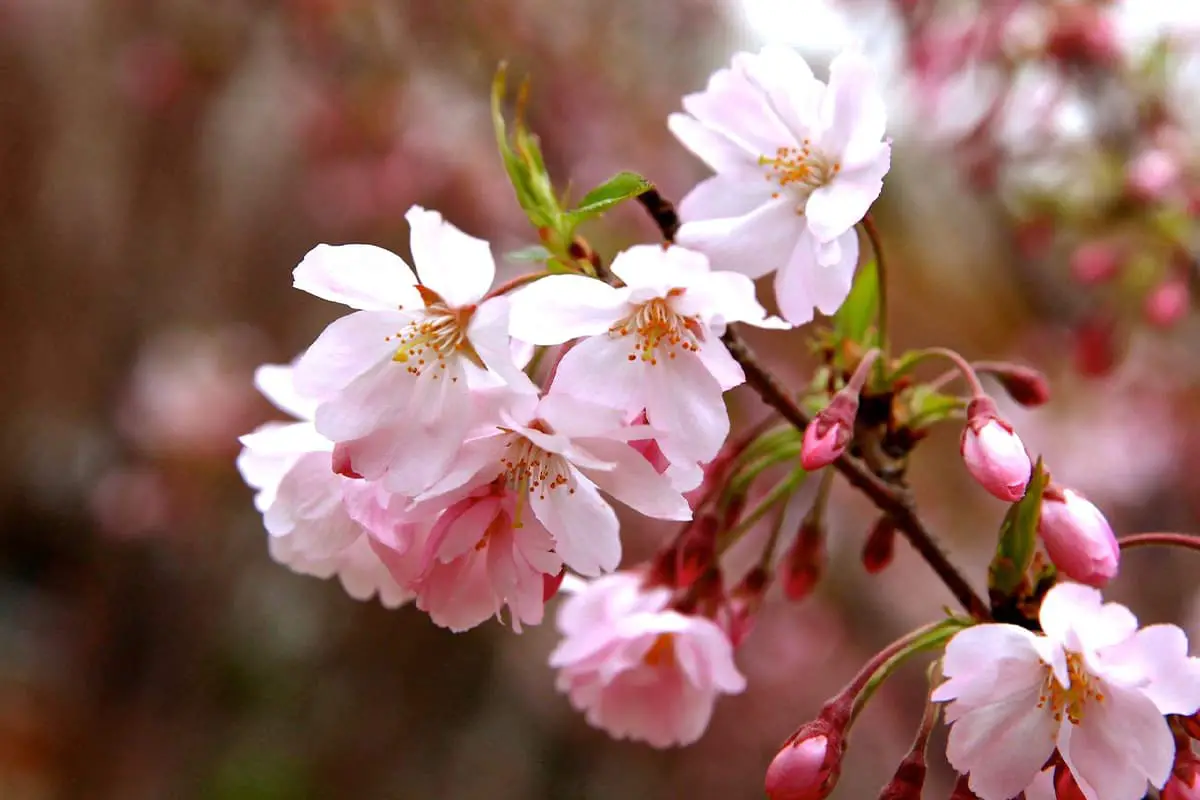
Its beautiful shape, large vivid flowers, and autumn leaves that turn orange or red make it a premium among the cherry blossom varieties, making it an excellent garden ornamental tree.
In 1972, when relations between China and Japan were normalized, the Oyama cherry tree was given as a gift to China by then-Japanese Prime Minister Kakuei Tanaka.
The Oyama cherry tree belongs to the Rosaceae family and is native to Hokkaido, Japan. It is suitable for cultivation in cold regions and has high ornamental value. It naturally grows in Japan, South Korea, and Russia (Kuril Islands).
In 1972, the late Japanese Prime Minister Kakuei Tanaka gifted China with the Oyama cherry tree when diplomatic relations between China and Japan were restored.
The Oyama cherry is similar to the cherry blossom P. serrulata Lindl. The main differences are that the former has fewer flowers, not clustered, smaller bracts, rose-colored petals, and blackish-purple fruits. It is easy to distinguish.
The Oyama cherry naturally grows in Japan, South Korea, and Russia (Kuril Islands). It is cultivated in Dalian, Dandong, Shenyang in Liaoning, China, and Beijing.
The Oyama cherry is a deciduous large tree, up to 25 meters high. The bark is dark brown with ring-like stripes; the small branches are gray-brown, yellow-brown when young, hairless.
The tree bears 2-4 flowers with a diameter of 3-4 cm; the petals are rose-colored, the stamens are numerous, shorter than the petals; the pistil is slightly longer than the stamens or nearly equal in length, hairless, the ovary is hairless.
The fruit is nearly spherical, about 1 cm in diameter, blackish-purple. The flowering period is from April to May, and the fruiting period is from June to July.
The Oyama cherry likes light, slightly tolerates shade, has strong cold resistance, likes humid climate and well-drained fertile soil.
It grows well in sandy loam and clay loam with more humus (pH5.5-6.5). In the south where the soil is heavy, generally mixed homemade leaf mold soil (soil made by collecting leaves, acid soil, chicken manure, and charcoal powder).
Note that before mixing, all the original clay lumps must be broken up, otherwise it will not improve the soil. In places where the groundwater level is less than 1 meter, use the high planting method, that is, after leveling the entire planting hole, stack soil on it for planting.
In the north with alkaline soil, sulfur powder or ferrous sulfate, etc. are needed to adjust the pH value to about 6. Each square meter of sulfur powder is 2 grams, the effective period is 1 to 2 years, and it is tested each year to prevent the pH value from exceeding 7.
As soon as the soil thaws in early spring, it is generally planted in February and March. Carefully prepare the land before planting. For flat planting, dig a hole with a diameter of 1 meter and a depth of 0.8 meters.
Fill about half of the hole with improved soil, place the seedling in the center of the hole, and spread the roots in all directions.
After filling a small amount of soil, lift the seedling slightly upward to fully extend the root system, and then lightly step on it. The planting depth should make the top layer of the seedling root 5 cm from the ground.
After planting, make a water storage pit and water thoroughly, and finally support it with bamboo slats about the same height as the seedling to prevent wind from blowing it down.
After planting, the seedlings are prone to drought. In addition to watering thoroughly when planting, water once every 8 to 10 days thereafter to keep the soil moist but not waterlogged.
After watering, loosen the soil in time, and it is best to thinly cover the ground with grass to reduce water evaporation. In the 2 to 3 years after planting, to prevent the tree trunk from drying out, wrap it with straw.
But 2 to 3 years later, new roots grow out of the seedling, and its adaptability to the environment gradually strengthens, so there is no need to wrap it with grass.
Fertilize twice a year, preferably with acidic fertilizer. One is winter fertilizer, using organic fertilizers such as bean cake, chicken manure, and mature fertilizer in winter or early spring; the other is after the flowers fall, using quick-acting fertilizers such as ammonium sulfate, ferrous sulfate, and superphosphate.
Generally, for large trees, the hole application method can be used, that is, dig a ring-shaped ditch about 10 cm deep at the edge of the tree crown: the normal projection line, and apply fertilizer.
This method is simple and beneficial for root absorption, and in the future, as the tree grows, the diameter and depth of the fertilizer ring ditch will also increase. The cherry tree has a shallow root system and requires good drainage and ventilation.
Therefore, especially in the root distribution range around the tree, avoid people and animals and vehicles from compacting the soil. Pedestrian trampling will cause the tree to weaken, shorten its lifespan, and even cause root rot and death.
Pruning mainly involves cutting off wilting branches, overgrown branches, overlapping branches, and branches with pests and diseases.
In addition, when many branches grow from the trunk of a large cherry tree, it is advisable to retain several vigorous branches and cut off the rest from the base to facilitate ventilation and light.
After pruning, the branches should be disinfected with medicine in time to prevent bacteria from entering after rain and causing rot. Cherry blossoms are prone to aging and damage after long periods of exposure to the sun, causing rot. It should be removed in time and disinfected.
Afterward, wrap the rotten part with leaf mold soil and charcoal powder to promote its recovery to normal physiological functions.
The Oyama cherry tree has a beautiful shape, large and colorful flowers, is extremely beautiful, and its autumn leaves turn orange or red. It is a high-quality cherry blossom variety and is an excellent garden ornamental tree.
In 1972, when relations between China and Japan were normalized, the then-Japanese Prime Minister Kakuei Tanaka gave the Oyama cherry tree to China as a gift.
The Oyama cherry trees gifted by Prime Minister Tanaka totaled 900, which were planted in places like Beijing Botanical Garden, Tiantan Park, Yuyuantan Park, and Zizhuyuan Park.

Peggie was once a high school mathematics teacher, but she set aside her chalkboard and textbooks to follow her lifelong passion for flowers. After years of dedication and learning, she not only established a thriving flower shop but also founded this blog, “Flowers Library”. If you have any questions or wish to learn more about flowers, feel free to contact Peggie.
 English
  العربية
  Bahasa Indonesia
  Deutsch
  Français
  Italiano
  Nederlands
  Português
  Русский
  日本語
日本語