600+ Types of Flowers A To Z (With Names and Pictures)
Types Of Flowers By Names (A-Z) Types Of Flowers By Color Types Of Flowers By Season Types Of Flowers By Blooming Time 600+ Types of Flowers No. Flower Name No.…

Musella lasiocarpa, also known as Chinese dwarf banana or Golden Lotus, is originally from Yunnan, China. This unique plant is native to China and known for its small flowers that grow in the axils of the pseudostem’s leaves.
These flowers are delicate, fragrant, and interlaced with yellow and green, adding an element of exquisite beauty. The inflorescence stands upright, directly growing from the pseudostem, densely clustered like a ball spike, about 20-25 cm long.
The bracts are dry and membranous, yellow or pale yellow, with two rows of flowers, each row having 4-5 flowers. The coalescent perianth segments are ovate-elongated, and the flowering period can last up to six months.
The fruits are triangularly ovate, about 3 cm long and 2.5 cm in diameter, densely covered with hard hairs on the outside, and contain numerous seeds inside. When in bloom, the golden lotus-like flowers seem to surge out from the ground, creating a very magnificent sight.
The plants cluster, with horizontal rhizomes. The pseudostem is small, no more than 60 cm tall, with a base diameter of about 15 cm. There are persistent leaf sheaths at the base. The leaf blades are elongated oval, up to 0.5 m long, about 20 cm wide, with a sharp apex and nearly round base, symmetrical on both sides, and have a white powder.
The inflorescence stands upright, directly growing from the pseudostem, densely clustered like a ball spike, about 20-25 cm long.
The bracts are dry and membranous, yellow or pale yellow, with two rows of flowers, each row having 4-5 flowers. The coalescent perianth segments are ovate-elongated, and the free perianth segments have a slightly concave apex, with a short tip in the recess.
The fruits are triangularly ovate, about 3 cm long and 2.5 cm in diameter, densely covered with hard hairs on the outside, and contain numerous seeds inside. The seeds are large, flatly spherical, 6-7 mm wide, black-brown or brown, smooth, with a large, white umbilicus on the ventral surface.
Musella lasiocarpa is a heliophilous plant that prefers plenty of sunlight and warmth. In temperatures below 0℃, the above-ground parts may be frost-damaged. It prefers fertile, loose soil and is easy to transplant. It usually grows on slopes in mountains or is planted in gardens; at an altitude of 1500-2500 meters.
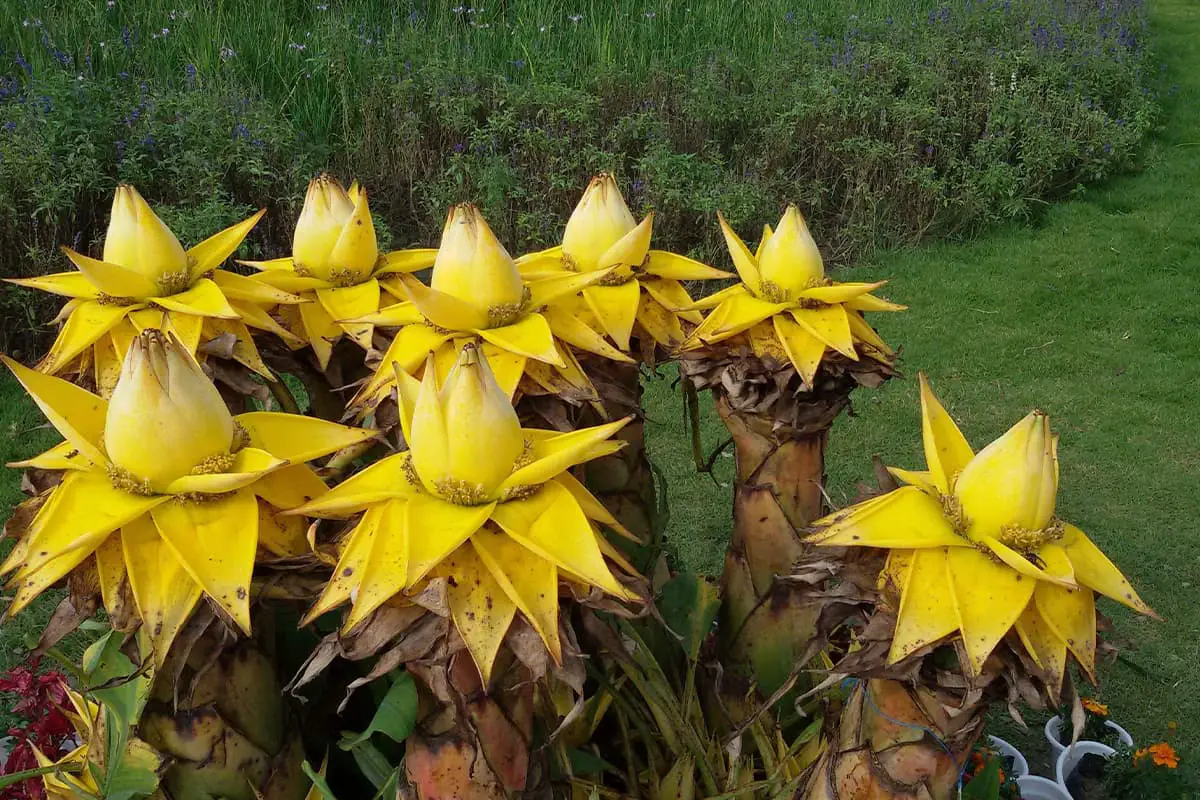
Musella lasiocarpa is originally from Yunnan province, China, and is also found in Sichuan province. It is a unique native flower to China. It is especially commonly cultivated in Xishuangbanna, while in the northern regions, it is suitable for pot planting.
Propagation is mainly done by division. In early spring or autumn, small shoots grown from the base with their rhizomes can be cut from the mother plant and planted separately. It can also be propagated by seed.
In the warm areas of the south, they are often cultivated in the open ground. After dividing and planting in spring and autumn, it is necessary to pay attention to watering and keep the soil moist. In the dry season, appropriate watering is required, and in the rainy season, drainage should be timely.
In early spring and late autumn, trenches are opened around the plant to apply well-rotted organic fertilizer, and fertile soil is prepared at the base of the pseudostem. An appropriate amount of top dressing during the vigorous growth period can promote growth and flowering.
After flowering, the above-ground pseudostem gradually dies. It should be cut in time to facilitate the growth of the next year. In cold areas, it should be cultivated in a greenhouse, and the winter temperature should not be lower than 1℃.
In indoor cultivation in the north, if the ventilation is not good, it is prone to harm from scale insects. This can be prevented and controlled by spraying with a 1000-fold dilution of 40% oxydemeton-methyl emulsifiable oil.
When it blooms, it’s like a golden lotus surging out of the ground, creating a very magnificent sight. In the garden, it is suitable for planting in front of windows, in corners, beside rockeries, or in patches. It is also suitable for pot cultivation for ornamental purposes.
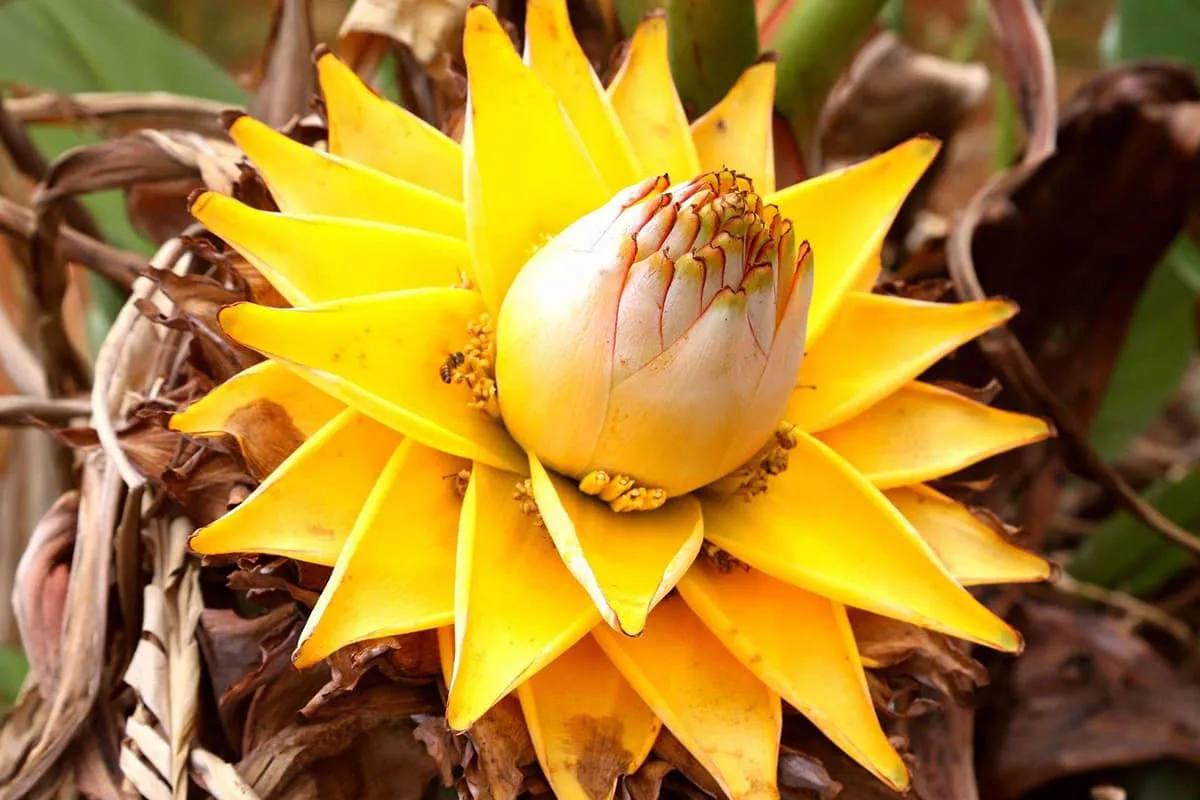
The flower can be used as medicine and has astringent and hemostatic effects. It is used to treat leukorrhea, metrorrhagia, and bleeding from the large intestine. The stem juice is used to relieve alcohol and aconite poisoning.
Musella lasiocarpa is designated as one of the “Five Trees and Six Flowers” by Buddhist temples, and it is also a symbol of kindness and punishment of evil in Dai literary works.

Peggie was once a high school mathematics teacher, but she set aside her chalkboard and textbooks to follow her lifelong passion for flowers. After years of dedication and learning, she not only established a thriving flower shop but also founded this blog, “Flowers Library”. If you have any questions or wish to learn more about flowers, feel free to contact Peggie.
 English
  العربية
  Bahasa Indonesia
  Deutsch
  Français
  Italiano
  Nederlands
  Português
  Русский
  日本語
日本語