600+ Types of Flowers A To Z (With Names and Pictures)
Types Of Flowers By Names (A-Z) Types Of Flowers By Color Types Of Flowers By Season Types Of Flowers By Blooming Time 600+ Types of Flowers No. Flower Name No.…

Malus micromalus Makino, belonging to the apple genus of the Rosaceae family, is a small deciduous tree, reaching a height of 2.5-5 meters. It has a vigorous upright growth habit, with near-round or elongated oval petals, about 1.5 cm long, with short claws, and pink in color.
It blooms from April to May and bears fruit from August to September. This unique Chinese plant grows well in the dry regions of the north and is a popular choice for green landscaping projects.
The variety of crabapple fruit in Chinese nomenclature is extremely complex and still needs to be researched and standardized. In plant taxonomy, all are temporarily generalized under the name of Malus micromalus Makino to avoid confusion by listing as multiple varieties.
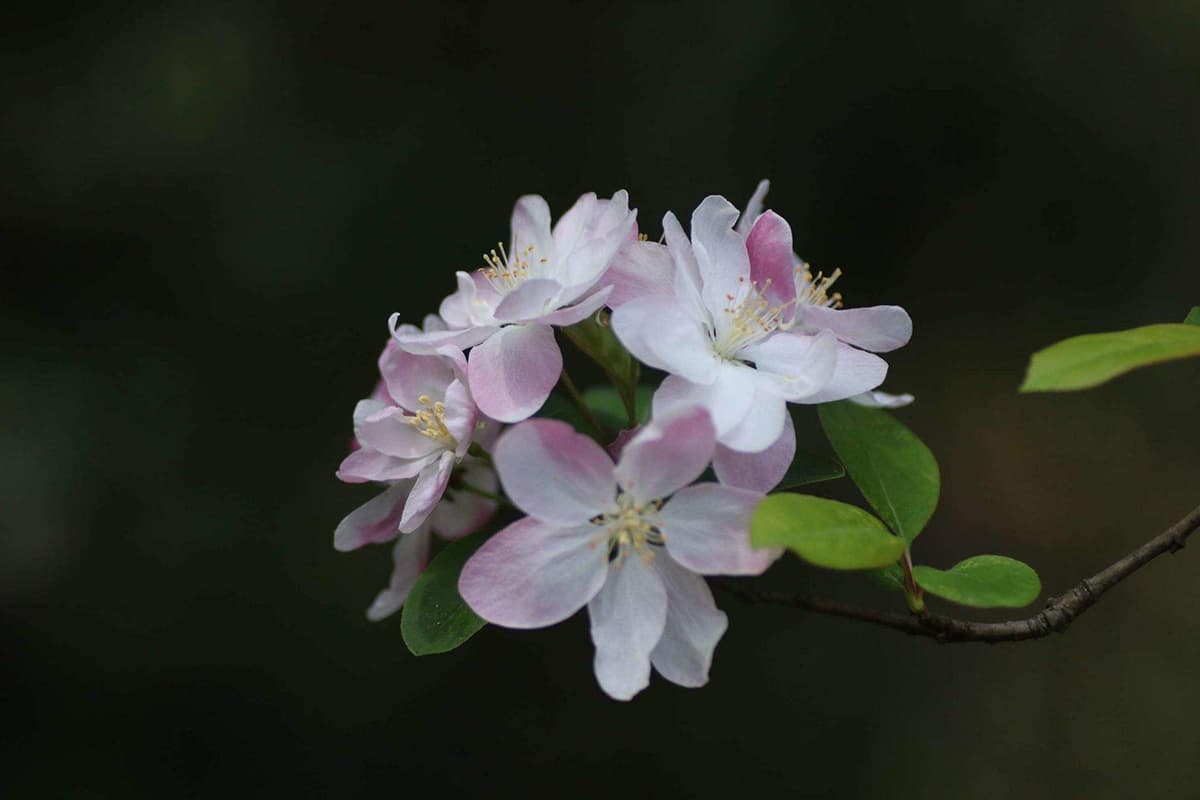
Malus micromalus stands out among crabapple flowers, resembling a delicate young maiden. With its red flowers, green leaves, and beautiful fruit, whether planted singly, in rows, or in clusters, it is extremely attractive.
This small deciduous tree, reaching a height of 2.5-5 meters, has a strong upright growth habit. The slender, cylindrical branches are covered in short soft hairs when young, which fall off as they age, turning purple-red or dark brown, with sparse lenticels.
The winter buds are ovate, with a sharp apex, hairless or only hairy along the edges, and dark purple. The leaves are long elliptic or elliptical, 5-10 cm long, 2.5-5 cm wide, with a sharp or tapering apex, a cuneate or rarely round base, and sharp serrated edges.
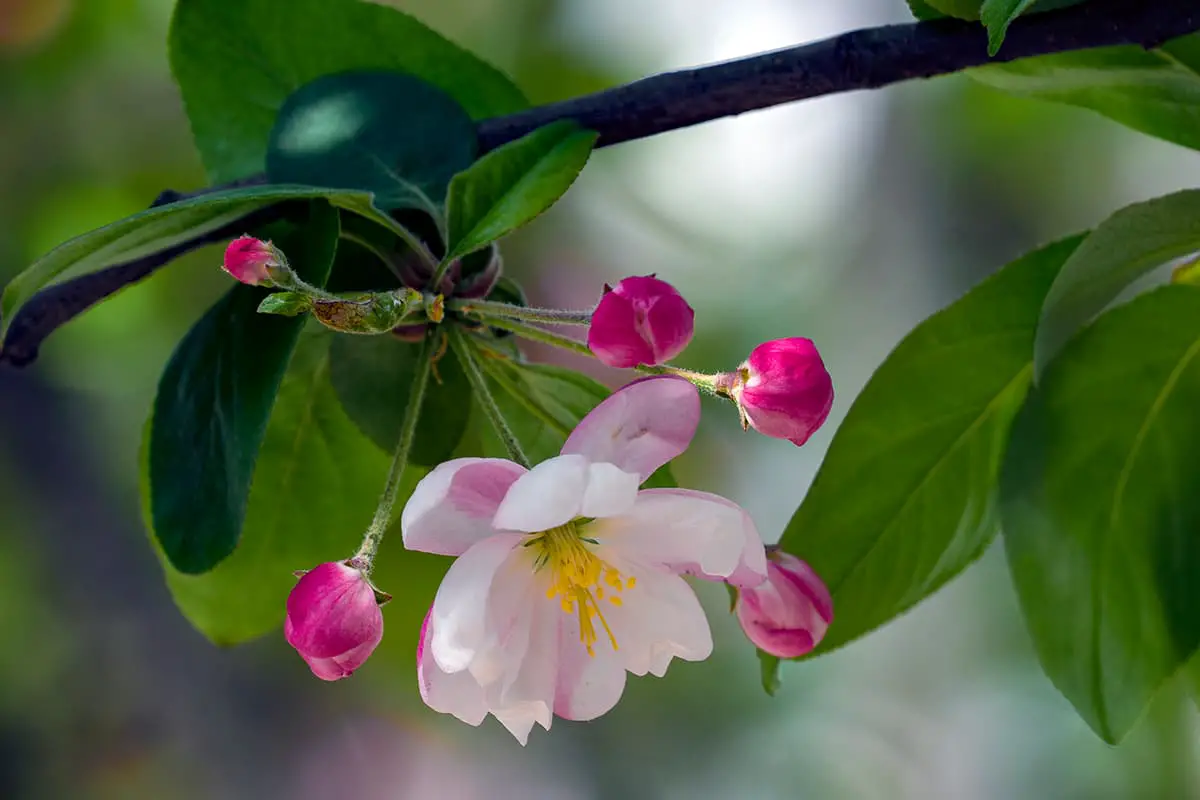
The young leaves are covered in short soft hairs, denser on the underside, which fall off as they age. The petioles are 2-3.5 cm long. The stipules are membranous, linear-lanceolate, with a tapering apex, glandular serrated margins, nearly hairless, and deciduous.
The umbel inflorescence has 4-7 flowers, clustered at the top of the branches. The flower stalk is 2-3 cm long, covered in long soft hairs when young, which gradually fall off. The bracts are membranous, linear-lanceolate, and early deciduous.
The flowers are about 4 cm in diameter. The outside of the calyx tube is densely covered with white long velvety hairs.
The sepals are triangular-ovate, triangular-lanceolate to long ovate, with a sharp or tapering apex, entire, 5-8 mm long, with white velvety hairs on the inside, sparser on the outside, and the sepals are equal in length to or slightly longer than the calyx tube.
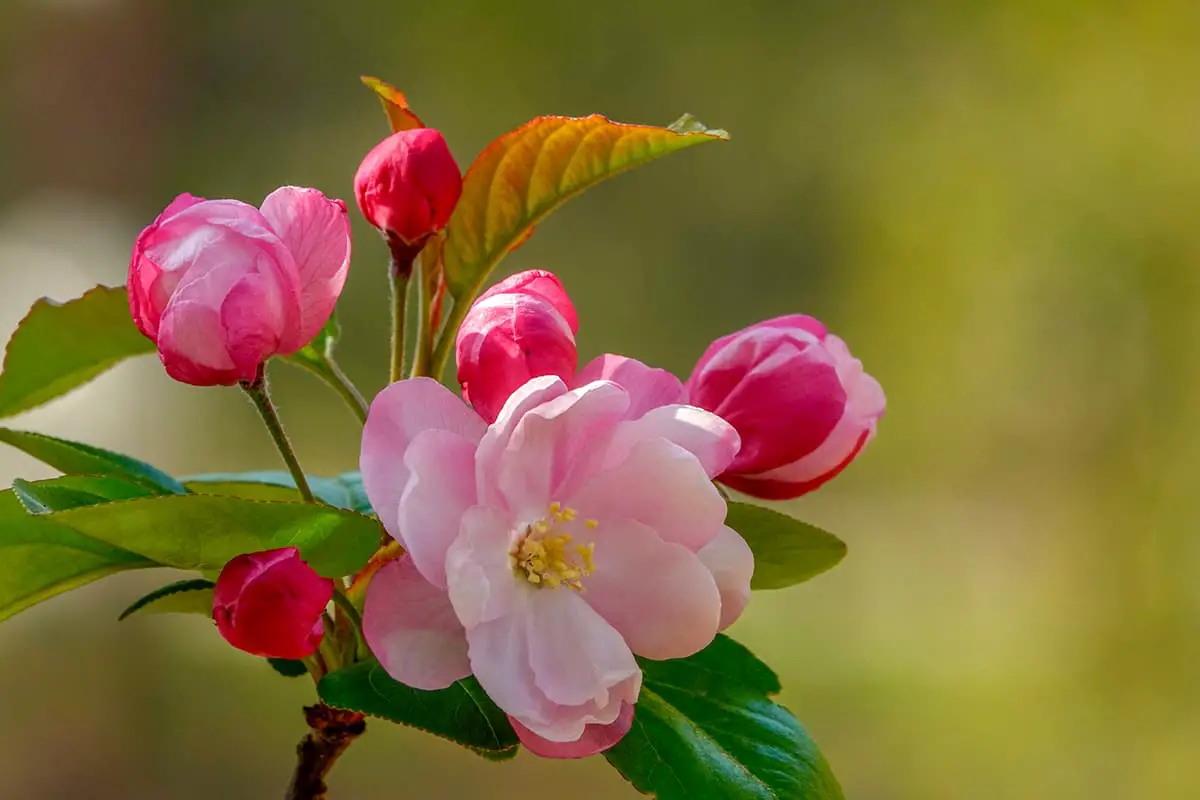
The petals are near-round or elongated oval, about 1.5 cm long, with short claws, and pink. The stamens are about 20 in number, with stamens of varying lengths, slightly shorter than the petals.
The pistils are 5 in number, with velvety hairs at the base, about the same length as the stamens.
The fruit is near spherical, 1-1.5 cm in diameter, red, with both the calyx and stem cavities sunken, and most of the sepals falling off, with a few remaining. It blooms from April to May and bears fruit from August to September.
It prefers sunlight, is cold-resistant, dislikes waterlogging and excessive humidity, and is relatively drought-tolerant.
It is found at elevations of 100-2400 meters.
The Begonia is typically propagated through grafting or division, but it can also be propagated by seeding, layering, and root insertion. Seedlings obtained through grafting can bloom earlier and retain their original excellent characteristics.
Although seedlings grow slower, they often produce variations. Hence, to obtain a large number of rootstocks or hybrid breeding, the seeding method is still used.
Begonia seeds must go through a low-temperature stratification process for 30 to 100 days before sowing. Fully stratified seeds germinate quickly, uniformly, and have a high germination rate. Non-stratified seeds cannot germinate, or germinate very little.
The seeds can also be sown in a sand bed in the fall after harvesting the fruit, removing the flesh, and drying slightly, allowing the seeds to mature naturally.
The soil covering depth is about 1 cm. Cover with a plastic film to retain moisture. After the seedlings emerge, remove the plastic film, timely spread a layer of loose fertile soil, and strengthen the management of fertilizer and water. By late autumn, they can be transplanted.
The seedlings propagated by seeding are used as rootstocks for grafting or budding. Grafting or budding is carried out when the sap of the tree flows and buds sprout in the spring. Budding can also be done in the fall (between July and September).
Grafting can be done using the splice or whip and tongue grafting methods. The scion is selected from fully developed one-year-old branches, taking the middle section (with two or more full buds).
After grafting, fine soil is used to cover the scion. Budding often uses the “T” method. About ten days after grafting, if the bud is fresh and a corner of the petiole falls, it is proof of successful grafting.
After a few days, the binding material can be removed. When the seedling is 80 cm to 100 cm tall, the main branches are developed. Thereafter, only over-dense branches, inward branches, overlapping branches are pruned to maintain a rounded crown.
This tree is commonly cultivated for its fruit and ornamental value. It has an upright form and a dense cluster of flowers. The fruit has a sweet and sour taste, suitable for fresh consumption and processing.
There’s a wide variety of cultivars differing in fruit shape, size, color, and maturation period, hence the names Hot Flower Red, Cold Flower Red, Iron Flower Red, Purple Begonia, Red Begonia, Old Sea Red, and Eight-Edge Begonia.
In some parts of North China, it is used as a rootstock for apples and red flowers. It grows well and is more drought-resistant than mountain hawthorn.
The Western Mansion Begonia stands tall among begonia species, resembling a graceful maiden. With red flowers, green leaves, and beautiful fruit, it looks stunning whether planted alone, in a row, or in a cluster.
Its vibrant colors make it a popular choice for garden landscaping. The flowers of the Western Mansion Begonia are a mixture of red and pink, the leaves are a lovely tender green, and the fruit is enticingly delicious.
It looks extremely beautiful whether planted alone, in rows, or in clusters and is most suitable for planting by the water or in a corner of a small courtyard.
In modern gardens, with dark green evergreens as a backdrop and begonias in the front, the colors are particularly eye-catching. If planted in a row as a flower hedge, the blooming flowers are spectacular.
Begonia flowers are charming and attractive, but generally, begonias are scentless. Only the Western Mansion Begonia is both fragrant and beautiful, making it a premium variety among begonias.
When the flower is not yet open, the bud is bright red like rouge dots, turning pale pink when it opens, resembling the morning glow.
The fruit is known as begonia fruit, similar in taste and shape to hawthorn, it’s sweet and tangy, suitable for fresh consumption or making preserved fruit.
Boiling the leaves of the green thorn fruit with plantain and begonia fruit has anti-inflammatory, cooling, and detoxifying effects. If humans or livestock are poisoned, the juice from crushed green thorn fruit leaves can be taken to detoxify.
The tender leaves of the green thorn fruit can be eaten as vegetables or pickled, having good therapeutic effects such as stimulating appetite, clearing heat, reducing inflammation in the mouth and intestines.
Washing feet with water boiled with green thorn fruit and leaves can prevent and treat athlete’s foot. The kernel of the green thorn fruit can be used for oil extraction.
Regular consumption of green thorn fruit oil can lower blood lipids, regulate blood pressure, promote microcirculation, enhance the body’s resistance, and prolong life. Green thorn fruit oil is also widely used to treat skin burns and ulcers.
There have been many analyses of the fatty acid composition of green thorn fruit oil, but no reports of the elemental analysis of the kernels and leaves of the green thorn fruit.

Peggie was once a high school mathematics teacher, but she set aside her chalkboard and textbooks to follow her lifelong passion for flowers. After years of dedication and learning, she not only established a thriving flower shop but also founded this blog, “Flowers Library”. If you have any questions or wish to learn more about flowers, feel free to contact Peggie.
 English
  العربية
  Bahasa Indonesia
  Deutsch
  Français
  Italiano
  Nederlands
  Português
  Русский
  日本語
日本語