600+ Types of Flowers A To Z (With Names and Pictures)
Types Of Flowers By Names (A-Z) Types Of Flowers By Color Types Of Flowers By Season Types Of Flowers By Blooming Time 600+ Types of Flowers No. Flower Name No.…

The Lupinus polyphyllus, also known as the large-leaved lupine, is a perennial herbaceous plant belonging to the legume family. It has an upright stem that branches out and clusters, with the entire plant being either hairless or having sparse soft hair on its upper parts. Its leaf stalks are longer than its leaflets, which are elliptical and invert lanceolate in shape.
The leaflets’ tips range from being bluntly rounded to sharply pointed. While the top of the leaflets is typically hairless, the underside may have some appressed hairs. Its inflorescence is much longer than its compound leaf and features numerous densely packed flowers that grow alternately.
The bracts are ovate-lanceolate, hairy, and fall off early. The pods are oval and densely covered with silky hairs, and the seeds are egg-shaped, gray-brown with deep brown markings, and smooth.
Native to the western United States, the large-leaved lupine thrives in cool, sunny environments. It prefers moisture, is not heat-tolerant, and is not particular about the soil type, though it does favor loose, fertile soil. This plant primarily propagates through seeds.
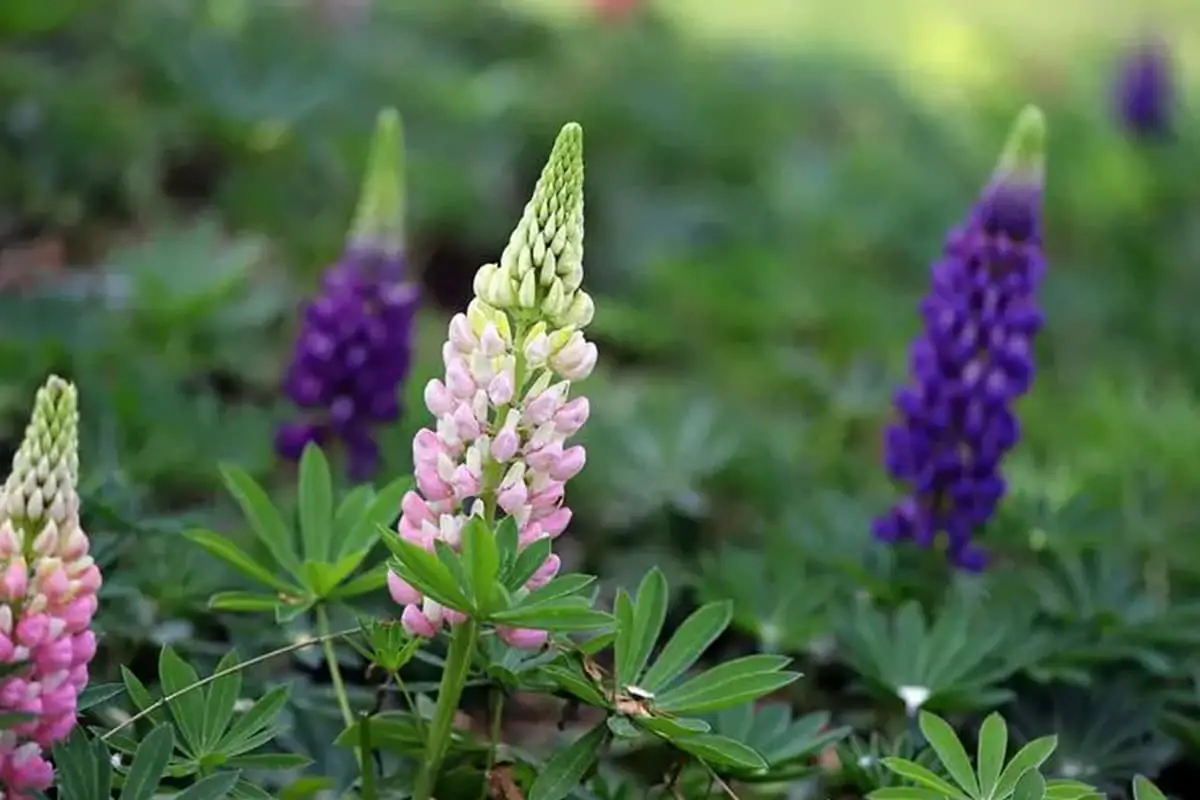
With its large and densely packed flower clusters that come in a rich and vibrant array of colors, the large-leaved lupine is ideal for use as a backdrop in flower beds, or for planting on lawns and forest edges.
It can also be grown as a potted plant for ornamental purposes or used for cut flowers, vase arrangements, and water cultivation. It has a long flowering period.
The multi-leaved feather pea (literal translation) is native to the western United States and North America. In China, it is cultivated.
The plant propagates through seeding.
Transplanting and Leaf Removal
Typically, seedlings are dug up between late September and early October when the soil moisture content is between 70%-80%. Using a large iron shovel, care is taken to minimize root damage. Seedlings can be transplanted with soil attached or bare-rooted. For easier transportation, the bare-root method is preferred. After digging up, the above-ground leaves are promptly removed to promote bud sprouting.
Potting Management
Pest and Disease Control
The plant is robust and rarely affected by pests or diseases. However, when cultivated in greenhouses, the warm and humid environment can lead to root rot. Besides treating the roots with fungicides, controlling soil moisture is a primary preventive measure against root rot. Loamy, breathable, and well-draining potting mix helps new roots develop and reduces the chances of root rot. The main pest in greenhouses is the snail, which can be manually removed.
The multi-leaved feather pea has large, densely arranged, and vibrant flower clusters making it suitable for decorative purposes. It can be used as the centerpiece or background in gardens, or planted in open, well-ventilated forests or along forest edges.
It can also be used for pot decoration, cutting, vase placement, or water cultivation.
The flowering period is long. Crossbreeding with other species has produced various cultivated varieties with beautiful leaves and striking flower clusters, which are widely used for garden decoration.

Peggie was once a high school mathematics teacher, but she set aside her chalkboard and textbooks to follow her lifelong passion for flowers. After years of dedication and learning, she not only established a thriving flower shop but also founded this blog, “Flowers Library”. If you have any questions or wish to learn more about flowers, feel free to contact Peggie.
 English
  العربية
  Bahasa Indonesia
  Deutsch
  Français
  Italiano
  Nederlands
  Português
  Русский
  日本語
日本語