Lobularia maritima is a herbaceous plant from the Brassicaceae family, standing 15-30 centimeters tall.
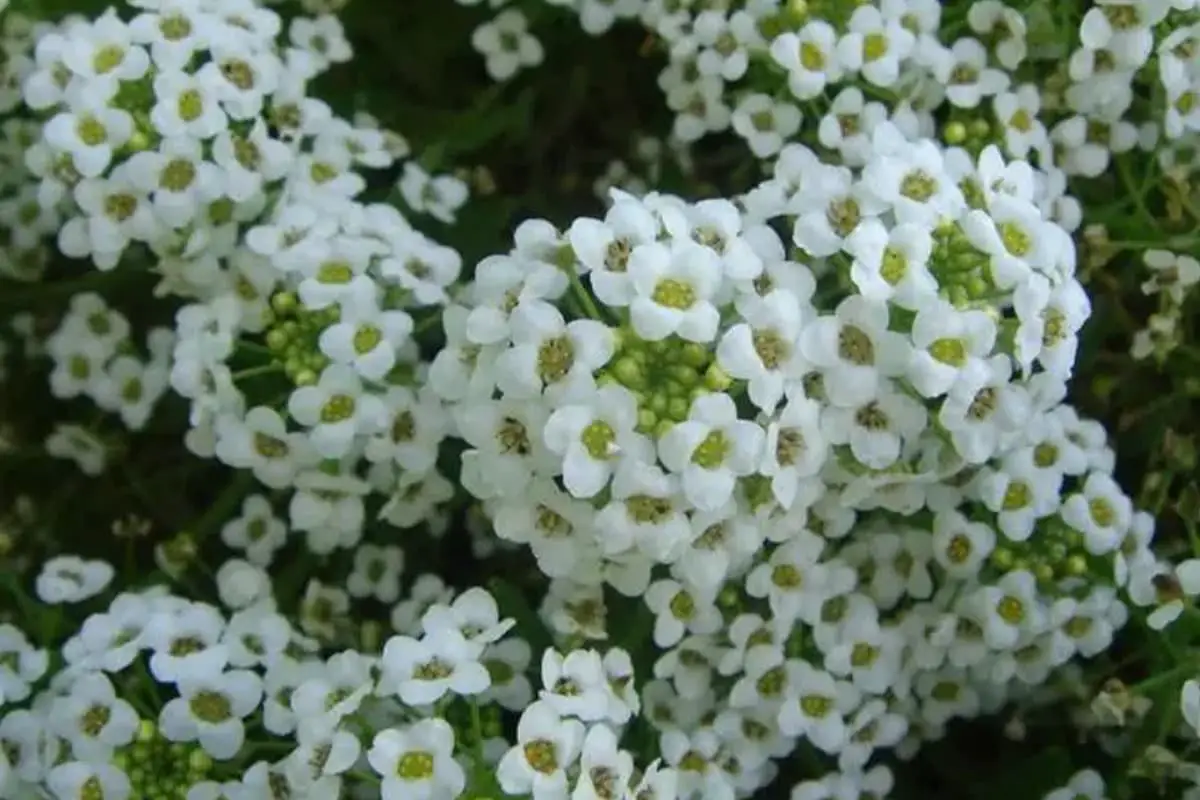
The plant is compact with extensive branching; stems branch out from the base; leaves are lanceolate or linear; the inflorescence is corymbose with small, slightly fragrant flowers, petals pale purple or white; the fruit is a short, elliptic silique that is either glabrous or sparsely haired; flowering occurs in greenhouses from March to April and outdoors from June to July.
Named “Sweet Alyssum” for its pure white flowers that resemble snow.
Native to the Mediterranean coast of Europe and regions of Western Asia, Sweet Alyssum is robust and can withstand light frosts, preferring cool climates over heat, partial sun to slight shade, and loose, dry, and poor soil. It is primarily propagated through seeding.
Sweet Alyssum emits a unique fragrance that repels insects and serves as an excellent source of nectar. Its dwarf stature, thick foliage, snowball-like flowers, and captivating fragrance have made it a popular choice among the public.
It is a premium plant for creating flower beds or for container gardening in landscapes and is also an exceptional outdoor plant for winter. The flower symbolizes elegance.
I. Botanical History
Named “Sweet Alyssum” for its pure white flowers that look like snow.
II. Morphological Characteristics
A perennial herb, the base may become woody, but cultivated plants, whether biennial or annual, do not become woody, growing 10-40 centimeters tall with a silvery-grey, T-shaped pubescence.
The stems branch upward from the base, often forming dense clumps. Leaves are linear or lanceolate, 1.5-5 centimeters long and 1.5-5 millimeters wide, tapering at both ends with entire margins.
The inflorescence is corymbose, with the fruiting stage significantly elongated.
The pedicels are filiform, 2-6 millimeters long; sepals are about 1.5 millimeters long, with the outer ones wider than the inner, the outer ones oblong-ovate, the inner ones narrow elliptic or narrow ovate-oblong; petals are pale purple or white, oblong, about 3 millimeters long, with blunt rounded tips and a narrowed claw at the base.
The silique is short-elliptical, 3-3.5 millimeters long, glabrous or sparsely haired with T-shaped hairs on the upper half; the valves are flattened and slightly inflated with a distinct midrib; the placental frame is often pale purple, with a white, semitransparent, veinless septum; the pedicel is 7-15 millimeters long, ascending obliquely or nearly horizontal, curving upwards at the end.
Seeds are one per chamber, suspended at the top of the ovary chamber, oblong, about 1.5 millimeters long, light reddish-brown, and become sticky when wet. Flowering occurs from March to April in greenhouses and from June to July outdoors.
III. Growth Environment
Prefers a cool climate and avoids extreme heat, with frost resistance. It favors drier air, and prolonged damp, rainy conditions can lead to fungal infections.
Avoid rain exposure and keep leaves dry at night. Ideal relative humidity for growth is 40-60%. It is not demanding in terms of soil, tolerating dry and poor conditions, but grows well in fertile, well-drained soil. Optimal growing temperatures are 15-25°C.
IV. Distribution Range
There are four species within the same genus, and one is cultivated in China. These species are distributed along the Mediterranean coast.
V. Propagation Methods
Sweet Alyssum can be propagated through seeds or cuttings, but seed propagation is more common. In northern regions, seeds are typically sown in greenhouses in March.
Sweet Alyssum seeds germinate quickly and uniformly, with an ideal germination temperature of 20°C (68°F), and seedlings emerge in about 5 days. Seedlings are transplanted and potted when they have 3-4 true leaves and will flower in June.
Growth and flowering decline during the hot summer months, at which time it is advisable to prune spent blooms, enhance fertilization and water management, and the plants will flourish again in the fall.
VI. Cultivation Techniques
Substrate: For potting Sweet Alyssum, a mix of garden soil and slag at a ratio of 3:1 is suitable, or garden soil, coarse river sand, and sawdust (or rice chaff) at a ratio of 4:1:2, or one can use rice paddy soil, pond mud, or leaf mold, or a mix of peat, perlite, and expanded clay pellets at a ratio of 2:2:1, or sawdust, vermiculite, and coarse river sand at 2:2:1.
After potting, water thoroughly and maintain the plants in a slightly shaded environment for a week.
Potting: When potting Sweet Alyssum seedlings, start by placing a 2-2 cm layer of coarse-grained substrate or expanded clay pellets at the bottom of the pot for drainage.
Sprinkle a layer of fully decomposed organic fertilizer as base fertilizer, about 1-2 cm thick, then cover with another layer of substrate, about 1-2 cm thick. Place the plant in the pot, separating the fertilizer from the root system to prevent root burn.
Transplanting: When transplanting Sweet Alyssum seedlings, prepare the planting hole first, spreading a layer of organic fertilizer at the bottom as a base fertilizer, about 4-6 cm thick.
Cover with a layer of soil before setting in the seedling, again keeping the fertilizer away from the roots to prevent root burn. After placing the seedling, backfill the soil, cover the roots and compact the soil with your foot, then water deeply.
Temperature: Sweet Alyssum is not very demanding in terms of winter temperatures and can survive winters without frost damage.
It may perish in late spring and early summer when temperatures exceed 30°C (86°F), with the optimal growth temperature range being 15-25°C (59-77°F).
During late autumn, winter, and early spring, when temperatures are not too high, provide direct sunlight to assist with photosynthesis and to encourage bud formation, flowering, and fruiting.
In summer, during high temperatures, shade the plants to block about 50% of the sunlight.
Fertilization and Watering: Like other flowering plants, Sweet Alyssum requires ample fertilization and watering but is sensitive to the improper application of fertilizers, especially high concentrations and imbalances of nitrogen, phosphorus, or potassium.
It is best to follow the principles of light but frequent fertilization, applying small amounts often, ensuring a complete nutrient profile and alternating between dry and moist soil.
Let the soil dry out thoroughly between watering. After fertilizing, keep the leaves and flowers dry overnight.
Autumn: After the seedlings have been potted and had time to recover, quickly catch up with fertilization and watering management.
Follow a cycle of fertilizer → fertilizer → water → fertilizer → fertilizer → water, with intervals of 1-3 days, shorter during sunny or hot weather and longer during rainy, cooler weather, or even skipping watering altogether.
Winter: Although Sweet Alyssum continues to grow in winter, the cooler temperatures slow its growth, and it requires less fertilization and watering.
Manage this with a cycle of fertilizer → water → water → fertilizer → water → water, with intervals of about 4-7 days. Watering should ideally be done at noon on sunny days when temperatures are higher.
Spring: With rising temperatures in spring, Sweet Alyssum’s growth rate accelerates, entering a phase of bud differentiation and flowering, demanding more fertilization and water.
Manage this with a cycle of fertilizer → water → fertilizer → water every 2-4 days. After the fruit-setting period begins, stop providing fertilizer.
Pinching: Pinch Sweet Alyssum twice before flowering to encourage the sprouting of more flowering branches.
Pinch the top shoot one to two weeks after potting or when the seedling reaches 6-10 cm in height with more than six leaves, keeping 3-4 leaves at the bottom to promote branching.
Perform a second pinch 3-5 weeks after the first or when side branches reach 6-8 cm, removing the top shoot of the side branches while keeping 4 leaves below.
VII. Main Value
Ornamental
Sweet Alyssum is a herbaceous plant with a woody base that does not lignify in cultivation, whether it is grown as an annual or biennial.
Its prostrate growth, pleasant fragrance, and suitability for rock gardens and wall edges make it popular. Its compact size, lush foliage, snowball-like flowers, and delightful scent are favored by many.
It is an excellent choice for arranging flower beds or for container gardening and is also an ideal flower for outdoor cultivation in winter.
Economic
Sweet Alyssum’s unique aroma has insect-repellent properties. It is also an excellent source of nectar for bees.
VIII. Plant Culture
The flower language of Sweet Alyssum represents elegance.





 English
  العربية
  Bahasa Indonesia
  Deutsch
  Français
  Italiano
  Nederlands
  Português
  Русский
  日本語
日本語