600+ Types of Flowers A To Z (With Names and Pictures)
Types Of Flowers By Names (A-Z) Types Of Flowers By Color Types Of Flowers By Season Types Of Flowers By Blooming Time 600+ Types of Flowers No. Flower Name No.…

The Rhododendron simiarum belongs to the Rhododendron family and genus. Its elegant shape coupled with milky white or pink flowers set against green leaves make it particularly eye-catching whether grown in clusters or individually in gardens.
It can also be used as a material for floral arrangements. Typically, the Monkey Head Rhododendron thrives in the wild at altitudes of 500-1800 meters in valleys, mountain ridges, mixed forests, or sporadically scattered locations.
It often forms semi-primitive evergreen rhododendron forests in well-preserved areas alongside ditches, mountain ridges, and cliff tops.
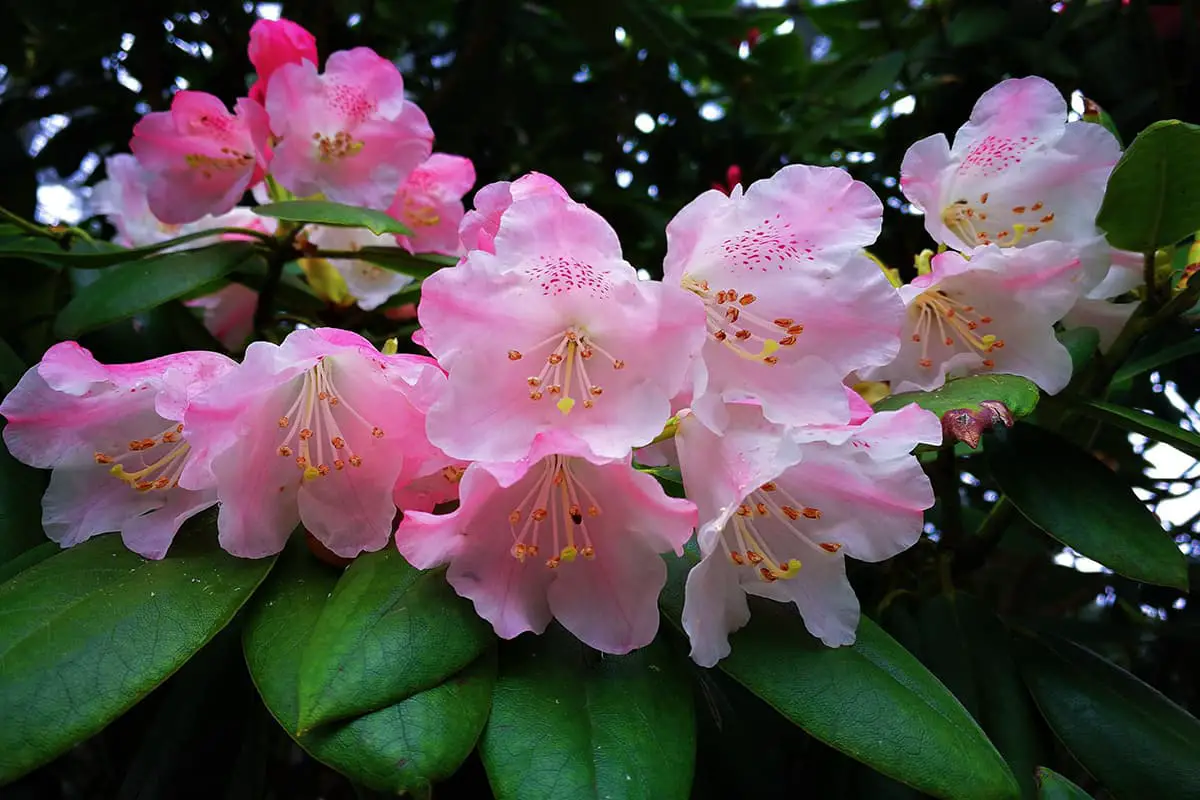
The Monkey Head Rhododendron, scientifically known as Rhododendron simiarum Hance, is a plant of the Rhododendron family and genus. It is an evergreen shrub, typically reaching a height of 2-5 meters, but occasionally growing as tall as 10-13 meters.
Its young branches have smooth, light brown bark, while the old branches have layered, light gray or white bark. The leaves are densely populated at the top of the branches, 5-7 in number, thick and leathery, oval to elliptical in shape, and measure 5.5-10 centimeters in length and 2-4.5 centimeters in width.
The flowers grow in terminal umbel-like clusters of 5-9, and the ovary is elongated and oval-shaped, covered with rust-colored hair, which eventually disappears.
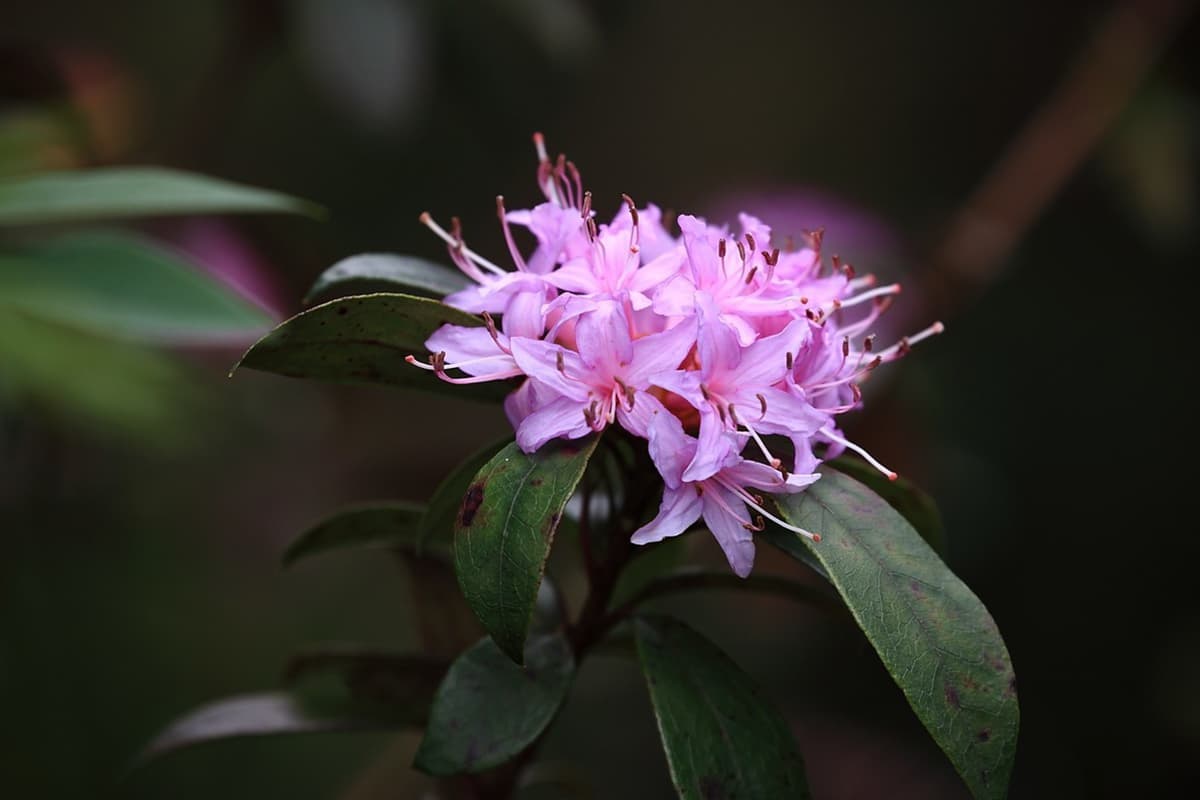
Rhododendron simiarum Hance var. versicolor, differs from the original species by having thicker, leathery leaves that are oval in shape, measuring 8-13 centimeters in length with a rounded tip.
The flower stalk is short, only 1.5-2.2 centimeters in length, and the flower is funnel-shaped and narrow, measuring only 2-2.8 centimeters in length. It is milky white or pink in color with 5 lobes and a round tip.
The blooming period is in April. This variant grows in mountain valley forests at altitudes of 850-1720 meters. The differences in flower size, shape, and leaf veins between this variant and the original species are significant, thus, it is more appropriate to classify them as different variants.
The Monkey Head Rhododendron thrives in the wild at altitudes of 500-1800 meters in valleys, mountain ridges, mixed forests, or sporadically scattered locations.
It is partial to light, but the tender leaves can easily get scorched in strong sunlight, and the roots close to the soil surface can get damaged by dry heat.
It grows well in cool, humid climates, in acidic soils rich in organic matter, in mixed sparse forests where the trees have deep roots, and on the edges of taller forest zones.
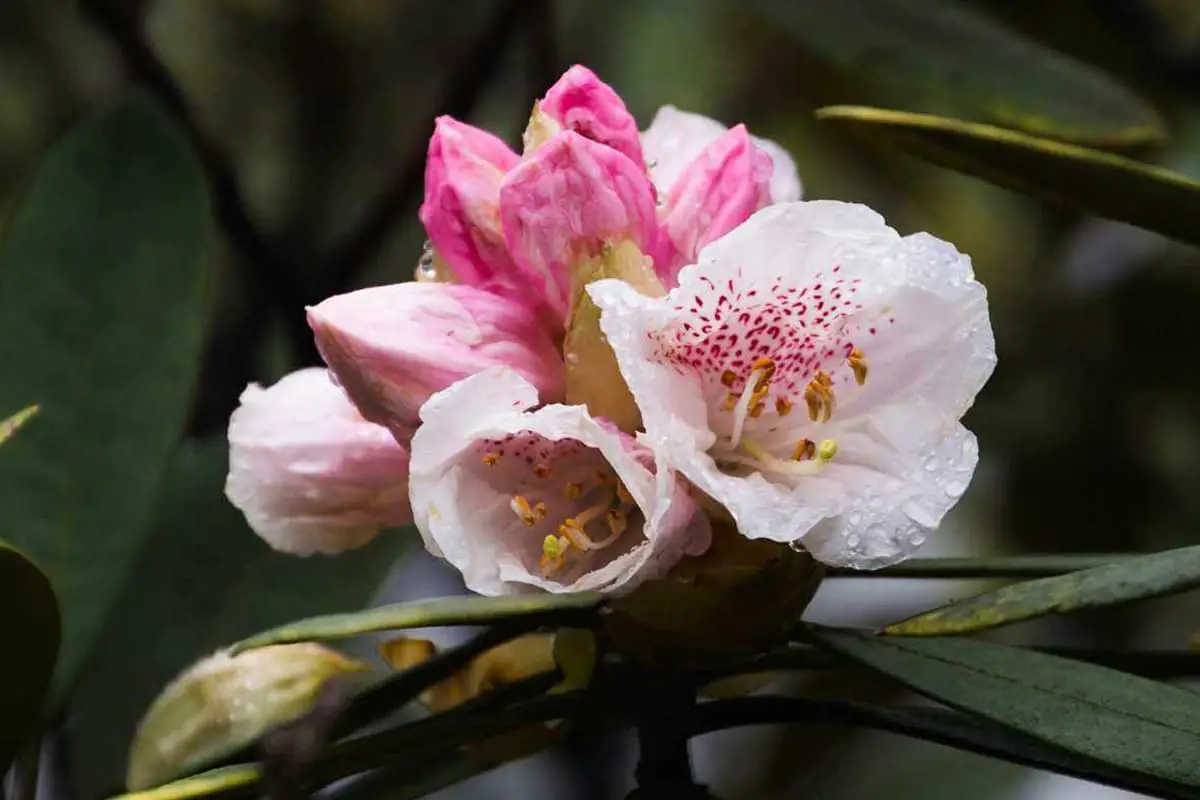
This evergreen shrub is typically 2-5 meters tall, but it can occasionally reach 10-13 meters. Its young branches have smooth, light brown bark, while the older branches have flaking bark in shades of pale gray or white.
The leaves are densely concentrated at the top of the branches, with 5-7 leaves that are thick and leathery. They are ovate-lanceolate to elliptic-lanceolate in shape, measuring 5.5-10 cm in length and 2-4.5 cm in width.
The leaf tips are obtuse or rounded, with a wedge-shaped base that slightly extends into the petiole. The upper surface is dark green and hairless, while the lower surface is covered with a thin layer of light brown or gray hair.
The midrib is recessed on the upper surface, forming a shallow groove, but it is prominently raised on the lower surface. The lateral veins are slightly visible, with 10-12 pairs. The petiole is cylindrical and 1.5-2 cm long, only hairy when young.
The plant has terminal cymose umbel inflorescences with 5-9 flowers. The total axis is 1-2.5 cm long, sparsely covered with soft hair in a light brown color.
The flower stalks are straight and thick, measuring 3.5-5 cm in length and approximately 2.5 mm in width, covered in sparse soft hair or almost hairless. The calyx is disc-shaped with five sections.
The corolla is bell-shaped, 3.5-4 cm long and about 4-4.5 cm in diameter at the top, colored cream to pink with purple-red spots in the throat. It has five sections with semi-circular lobes, 1.5 cm long and 2-2.5 cm wide, with a notch at the tip.
There are 10-12 stamens of varying lengths, 1-3 cm long. The filaments are slightly broad and flat at the base, with spreading soft hairs. The anthers are elliptical and about 3 mm long.
The ovary is cylindrical, 5-6 mm long, covered with light yellow branching down and glands. The style is slender, 3.5-4 cm long, sometimes glandular at the base, otherwise smooth.
The fruit is an elongated capsule, 1.2-1.8 cm long and 8 mm in diameter, covered in rust-colored hair that later becomes hairless.
The Monkey Head Rhododendron is a shallow-rooted tree species. The seeds germinate and root after 30-35 days of sowing, with developed root hairs and no obvious main root.
The stem of the one and two-year-old seedlings does not elongate, and the one-year-old seedlings have 5-7 small leaves in a rosette. Three-year-old seedlings have a clear main stem that gradually elongates.
By the fourth year, the plant grows vigorously, forming flower buds in the fall. In the fifth year, when the plant height reaches more than 30 cm, it starts to bud. It flowers from mid to late April, with a flowering period of about half a month.
After flowering, around the beginning of May, the plant sprouts, usually once a year. Before the hot summer weather, the tender shoots stop growing and start to lignify. From August to September, the flower buds start to differentiate. The fruit matures in September to October.
Wild seedlings can be directly introduced for cultivation by selecting robust seedlings from low to mid-altitude areas, ideally between 50-90 centimeters in height.
The root system should remain intact, preferably with additional native soil, wrapped into a small soil ball with straw. Trim some of the seedling leaves, carefully transport to the planting site, and plant promptly.
Alternatively, you can cultivate in a pot for one to two years before planting in the open. Potting soil should be a mix of orchid mud and mountain yellow clay. After planting, pay attention to soil management, water appropriately, and apply thin fertilizer.
The best times for introducing seedlings are in autumn, from October to November, and early spring, from February to March.
One to two years after the seedling’s growth, it should be divided. For robust seedlings, transfer in early spring (February) one year after sowing. Smaller ones should be transferred after two years of pot cultivation, yet in a timely fashion.
Use pots with a diameter of 9-10 centimeters for division, planting 1-3 per pot, using the same soil as the sowing substrate. Newly divided seedlings should be protected from rain to prevent young leaves from being damaged by bacteria and rotting to death.
Transplanted seedlings start growing robustly after one year of protective cultivation. In the first year, seedlings often grow as single stems; in the second year, many thin and messy branches sprout from the root neck.
You can top it once when the terminal bud forms in autumn and winter (November – December) each year to promote branching and preliminary shaping.
For the directed selection of new varieties, artificial cross-breeding methods can be used.
Male flowers should be removed and bagged about a week before blooming, then carefully pick the father plant’s flowers that are about to bloom the day before opening, remove the anthers, shake the pollen onto clean thin paper placed in a test tube, stopper the tube with sterilized cotton, attach a label with the species name, place in a dry box with silica gel, and store in a room temperature refrigerator for later use.
Within a week after emasculation, check that the bagged maternal plant’s style has extended, the stigma has swelled to a yellow-green color, and is covered with plenty of mucus, at this point, you can remove the bag and pollinate, preferably between 9-10 AM on a clear day.
After pollination, bag it again, and hang a tag noting the parents’ names, pollination date, and time. When the stigma loses its gloss after pollination, the bag can be removed.
The fruit gradually swells thereafter, turning from green to brown in October-November of that year, and when a slight crack appears at the top of the fruit, it can be harvested, the seeds dried, and either sown in a greenhouse in winter of the same year, or stored in a refrigerator and sown the following year as described.
The primary method of propagation for the Monkey Head Rhododendron, with only a few species capable of vegetative propagation through cuttings, is sexual propagation by seedlings.
Seed sowing should be performed in a shaded area, and a bamboo arch should be set up for plastic film coverage. The rhododendron seeds are tiny, and the seedlings are tender, hence it is advisable to use wide, shallow pots for sowing.
The soil should be a mixture of humus (known as “orchid mud” in horticulture), pine needles cut into about 3 cm lengths (preferably from the larch or metasequoia), and yellow sand.
Fresh live moss, which only adheres to the surface of the pot soil and does not root in it (such as large gray moss), should be spread on top. Sowing should be done from late March to early April.
Before sowing, fill the pot with 4/5 of the soil, top it with 1 cm of chopped moss, and thoroughly water it using a spray bottle. The seeds should be placed on a hard cardboard and evenly sprinkled on the moss using a vibrational tapping method.
After sowing, place the pot under the arch in the shaded area and cover the arch with a plastic film. For one month after sowing until the seeds sprout and root, adopt a closed nursery management method.
The film should be removed when the pot soil is dry and needs watering, or when the weather is sunny and warm, and both ends of the film need ventilation.
The film should be used to create an environment with a relative humidity of over 9%, to facilitate seed germination and seedling emergence. After the seedlings have emerged, the film should be removed promptly.
During the entire growth period of one-year-old pot seedlings, whenever there is medium or heavy rain, they should be covered with film. The seedlings dislike overly wet pot soil but prefer humid ambient air.
Use yellow loam, yellow sandy soil, or red and yellow loam as the cutting bed soil, which must be acidic. The bed soil should be finely prepared and free from pebbles and debris. The bed soil should be 20 cm thick and 100 cm wide.
After spraying with a 0.3% ferrous sulfate solution for disinfection, it is ready for use. Cutting can be done generally in summer, but also in spring.
For summer cutting, select tender branches of the year that are 5-10 cm long, leave the shoots, make a single-sided oblique cut at the base, tie them into small bundles, soak the base 2-3 cm in clean water for 24 hours, and then dip it in 500 mg/l ABT liquid for cutting.
For spring cutting, select one-year-old hard branches that are 5-10 cm long, and follow the same cutting and treatment procedure as summer cutting. The survival rate of summer cutting is relatively high at 75%, while that of spring cutting is lower at only 56.6%.
The main seedling diseases of the Monkey Head Rhododendron include the white silk disease and sudden wilt disease, while leaf diseases include brown spot disease and grey mould. The main root diseases include white silk disease and Verticillium wilt.
To prevent the white silk disease, it is essential to ensure that the nursery is cool and well-ventilated, and the cultivation soil should be fumigated with formaldehyde for sterilization. Control the moisture content of the potting soil during the seedling stage.
In the early stages of the disease, a 1,000-fold solution of Carbendazim can be sprayed to suppress it. Potted seedlings can be sprayed with a 500-fold solution of Pentachloronitrobenzene. In addition, rhododendrons can be planted in areas where this disease has not previously occurred.
To prevent brown spot disease, diseased leaves can be plucked and incinerated to eradicate overwintering pathogens. Starting in early autumn, a 100-fold solution of Bordeaux mixture can be sprayed every 10 days, with 2-3 consecutive sprays.
To prevent sudden wilt disease, during the spring rain and monsoon season, a solution of either Methotobuprazim or Carbendazim (800-1000-fold diluted) can be sprayed every 7-10 days.
Moreover, the nursery should be well-ventilated and have good drainage. Attention should also be paid to the cleanliness of the irrigation water.
The main root pests include chafer beetles, mole crickets, and termites, while leaf pests include Rhododendron bugs, leafhoppers, caterpillars, aphids, mites, and Pear Leafroller Moths. Flower pests mainly include borer insects.
Chafer beetles are the larvae of various scarab beetles. They can be eradicated by weeding and tilling the soil in winter, and by spraying a 100-fold solution of Chlorpyrifos on the soil before planting. During the growing season, a 1000-fold solution of Phoxim or Dimethoate can be used to kill them.
Borer insects cause damage when the larvae bore into the flower buds around June and July. To control them, clear the surrounding weeds and foliage to eliminate overwintering larvae.
From May onwards, spray a 100-fold solution of Chlorpyrifos every half month, and remove damaged flower buds to prevent the spread of damage.
Rhododendron leafhoppers are a major leaf-eating pest. When they occur in small numbers, the larvae can be manually removed. In severe infestations, a 1000-fold solution of Dimethoate or Isocarbophos can be sprayed to kill the larvae. Clear the weeds to eliminate overwintering pupae.
To control caterpillar pests, remove the chrysalis when they occur in small numbers. In severe infestations (typically from late June to mid-July), spray a 1000-fold solution of Dimethoate to kill the larvae.
Termites cause damage to the roots of Rhododendrons. Before planting, spray a 100-fold solution of Chlorpyrifos on the soil. For potted seedlings, spray a 100-fold solution of Chlorpyrifos around the bottom and sides of the pot to prevent damage.
For already planted nurseries, a 300-500-fold solution of Chlorpyrifos can be drenched into the soil around the base of the seedlings to kill the termites in April or May.
The Monkey Head Rhododendron is a beautiful plant with milky white or pink flowers set against a backdrop of green leaves, making it especially eye-catching. It can be planted in clusters or individually in gardens and can also be used as material for flower arrangements.

Peggie was once a high school mathematics teacher, but she set aside her chalkboard and textbooks to follow her lifelong passion for flowers. After years of dedication and learning, she not only established a thriving flower shop but also founded this blog, “Flowers Library”. If you have any questions or wish to learn more about flowers, feel free to contact Peggie.
 English
  العربية
  Bahasa Indonesia
  Deutsch
  Français
  Italiano
  Nederlands
  Português
  Русский
  日本語
日本語