600+ Types of Flowers A To Z (With Names and Pictures)
Types Of Flowers By Names (A-Z) Types Of Flowers By Color Types Of Flowers By Season Types Of Flowers By Blooming Time 600+ Types of Flowers No. Flower Name No.…

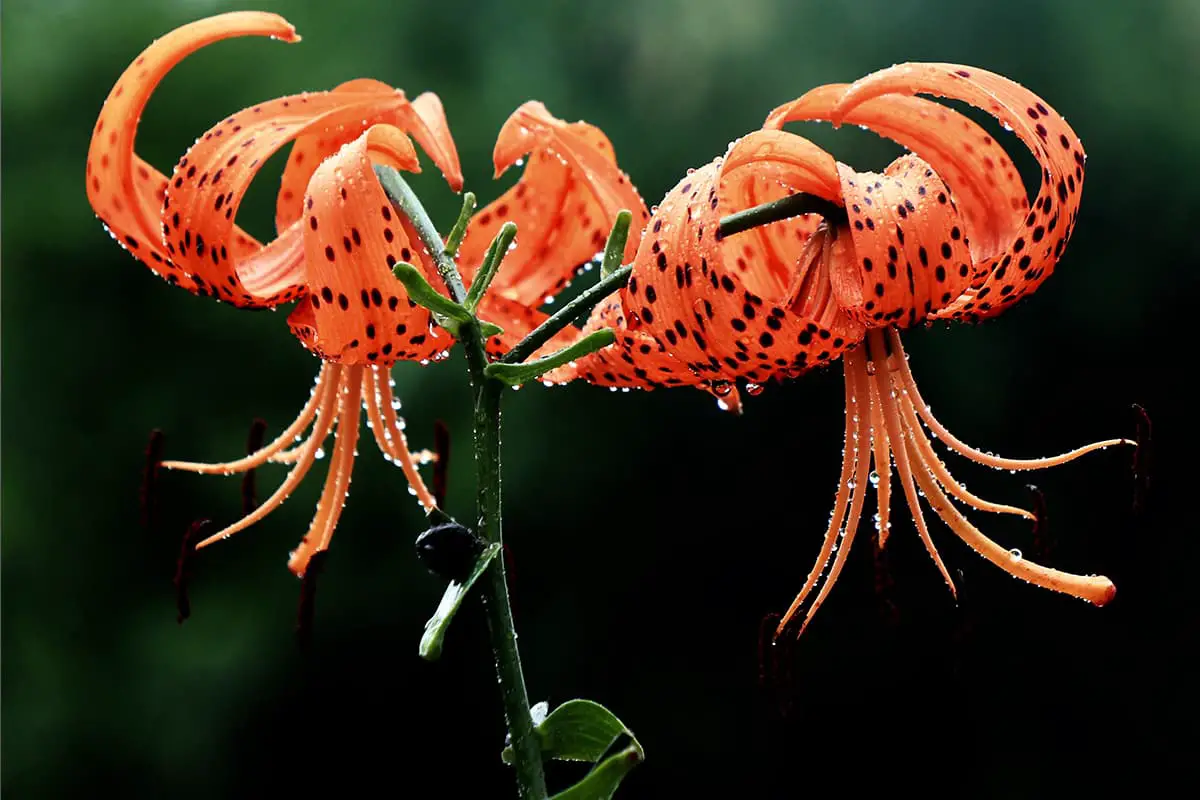
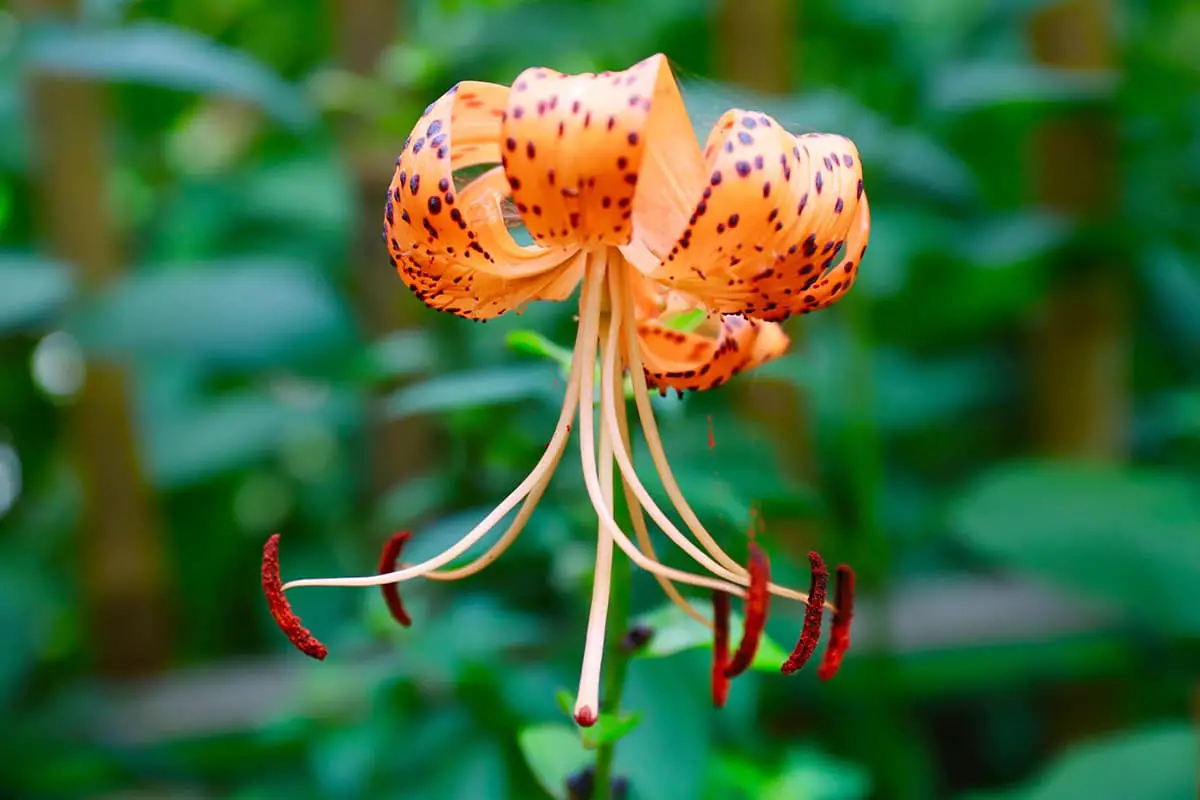
The Tiger Lily, scientifically known as Lilium lancifolium, is a perennial herbaceous bulbous plant of the lily family. It is known for its orange-red or brick-yellow flowers and long petals that curl backwards, revealing deep purple-black spots on the inner surface.
The flowers are in an umbel arrangement and hang downwards, with their stamens spreading outwards, hence the nickname “curled dan.” The petals’ purple-black speckles resemble the pattern on a tiger’s back, thus the name “tiger lily.”
The Tiger Lily is native to China, Japan, and Korea, and is now widely cultivated. The plant can grow up to 1.5 meters tall, earning it the title “crown of lilies.” The flowering period is in summer, from July to August.
The bulb can survive winter exposed and the flowers are large, long-blooming, beautiful, and fragrant, making them valuable ornamental flowers.

They also have beneficial effects in nourishing, strengthening, relieving coughs, and eliminating phlegm, and are highly effective in treating tuberculosis and chronic bronchitis. The Tiger Lily grows along forest edges, roadsides, and on hillside grasslands.
The Tiger Lily stands 50-150cm tall. The underground part has a white, broadly ovate bulb that can be eaten and used medicinally, although it has a slightly bitter taste and is 1-8cm in diameter.
The stem is brown or purple with white woolly hair. Dark purple spots are found on the stem, making it appear dark brown. The leaves are grown alternately and are lanceolate. Black bulbils grow in the leaf axils.
The 3-20 flowers are pendulous and numerous, with the orange-red or brick-yellow petals curling backwards and revealing purple-black spots. The anthers are purple, and the flower diameter is 9-12cm.
The plant tolerates the cold, prefers semi-shade but can withstand strong sunlight. The fruit is oblong to obovate and 3-4cm long. The fruiting period is from August to October.
The Tiger Lily reproduces by division, a common method among lilies. This is best done in early spring (February or March) after the soil has thawed. The mother plant is removed from the pot, excess soil is shaken off, and the roots are separated as much as possible.
The plant is then split into two or more plants with a sharp knife, ensuring each plant has a substantial root system.
After division, the plants are watered thoroughly. Because the roots have been significantly damaged and their water absorption capability is very weak, it takes around 3-4 weeks for them to recover and sprout new roots.
Therefore, watering should be restricted during the 3-4 weeks after division to avoid root rot. Each day, the leaves need to be sprayed 1-3 times to maintain their moisture balance.
Fertilizer should not be applied during this period, and the plants should be kept out of strong sunlight, preferably in a shaded shed.
The Tiger Lily grows along forest edges, roadsides, and on hillside grasslands.
Harvesting: Same as lilies.
Characteristics: The scales are elliptical, 2-5cm long, 1-2cm wide, and 1.3-4mm thick in the middle. The surface is near-white, pale tan, or slightly purplish, with several vertical and parallel white vascular bundles. The tip is slightly pointed, the base is wider, the edges are thin, slightly wavy, and slightly curved inward. The texture is hard and brittle, the cross-section is relatively flat, and horn-like. It is odorless and slightly bitter in taste.
Chemical Composition: The bulb contains proteins, etc.; the anthers contain proteins, fats, a variety of vitamins, organic acids, and β-carotene, etc.
Taste: Same as lilies.

Functions and Indications: It has nourishing, strengthening, cough suppressing, and phlegm removing effects, and is highly effective in treating tuberculosis and chronic bronchitis.

Peggie was once a high school mathematics teacher, but she set aside her chalkboard and textbooks to follow her lifelong passion for flowers. After years of dedication and learning, she not only established a thriving flower shop but also founded this blog, “Flowers Library”. If you have any questions or wish to learn more about flowers, feel free to contact Peggie.
 English
  العربية
  Bahasa Indonesia
  Deutsch
  Français
  Italiano
  Nederlands
  Português
  Русский
  日本語
日本語