600+ Types of Flowers A To Z (With Names and Pictures)
Types Of Flowers By Names (A-Z) Types Of Flowers By Color Types Of Flowers By Season Types Of Flowers By Blooming Time 600+ Types of Flowers No. Flower Name No.…

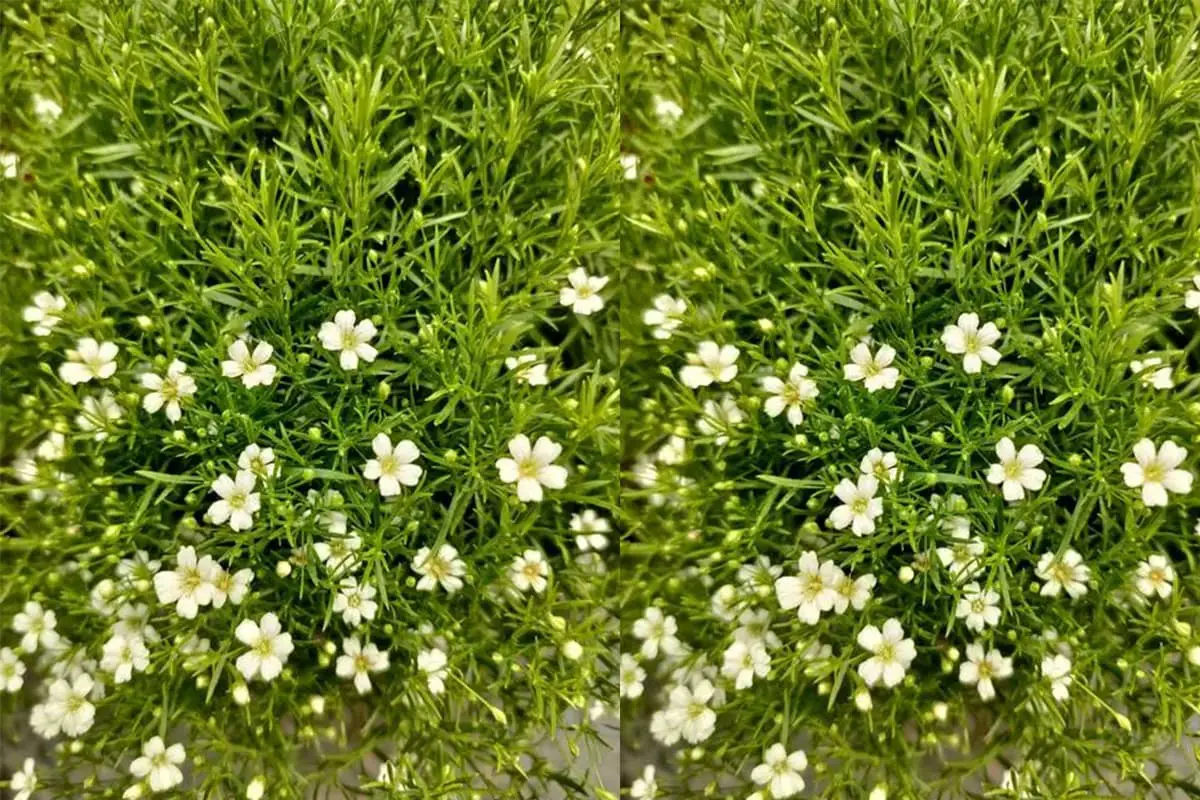
Gypsophila paniculata, also known as Baby’s Breath or Round-headed Gypsophila, is a perennial herbaceous plant from the carnation family, genus Gypsophila.
Its panicle inflorescence branches abundantly, bearing numerous small flowers with white or pale pink petals. Its fruit is spherical, with small, round seeds. Flowering occurs from June to August, and fruiting from August to September.
The plant thrives at altitudes of 1100-1500 meters, in river beaches, grasslands, fixed dunes, stony slopes, and farmlands, demonstrating exceptional vitality.
Propagation can be achieved through cuttings, which should be appropriately shaded after planting, and regularly misted to maintain high air humidity.

Baby’s Breath flourishes at altitudes of 1100-1500 meters, in areas such as river beaches, grasslands, fixed dunes, stony slopes, and farmlands. The species is extremely hardy and roots quickly.
It prefers sunny conditions and loose, fertile, well-drained, slightly alkaline sandy loam for growth. The soil should be loose, rich in organic matter, have a moderate moisture content, with a pH of around 7.
Kazakhstan, Russia, Europe, North America.
Baby’s Breath is a perennial herb, standing at a height of 30-80 centimeters. Its roots are robust. The stem grows singularly or in small clusters, is erect, and branches out extensively. It is either hairless or glandular hairy at the bottom.

Its leaves are lanceolate or linear-lanceolate, measuring 2-5 centimeters in length and 2.5-7 millimeters in width, with a pointed tip and a distinct midvein.
The corymbose inflorescences branch out extensively, are sparse, and bear numerous tiny flowers. The flower stalks are slender, ranging from 2-6 millimeters in length, and are hairless.
The bracts are triangular with a sharp tip. The calyx is broadly bell-shaped, measuring 1.5-2 millimeters in length, and features purple broad veins. The calyx teeth are ovate, blunt, and have a white, membranous edge.
The petals are white or pale pink, spoon-shaped, approximately 3 millimeters in length and roughly 1 millimeter wide, with a flat or blunt tip.
The filaments are flat and linear, nearly the same length as the petals. The anthers are round. The ovary is ovoid, with a diameter of about 1 millimeter, and a slender style.
The capsule fruit is spherical, slightly longer than the persistent calyx, and splits into four sections. The seeds are small, round, with a diameter of approximately 1 millimeter, reddish-brown, and feature an orderly blunt warty protrusion.
The blooming period is from June to August, and the fruiting period is from August to September.
False Planting
After the cuttings have rooted (generally around 40 days), seedlings are removed from the cutting bed for false planting. A mixture of 1:1 peat soil and garden soil is placed into the nutrient pots.
For false planting starting at 40 days, use a nutrient pot with a diameter of 9 cm. For those starting after 45 days, use a nutrient pot with a diameter of 10-12 cm. After false planting, provide shade for one week.
Around 3 weeks after false planting, the plant begins to grow. At this time, it is necessary to pinch out the growing tip completely. After pinching, lateral buds sprout, and you can then plant out, typically leaving 3-5 branches.
Planting Out
Make a high bed, 15-30 cm in height and 90 cm in width. When making the bed, apply base fertilizer at a rate of 30 grams of nitrogen, 25 grams of phosphorus, and 20 grams of potassium per square meter, mixed together, primarily using organic fertilizer.
The density for planting out should be 30 x 30 cm. After planting out, irrigate thoroughly.
Pinching
A month after the seedlings are planted out, begin pinching when the leaves have grown to 7-8 pairs. When the side branches extend, leave 5-7 branches and remove the rest.
Netting: To prevent the Conehead Stone Flower from falling over, start pulling strings or applying a layer of netting about 60-80 days after pinching. After the Conehead Stone Flower begins to moss, it should be tied up in a timely manner.
Watering
The Conehead Stone Flower is quite drought-tolerant and dislikes waterlogged conditions. However, it requires a larger amount of water during the initial growth and development stage, so water it more frequently.
Once the seedling grows to 30 cm in height, it generally doesn’t need watering or needs less watering. Watering should be controlled even more during the flowering period to prevent the branches from becoming weak and elongated.
Fertilizing
Light fertilization is preferred. The first time is two weeks after the seedlings are planted out. When the new heart leaf grows to 2-3 cm, apply a follow-up nitrogen-based dilute liquid fertilizer, and then every 10 days or so afterward.
During the moss stage (when the plant transitions from vegetative growth to reproductive growth), reduce the proportion of nitrogen fertilizer and increase the amount of phosphorus and potassium fertilizer.
At the same time, apply some quick-acting fertilizers like calcium nitrate, potassium nitrate, wood ash, etc. Stop applying nitrogen fertilizer 45 days before flowering.
Temperature and Sunlight
The optimal growth temperature for this species is 25-30℃ during the day and 10-15℃ at night. High temperatures can cause deformed flowers like lion’s head flowers or green flowers, while low temperatures can cause clusterization or induce a dormant state.
This species is a long-day plant, and it performs best with at least 16 hours of sunlight. Clusterization usually occurs with less than 8 hours of sunlight, and it cannot set buds with 12 hours of sunlight.
It can flower with more than 14 hours of daylight, and 16-18 hours of daylight is most suitable. Moreover, the flowering period can be advanced. During the day, keep the temperature around 25℃, ensure good ventilation and sufficient sunlight.
At night, keep the temperature around 10-15℃. To maintain daylight for over 15 hours, use electric lighting. Generally, set up one 100-watt light every 10 square meters, at a height of 1.2 meters from the seedlings. Start the electric lighting at midnight for 3-4 hours each time.
The Coneflower can be propagated through cuttings. From late August to late April of the following year, lateral buds that have 4-5 nodes and are not elongated from the stem of the robust parent plant are taken for cuttings.
Remove the 2-3 pairs of leaves at the base, leaving the 3-4 pairs of leaves at the top. Quickly dip the cuttings in a 500 ppm solution of indolebutyric acid, then insert them into a seedbed with a 1:1 mixture of perlite and rice husk biochar.
The spacing between the plants should be 3×3 cm. After insertion, provide appropriate shading, with a light intensity of 30-50%, and regularly spray to maintain high air humidity. The temperature should generally be kept around 20°C, and roots will appear within 25-30 days.
This species is prone to epidemics in high summer temperatures, mainly manifesting as stem or root rot or plant death.
Preventive methods: Disinfect the soil with formalin or potassium permanganate before planting. At the initial stage of the disease, use a 1000x solution of methyl tobutin to disinfect the roots. In summer, pay attention to rain prevention, cooling, and ventilation.
The Coneflower is one of the cut flowers, ranking second in consumption of fresh cut flowers in Japan. Its white flowers have a slight fragrance and are quite aesthetically pleasing, making them a common material for flower arrangements.
The roots and stems of the Coneflower can be used for medicinal purposes.
Harvesting: Harvest when the flowers and leaves are lush in summer and autumn, wash them clean, and dry them in the shade or use them fresh.
Components: It contains flavone glycosides, phenols, amino acids, volatile oils, coumarins, etc.
Taste: It has a neutral property and a bitter taste.
Dosage: 15-25 grams. Use an appropriate amount externally, mashing the fresh product and applying it to the affected area.
Indications: It clears heat, promotes urination, transforms phlegm, and stops coughing. It is used for acute jaundice hepatitis, acute nephritis, whooping cough, urinary tract stones, athlete’s foot, shingles, conjunctivitis, erysipelas.
It has the effect of removing wind and clearing heat. For red eyes due to wind-heat, it can be used with mulberry leaves, trillium, etc. For sore throat, it can be used with ox knee, white summer grass, etc.
To treat snake entanglement sores, use freshly mashed whole grass, soak it in alcohol for half a day, then apply it to the affected area with a cotton ball.

Peggie was once a high school mathematics teacher, but she set aside her chalkboard and textbooks to follow her lifelong passion for flowers. After years of dedication and learning, she not only established a thriving flower shop but also founded this blog, “Flowers Library”. If you have any questions or wish to learn more about flowers, feel free to contact Peggie.
 English
  العربية
  Bahasa Indonesia
  Deutsch
  Français
  Italiano
  Nederlands
  Português
  Русский
  日本語
日本語