600+ Types of Flowers A To Z (With Names and Pictures)
Types Of Flowers By Names (A-Z) Types Of Flowers By Color Types Of Flowers By Season Types Of Flowers By Blooming Time 600+ Types of Flowers No. Flower Name No.…

The Erythrina variegata belongs to the Fabaceae family and the Erythrina genus. It is a deciduous tree, standing approximately 20 meters tall, with grey bark and conical thorns. It blooms in March, producing red flowers measuring 6-7 millimeters in length.
The flowers have elliptical petals, and the fruit takes on a bead-like shape. The fruit swells to a black color, and is thick, slightly constricted between the seeds, and measures 15-30 centimeters in length and 2-3 centimeters in width.
The fruit is slightly curved with a sterile apex. It contains 1-8 kidney-shaped seeds, each about 1.5 centimeters long and 1 centimeter wide, and are of a dark red color.
The tree originates from the tropical regions of Asia and the Pacific islands. It is suitable for standalone planting in grasslands or beside buildings, and is an excellent choice for parks, green spaces, and scenic areas.
The Indian Coral Tree is also an excellent roadside tree for highways and city streets. With its beautiful flowers, it can be used as an ornamental tree. This species grows rapidly, and can be used as a stake for pepper plants.
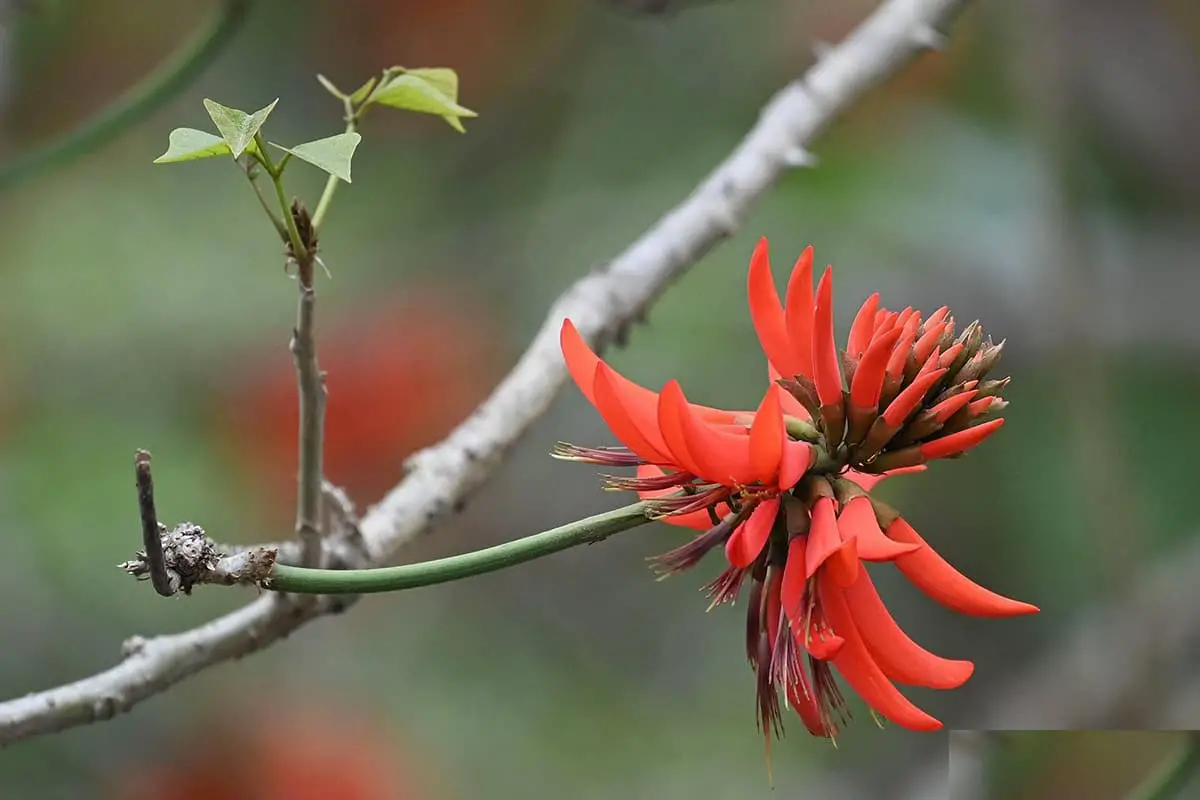
The Indian Coral Tree is a large deciduous tree, reaching heights of up to 20 meters. Its bark is grey-brown and the branches have visible leaf scars and short, black, conical thorns. The pith is loose, and the decayed parts form cavities.
The compound leaf has 3 leaflets that are often densely clustered at the branch tips. The stipules are lanceolate and early-deciduous. The leaf stalk is 10-15 centimeters long and usually spineless.
The leaflets are membranous, and are broadly ovate or rhomboid-ovate, measuring 15-30 centimeters in length and width. The apex of the leaf is gradually pointed but blunt, and the base is broadly cuneate or truncate.
There are three primary veins and five pairs of secondary veins. The base of the leaf stalk has a pair of glandular stipules.
The inflorescence is terminal and measures 10-16 centimeters in length, with densely arranged, paired flowers. The inflorescence stalk is woody and robust, measuring 7-10 centimeters in length.
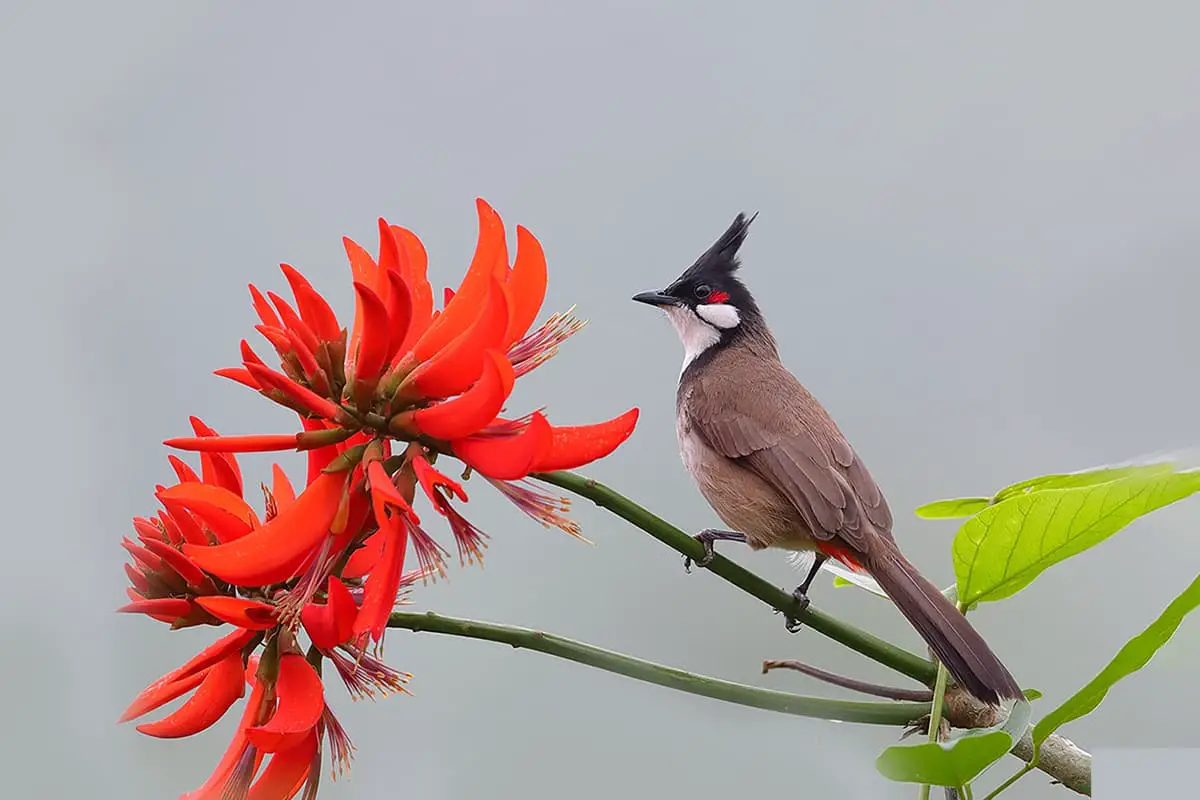
The flower stalk is roughly 1 centimeter long and has short velvet hair. The flower calyx is Buddha-flame-shaped, 2-3 centimeters long with an oblique mouth and one side split.
The corolla is red, 6-7 millimeters long, with elliptical petals measuring 5-6 centimeters in length and about 2.5 centimeters in width. The apex of the petal is round and the petal stalk is short. The wing petals and keel petals are almost equal in length.
The keel petals are two separate pieces, and there are 10 stamens in individual pieces. The ovary is covered in fine soft hair and the style is hairless.
The fruit is swollen black, thick, slightly constricted between seeds, measuring 15-30 centimeters in length and 2-3 centimeters in width. It is slightly curved with a sterile apex.
It contains 1-8 kidney-shaped seeds, each about 1.5 centimeters long and 1 centimeter wide, and are of a dark red color. The tree blooms in March and fruits in August.
The main characteristics are the black thorns; the Buddha-flame-shaped, oblique, split to the base calyx, which is not two-lipped; the two separate keel petals; and the red seeds.
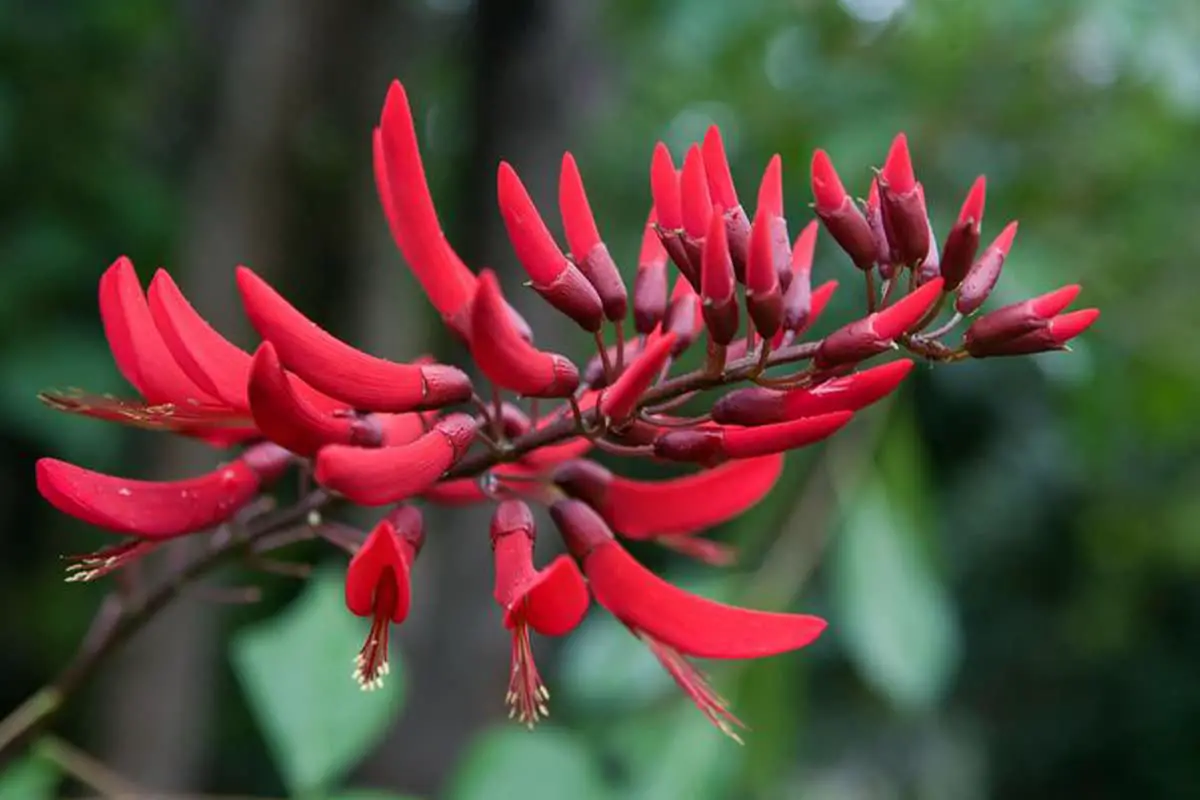
The Indian Coral Tree is commonly found near trees or by the seaside, or planted in parks. It originates from India and Malaysia. It is robust, with strong germination ability and fast growth.
New shoots can grow up to 1.5 meters during the flowering period, and the inflorescence can reach 50 centimeters in length. It prefers warm, humid environments with ample sunlight. It is both drought and moisture tolerant and does not require specific soil conditions.
However, it thrives in fertile, well-drained sandy loam soil. It is not very cold-resistant. In the Nanjing area, it can survive the winter with a little cover, but potted plants need to be placed in a greenhouse to ensure safety.
The Indian Coral Tree is native to tropical Asia, specifically India and Malaysia. It is the national flower of Argentina and the prefectural flower of Okinawa, Japan.
Propagation is primarily done through cuttings, but can also be achieved by seeding. Cuttings are typically taken in April, selecting 1-2 year old branches that are robust and healthy.
These are cut into 12-20cm sections and planted in sandy soil. After planting, it is important to water and keep the soil moist as roots easily form. Seedlings should be placed in semi-shade and the potting soil kept damp.
When small red buds emerge on the cutting, it indicates rooting has occurred. Seedlings propagated from cuttings can be pruned and planted the following spring.
Leaf Spot Disease
The pathogenic fungus of this disease is Alternaria sp., which mainly affects the leaves of the tree. After infection, the leaf tips and edges begin to show disease symptoms. The disease spots are V-shaped, thin, gray-brown, with gray-black specks.
The edges of the disease spots are thicker. In the later stages, the spots expand and can reach up to a quarter of the leaf, appearing gray-brown to gray-white, paper thin and easily cracked, with dark brown edges.
This disease can occur between May and October, reaching its peak in July and August. In severe cases, a large number of diseased leaves turn yellow and break in July and August, seriously affecting normal growth and ornamental effects.
Control Suggestions
Brown Spot Disease
The pathogenic fungus of this disease is Phyllosticta sp., which mainly affects the leaves of the tree. In the early stages of infection, green spots on infected parts fade. Often, the leaf tips or edges are the first to show symptoms.
Later, the disease spots gradually expand inward, forming round or irregular yellow-brown, gray-white spots. The edges of the spots are dark brown and clearly outlined.
The dead part becomes brittle and easy to crack and fall off. In the later stages of infection, black specks scatter on the disease spots, which are the conidia of the pathogen.
When humidity is high, a large number of black molds can grow on the disease spots. This disease can occur from June to September, peaking in July and August.
Control Suggestions
The bark or root bark of the tree is used in medicine, known as Cortex Erythrinae, to dispel wind-damp, relax muscles and joints, treat numbness from rheumatism, pain in the waist and legs, sprains and injuries.
It has a relaxing effect on striated muscle and a calming effect on the central nervous system. However, it has a cumulative effect, and toxicity mainly manifests as inhibition of myocardium and cardiac conduction system.
The tree is suitable for single planting in grassland or next to buildings, suitable for beautification of parks, green spaces and scenic areas, and is an excellent tree for streets and roads.
With beautiful flowers, it can be grown as an ornamental tree. This species grows rapidly and can be used as a support for pepper plants.
The flower of this tree is the national flower of Argentina, the city flower of Quanzhou and Miyakojima, Japan, and the prefectural flower of Okinawa. It can also be used as a hemostatic external medicine.

Peggie was once a high school mathematics teacher, but she set aside her chalkboard and textbooks to follow her lifelong passion for flowers. After years of dedication and learning, she not only established a thriving flower shop but also founded this blog, “Flowers Library”. If you have any questions or wish to learn more about flowers, feel free to contact Peggie.
 English
  العربية
  Bahasa Indonesia
  Deutsch
  Français
  Italiano
  Nederlands
  Português
  Русский
  日本語
日本語