600+ Types of Flowers A To Z (With Names and Pictures)
Types Of Flowers By Names (A-Z) Types Of Flowers By Color Types Of Flowers By Season Types Of Flowers By Blooming Time 600+ Types of Flowers No. Flower Name No.…

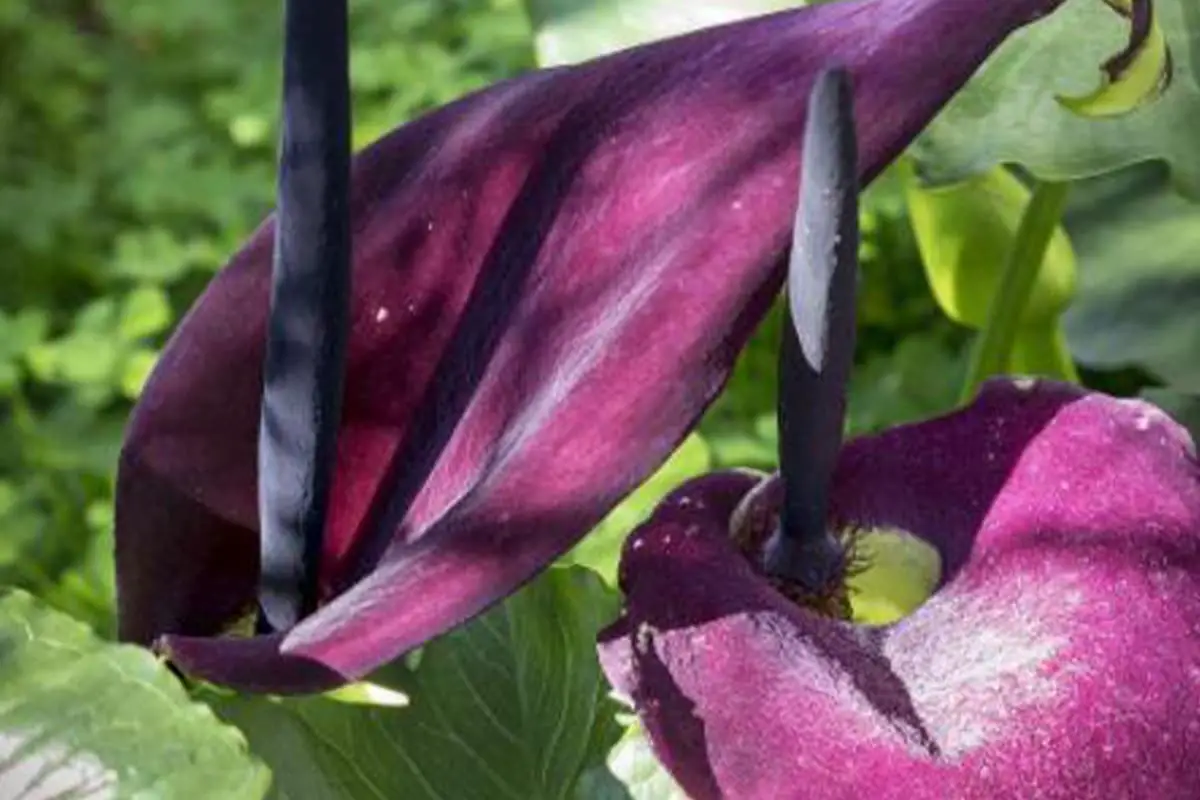
Dracunculus vulgaris, also known as the Voodoo Lily, hosts deep purple flowers on its central stem, which exude a scent of decay. Its upright stalk is surrounded by larger green leaves, laced with white veins.
As a shade-loving plant, it is among the top 16 most notoriously foul-smelling, yet beautiful plants in the world. It thrives across a vast region including the Balkan Peninsula, the Mediterranean area of Europe, Crete, the Aegean Islands of Greece, and southwest Turkey. In certain places, it truly earns its title as a wild weed.
The Dracunculus vulgaris grows in the vast expanses of the Balkan Peninsula, Mediterranean Europe, Crete and the Aegean Islands of Greece, and southwestern Turkey. In some locations, it truly lives up to its reputation as a wild weed.
Also known as the Black Dracunculus vulgaris, these plants primarily grow in Greece and boast a history even longer than that of humankind. It stands as one of the most astonishingly notorious plants.
The central stem of the Dracunculus vulgaris bears deep purple flowers that emit a rotten smell. These flowers, held upright, are encircled by large green leaves patterned with white veins. This shade-loving plant is one of the world’s 16 most notoriously beautiful but foul-smelling species.
They propagate through their own seeds or by spreading their lateral corms. If the seed heads are not collected, they will eventually scatter throughout the park, carried away by beetles or ants, further spreading the Dracunculus vulgaris to distant locations.
The flowers, resembling rotting meat in scent, are leaf-like, with a color similar to Burgundy wine, surrounded by numerous slender black branches and leaves. In Greece, it is known as “Drakondia”, likened to a dragon or venomous snake lurking in the spathe.
Although it appears to be a tropical plant, it is not. Gardeners in the northwest report that it spreads rapidly in the wild, requiring no special care.

Peggie was once a high school mathematics teacher, but she set aside her chalkboard and textbooks to follow her lifelong passion for flowers. After years of dedication and learning, she not only established a thriving flower shop but also founded this blog, “Flowers Library”. If you have any questions or wish to learn more about flowers, feel free to contact Peggie.
 English
  العربية
  Bahasa Indonesia
  Deutsch
  Français
  Italiano
  Nederlands
  Português
  Русский
  日本語
日本語