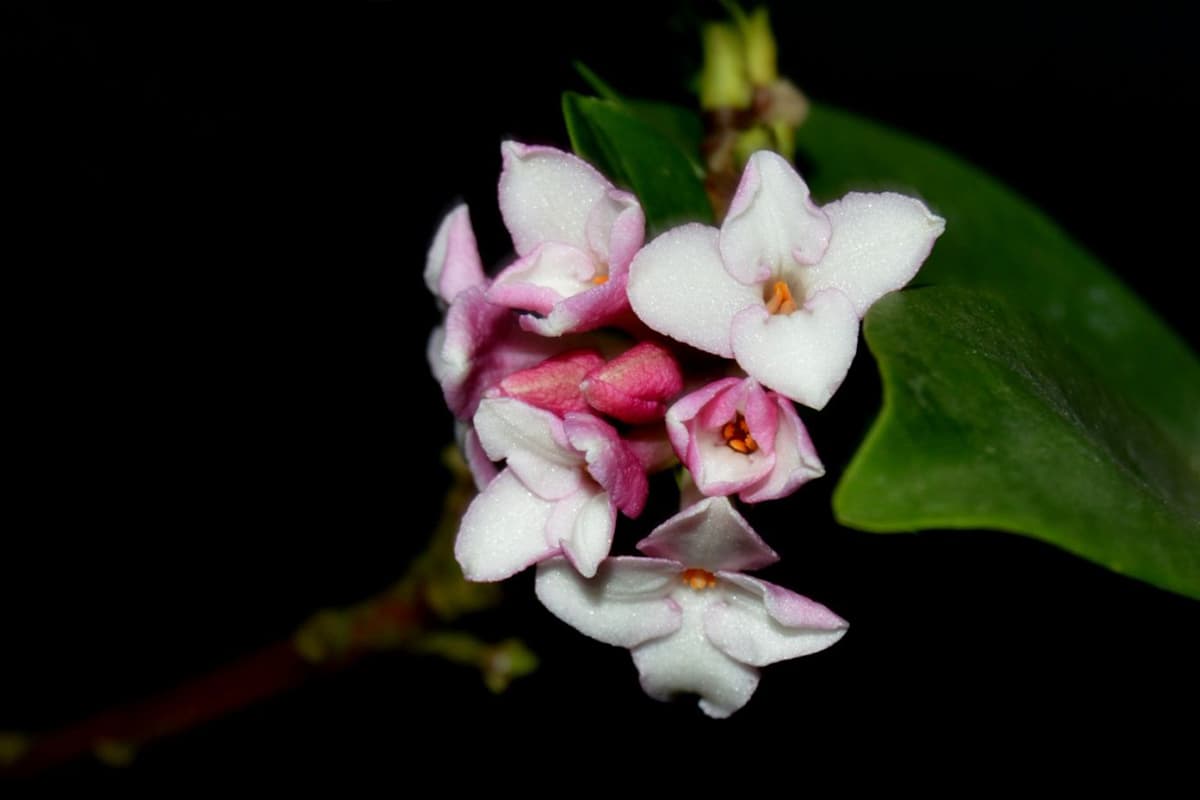
Daphne odora, also known as Winter Daphne, is a traditional evergreen shrub belonging to the Thymelaeaceae family. Renowned for its compact and natural elegance, it is often referred to as the Penglai flower or the Stylish Tree. Its leaves are thick and oval-shaped, with red buds that bloom into pale white flowers. Small yet numerous, the flowers emanate a rich and long-lasting fragrance. Its blooming period can even start as early as the Chinese New Year.
Daphne odora is distributed in China and the Indochinese Peninsula. Japan has only cultivated varieties. Admired for its elegant bearing, evergreen foliage, early spring bloom, and rich aroma, it has earned the reputation of a “top-notch flower.
Growth and Distribution
Growth Environment
Despite being domesticated, Daphne odora remains demanding of its growth environment. It thrives in warm, humid, and cool climates, but cannot withstand severe cold; it despises hot weather; it prefers weak light and is averse to direct sunlight, thriving in semi-shady places; it likes loose, well-drained fertile sandy loam soil, and struggles to grow in heavy and arid poor soils; it detests waterlogged ground.
Distribution Range
Native to China and Japan, Daphne odora is a traditional Chinese flower. It is distributed in provinces south of the Yangtze River basin, with presence also in Japan. Ganzhou City, Jiangxi Province, has designated it as the “city flower”.
Morphology and Characteristics
Daphne odora is an evergreen upright shrub; its branches are thick, often bifurcated, and the twigs are cylindrical, purple-red or purplish-brown, and hairless. Its leaves are alternate, papery, oval or obovate-elliptical, 7-13 cm long and 2.5-5 cm wide.
The apex is blunt, the base is cuneate, the margin is entire, the upper side is green, the underside is light green, both sides are hairless, with 7-13 pairs of veins, and the midrib is obviously raised on both sides; the petiole is stout, 4-10 mm long, with few soft hairs or hairless.
The outside of the flower is pale purple-red, the inside is meaty red, and hairless, several to 12 flowers form terminal capitate inflorescences; bracts are lanceolate or ovate-lanceolate, 5-8 mm long, 2-3 mm wide, hairless, with prominent veins; the calyx tube is tubular, 6-10 mm long, hairless, with 4 lobes, heart-shaped or ovate-lanceolate, the base is heart-shaped, equal to or longer than the calyx tube; there are 8 stamens in 2 whorls, the lower whorl stamens attached above the middle of the calyx tube, the anthers of the upper whorl stamens half protruding from the throat of the calyx tube, the filaments are 0.7 mm long, the anthers are oblong, 2 mm long; the ovary is oblong, hairless, the apex is blunt, the style is short, the stigma is capitate. The fruit is red. The flowering period is from March to May, and the fruiting period is from July to August.
Reproduction Methods
Cutting Propagation
Reproduction of Daphne odora can be achieved by sowing, layering, and cuttings. However, the first two methods demand high nursery conditions and are unsuitable for field cultivation with slower results, so cuttings are often used in production.
Selection of Cuttings
The maturity of the Daphne odora twig directly affects the survival rate of the cuttings. Thus, different requirements apply to the cuttings at different times: between April and June, vigorous young shoots grown in the current year should be selected; between July and September, robust semi-woody twigs grown in the current year should be selected.
Pruning of Cuttings
Selected twigs are cut into sections of 5-7 cm long, lower leaves are removed, leaving 2-3 top leaves. When cutting, a branch cutter or a sharp knife must be used to ensure a smooth wound and increase survival rates.
Treatment of Cuttings
Cuttings should be inserted immediately after harvesting. Cuttings are tied into bundles and soaked in a 50-100mg/L NAA or IAA solution for 18-24 hours, then inserted into loose, well-drained acidic sandy mountain soil or burned soil.
Bed Management
After insertion, a shade shed should be erected above the bed to provide shade, with a shading rate above 70%. Direct sunlight should be avoided for 50 days, and bed temperature should be maintained at 25-30℃.
The moisture content of the bed medium should be generally controlled at around 20% or lower, as excess moisture will affect rooting. It is best to use an intermittent spray method to maintain humidity and improve survival rates.
Once the cuttings have rooted, a 1/2MS nutrient solution or other diluted liquid fertilizer can be sprayed every 10-15 days, adhering to the principle of thin and frequent fertilizing. Once the seedlings reach a height of 10-15 cm and the root system is relatively developed, they can be transplanted into pots.
Transplanting Management
Daphne odora has strong bud force and can withstand pruning, but transplanting is difficult. Transplanting is usually carried out in spring and autumn. If summer transplanting is required, early mornings, late evenings, or cool weather should be selected.
During transplanting, seedlings should carry more original soil, the branches need to be pruned, and appropriate shading will make it easier for the plant to survive.
Cultivation Techniques
Daphne odora grows in mixed forests on slopes and at the edges of forests. It prefers indirect sunlight and well-drained acidic sandy loam. It should be planted in semi-shady areas with deep topsoil and moist conditions.
To avoid direct sunlight while still getting sunlight in winter, it is often mixed with deciduous trees and shrubs. Transplanting can be done in both spring and autumn, but it is best to do it during the flowering season in spring or during the rainy season. Mature trees are not tolerant of transplanting, so it is essential to bring as much original soil as possible and prune heavily.
After planting, outdoor cultivation is relatively extensive, watering is only needed when the weather is extremely dry; before winter, some well-rotted manure should be applied around the base of the plant.
Daphne odora tolerates pruning. Before budding, dense small branches can be pruned to leave some gaps for ventilation and light. If you want to cultivate dwarf Daphne odora, you can prune part of the previous year’s branches after flowering to promote new buds. It’s important not to prune after bud formation.
In northern regions, indoor care is needed in winter, not lower than 5℃. In addition, avoid overwatering, avoid strong and fresh fertilizers, avoid alkaline soil, avoid rain, and avoid worms and ants in the pot. Especially close to the flowering period, all the above points need more attention to avoid bud and flower drop.
Pest and Disease Control
Daphne odora has very few pests and diseases. If the potting soil is too wet or uncomposted organic fertilizer is used, it can easily cause root rot. It is recommended to spray a fungicide, such as a 50% carbendazim 800 times solution or a 70% methyl tobujin 1000 times solution, every 10-15 days.
Main Value
Daphne odora blooms in early spring, has a pleasant scent, and remains green all year round. It is a famous traditional aromatic plant, most suitable for planting on the shady side of buildings, rockeries, forest lands, and the front edge of trees. It is also used for potted viewing.
Daphne odora is not only a beautiful plant but also has various economic values. Its roots can be used for medicinal purposes, having effects of promoting blood circulation, dispersing blood stasis, and relieving pain; its flowers can extract aromatic oil; its bark fiber can be used for papermaking.
Plant Culture
Daphne odora is a traditional famous flower in China. It has an elegant tree posture, stays green all year round, blooms in early spring, and has a strong fragrance. Therefore, it is named “Daphne odora” and is quite popular among people, being known as “top-grade flower”. The Daphne odora, born of Buddhism, puts out buds at the beginning of spring, emitting a rich fragrance.
The Daphne odora has a strong fragrance and beautiful plant form and leaf color, so it is popular in homes. According to legend, a monk on Mount Lu fell asleep on a flat rock and was woken up by a strong fragrance in his dream. He later found the flower and named it “sleep fragrance”.
Because it blooms around the cold Lunar New Year, people consider it auspicious and renamed it “Daphne odora”. The flowering period of Daphne odora is when other flowers are withering, and its fragrance is a mixed type, so it was known as the “snatching fragrance flower” in old times.



 English
  العربية
  Bahasa Indonesia
  Deutsch
  Français
  Italiano
  Nederlands
  Português
  Русский
  日本語
日本語