600+ Types of Flowers A To Z (With Names and Pictures)
Types Of Flowers By Names (A-Z) Types Of Flowers By Color Types Of Flowers By Season Types Of Flowers By Blooming Time 600+ Types of Flowers No. Flower Name No.…

The Cerbera manghas is a tree species belonging to the Dogbane family, Cerbera genus. It can grow to heights of 4 to 8 meters with a grey-brown bark. The entire plant is rich in milky sap.
The leaves are thick and paper-like, ranging from inverted egg-shaped to lanceolate, dark green on top and light green on the underside. The flowers are white and fragrant.
The fruit, either solitary or in pairs, is broadly ovoid or spherical with a fibrous or woody outer shell that turns orange-yellow when ripe.
Typically, there is only one seed per fruit. The flowering season runs from March to October, with the fruiting period extending from July to the following April.

The Sea Mango is distributed across other Asian countries and the tropical regions of Australia. It prefers full sunlight to partial shade and thrives in warm, humid climates without demanding soil conditions.
It is classified as ‘Least Concern’ (LC) on the IUCN Red List of Threatened Species. For propagation, seed sowing is the method used.
The plant is for topical use only and should not be ingested. The seeds can be utilized in surgical plasters or as an anesthetic, but must not be taken orally or injected.
The sap induces vomiting and purging and can precipitate abortion; it is used in emergencies for heart failure. Due to its toxicity, it must be used with great caution.
The Sea Mango can be cultivated in gardens, parks, roadside greenings, or beside lakes for ornamental purposes and serves as an excellent moisture-resistant tree species.
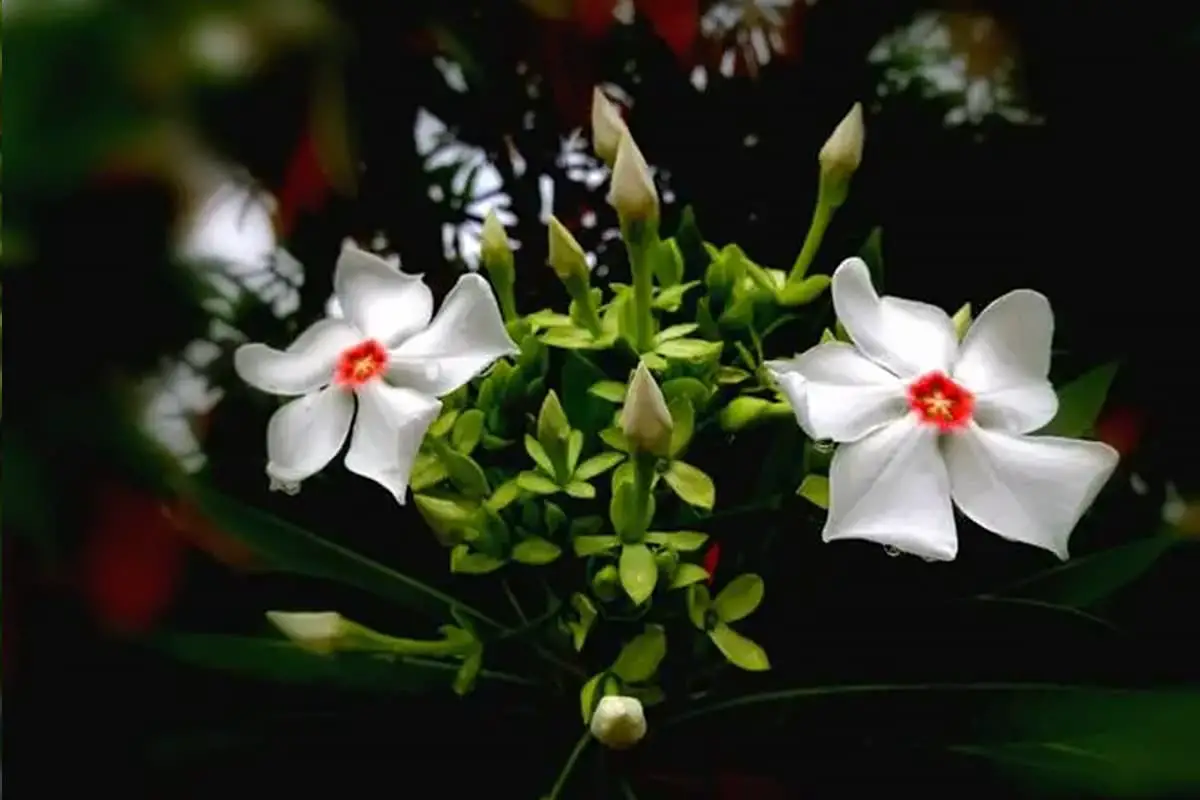
The Cerbera manghas is a tree that typically reaches 4 to 8 meters in height with a trunk diameter of 6 to 20 centimeters. The bark is grayish-brown, and the branches are thick and green with inconspicuous lenticels, hairless, and full of rich milky sap.
The leaves are thick, paper-like, inverted egg-shaped to lanceolate, occasionally elliptic, with a blunt or slightly tapered tip and a wedge-shaped base, measuring 6 to 37 centimeters long and 2.3 to 7.8 centimeters wide, hairless, with a deep green upper side and a lighter green underside.
The central and lateral veins are flat on the surface and raised on the underside, with the lateral veins forming a network before reaching the margins; the leaf stalks are 2.5 to 5 centimeters long, light green, and hairless.
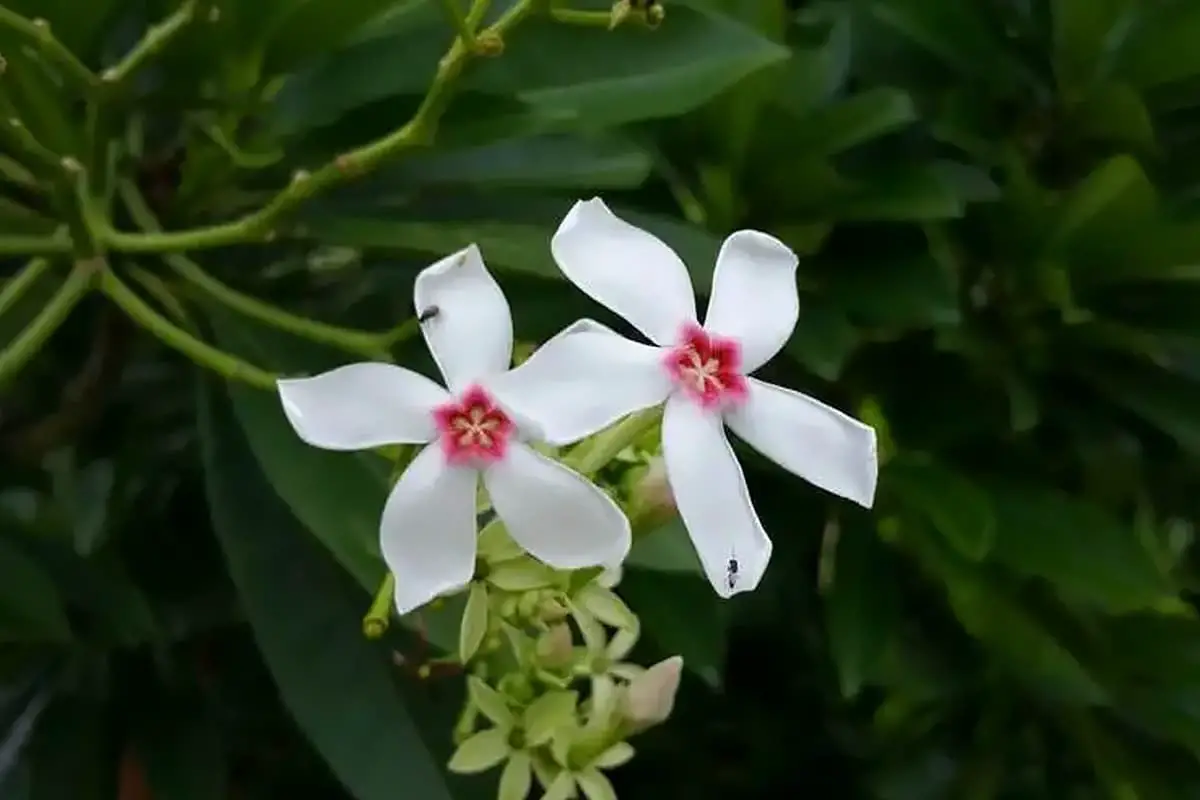
The flowers are white, approximately 5 centimeters in diameter, and fragrant. The peduncles and pedicels are green, hairless, with indistinct spots; the peduncles are 5 to 21 centimeters long, and pedicels are 1 to 2 centimeters long.
The sepals are oblong or inverted egg-shaped, tapering shortly to a blunt tip, 1.3 to 1.6 centimeters long and 4 to 7 millimeters wide, unequal in size, curling downward, yellow-green, hairless on both sides.
The corolla tube is cylindrical, swollen at the top and narrowing at the bottom, 2.5 to 4 centimeters long, with a diameter of 7 to 10 millimeters at the top and about 3 millimeters at the bottom, yellow-green and hairless on the outside, long and soft-haired on the inside, with a red throat and five hairy scales.
The corolla lobes are white, tinged with pale red on the back left side, inverted egg-shaped to sickle-shaped with a short tip, 1.5 to 2.5 centimeters long, with the width varying from 1.5 to 2.5 centimeters at the top and about 8 millimeters at the bottom, hairless on both sides, spreading horizontally.
The stamens are attached at the throat of the corolla tube, with short, yellow filaments, ribbed at the base, and anthers that are oval, with a short point at the top and round at the base, curving inward.
There is no nectar disc; the ovaries are two, separate, hairless, with a thread-like, weak, hairless style, 2.3 to 2.8 centimeters long, and a spherical stigma with an annular base, ending in a rounded bifurcation.
The fruit, either in pairs or solitary, is broadly ovoid or spherical, 5 to 7.5 centimeters long and 4 to 5.6 centimeters in diameter, with a blunt or sharply pointed tip, fibrous or woody exterior, green when immature, and turning orange-yellow upon ripening; usually, there is only one seed.
The flowering period is from March to October, and the fruiting period is from July to the following April.
Cerbera manghas is often confused with the Cerbera odollam Gaertn. found in India and Malaysia; the latter has a white corolla tinged with yellow in the throat, and its lobes are longer than the corolla tube.
The stamens are attached at the middle of the corolla tube, making the two quite distinguishable from each other.
Cerbera manghas is distributed across other Asian countries and the tropical regions of Australia.
Cerbera manghas thrives in sunlight, tolerates semi-shade, and prefers warm, humid climates, with no high soil quality demands. It grows near the sea or in moist areas close to the coast and is a coastal mangrove swamp plant that can also grow farther inland.
It is often found on sandy or muddy shores, typically in high tide zones or river estuaries, and commonly interspersed at the edges of mangrove forests.
For artificial propagation, Cerbera manghas is typically grown from seeds.
Seed Collection: Harvest the fruit that has fallen to the ground after ripening, pile and compost for ten days, then wash off the fruit skin, dry the seeds, and store them dry. Seedlings can be propagated by sowing or cutting.
Seeding Method: Choose a nursery site with gentle slopes, ample sunlight, good drainage, and deep, fertile sandy loam soil. The seedbed should be approximately 15 centimeters high, leveled with a small board.
After sowing the seeds, cover them with fine topsoil or clean river sand to a thickness of about 2 to 3 centimeters, so that the seeds are not exposed after watering. Keep the seedbed moist.
Seeds will start germinating about 30 days after sowing and finish germinating after about 50 days. Once the seedlings have 2 to 3 true leaves, they can be transferred to nutrient bags (cups) or separated into different beds.
Use a mix of topsoil and burnt soil as the nutrient medium in bags. Cover with a shade net to shield from light, and after 40 days, apply a concentrated compound fertilizer solution at about 1%, rinsing the leaves thoroughly with clean water thereafter.
After a year, when the seedlings reach a height of about 50 to 80 centimeters and a ground diameter of approximately 2 centimeters, they meet the standards for afforestation.
Mature branches are used for propagation by cutting. Cuttings can be done in spring or summer.
Before inserting the cuttings, soak the base in clean water for 7 to 10 days, changing the water several times to keep it fresh and enhance rooting, thus improving the survival rate.
If using water cuttings, maintain the water temperature at 18 to 20°C, changing the water frequently to promote rooting.
Cerbera manghas favors deep, moist, and loose soil, and grows better in areas with deep soil layers on middle and lower slopes. The planting distance should be 2 meters by 3 meters or 2.5 meters by 3 meters.
It can be interplanted with other coastal tree species. Bare-root seedlings should be planted in spring, while bagged seedlings can be planted in spring and summer.
For garden greening, it is advisable to plant seedlings that are at least 1.5 centimeters tall with a ground diameter of more than 2 centimeters.
For the first three years after afforestation, tending should be done once each in April-May and September-October.
Tending includes pruning and weeding, expanding the pits and loosening the soil, and applying 1.5 kilograms of mature farmyard manure or 0.15 kilograms of compound fertilizer.
The fertilizer should be placed on either side of the outermost drip line of the leaves to avoid root damage and impact on growth. The forest will typically become dense in 3 to 4 years.
The seeds can be used for surgical plasters or anesthetics but should not be ingested or injected; the sap can induce vomiting, act as a purgative, and be used in cases of acute heart failure. It is toxic, and dosage must be used with caution.
Cerbera manghas can be planted in gardens, parks, roadside greenery, or beside lakes for ornamental purposes and is also an effective species for moisture control.
Cerbera manghas is classified as Least Concern (LC) on the IUCN Red List of Threatened Species.
The skin of Cerbera manghas fruit contains cerberin, toxic bitter principles, alkaloids, and cyanic acid, which are highly toxic and can be lethal if ingested by humans or animals.

Peggie was once a high school mathematics teacher, but she set aside her chalkboard and textbooks to follow her lifelong passion for flowers. After years of dedication and learning, she not only established a thriving flower shop but also founded this blog, “Flowers Library”. If you have any questions or wish to learn more about flowers, feel free to contact Peggie.
 English
  العربية
  Bahasa Indonesia
  Deutsch
  Français
  Italiano
  Nederlands
  Português
  Русский
  日本語
日本語