600+ Types of Flowers A To Z (With Names and Pictures)
Types Of Flowers By Names (A-Z) Types Of Flowers By Color Types Of Flowers By Season Types Of Flowers By Blooming Time 600+ Types of Flowers No. Flower Name No.…

The Calonyction aculeatum belongs to the Convolvulaceae family and is an annual herbaceous plant. It can grow up to 10 meters with a milky sap, sporting a green cylindrical stem.
Its leaves are ovate with a tapering tip and a heart-shaped base. The plant boasts large, fragrant flowers that bloom at night, arranged in a raceme, sometimes with a zigzagging rachis.
The sepals are ovate and green with an extended awn, while the inner sepals may have a shorter awn or none at all. The corolla is strikingly large and snow-white with a tinge of pale green, and the stamens and style extend beyond the corolla.
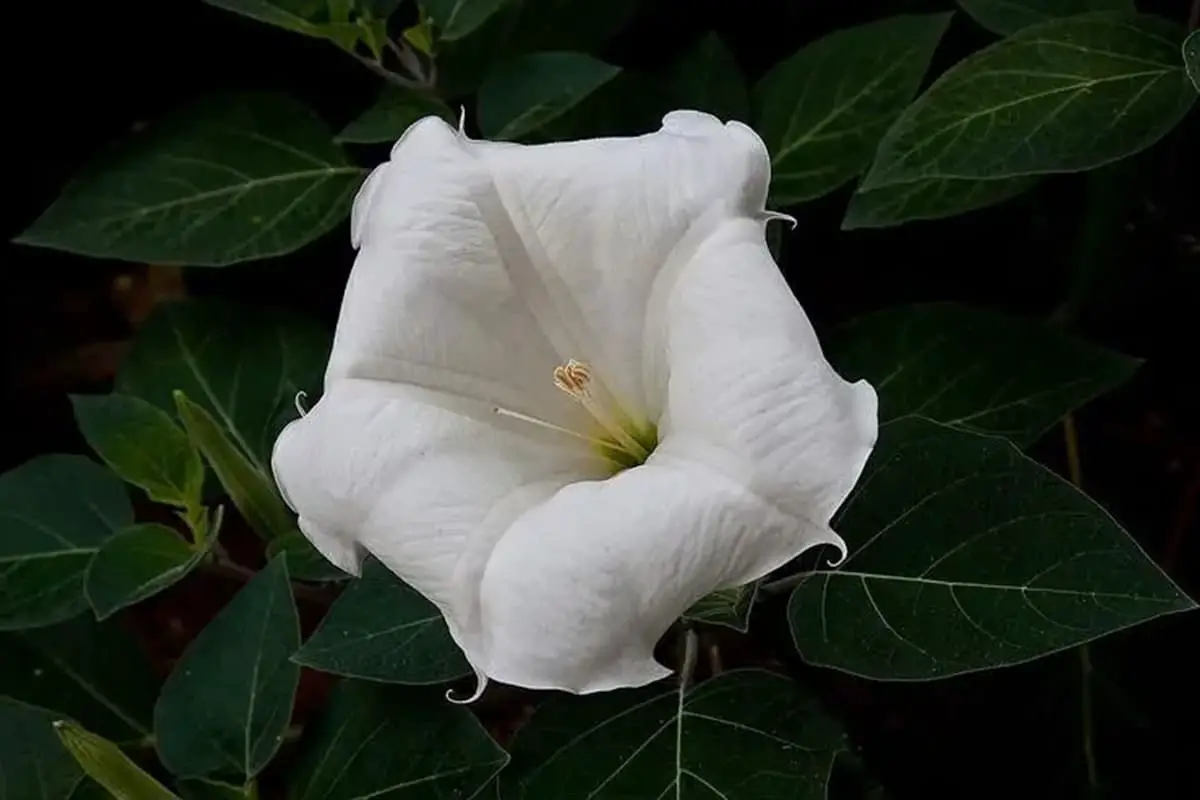
The filaments are cylindrical, and the anthers are large, pale yellow, and arrow-shaped at the base. The fruit is an ovate capsule with a thick pedicel, and the seeds are large and hairless. Native to tropical America, it has been widely distributed in all tropical regions since 1979.
The Moonflower is a large, annual, twining herb that grows up to 10 meters with a milky sap. Its green, cylindrical stem is nearly smooth or slightly prickly.
The leaves are ovate, measuring 10-20 centimeters with a tapering tip and heart-shaped base, with entire margins or slightly lobed or split. The large and aromatic flowers open at night, arranged in racemes, sometimes with a zigzagging rachis.
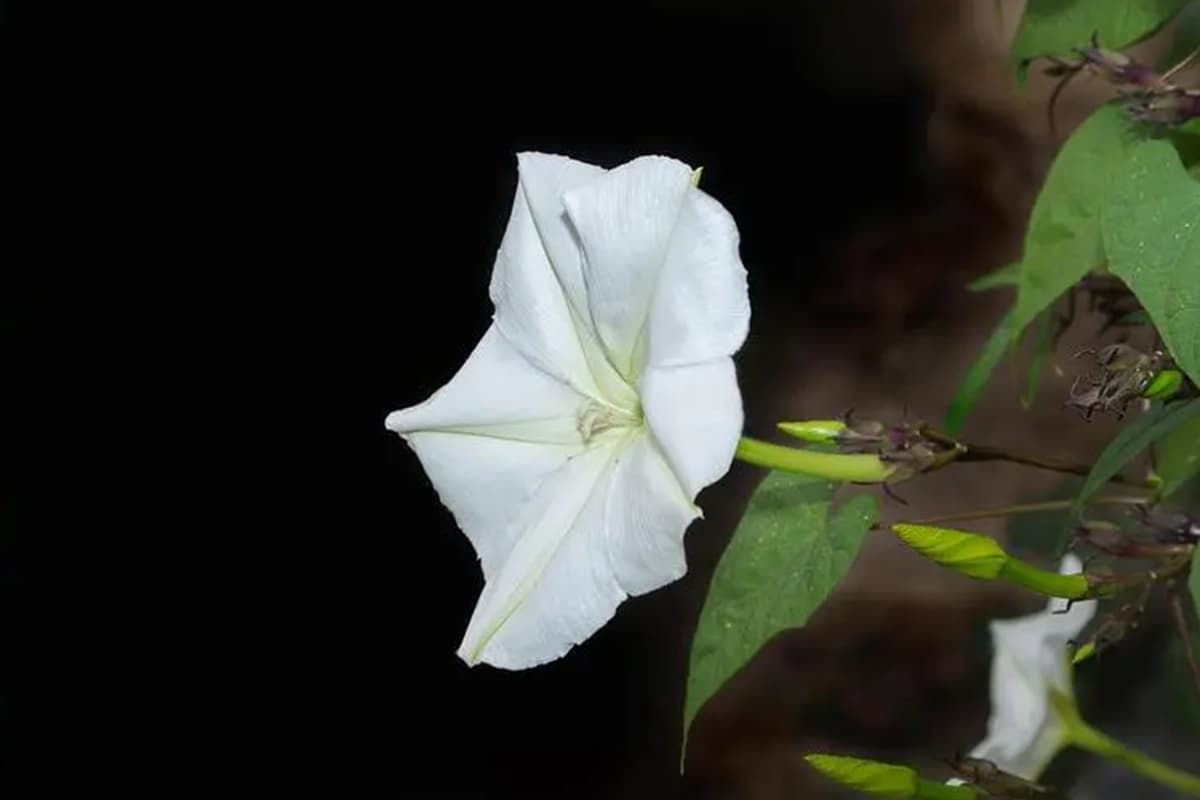
The three outer sepals have extended awns and measure 5-12 millimeters (excluding the awn), while the inner sepals are 7-15 millimeters long (excluding the awn) with a shorter awn or none at all.
The corolla is impressively large and snow-white, with pale green shades, a tube 7-12 centimeters long and about 5 millimeters wide, slightly flaring at the top, and a shallowly lobed crown spreading over a diameter of 7-12 centimeters.
The stamens and styles protrude beyond the corolla. There are five stamens with cylindrical filaments attached to the tube, large anthers with an arrow-shaped base, and a pale yellow color.
The disk is annular, thick, and fleshy. The ovary is long-conical, and the style is cylindrical and white with a large, bi-globular stigma.
The fruit is an ovate capsule about 3 centimeters long with a sharp point, surrounded at the base by enlarged sepals, and has a thick pedicel. The seeds are large, hairless, about 1 centimeter long and 7-8 millimeters wide.
The Moonflower is native to tropical America and has been widely found in all tropical regions since 1979.
The Moonflower thrives in environments with abundant sunlight, requiring no less than 4 hours of sun exposure daily. It prefers warm conditions and is not frost-tolerant, growing best at temperatures between 18-28℃.
The Moonflower can be grown from seeds. Seeds are collected at the end of autumn, dried, and stored for planting between March and April of the following year.
When direct sowing in the open ground, seedlings should be transplanted after the true leaves have developed. In early spring, seeds are sown in seedbeds and transplanted when the seedlings have 3-5 true leaves, allowing them to climb on trellises or fences.
Additionally, the Moonflower can propagate from cuttings and layering due to its tendency to develop adventitious roots along the vine.
To prevent diseases and pests such as powdery mildew and aphids, timely measures should be taken for control and treatment.
Moonflower is often susceptible to powdery mildew, aphids, and other pests. If an infestation occurs, timely measures should be taken to address the issue.
The Moonflower is cultivated for its ornamental appeal and also serves as a material for vertical greening.
In night gardens, its large white blossoms exude a captivating fragrance that embellishes the nocturnal landscape, adding charm to evening events and serving as a delightful cut flower for nighttime monitoring.
The Plant Hormone Research Group at Xiamen University has isolated a natural phytohormone from the stems and leaves of the Moonflower known as Moonflower Acid.
This substance has demonstrated significant physiological activity in a variety of crops including rice, wheat, soybeans, rapeseed, carrots, and more than ten other types.
It has been particularly effective in increasing the yield of sweet potatoes, potatoes, and peanuts. Moonflower Acid garnered considerable attention at the 10th (1979 in the United States) and 11th (1982 in the United Kingdom) International Conferences on Plant Growth Substances.
With its potent physiological activity, it can regulate plant metabolism and promote growth and development, leading to high yields in crop production.
As a natural extract with no toxic side effects, even with long-term use, it holds a broader potential for application compared to synthetic growth regulators.
The fleshy calyx and tender leaves of the Moonflower can be used as vegetables, while the dried flowers can be used in soups and desserts.
Both the whole plant and seeds of the Moonflower have medicinal properties. The entire plant treats snakebites, while the seeds are used to treat bruises, swelling, fractures, and other injuries.
The symbol of everlasting love.
The fragile and fleeting beauty.
The visage that never fades in the twilight, the warmth that is never lost in life.

Peggie was once a high school mathematics teacher, but she set aside her chalkboard and textbooks to follow her lifelong passion for flowers. After years of dedication and learning, she not only established a thriving flower shop but also founded this blog, “Flowers Library”. If you have any questions or wish to learn more about flowers, feel free to contact Peggie.
 English
 العربية
 Bahasa Indonesia
 Deutsch
 Français
 Italiano
 Nederlands
 Português
 Русский
 日本語