600+ Types of Flowers A To Z (With Names and Pictures)
Types Of Flowers By Names (A-Z) Types Of Flowers By Color Types Of Flowers By Season Types Of Flowers By Blooming Time 600+ Types of Flowers No. Flower Name No.…

The Weigela florida, a member of the Caprifoliaceae family, is a deciduous shrub. Its bark is gray, with short pointed buds that are often smooth.
The leaves are rectangular, oval, or egg-shaped, tapering at the top with serrated edges, and densely hairy veins. The leaves either have short stems or are stemless.
The flowers, either solitary or umbrella-shaped clusters, bloom in the leaf axils of the short lateral branches or at the branch tips. The calyx tube is elongated cylindrical, the corolla is purple-red or rose-red, the anthers are yellow, and the pistil is slender.
The fruit has a short beak-like stem and is sparsely covered with soft hair. It flowers from April to June and bears fruit in October.
During the transition from spring to summer, the long branches are filled with clusters of pink bell-shaped flowers, so dense that the leaves are hardly visible. They resemble a mass of decorative ribbons, hence the name Weigela.
Originally native to China, Weigela is also found in Russia, North Korea, and Japan. This plant enjoys sunlight, tolerates shade, cold, and poor soil, but fears flooding. It thrives best in deep, moist soil rich in humus. Propagation methods include seeds, cuttings, and layering.
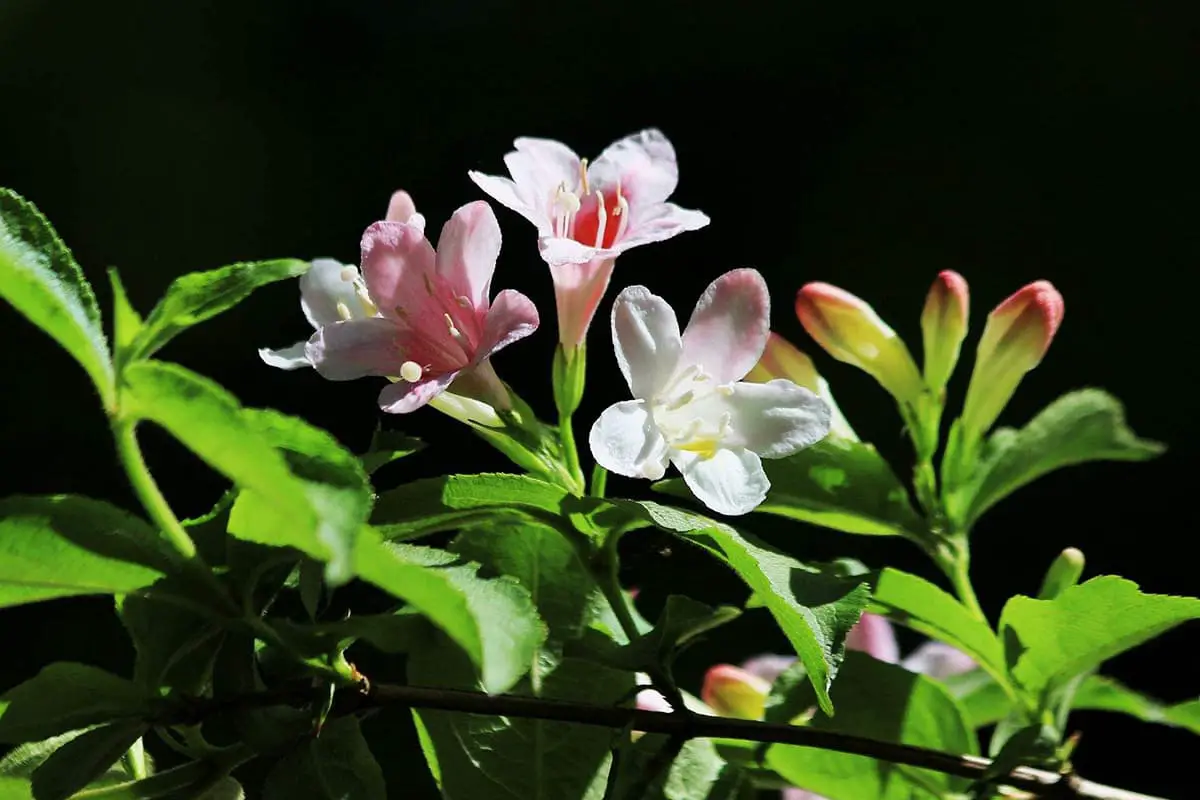
With its dense branches and leaves and vibrant flowers, Weigela is suitable for planting in courtyard corners or by the lake.
It can be planted in groups at the edge of a forest or as ornamental shrubbery. It also adorns rockeries and slopes. The tender stems, leaves, and flowers are edible.
During the transition from spring to summer, the long branches are filled with clusters of pink bell-shaped flowers, so dense that the leaves are hardly visible. They resemble a mass of decorative ribbons, hence the name Weigela.
The Weigela grows up to 3 meters high and 3 meters wide. The branches are spreading, the tree shape is round and simple, some branches can bend to the ground, the twigs are weak, and the young ones have 2 rows of soft hair.
The leaves are oval or egg-shaped, sharp at the end, round to wedge-shaped at the base, serrated at the edge, hairy on the surface, and especially dense on the back.
The corolla is funnel-shaped bell, rose-red, with 5 segments. The fruit is cylindrical; the seeds have no wings. It flowers from April to June and bears fruit from August to October.
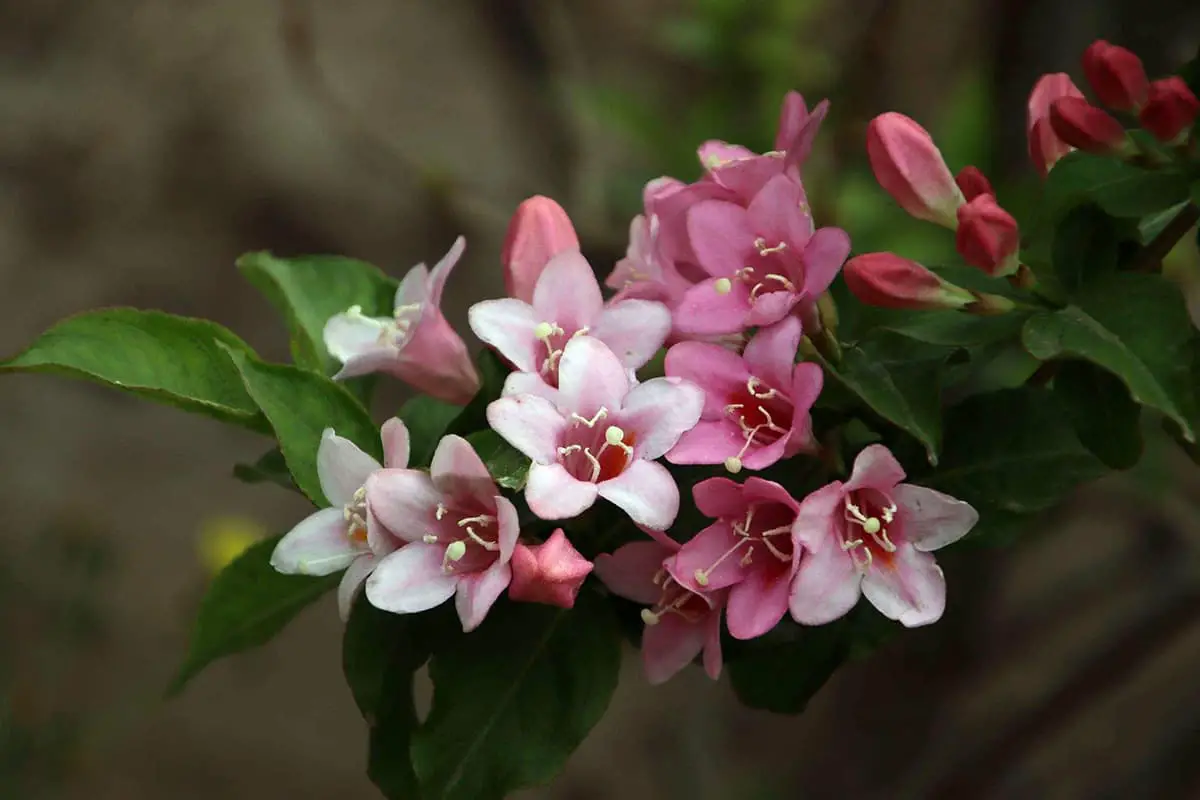
It grows at an altitude of 800-1200 meters in moist valleys, in the shade or semi-shade, loves light, tolerates shade, and cold. It is not demanding about soil, can tolerate poor soil, but grows best in deep, moist, humus-rich soil, and fears flooding. It has strong budding power and grows rapidly.
Originally native to China, Weigela is also found in Russia, North Korea, and Japan.
Propagation can be achieved through seed propagation, cutting propagation, and layering propagation.
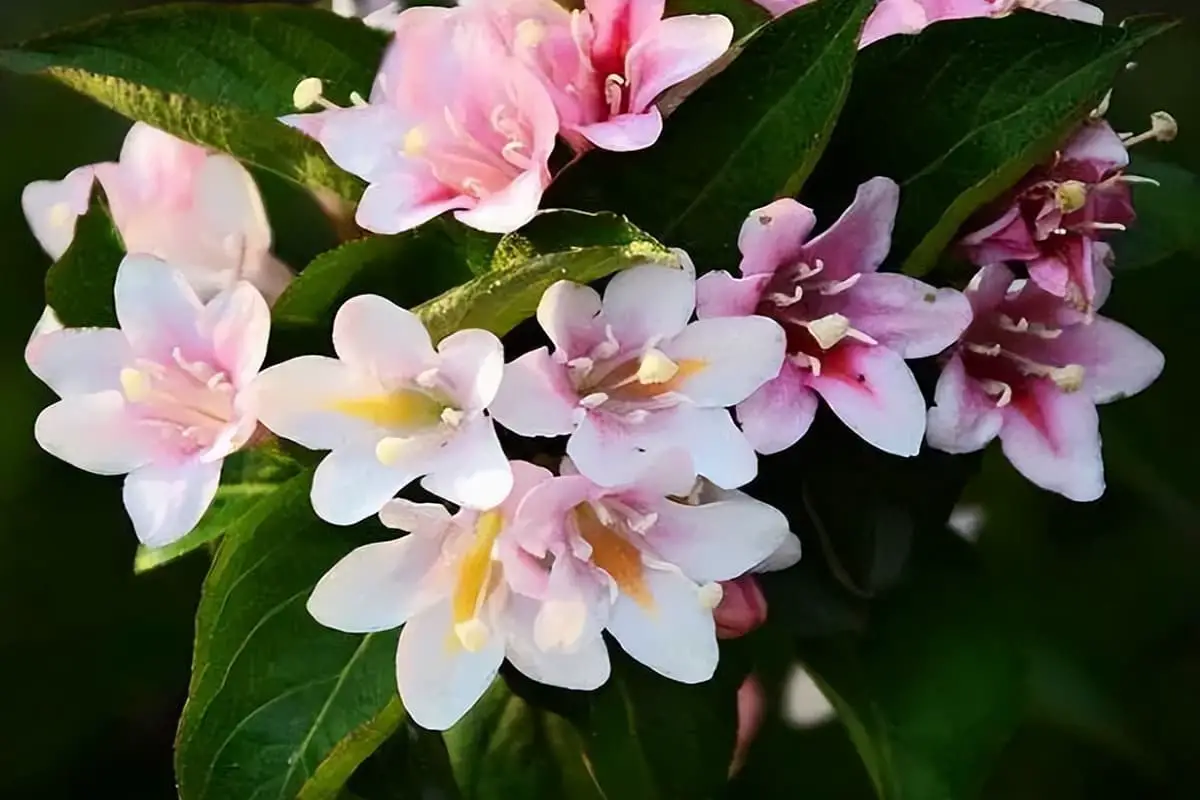
Seeds can be harvested in September and October. After picking, the fruit should be air-dried, crushed, and the chaff removed by wind selection to obtain pure seeds. The weight of a thousand seeds is 0.3g, and the germination rate is 50%.
For seed treatment (germination), either sow directly or soak the seeds in cold water for 2-3 hours one week before sowing. After soaking, take them out and place them indoors, wrap them in a damp cloth to promote germination before sowing for better results.
Sowing should be done on windless days and when there is no heavy rain forecasted. The bed should be leveled and refined. Seeds can be broadcast on the bed surface or in lines, with a sowing quantity of 2g/square meter.
The thickness of the soil cover after sowing should not exceed 0.3cm. Keep the bed surface moist within 30 days after sowing, and seedlings will emerge in about 20 days.
Seedling Management: When the seedlings have grown 3-4 adventitious roots, the first thinning can be done, and soil should be loosened and weeds removed in time.
The seedling yield is 200 plants/square meter, and the seedling height of the current year is 30-50cm. 1-2 year old seedlings can be transplanted.
For varietal types of cockscomb flowers, cutting propagation is used. Seed propagation cannot maintain the characteristics after variation.
In Heilongjiang Province, the practice is to cut 1-2 year old branches that have not sprouted in early April into 10-12cm cuttings, dip them in a solution of 2000mg/kg of α-naphthylacetic acid, and insert them into a sandy bed covered with film in the open air.
The bottom of the sand bed should be lined with a layer of rotted horse manure to increase the soil temperature.
The soil temperature should be 25-28°C, the air temperature should be 20-25°C, the air humidity in the shed should be 80%-90%, and the light transmittance should be about 30%.
Roots can be formed in 50-60 days, and the survival rate is about 80%.
In addition, it can also be propagated by division and layering.
During the growing season, it is pressed into the soil for layering propagation. Usually, the lower branches are selected for layering after flowering, as they tend to be prostrate and can easily take root at the nodes.
Division is carried out in early spring and autumn-winter. Usually, it is combined with transplanting around the spring budding period. The whole plant is dug out, divided into several clumps, and replanted separately.
This should be done in mid-April. After sowing, water should be applied by irrigation, not by spraying the soil surface with a watering can, to avoid washing the seeds out of the soil. Seedlings will emerge about 15 days after sowing.
However, the growth period is longer when using the seeding method, so this method is generally not used for small-scale propagation.
The Ribbon Plant is highly adaptable and prolific, making it easy to cultivate. Opt for well-drained sandy loam as the seedling bed. One to two-year-old seedlings or cuttings can be ridge planted for large seedling cultivation, with a plant spacing of 50-60cm.
After planting, level the plant to 10-15cm from the ground. Once the seedling exceeds 100cm in height after three years, it’s suitable for landscape greening.
For potted plants, mix three parts garden soil with one part rice husk ash, and add a small amount of barnyard manure as base fertilizer.
At planting, apply decomposed compost as base fertilizer, and thereafter every 2 to 3 years during the dormant period in winter or early spring, trench fertilize at the root. During the growing season, fertilize once or twice a month.
During the growing season, watering is crucial. After the spring buds, gradually increase the amount of water, and always keep the soil moist.
In the hot and dry summer, leaves can yellow and shrink, and branches can wither, so maintain adequate moisture and spray water to cool or move to a semi-shady, humid spot for care. Water thoroughly once or twice a month to meet growth needs.
Given the Ribbon Plant’s long growing period, the small branches at the top often do not fully grow before winter, making them prone to withering.
Therefore, before the spring buds each year, prune the withered branches at the top of the plant as well as other old, weak, diseased, and insect-infested branches, and shorten the long branches.
If not saving seeds, prune the spent flower branches promptly after flowering to prevent excessive nutrient consumption that can affect growth. For branches that have grown for three years, prune from the base to promote robust growth of new branches.
Since new flower-bearing shoots often sprout on 1-2-year-old branches, avoid heavy pruning of last year’s branches in early spring; generally only thin out the dead branches.
This flower is not often troubled by pests. Occasionally, aphids and red spider mites may cause damage, which can be controlled by spraying with insecticide.
Hybridization over the centuries has resulted in over a hundred types and varieties of this plant. Some that are commonly cultivated include:
Beautiful Ribbon Flower: This variety has light pink flowers and smaller leaves.
White Ribbon Flower: This variety has white flowers that are nearly white and subtly fragrant.
Changing Ribbon Flower: The flowers of this variety start off white-green and later turn red.
Flower Leaf Ribbon Flower: This plant grows between 2-3 meters in height, with a dense growth habit. The plant is 1.5-2m tall with a crown that is 2-2.5m in diameter. The leaves are a creamy yellow or white, and are oppositely arranged and ovate.
The flower cluster is green and trumpet-shaped, and the color gradually changes from white to pink as they mature. Because the flowers bloom at different times, the plant often has both white and red flowers at the same time, making it particularly vibrant and colorful.
Purple Leaf Ribbon Flower: This variety has leaves with a purple hue and pinkish-purple flowers.
Hairy Leaf Ribbon Flower: Similar to the Ribbon Flower, this variety’s key feature is that both sides of the leaf are hairy. The calyx is slit and basally fused, and is hairy.
The corolla is narrowly bell-shaped, suddenly narrowing below the middle, and the outside is hairy. The flowers are rosy or pink, with a yellow throat; 3-5 of them grow on the side of short branches. The flowers bloom early (April-May).
Spotted Leaf Ribbon Flower: This variety has leaves with white spots.
Red Prince Ribbon Flower: This plant is relatively short, growing 1-2 meters in height with a crown width of 1.4 meters. The young branches are pale red, while the old branches are gray-brown.
The leaves are a golden yellow throughout the growing season. The plant begins to flower in early summer, and the flowering period lasts from April to October. The inflorescence is funnel-shaped and dense, and the flowers are a bright, pleasing red.
Japanese Ribbon Flower Weigela japonica Thunb.
Japanese Ribbon Flower (original variant) Weigela japonica Thunb. var. japonica
Half Moon (variant) Weigela japonica Thunb. var. sinica (Rehder) L. H. Bailey
The tender stems, leaves, and flowers can be eaten. The fresh edges of the tender stems and leaves of the plant are harvested in April-May. After blanching in boiling water, they can be served cold, stir-fried, or used in soups.
The Ribbon Flower blooms in late spring when many other flowers have faded, making it a significant ornamental shrub in Northeast and North China.
With its dense foliage and bright flowers that can bloom for over two months, it is a major early spring flowering shrub in North China.
It is suitable for planting in courtyards, corners of walls, and lakesides; it can also be used as a hedge or clustered planting at the edge of a grove. It can be used as a decorative element in rockeries and slopes.
The Ribbon Flower is resistant to hydrogen chloride and is a good pollution-resistant plant. Its flowering branches can be used for vase arrangements.

Peggie was once a high school mathematics teacher, but she set aside her chalkboard and textbooks to follow her lifelong passion for flowers. After years of dedication and learning, she not only established a thriving flower shop but also founded this blog, “Flowers Library”. If you have any questions or wish to learn more about flowers, feel free to contact Peggie.
 English
  العربية
  Bahasa Indonesia
  Deutsch
  Français
  Italiano
  Nederlands
  Português
  Русский
  日本語
日本語