600+ Types of Flowers A To Z (With Names and Pictures)
Types Of Flowers By Names (A-Z) Types Of Flowers By Color Types Of Flowers By Season Types Of Flowers By Blooming Time 600+ Types of Flowers No. Flower Name No.…

The Tulip (Tulipa Gesneriana), a member of the lily family and tulip genus, is a world-renowned bulbous flower and an exceptional variety for cut flowers. With its robust and upright figure, elegantly colored leaves, and lotus-like blossoms, it is adored for its dignified yet dynamic beauty.
It symbolizes victory and beauty in Western culture and is treasured as the national flower in many countries, such as the Netherlands, Iran, and Turkey. Tulips bloom individually, flaunting large, vibrant blossoms in various colors, such as white, pink, bright red, dark red, deep red, purple-red, and pale yellow. They exhibit high ornamental value and typically bloom from March to May each year.
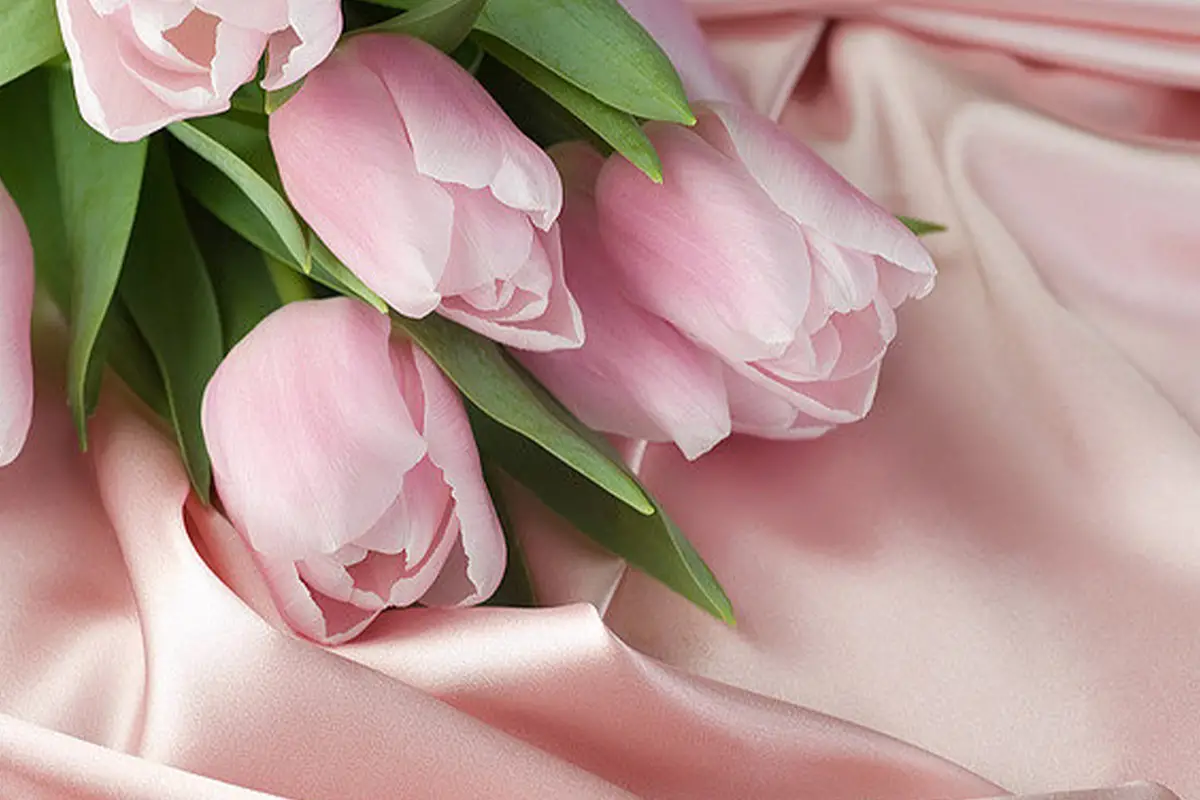
The term ‘tulip’ collectively refers to all cultivated varieties within the tulip genus of the lily family. It’s a bulbous plant with papery, bulb scales, only a few of which are covered in down at the top and base. The stem is upright, smooth, covered in white powder, and jade-green in color, although individual varieties may be yellow or reddish-brown.
It generally possesses 3-5 strap-shaped to ovate lanceolate leaves. The flowers are large and stunning, showcasing various shapes such as cup, bowl, goblet, butterfly, star, and more, including single, double, and semi-double petal variants.
Some have smooth, wavy, serrated, notched, or fringed edges. Patterns of spots, stripes, and edgings may be present, and the colors range from white, pink, bright red, dark red, deep red, purple-red, pale yellow, to orange-yellow. Blooming periods can vary with latitude but are typically from late March to early May.
Tulips originate from the Mediterranean and Central Asia, shaped by a Mediterranean climate, adapting to warm, humid winters and cool, dry summers. They thrive in cool, damp, sun-exposed, and wind-protected environments. They prefer organically rich, loose, fertile, well-draining, slightly acidic sandy loam soil.
Tulips are classified into 15 groups. Several groups have been established since the beginning of commercial production in the early 18th century. There are approximately 3500 tulip varieties worldwide, but only about 150 are produced in large quantities. Tulips are famous, precious ornamental flowers, cherished globally for their unique shapes and beautiful colors.
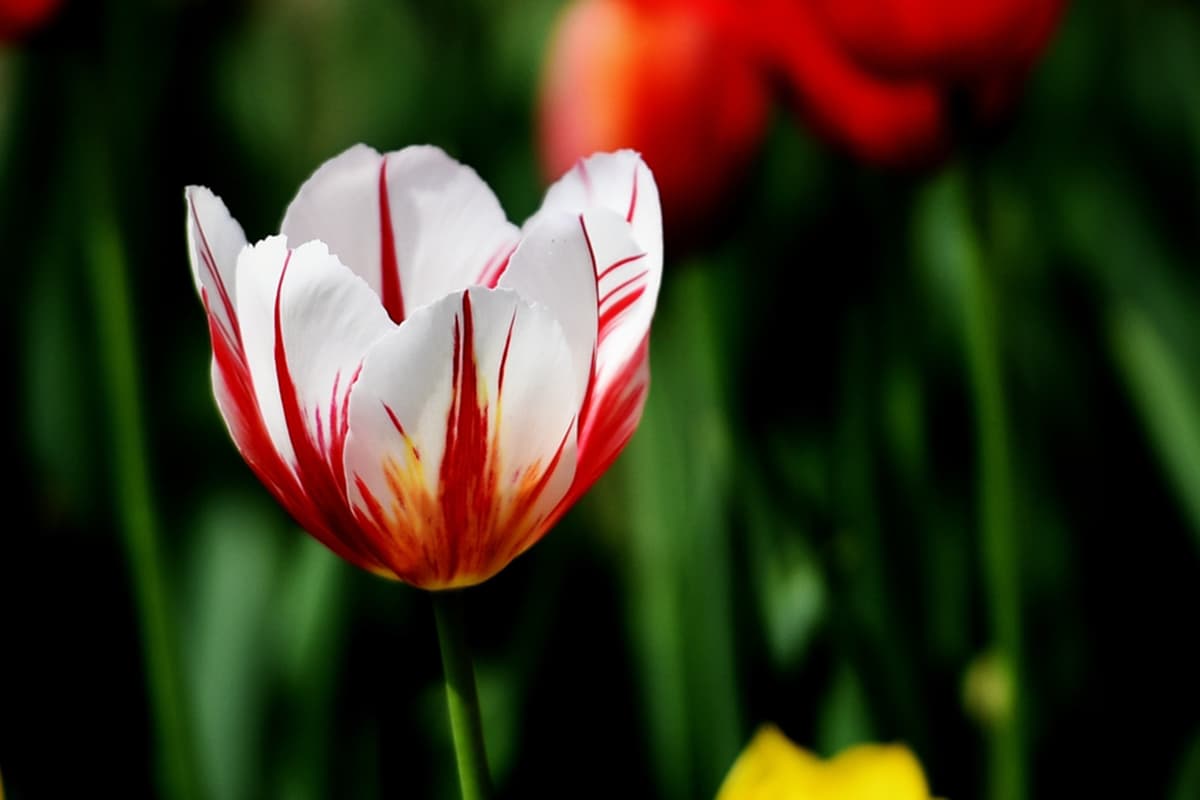
Tulips come in a variety of beautiful colors and types. Based on flower shape, they can be classified into cup, bowl, lily, spherical, fringe, parrot types, and more. According to their bloom times, they can be categorized into early, mid, and late-blooming varieties. There are four categories and fifteen groups of tulips with more than 3500 horticultural varieties. Here are a few tulip varieties:
Queen of Night: Hailed as the enchanting wine glass, it is very precious. It sports captivating purple-red petals during its bloom, making it particularly elegant and noble. Its stamen is rich in phosphorus, making petals sparkle like fireflies when in full bloom.
Dutch Lady: A hybrid variety with goblet-shaped flowers in deep purple-red. The exterior petals have a purple-red halo, the flower’s heart is yellow with blue stripes. It boasts deep blue filaments and deep brown anthers, contributing to a high ornamental value during its bloom.
Emperor’s Blood: During its bloom, the entire flower is as red as fresh blood, without any impurities. This broad-goblet-shaped flower stands 9-10 cm high with a stem height of 60-70 cm.
Blue Parrot: A parrot type and one of the most prized varieties. Being blue, a rare color, it gets its name due to its parrot-like shape when in full bloom. Its unique and beautiful petals are twisted and curled, resembling a flying bird.

Greenland: A green-flowered type, with goblet-shaped flowers, light red on both sides and pink at the tip. It has no heart, black anthers, white filaments, and black tips.
Golden Melody: A Kaufmann type, with deep yellow, goblet-shaped flowers and amber hearts. It stands between 53-55 cm high.
Golden Parade: A cup-shaped tulip variety in pure yellow, exuding an understated elegance. It is commonly used in many flower exhibitions and park festivals. It is a taller type with 3-5 leaves.
Negrita: Despite its name, Negrita, it is a pure and non-glaring purple color with a matte sheen. The flower shape is slightly smaller, and it’s considered a shorter type. The flower stem is upright, the petals are broad and flat, and the bud has a square appearance.
Eskimo Chief: Pure white in color, the petals are wider from the base to the middle and taper towards the top. The petals are tightly packed, giving a simple, pure, and soothing feel. It is of medium height, with 3 to 5 leaves.
Tulips are indigenous to the temperate mountain regions, commonly seen in grasslands and in areas with winter rainfall in Mediterranean climates. They thrive in long, cool springs and dry summer weather.
Tulips are most common in meadows, prairies, and forests, but they also appear in fields, orchards, roadside, and abandoned gardens. Influenced by the Mediterranean climate, tulips adapt well to a climate that is warm and wet in winter, and cool and dry in summer. They prefer cool, moist, sun-facing, and wind-protected environments.
The native species of tulips are found in Xinjiang, China. Xinjiang tulips were first brought to Turkey by a missionary from Xinjiang, then introduced to Europe, becoming popular in Belgium, the Netherlands, and the United Kingdom in the mid-17th century.
In the 19th century, tulips were introduced to Shanghai, China, and in the early 20th century, they were introduced and applied in places like Nanjing and Lushan.
Tulips are perennial bulbous flowers. Their leaves are broad lanceolate to ovate-lanceolate, broad at the base, long and tapering towards the top, succulent, with a pale blue-gray waxy layer, usually with 2-4 pieces, some varieties have one or several, attached to the middle and lower part of the stem.
Some wild species or horticultural varieties have purple-brown or reddish-brown spots or stripes on the leaves, adding special ornamental value.
The stem is upright, smooth, covered with white powder, emerald green, and some varieties are yellow or reddish-brown. The bulb disk is a shortened stem, on which scales, leaves, flower buds, and lateral buds are attached.
The base of the stem (stem base) forms roots from the moon-shaped protrusions. This forms a complete individual, also called a bulb or seed ball. The bulb is flat conical, covered with a layer of light yellow or brownish dry membranous scales. The bulb consists of 3-5 succulent scales, similar to onion bulbs, but the tulip bulb is irregularly conical, while the onion is regularly flat spherical.
The tulip bulb is a special form to resist high temperatures. Many agricultural production technologists believe that the tulip bulb is in a dormant state, but in fact, the tulip bulb is not a dormant body. Unlike other bulbous plants, its inner bud is active and undergoes qualitative changes, eventually forming a flower bud.
The flower is usually a single flower (except for double varieties), with 6 petals arranged in two rounds, divided into inner and outer layers. The flowers are large, solitary, but also 2-5 clustered; the flower shape is peculiar, there are cup-shaped, bowl-shaped, goblet-shaped, butterfly-shaped, star-shaped, etc.; there are single petals, double petals (20-40 pieces or more), semi-double petals, etc.
The petal edges are smooth, wavy, serrated, notched, fringed, etc.; some have spots, stripes, trims, etc. on the petals; flower colors include white, pink, bright red, big red, dark red, purplish red, light yellow, orange yellow, deep yellow, light purple, deep purple, dark green, dark brown, black, etc.
There are usually 6 stamens, 3 in 1 round, and some varieties have stamens that degenerate into double petals. The pistil is 3-lobed, and the ovary is superior and 3-chambered. The fruit is large, 3-5 cm long; the seeds are flat triangular, winged, brown, with a diameter of 3-5 cm, and have a silky luster; the flowering period is from March to May, and the seed maturity period is in June.
Tulips have the habit of summer dormancy, root growth in autumn and winter, and new bud germination without emerging from the soil. Tulips are long-day flowers. They prefer sun-facing, wind-protected environments and can grow normally at temperatures above 8°C. Generally, they can withstand low temperatures down to -14°C and have strong cold resistance. In severely cold areas, if there is heavy snow cover, the bulbs can overwinter in the open ground.
However, they are afraid of extreme heat. If summer comes early and the midsummer is very hot, the bulbs will find it difficult to survive the summer after dormancy. Tulips prefer rich humus, loose fertile, well-drained slightly acidic sandy loam soil, and dislike alkaline soil and continuous cropping.
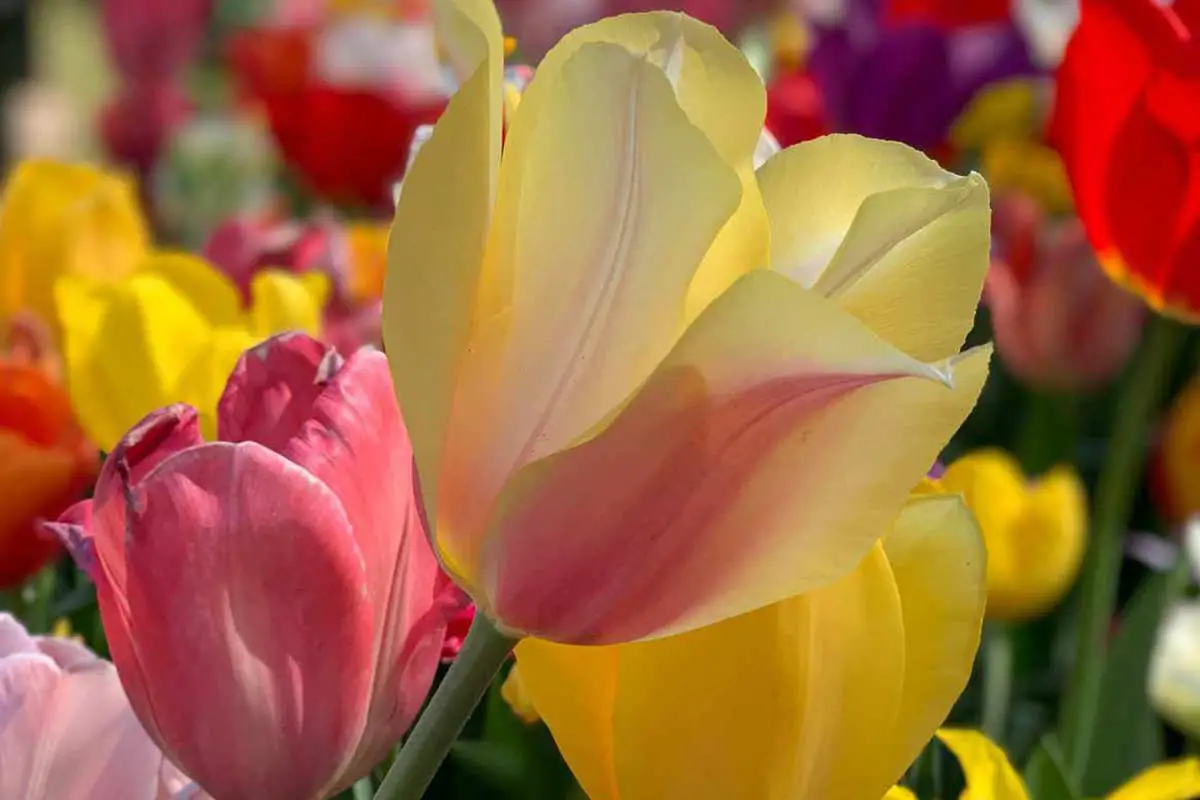
Tulips require soil that retains moisture while still being breathable. Neutral soil with a pH value between 6 and 7—neither too acidic nor too alkaline—is preferable. For pot cultivation, it’s best to choose nutrient soil composed of leaf mold, fine river sand, perlite, mushroom residue, dried livestock manure, and peanut husks. This will promote robust growth and successful flowering. A mix of peat, decomposed soil, and sand in a 1:1:1 ratio works well as a cultivation base.
After planting, the soil should be thoroughly watered to ensure that the soil and the bulbs adhere closely, which is beneficial for rooting. Once sprouting occurs, water intake should be regulated. As the leaves grow longer, water can be sprayed on the leaf surface to increase air humidity. During the stalk growth and budding period, ample water supply must be maintained to promote the full development of flowers. After blooming, water should be controlled appropriately.
Tulips need ample fertilization during their growth and bulb expansion phase. In the Yangtze Delta region, common fertilizers include loose, fertile barn manure, mature compost, various cake fertilizers, and bone meal. In early spring, from the extension of the stem and leaves to the appearance of buds, fertilization should be pursued 2-3 times. Pot-cultivated tulips in greenhouses require a sufficient amount of base fertilizer.
Tulips are highly sensitive to fertilizers. If nitrogen fertilizer is lacking, the number of bulbs will decrease, the leaves will be small and of inferior quality, the flower stems will be short, the flowers will be small, and the blooming period will be delayed.
On the other hand, with sufficient nitrogen fertilizer, the reproductive coefficient is significantly improved. The effect of single-application phosphate fertilizer is not obvious, but if used in combination with potash fertilizer, it will greatly promote the development of flower stems.
When nitrogen and potash fertilizers are used together, the number of medium-sized bulbs increases. Note that good root development leads to a higher absorption and utilization rate of nutrients, making tulips grow more robust and develop better.
Tulips enjoy a cool environment and dislike high temperatures throughout their growth cycle, with an optimal temperature range of 8–16°C. Under natural conditions, tulip bulbs begin to root in mid to late September, when the temperature is 15-25°C. At this time, stored bulbs must be kept at 9°C to prevent the continuous rooting under the base of the bulb. They are generally planted from late October to late November.
In the northern regions, during winter, when the air temperature is 1-3°C and the soil temperature is 5-7°C (slightly higher in the southern regions), the roots on the bulbs continue to grow, but at a significantly slower pace. The young buds hibernate underground and do not surface.
Thus, tulips in the open field pass through a 70-90 day period of 5-9°C. If the winter temperature is too high and there’s not enough cold, the growth of tulips is noticeably affected, and the flowers become smaller.
In late February of the following year, when the temperature rises to 8-10°C, young buds start to surface. By mid-March, when the temperature is between 10-14°C, the seedlings unfurl their leaves and gradually enter a period of vigorous stem and leaf growth. At this point, if the temperature exceeds 20°C, it inhibits root development.
Tulips are medium light exposure plants and enjoy a sunny environment. Light exposure is an important limiting factor for tulip blooming. During cultivation, tulips must receive no less than eight hours of light exposure per day. This helps tulips accumulate more photosynthetic products, ensuring good plant growth and normal flowering.
Tulips enjoy sunlight, but in a sunlight greenhouse or in an open field in spring when the sunlight is strong, appropriate shading should be implemented. A single tulip usually blooms for 5-6 days. In low temperatures, high humidity, and overcast conditions, the blooming period can be extended to 10-14 days.
If tulips receive too much sunlight, the flowers will fully open, significantly shortening the optimal viewing period, which in some cases lasts only 3-5 days. If there is a severe lack of sunlight, this can also lead to a shortened blooming period, thin and short flower stems, pale flowers, loss of aesthetic appeal, and can even affect bulb growth.
After flowering, pot-cultivated tulips should be placed in a cool indoor environment to extend the flowering period. If you wish to seed, remove the flowers (leaving the flower stems) after they wilt, and move them to an outdoor environment with appropriate light for cultivation, taking care of water and fertilizer management. If you don’t need to seed, the plant can be discarded after the flowers wilt.
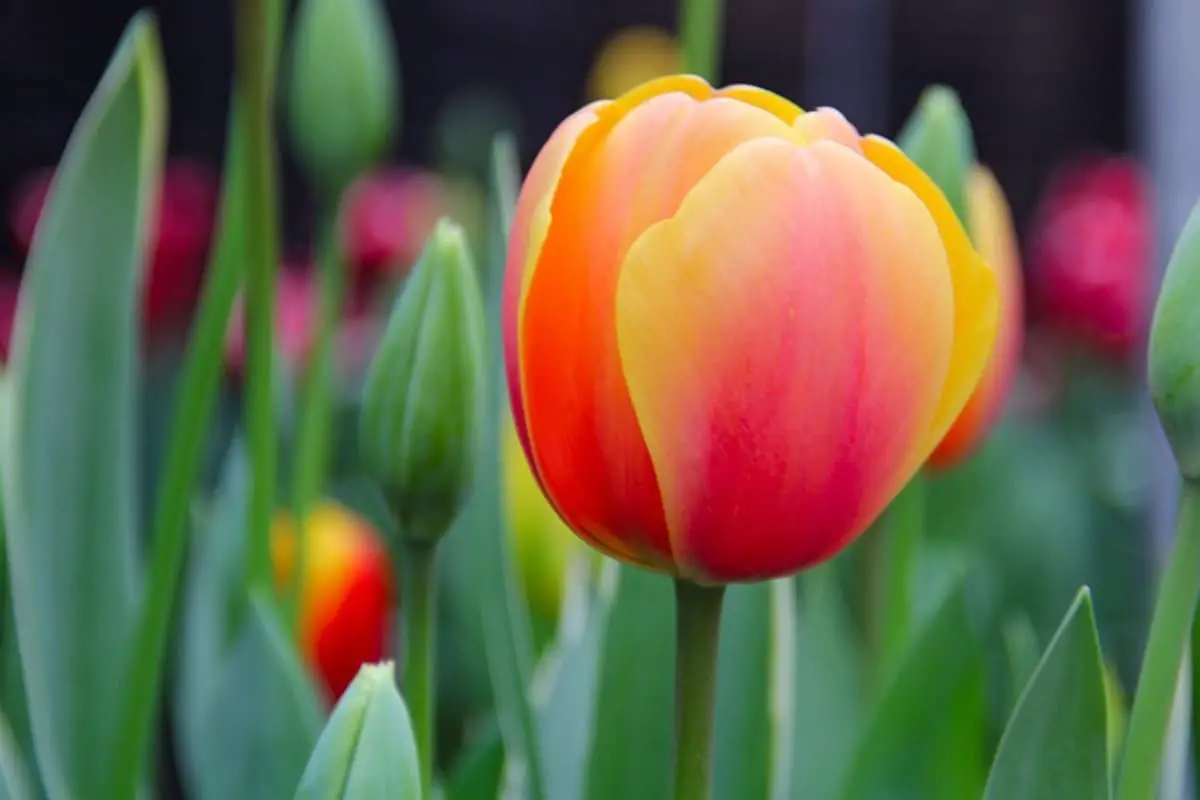
Tulip diseases and pests can be carried by the bulbs or can infect the bulbs through the soil, often occurring in hot and humid environments. The main diseases include stem rot, soft rot, breaking virus, damping off, and blind bud, while aphids are common pests.
Before planting, thoroughly disinfect the soil and, if possible, use disease-free bulbs for cultivation. Diseased plants should be dug out and destroyed promptly. During greenhouse growth, applying fungicide 1-2 times proves more effective.
Maintain good ventilation to prevent high temperature and humidity. In case of aphid infestation, a spray of 3% natural pyrethrum at 800 times dilution can be used.
Gift Use
Red tulips are used for Valentine’s Day. It is said that in the 16th century, a Persian Sultan showcased deep red tulips to his loved ones, expressing his love for tulips, symbolizing the flame of love.
Suleiman the Magnificent of the Ottoman Empire gifted tulip-shaped jewelry to Hurrem Sultan (his beloved).
Ornamental Value
Tulips are vividly colored, blooming single, top-growing flowers with striking hues such as white, yellow, purple, pink, red, and blue. There are also varied patterns like edging and vibrant stripes. Tulips have graceful shapes, and the variations include lotus-like, lily-like, ovate or spherical shapes. As a famous bulbous ornamental flower, it can be used as a cut flower, an indoor potted plant, or for garden greening, and is widely adored.
Standing among them is like being in the most beautiful spring. The charm emitted by tulips has won many people’s admiration. Whether clustered or piece-planted in gardens, flower beds, or flower belts, tulips offer unique ornamental effects. They are indispensable to many renowned parks and sightseeing sites worldwide, such as the flower beds of the White House in the United States and the Louvre in France.
Each year, countless visitors come to appreciate their beauty. Furthermore, tulips are valuable materials in artistic flower arrangements. Their flower stems can grow up to 40-50 cm long, adding elegance and sophistication, freshness and significance to any vase or container. They are so captivating that one never tires of looking at them.
Food Value
The Roman Empire’s envoy sent tulip bulbs to Roewer in Vienna, who didn’t know what to do with them, so he planted them. When they matured, he sent a hundred bulbs to a grocer who fried and ate them with oil and vinegar. Tulip bulbs can be consumed, though it’s not common. The use of bulbs as a food source can be traced back to the winter of 1944-1945, during World War II. During the Dutch famine, desperate people used tulip bulbs as available food.
Tulip petals are edible. The taste varies with the variety and season, somewhat similar to lettuce or other salad vegetables. Some people may be allergic to tulips. Although tulip bulbs resemble onions, they generally should not be considered as food. The toxicity of bulb scales has not been well-analyzed, and there are no recognized safe methods for preparing bulbs for human consumption. Consumption can reportedly lead to illness, depending on the quantity.
The Symbolism of Tulips
Tulips symbolize sanctity, happiness, and victory. In Western novels and poems, tulips are seen as symbols of triumph and beauty, representing grace and elegance. Their appearance and colors are noble, like a chalice. They are splendidly colorful. Under refined appreciation, they resemble a spring breeze, bringing relaxation and joy.
The Language of Tulips
There are numerous varieties of tulips, and the language of different tulips varies:
Language: Hopeless love, fervor, eternal affection, pure love in friendship.
Language: Declaration of love, overwhelming joy, tender care.
Language: Lost love, dying affection, or alternatively pure feelings.
Language: Nobility, uniqueness, expressing undivided affection.
Language: Endless love, lifetime commitment without regrets.

Peggie was once a high school mathematics teacher, but she set aside her chalkboard and textbooks to follow her lifelong passion for flowers. After years of dedication and learning, she not only established a thriving flower shop but also founded this blog, “Flowers Library”. If you have any questions or wish to learn more about flowers, feel free to contact Peggie.
 English
  العربية
  Bahasa Indonesia
  Deutsch
  Français
  Italiano
  Nederlands
  Português
  Русский
  日本語
日本語