600+ Types of Flowers A To Z (With Names and Pictures)
Types Of Flowers By Names (A-Z) Types Of Flowers By Color Types Of Flowers By Season Types Of Flowers By Blooming Time 600+ Types of Flowers No. Flower Name No.…

Teamillet, also known as the foamy rose, is a species of flowering plant in the genus Rubus, family Rosaceae. It is scientifically known as Rubus pectinellus. Teamillet is characterized by its dense flowering branches, fragrant blossoms, and red fruits that appear in autumn.
This versatile shrub is suitable for use as a hedge or as a solitary planting at the edge of grasslands. Its fruits can be eaten fresh or used in winemaking, and its roots, which contain tannins, can be used to extract starch. The flowers are an excellent source of nectar and can be used to distill essential oils.

Teamillet grows in areas ranging from 250 to 2200 meters above sea level, commonly found in hillside shrublands, grasslands, mixed forests, along streams, on hillside roadsides, in shaded places, and at forest edges. It is drought-tolerant but sensitive to waterlogging.
Teamillet is an erect or climbing shrub, reaching heights of 2 to 3 meters. Its characteristics include:
Flowering occurs from June to July.
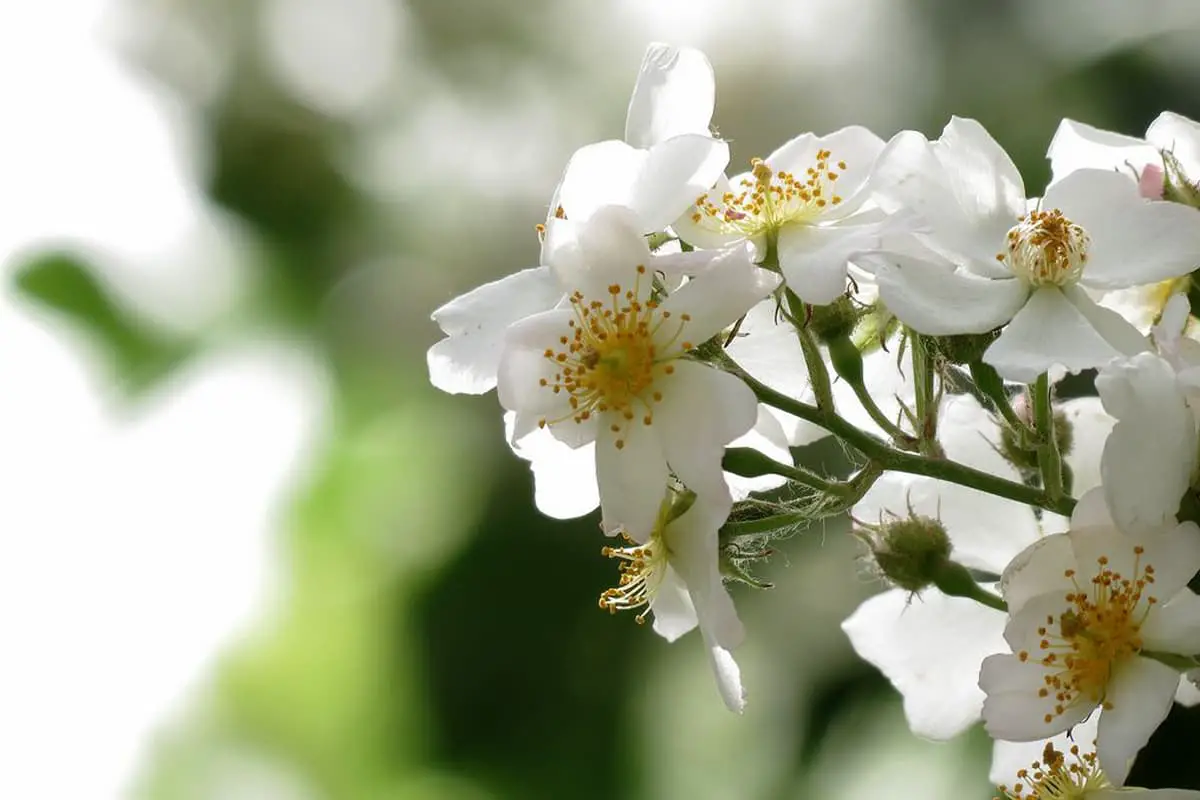
Teamillet prefers warm temperatures and full sun exposure. It is often found on slopes, roadsides, grassy slopes, or shrublands between altitudes of 500-1300 meters. While it is drought-resistant, it does not tolerate waterlogging. The branches of Teamillet are densely flowered, and the flowers are abundant and fragrant. In autumn, the fruits turn a vibrant red.
Teamillet can be propagated through layering or stem cuttings. While its cultivation shares similarities with other roses and Rosa chinensis, it generally requires less intensive management. Key cultivation points include:
Teamillet is an erect or climbing shrub, 2 to 3 meters high; its twigs are cylindrical, softly hairy or almost hairless, often with light yellow glands, and sparsely bearing straight thorns.
The leaves have 5-7 leaflets, ovate-lanceolate or lanceolate, 3-5 (up to 7) cm long and 1.5-2 cm wide, apex tapering, base rounded, both sides sparsely hairy, nearly hairless when old, with light yellow shiny glands, undersides along the midrib have sparse small thorns, edges have sharp dentate serrations.
Leaf stalks are 2-3 cm long, terminal leaflet stalks are 0.8-1.5 cm long, both the stalks and rachis have soft hairs and small thorns, sometimes almost hairless, covered with light yellow glands; stipules are ovate-lanceolate or lanceolate, softly hairy.
The flowers are double-layered and fragrant, often 1-2 flowers per branch, terminal or axillary; flower stalks are 2-3.5 cm long, with sparser or denser soft hairs, sparsely thorny, sometimes glandular; flower diameter is 3-5 cm; calyx is softly hairy and glandular outside.
Sepals are lanceolate or ovate-lanceolate, apex long-tailed, often reflexed after flowering; petals are oblong, oblong-ovate or nearly round, 1-1.5 cm long, 0.8-1 cm wide, white, with a claw at the base, longer than sepals, outside with short soft hairs, gradually falling off; stamens are broad; there are many pistils, styles and ovaries are hairless; hypanthium has a short stalk.
The fruits are ovoid or oblong-ovoid, 1-1.5 cm long, red, shiny, hairless; the core has deep pitted pores. Flowering occurs in June-July.
Propagation of Teamillet is typically done through layering or stem cuttings. While its cultivation shares similarities with other roses and Rosa chinensis, it generally requires less intensive management. When planting, ensure a spacing of at least 2 meters between plants.
From early spring budding to flowering, water the plants 3-4 times depending on weather conditions to maintain soil moisture. Drought during this period can significantly reduce flower production. During summer drought, water 2-3 times. In the rainy season, ensure proper drainage to prevent waterlogging, as roses are susceptible to root rot in overly wet conditions. In autumn, water 2-3 times as needed.
Throughout the year, be cautious not to overwater the roots. Apply a thin layer of organic fertilizer 1-2 times during the bud phase to ensure vibrant flower colors and a prolonged blooming period.
Pruning is an indispensable important process in the landscape shaping of Teamillet. Poor pruning can Pruning is an essential process in the landscape shaping of Teamillet. Poor pruning can result in a disorderly mass of thorny growth, increasing susceptibility to pests and diseases and detracting from its aesthetic appeal.
Generally, each plant should undergo pruning before budding in spring. Pruning should be moderate, typically retaining the main branch (main vine) within 1.5 meters, with the rest pruned back. For each side branch, retain 3-5 buds at the base. Simultaneously, remove dead, weak, and diseased branches and cut off overage and dense branches to promote new shoot growth. This constant renewal of the old plant ensures abundant blooming every year.
Teamillet’s dense flowering branches and fragrant blossoms make it valuable for ornamental purposes. Its red fruits, appearing in autumn, can be eaten fresh or processed into wine. The root bark contains 11-19% tannin, which can be extracted for various uses. The flowers are an excellent source of nectar for pollinators and can be distilled to produce essential oils and extracts.
In flower language, Teamillet symbolizes “Beauty at the End of the Road.” Its blooming is often associated with the end of a woman’s youth or the conclusion of a relationship. As one of the last plants to bloom in spring, its flowering signifies the end of the season, embodying the sentiment “After three springs, all fragrances are gone.” This sentimental association makes Teamillet a poignant symbol in Chinese culture, often used metaphorically to describe life’s transitions and the bittersweet nature of change.

Peggie was once a high school mathematics teacher, but she set aside her chalkboard and textbooks to follow her lifelong passion for flowers. After years of dedication and learning, she not only established a thriving flower shop but also founded this blog, “Flowers Library”. If you have any questions or wish to learn more about flowers, feel free to contact Peggie.
 English
  العربية
  Bahasa Indonesia
  Deutsch
  Français
  Italiano
  Nederlands
  Português
  Русский
  日本語
日本語