600+ Types of Flowers A To Z (With Names and Pictures)
Types Of Flowers By Names (A-Z) Types Of Flowers By Color Types Of Flowers By Season Types Of Flowers By Blooming Time 600+ Types of Flowers No. Flower Name No.…

The Spiraea cantoniensis, is a member of the Rosaceae family, genus Spiraea, and is a shrub that can grow up to 1.5 meters tall. Its slender twigs and small winter buds are ovate in shape.
The leaves are diamond-shaped to oblong-lanceolate, with the upper surface a deep green and the underside a grayish-blue. Both surfaces are hairless, as are the petioles.
The umbel inflorescence carries numerous flowers; bracts are linear, and the calyx tube is bell-shaped. Sepals are triangular or ovate-triangular, and petals are nearly round or obovate and white.
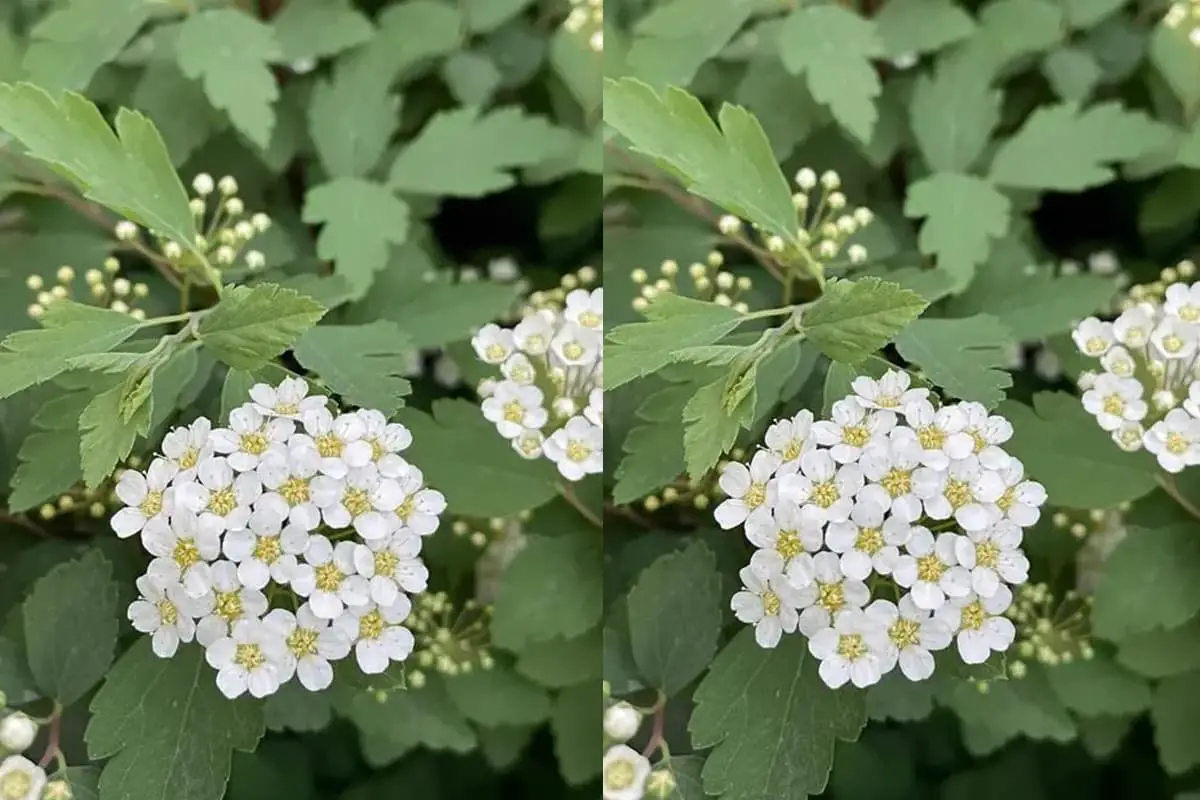
The floral disk consists of nearly round lobes of varying sizes, and the ovary is nearly hairless. The fruit capsule stands erect and opens widely, with styles that are terminal and bloom from April to May, bearing fruit from July to September.
Reeves’ Spiraea is well-loved for its brilliant flowers and lush blossoms that cover the branches entirely when in full bloom, creating arched bands of flowers that blanket the area above and below the tree in a captivating snow-white display.
This plant is easy to propagate, cold-hardy, drought-resistant, and is an excellent flowering shrub for urban garden landscaping.
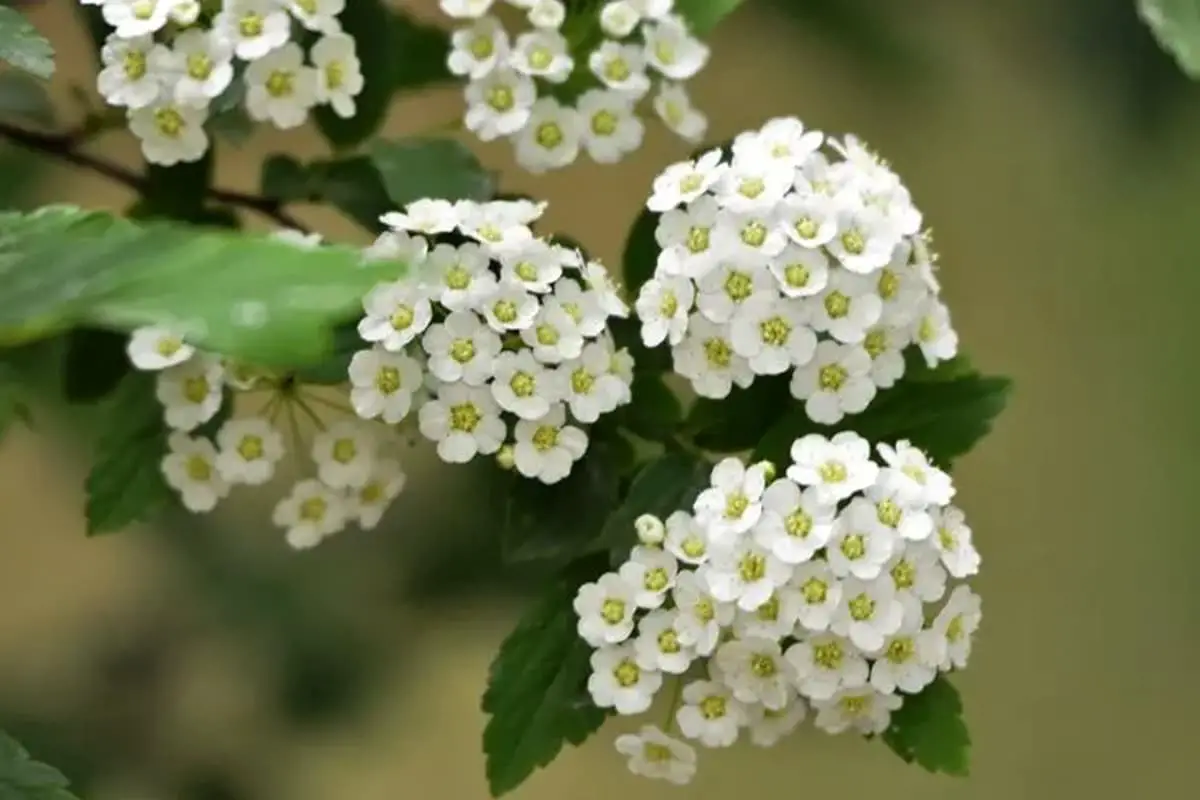
This shrub can reach up to 1.5 meters in height, with slender, cylindrical, arching twigs that are dark reddish-brown when young and hairless. The winter buds are small, ovate, pointed at the tip, and hairless, with several exposed scales.
The leaves range from diamond-shaped lanceolate to oblong-lanceolate, 3-5 centimeters in length, and 1.5-2 centimeters in width, with a sharp tip, a wedge-shaped base, and notched serrations from near the middle to the edge.
The upper surface is a deep green and the underside is grayish-blue. The leaves have pinnate veins and are hairless, including the 4-7 millimeter petioles.
The corymb inflorescence bears numerous flowers; the flower stalks are 8-14 millimeters long and hairless. The bracts are linear and hairless.
Flowers are 5-7 millimeters in diameter, with a bell-shaped calyx tube that’s hairless on the outside and short-soft-haired on the inside. The sepals are triangular or ovate-triangular with a sharp tip or short tapering end, and the inside has a light covering of short soft hair.
Petals are nearly round or obovate, with a slight concave or rounded tip, each about 2.5-4 millimeters long and wide, and white. There are 20-28 stamens, slightly shorter than or nearly equal to the length of the petals.
The floral disk is composed of nearly round lobes that sometimes have a slight concave tip and are arranged in a circular ring. The ovary is nearly hairless, and the style is shorter than the stamens.
The fruit capsule is erect and open, hairless, with styles that are terminal and often inclined, featuring standing open sepals. The flowering period is from April to May, and the fruiting period is from July to September.
Reeves’ Spiraea prefers warm, sunny environments. It is somewhat frost-resistant, shade-tolerant, fairly drought-resistant, and does not thrive in wet, waterlogged conditions. It has strong tillering ability.
The ideal growth temperature is between 15-24°C, and it can withstand low temperatures down to -5°C in winter. The preferred soil is fertile, loose, and well-drained sandy loam.
Seeds begin to germinate within 2-3 days, and normal fruiting occurs after 4 days. Seeds do not have a pronounced dormancy. Soak the seeds in warm water (30°C) for 24 hours, then place them on moist filter paper in a petri dish.
Germination begins in 8-10 days at 18-20°C indoors, with a germination rate of 80%-95%. Seeds can be sown immediately after they mature and dry out in early summer, either in pots or directly in the ground.
In the southern regions, seeds sown in autumn germinate quickly and overwinter as seedlings. In Beijing, seeds can be sown in early April, and in Nanjing, as early as early March.
After sowing, cover the seeds with 0.5-1.0 centimeters of soil and cover with a plastic film to retain moisture. Seedlings emerge successfully within 7-10 days, and primary leaves appear after 7 days.
Seedlings can reach a height of 30-45 centimeters within the year. Transplant once, and generally, blossoms appear after about 3 years.
For cold stratification, soak the seeds in wet sand for 3-5 days. Sow 1.50-2.25 kilograms per square meter, cover with 4 millimeters of soil and shade.
This can yield 150-225 seedlings per square meter. Planting seeds under the shade of the parent plant promotes germination and early seedling growth, improving the seedling emergence and survival rates.
Hardwood cuttings are taken in spring, and softwood cuttings in summer. Cuttings, 10-15 centimeters long, taken 1-2 days earlier, are soaked in hormone rooting powder overnight.
After planting, shade with a net and mist to keep the seedbed moist. The survival rate can exceed 95%.
Guo Xiaofan has summarized the softwood cutting techniques for Spiraea: soak the cut base of the prepared cuttings in 50-100 mg/kg of naphthaleneacetic acid for 12-24 hours, then provide shade with a net (50% light transmission) after planting, achieving a survival rate of over 90%.
Spiraea, due to its strong sprouting nature, can also be propagated by division, ideally carried out from October to December each year.
Spiraea is quite resistant to pests and diseases when cultivated in nurseries and rarely suffers from severe afflictions. However, after heavy rain, excessive standing water can lead to root rot, so it’s important to drain water promptly.
Affected plants can be treated with a 1000-fold solution of mancozeb and zinc or an 800-fold solution of carbendazim, applied to the roots and leaves three times until symptoms disappear.
Reeves’ Spiraea, with its bright flowers and profuse blossoms, is particularly enchanting when in full bloom, as the branches are completely covered with delicate flowers forming arch-like bands, creating a breathtaking white landscape above and below the tree.
Easy to propagate, cold-hardy, and drought-resistant, Reeves’ Spiraea is an excellent choice for urban garden landscaping, whether in squares, residential green spaces, or as part of smaller landscape features.
In urban garden landscaping, Spiraea can be planted in clumps on hillsides, by watersides, lakes, near rocks, in corners of lawns, or in front of buildings, serving as an accent or backdrop and creating a scenic focal point.
It provides a charming view of flowers in early summer and foliage in autumn, creating an enchanting year-round landscape.
This deciduous shrub has thin branches and strong sprouting ability, making it a suitable substitute for privet or boxwood in green hedges, providing a barrier and offering a floral display, as it has a long flowering period. It can also be used to create beautiful floral borders.
Reeves’ Spiraea’s striking flowers also make it suitable for cut flower production. It can be arranged into bouquets, baskets, or vases.
With simple propagation techniques, it’s easy to scale up production. During the transition from spring to summer, it can adorn major holidays like Labor Day and Children’s Day.
Additionally, the plant has strong resistance to adversity, tolerates both drought and cold, has no significant pests or diseases, and is easy to cultivate and manage.
The roots, leaves, and fruits are used to clear heat, cool the blood, eliminate stasis, and reduce swelling and pain. They are used to treat trauma, scabies, and other ailments.

Peggie was once a high school mathematics teacher, but she set aside her chalkboard and textbooks to follow her lifelong passion for flowers. After years of dedication and learning, she not only established a thriving flower shop but also founded this blog, “Flowers Library”. If you have any questions or wish to learn more about flowers, feel free to contact Peggie.
 English
  العربية
  Bahasa Indonesia
  Deutsch
  Français
  Italiano
  Nederlands
  Português
  Русский
  日本語
日本語