600+ Types of Flowers A To Z (With Names and Pictures)
Types Of Flowers By Names (A-Z) Types Of Flowers By Color Types Of Flowers By Season Types Of Flowers By Blooming Time 600+ Types of Flowers No. Flower Name No.…

Spathiphyllum floribundum ‘Clevelandii’ is a perennial herb standing 30-40cm tall with little to no stem. Its lanceolate or elliptical leaves, deep green in color, feature noticeable midribs and petioles.
The plant blooms in spring and summer, producing large, prominent spathes that rise above the leaf surface in white or a faint green color. Its spadices are creamy yellow. This large variety has deep-colored leaves and small, white flowers.
It grows slowly and flowers from May to August. Native to tropical regions of the Americas, it is widely cultivated worldwide. The Spathiphyllum is splendidly beautiful when in bloom and serves as an excellent indoor potted plant even when not flowering.
It is a new generation of indoor potted plants that can filter indoor waste gases, and has a cleansing effect on ammonia, acetone, benzene, and formaldehyde. It can also be used as a cut flower.
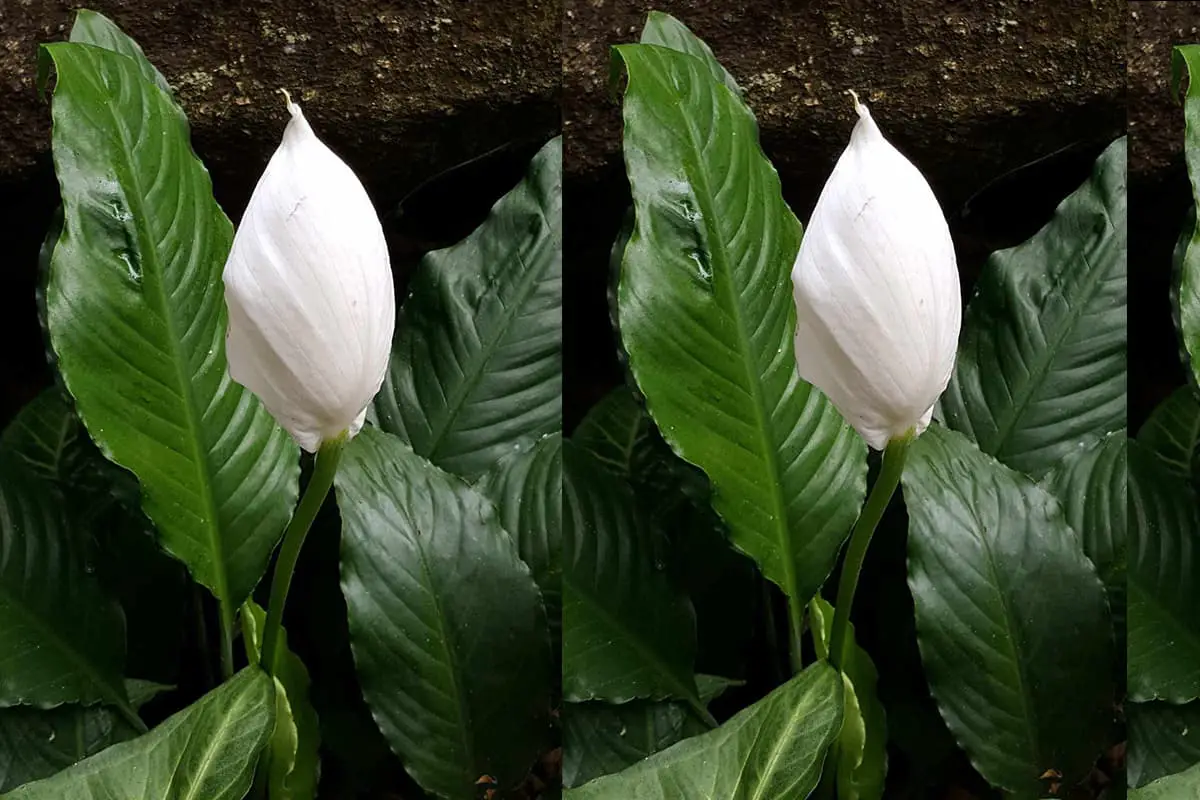
This perennial herb stands 30-40cm tall with little to no stem, and possesses either corms or elongated rhizomes, sometimes with stems thickening into a woody texture.
The leaves, deep green in color, are lanceolate or elliptical with noticeable veins and long petioles, and are sheathed at the base. They are either entire or slightly divided.
The plant blooms in spring and summer, with upright inflorescences rising above the leaf clusters, large and prominent spathes, slightly curled, and in white or a faint green color.
Its spadices are cylindrical and creamy yellow. This large variety has deep-colored leaves and small, white flowers, and grows slowly. It flowers from May to August.
The Spathiphyllum is native to the tropical regions of the Americas and is widely cultivated worldwide.

The Spathiphyllum prefers high temperatures and humidity but can tolerate shade. Its large leaves are sensitive to humidity and it dislikes strong sunlight.
During summer, it should be shaded by 60-70%, but if deprived of light for a long period, it is unlikely to flower. It thrives in fertile soil rich in humus. The optimal growth temperature is 22-28°C.
From March to September, 24-30°C is ideal, from September to the following March, 18-21°C is preferred, and in winter, the temperature should not drop below 14°C. If the temperature falls below 10°C, the plant’s growth is inhibited, and the leaves are susceptible to frost damage.
During storage and transportation, the temperature should be maintained at 13-16°C, with a relative humidity of 80-90%, and it can withstand dark conditions for 30 days.
The best time to propagate Spathiphyllum by division is between May and June. The whole plant should be lifted out of its pot, and the rhizome cut from the base of the plant clump. Each clump should have at least four leaves. After dividing, the plants should be placed in semi-shade to recover.
After flowering, the Spathiphyllum can be pollinated manually to produce seeds. These should be sown immediately after harvesting. The germination temperature is 30°C, and germination should occur 10-15 days after sowing.
If the temperature is too low during germination, the seeds are likely to rot. After sterilization, they should be inoculated onto a medium, where callus tissue and adventitious buds will appear after 45 days.
Young inflorescences and lateral buds of Spathiphyllum can be used as explants. After sterilization, they should be inoculated onto MS medium supplemented with 10mg/L of 6-benzylaminopurine and 2mg/L of indole-3-acetic acid.
Callus tissue and adventitious buds should appear after 40-45 days. The adventitious buds should then be transferred onto MS medium supplemented with 2mg/L of indole-3-acetic acid. After 30-40 days, roots should be induced, forming a complete plant.
The Peace Lily is highly susceptible to pests during its growth period. Regular applications of specialized mite-killing pesticides, such as Trichlorobenzene, Nissorun, and Damite, should be employed for its protection.
The Peace Lily can be pot-planted, or grown in shaded locations on flower stands, garden spots, rockeries, and pond edges, serving a greening function.
The erect and beautiful flower stems of the Peace Lily make it an elegant and distinctive adornment to living rooms and studies when used as a potted plant.
In the southern regions, it adds a unique touch to small gardens, pond sides, and corners of walls. Additionally, Peace Lily flowers are excellent decorative materials for flower baskets and bouquets.
The Peace Lily can filter indoor waste gases, effectively dealing with ammonia, acetone, benzene, and formaldehyde.
Cultivating Peace Lilies with water roots can regulate indoor temperature and humidity through evapotranspiration, effectively purifying volatile organic compounds in the air, such as alcohol, acetone, trichloroethylene, benzene, toluene, carbon monoxide, ozone, etc.
Among these, the purification rate for ozone is especially high. Placing them next to the kitchen gas can purify the air, remove cooking smells, fumes, and volatile substances.
Floral Language: Successful Career, Smooth Sailing.
Symbolism: Beauty, Nobility, Virtue, Passion, Friendship, Confidence, Pride.

Peggie was once a high school mathematics teacher, but she set aside her chalkboard and textbooks to follow her lifelong passion for flowers. After years of dedication and learning, she not only established a thriving flower shop but also founded this blog, “Flowers Library”. If you have any questions or wish to learn more about flowers, feel free to contact Peggie.
 English
  العربية
  Bahasa Indonesia
  Deutsch
  Français
  Italiano
  Nederlands
  Português
  Русский
  日本語
日本語