600+ Types of Flowers A To Z (With Names and Pictures)
Types Of Flowers By Names (A-Z) Types Of Flowers By Color Types Of Flowers By Season Types Of Flowers By Blooming Time 600+ Types of Flowers No. Flower Name No.…

Narrow-leaf Scabiosa (Scabiosa comosa), scientifically known as Scabiosa comosa, belongs to the Dipsacaceae family and the Scabiosa genus. It is a perennial herb that can grow up to 80 cm in height. The root’s outer skin is rough, brownish, while the inside is white.
The plant has erect stems. The basal leaves form a cluster, have a narrowly elliptical outline, and are pinnately dissected. These leaves often wither during flowering. The stem leaves are opposite. The calyx is slender, needle-like, brownish-yellow, and the corolla is blue-violet.
The filaments are slender, and the fruit is oblong, crowned with the persistent calyx spines. It flowers between July and August and fruits in September.
The plant is found in Russia, China, North Korea, and Mongolia. It thrives in dry sandy soils, sand dunes, dry slopes, and grasslands at altitudes between 500 to 1600 meters.
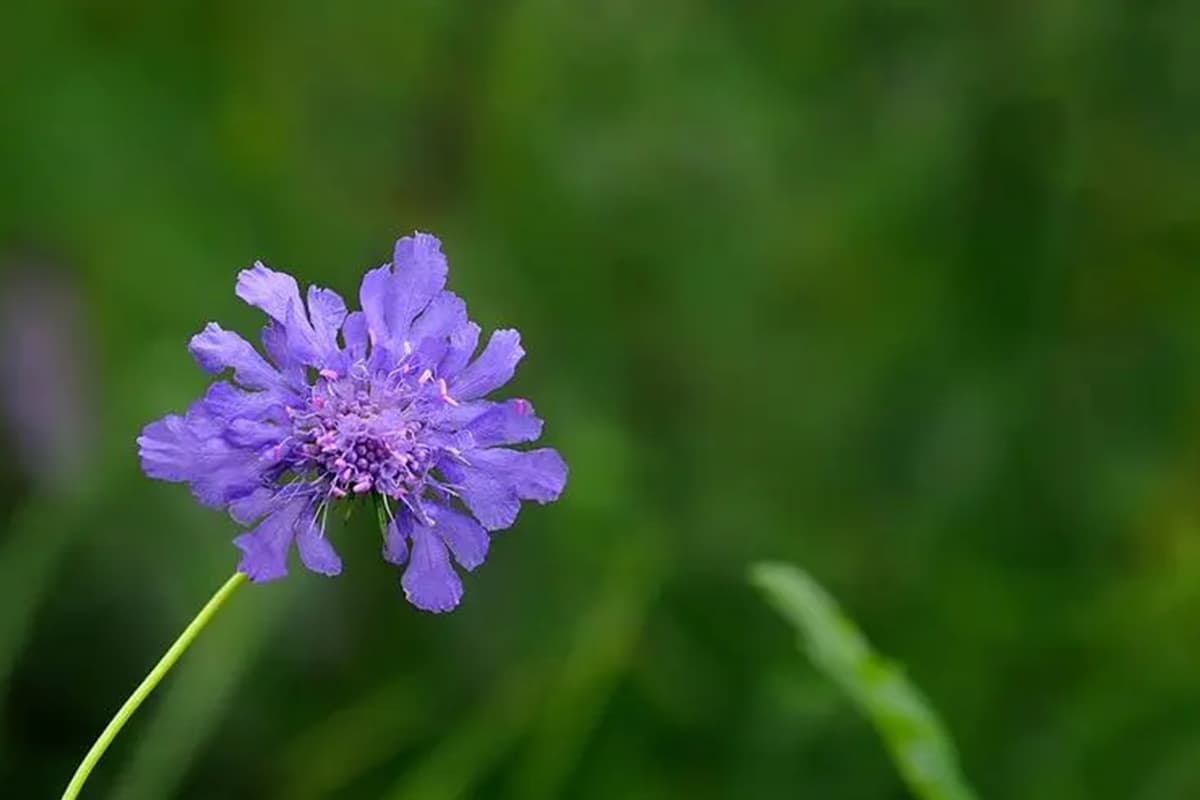
It’s a perennial herb, ranging from 30-80 cm in height. The root can be singular or have 2-3 heads, with a rough, brownish exterior and a white interior, measuring 12-25 cm in length and 3-5 mm in thickness. The stem is erect, pale yellow or purplish, angular, with internodes measuring 6-12 cm.
It’s sparsely or densely covered with white short appressed hairs, especially dense at the base and beneath the inflorescence. The basal leaves form a cluster, have a narrowly elliptical outline, measure 6-10 cm in length and 1-2 cm in width, and are pinnately dissected or rarely dentate.
The leaves wither during flowering. The leaf petiole measures 3-10 cm. Stem leaves are opposite, connected at the base into a short sheath, hugging the stem, and either stalkless or with a 1-1.2 cm stalk.
The leaf outline is elliptical, measuring 8-15 cm in length and 4-5 cm in width. Flowers bloom between July and August, while fruiting occurs in September.
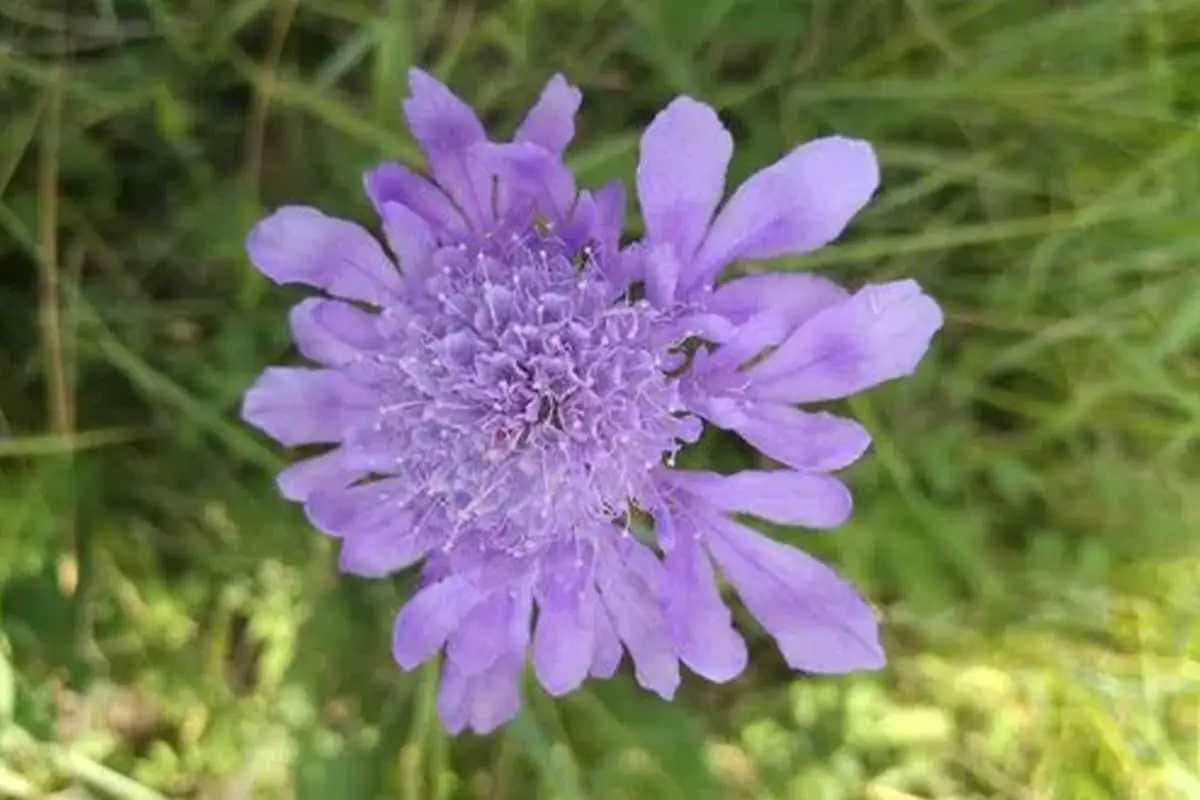
Scabiosa comosa is native to Russia, China, North Korea, and Mongolia. It grows at altitudes of 500-1600 meters in dry sandy soils, sand dunes, dry slopes, and grasslands.
The plant is drought-resistant, cold-resistant, and can tolerate infertile conditions. It thrives in full sunlight. When cultivated with adequate moisture and fertile soil, it shows robust growth.
The primary method of propagation is by seeds, though root division is also possible.
Seed Propagation: The seeds can germinate immediately upon maturity if conditions are suitable, making them non-dormant seeds. Their natural dormancy is enforced dormancy. Direct sowing or seedling cultivation can be done based on suitable timing.
As it doesn’t flower in its first year, cultivation for landscaping purposes should involve nursery cultivation, seedling division, wintering in cold beds, and then planting after the frost in the subsequent spring. Under moist conditions at 20°C, seeds can germinate within about two weeks.
Freshly collected seeds can have a germination rate of up to 95%, and germination is uniform. Seeds stored in a refrigerator for two years still maintain a germination rate of over 70%. Hence, it’s best to store the seeds in a cool place. The weight of a thousand seeds is approximately 1.5 grams.
Root Division: Root division is best done before the spring growth starts or after wilting in the fall during the dormant period. After digging out the roots and shaking off the soil, the overwintering buds on the segmented rhizomes can be divided into several pieces.
Each piece, with a part of the root system, can then be planted separately. The propagation rate using this method is relatively low, usually 2-3 times.
For garden cultivation of Narrow-leaf Scabiosa, it’s important to intensify water and fertilizer management.
There’s no specific requirement for soil pH value. In the Harbin region of China during winter, no special care is needed, and the plant can safely overwinter without any management.
For annual cultivation of Narrow-leaf Scabiosa, seeds are sown in nursery beds or open ground in early spring.
The optimal germination temperature is 21°C, and germination occurs within about 10-12 days. For biennial cultivation, seeds are sown in nursery beds in the fall. Again, the optimal germination temperature is 21°C, with germination taking 10-12 days.
For the same biennial cultivation, seeds sown in the nursery beds in the fall should be transplanted in the following March.
To encourage flowering in early spring, the seedlings sown in the fall should be moved and cultivated in greenhouses with temperatures no lower than 10°C.
Narrow-leaf Scabiosa has various medicinal properties, including anti-inflammatory, fever-reducing, antioxidant, renal function protection, sedative effects, and immune system enhancement. Therefore, it possesses significant medicinal value.
Additionally, as an essential wildflower, Narrow-leaf Scabiosa boasts beautiful flower shapes and vibrant colors. It enjoys light and has the characteristics of being cold-resistant, drought-tolerant, and able to thrive in infertile conditions. It’s already been partly utilized in gardens.
As a perennial herbaceous flower, it’s often arranged in perennial flower beds or light flower environments in gardens.
Due to its longer internodes, loose and delicate inflorescences, and blue-violet flowers, which belong to the cool color category, this plant can be grown individually, in clusters, or interspersed with other plants.

Peggie was once a high school mathematics teacher, but she set aside her chalkboard and textbooks to follow her lifelong passion for flowers. After years of dedication and learning, she not only established a thriving flower shop but also founded this blog, “Flowers Library”. If you have any questions or wish to learn more about flowers, feel free to contact Peggie.
 English
  العربية
  Bahasa Indonesia
  Deutsch
  Français
  Italiano
  Nederlands
  Português
  Русский
  日本語
日本語