600+ Types of Flowers A To Z (With Names and Pictures)
Types Of Flowers By Names (A-Z) Types Of Flowers By Color Types Of Flowers By Season Types Of Flowers By Blooming Time 600+ Types of Flowers No. Flower Name No.…

The Staghorn Sumac, scientifically known as Rhus Typhina, also known as Deer Antler Lacquer or Torch Lacquer, is a deciduous shrub belonging to the class of dicotyledonous plants, order Sapindales, family Anacardiaceae, and genus Sumac.
The fiery red and bright flowers compactly form a flame-like shape, thus earning the name “Torch Tree”. The Torch Tree presents three different colors throughout the year: white flowers in spring, green leaves and fruits in summer, and red fruits in autumn and winter.
It is a beautiful ornamental plant, typically less than 1 meter tall, with gnarled roots, bushy branches, and a dark tree bark, giving it an ancient appearance.
It is important to note that the Torch Tree is very similar to the Toona Sinensis tree. Although it is non-toxic, it is not good to eat it by mistake.
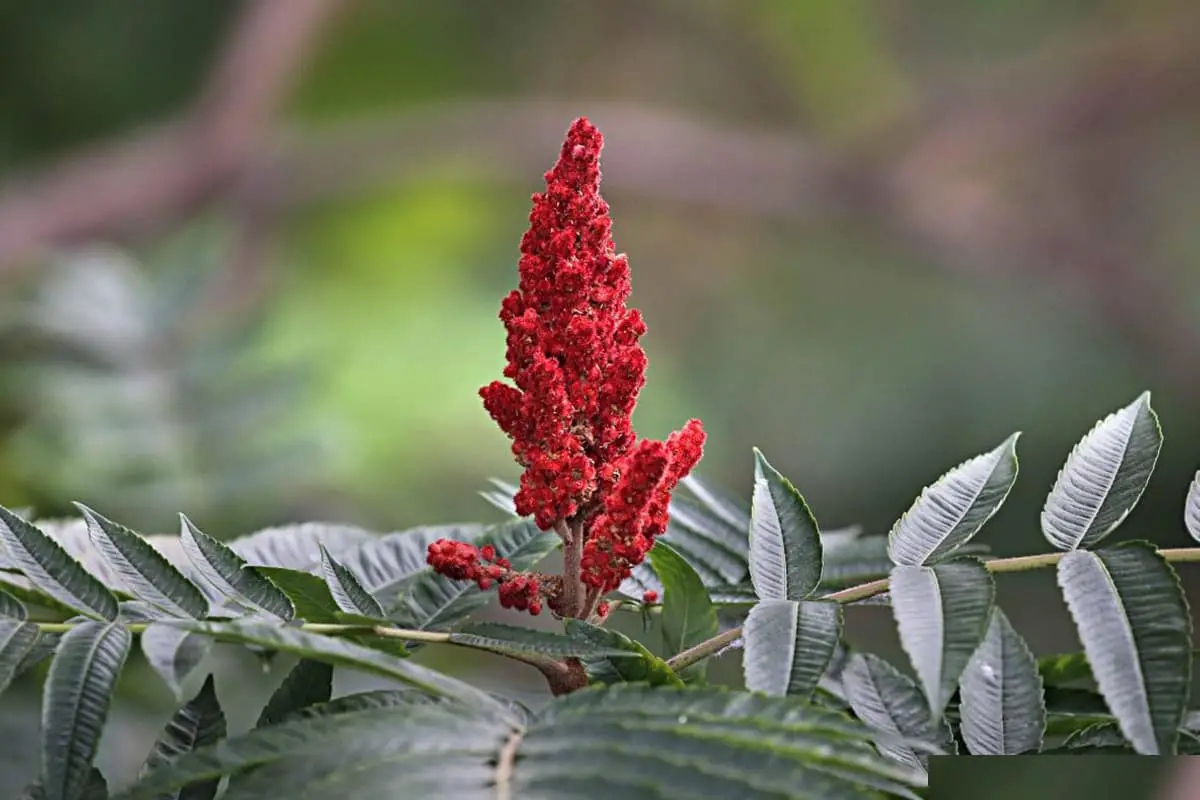
The Rhus Typhina, is a deciduous shrub belonging to the class of dicotyledonous plants, order Sapindales, family Anacardiaceae, and genus Sumac. It has pinnate leaves that are elliptical to lanceolate.
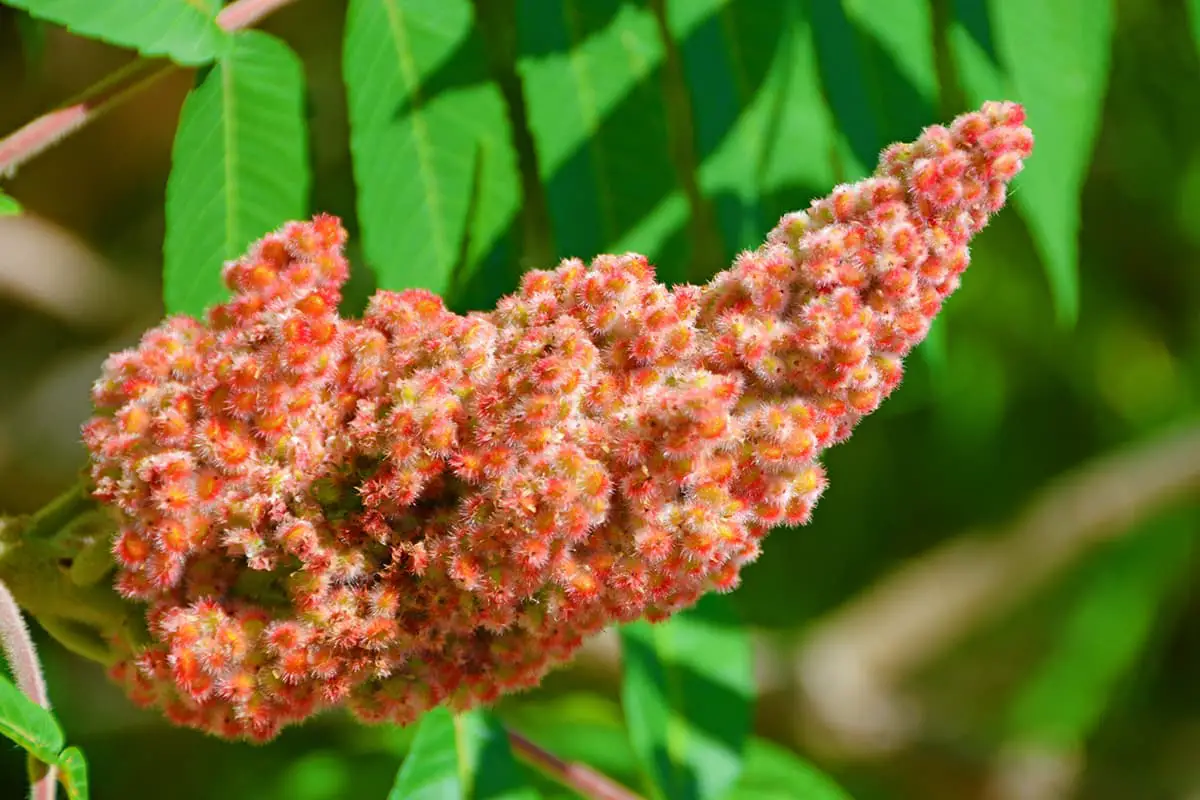
The flowers are in upright terminal panicles and have vibrant red seed clusters. The flat spherical fruits have red prickly hairs and are densely clustered, forming a torch shape.
The fruits remain on the tree for a long time after they ripen in September, and the leaves turn red in autumn, making a spectacular sight. It is a native species in Europe and America and often grows in open sandy or gravelly soils.
The Torch Tree loves sunlight, is cold-resistant, and has a strong adaptability to different types of soil. It can withstand drought, poor soil, waterlogging, and saline-alkali soils.
The tree has a well-developed root system and strong sprouting ability. It can sprout 30 to 50 sprouts within four years. It has a shallow root system, fast growth, and a short lifespan.
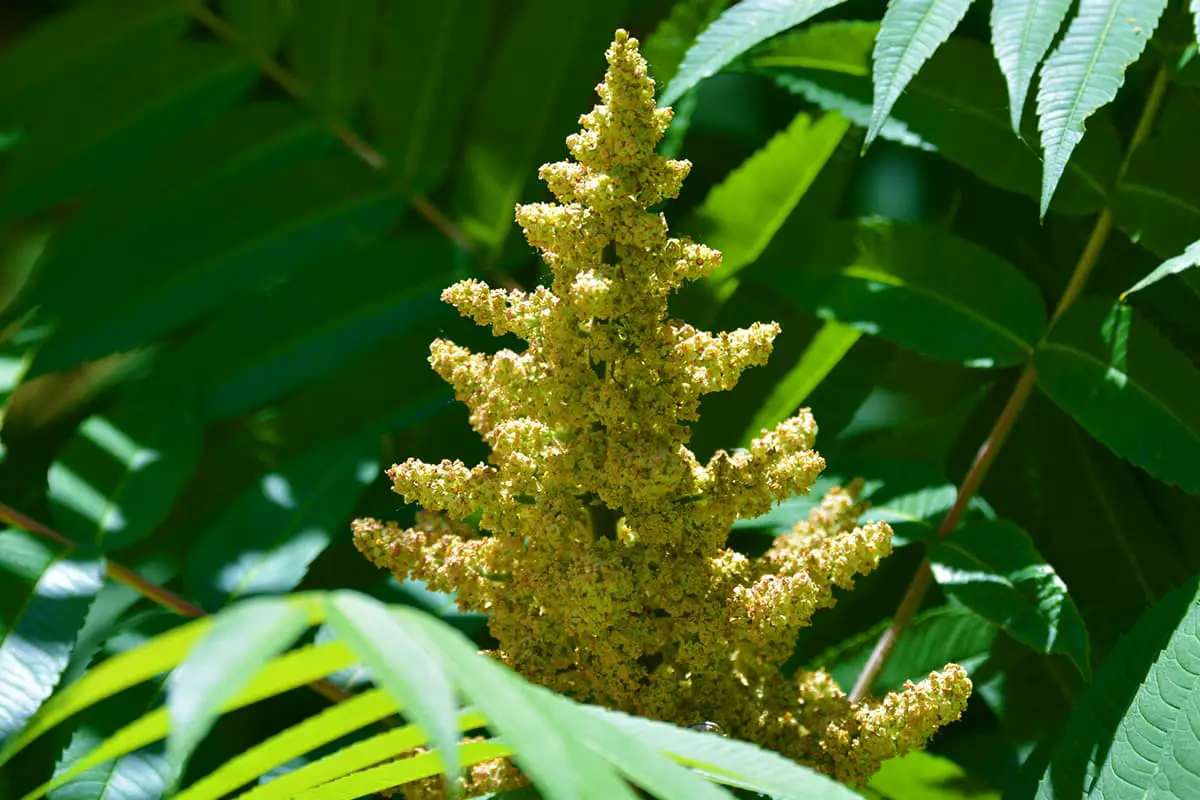
The Torch Tree, belonging to the Anacardiaceae family and Cotinus genus, is a deciduous shrub that can grow up to 12 meters high. Its grey-brown branches are densely covered with fine hairs.
The leaves are pinnate with 19 to 23 (or 11 to 31) leaflets, shaped from oblong to lanceolate, and 5 to 13 cm long. The edges are serrated, and the tips taper gradually.
The leaf surface is dark green, underneath is pale, and both sides have fine hairs that fall off as they age. The leaf axis has no wings.
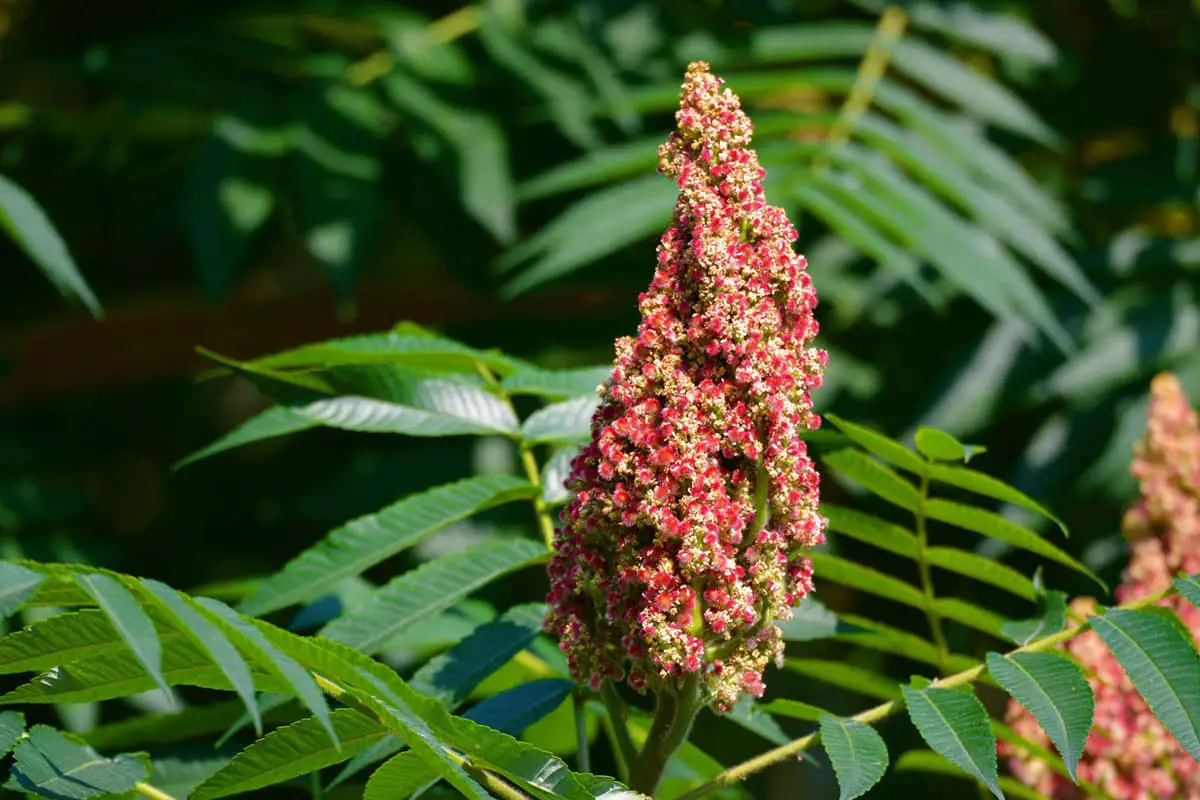
The flowers, which bloom from June to July, are pale green and densely covered with fine hairs. Female flowers have red spikes. The fruits are deep red, densely covered with fine hairs, and the persistent flower spikes cluster into a torch-like shape. The fruiting period is from August to September.
Location selection
Cultivating the Torch Tree is easy and requires little management. The planting location should be high, dry, and not prone to waterlogging. As a heliophilous species, the tree should be planted in wind-sheltered, sun-facing, and fertile areas.
Due to its strong self-propagation ability and tendency to invade, it should not be planted in the middle of other plants. Ideal locations include corners, entrances, etc.
Planting time
Transplanting Torch Tree seedlings should ideally be done after the leaves fall in late autumn and before the buds sprout in spring next year for higher survival rates.
However, considering growth characteristics, the best time would be between April 5th and 25th. Planting in autumn can lead to poor false planting, affecting the survival rate.
Planting method
When transplanting, the branches need to be heavily pruned to maintain a balanced energy in the tree. For spring planting, top pruning can be done. It’s essential to dig a hole first, take out the seedling, plant it, and water it immediately for the best results.
Seedlings should be straightened, and the root system should be spread out in the soil. Larger seedlings should be supported with a stake.
Fertilization management
The Torch Tree is resistant to poor soil and doesn’t require a high amount of fertilizer. Frequent fertilization can lead to rapid growth and suffocate other plants.
Generally, applying urea once or twice during the growth period is sufficient. Fertilize in the morning or evening, water after a while to dilute, and promote nutrient absorption.
Watering
During the seedling period, water every 10 days to ensure sufficient moisture for growth. Afterwards, watering can be reduced to once every half month. Avoid water accumulation to prevent root rot. Cold winter weather can damage the branches and leaves of the Torch Tree, so stop watering at the end of July to avoid damage in the harsh winter.
Pruning

The Torch Tree is often used for landscape planting and cluster planting, and less often for solitary planting.
During cultivation, dead branches, dense branches, pest-infected branches, and branches affecting the tree shape should be pruned each winter or early spring. Generally, no artificial shaping is done, and the tree is allowed to grow naturally.
Torch trees can be propagated by seeding, division, and rooting.
After the seeds mature in the autumn, collect the spikes, sun-dry to thresh, and then stratify in sand for germination. If there’s no sand storage in the autumn, the seeds can be soaked in high-temperature water for germination.
Method: In early April, pour clean seeds into boiling water, stirring as you pour. When the water temperature drops to 50℃~60℃, pour in laundry detergent and rub to remove the wax until the seed coat feels rough and not smooth.
After scrubbing, rinse the seeds clean with water, then soak in clean water for two days to fully absorb the moisture. Remove and germinate. You can also mix in some wet sand, and generally, 3~5 days later, the seed germination rate can reach 80%, and then seeding can be done.
The seeding rate is 5~6g per square meter. After the seedlings emerge, water every 10 days, and one month later, water every half a month. Generally, fertilize twice, mainly with urea, 5~7g per square meter, combined with watering.
Torch tree seedlings are delicate in their first year and are prone to frost damage in winter, so frost prevention measures should be taken.
Torch trees have many lateral roots that extend horizontally. Every year in early spring, choose lateral roots with a diameter of more than 1cm when the seedlings are out of the nursery, cut into 20cm long root sections, water thoroughly first, then hoe to open a trench 20cm deep, with rows 30cm apart, then plant the root sections at 30cm intervals, and cover with soil as you plant.
Make sure to plant according to the polarity of the root, with the top up and the stem down, and plant in a consistent direction. Firm the soil as you cover, with a soil depth of 1~2cm. Don’t water immediately, wait until the seedlings emerge.
For a plant spacing of 40×30cm, directly insert into the prepared nursery. After planting, cover the top of the root section with 2 to 4cm of thin soil, and keep moist by regularly spraying water.
Generally, adventitious buds sprout first, then new branches break through the soil, and then roots grow. The seedlings can grow over 1 meter in the first year.
Around Torch trees of two years old and above, many root suckers often sprout. You can select and retain according to row spacing, and pay attention to pruning root suckers and excessive lateral branches to cultivate well-shaped and robust seedlings.
The seedlings can reach a height of 1.5 to 2 meters in the first year. After propagation, the plants can be transplanted in mid-March of the second year. Plant spacing should be 50×40cm, and watering, soil loosening, and weeding should be done well.
Fertilize once in May and June, and stop watering and fertilizing before the end of July. Torch trees generally do not suffer from diseases. Seedlings and root cuttings can reach a breast diameter of 3 to 5cm in 3 years, and root suckers in 2 years, which can be used for afforestation.
Ecological Protection
The Torch Tree not only refrains from “igniting” but also serves as a fire-resistant species. Its branches and leaves have a moisture content of 30% and 62% respectively, which is comparable to that of the Wood Holly.
The Torch Tree has a strong adaptation to the soil after long-term domestication and is an excellent species for slope protection, embankment reinforcement, and sand fixation for soil and water conservation, as well as for firewood and charcoal forests.
The Torch Tree has dense leaves with a velvety surface, capable of absorbing a large amount of floating dust and harmful substances in the air. Cattle and sheep do not eat its leaves, and it is not subject to pests and diseases.
The Torch Tree can adapt to harsh site conditions. It can grow both in fertile soil and in yellow clay mixed with goose pebbles. It can grow in both barren soil and on construction waste and drought-stricken coal slag garbage.
It is extremely drought-resistant and cold-resistant. Even when the temperature reaches -36 to -38°C, the Torch Tree remains unharmed. To date, no large-scale disease phenomenon has been found on the Torch Tree.
The Torch Tree has a strong sprouting ability at the root, a fast natural propagation ability, a high survival rate of afforestation, and can still regain new life with its tenacious vitality after human destruction and forest fires.
At the same time, it has extremely strong cold resistance, drought resistance, and salinity resistance. It has a strong adaptability to the surrounding environment and is a good pioneer species for slope protection, fire prevention, embankment reinforcement, and beach sealing and sand fixation.
Due to the wide range of uses and adaptability of the Torch Tree and its excellent ornamental value, it has been introduced and cultivated in various countries and widely used in artificial forest construction, degraded land restoration, and landscape construction.
It is mainly used for barren hill greening and saline-alkali wasteland scenic forest species.
The Torch Tree’s torch lacquer female inflorescence, fruit order, and bright tree bark and leaves all contain tannin, which is the raw material for tannic acid.
The fruit contains citric acid and vitamin C, which can be used as a beverage. The seed contains oil wax, which can be used to make soap and candles.
The wood is yellow, with a dense and beautiful texture, suitable for carving and turning crafts. The root bark can be used as a medicine.
The Torch Tree has a high tannin content, making it an excellent raw material for producing rosin. This rosin is a mixed rosin with a very wide range of applications. Its roots, leaves, flowers, bark, seeds, and wood all have a wide range of uses.
The Torch Tree grows fast, its branches contain a high amount of water, and it has less oil and is not easily burned, so it cannot be used as a superior firewood species.
Harm
Species Invasion
The Torch Tree possesses remarkable reproductive abilities, demonstrating many characteristics of an invasive species.
For example, its strong adaptability, prolific root sprouting, and tendency to form dense colonies have led researchers to classify it as a weed in the southern regions of the United States and Canada.
The Torch Tree has a potent capacity for encroachment; once it leaves its original habitat, it grows wildly due to lack of natural predators, posing a threat to the natural ecosystems of the areas where it is introduced and leading to ecological imbalance.
Surveys have shown that in areas where Torch Trees grow densely, a multitude of species are crowded out.
Damage to Farmland and Road Foundations
The Torch Tree proliferates rapidly and can expand into adjacent farmlands. Uprooted Torch Tree roots, if discarded on the ground, can still sprout new shoots.
After five years of growth, the tree’s root system can penetrate the hard crevices of protective slopes, causing harm to highway facilities. Torch Trees can reproduce in large quantities through root sprouts after the parent tree withers.
The Torch Tree possesses a substantial interspecies competitive advantage. For instance, in mixed forests of Torch Trees and Rhus typhina in Jinan, Shandong, traces of Rhus typhina are now hard to find.
In 3 to 5 years, invasive shoots of the Torch Tree can spread 30 to 100 meters. In places where the Torch Tree is found, apart from a few types of herbaceous plants, native species are hard to find, with some areas having completely eliminated all native species, causing severe damage to the local ecosystem.
The Torch Tree’s root sprouts are astonishingly prolific and its root system is complex and tangled, making it hard to eradicate entirely. Additionally, the Torch Tree possesses a robust self-defense capability.
Its secretions and dense fuzz render it almost invulnerable to physical damage, with no insects eating it and no predators controlling it. The “torches” (fruits) of the tree can produce a vast number of seeds.
Although these seeds are difficult to sprout naturally, they still pose a significant threat. Consequently, when the Torch Tree proliferates in large numbers, it becomes an invasive species.
Allergic Reactions
The secretions of the Torch Tree can cause adverse reactions in allergic individuals.
As a member of the Anacardiaceae family, the Torch Tree secretes a variety of compounds, including volatile oils, resins, and water-soluble glycosides, which can trigger allergic reactions, such as skin redness and swelling in some people.
Additionally, its large inflorescences produce a lot of pollen. If planted on a large scale, it can become a new source of allergens.
Control Methods
It’s crucial to note that uprooting the Torch Tree stimulates more root sprouts, resulting in a significantly higher number of new seedlings than when only the above-ground part is cut down.
Considering the cost-effectiveness of prevention and eradication, a 41% concentration of Nongda pesticide at 0.3mL·m-2 has a 99% prevention effect, making it worth promoting in production.
For introduced Torch Trees, it’s essential to closely monitor their spread and expansion, and when necessary, employ artificial control methods.
For example, as the root system of the Torch Tree is shallow, mainly distributed in the top 20cm of soil, it can be controlled within a certain range by digging isolation trenches. If the goal is to eliminate the Torch Tree, flooding can be employed.
Over 90% of the drawbacks of the Torch Tree can be turned into advantages with proper human planting and management.
For instance, the tree’s robust reproduction and strong adaptability make it an excellent choice for landscaping, afforestation of barren hills, and greening along railways.
It can be planted in parks, residential areas, alongside roads, in landscapes, and to stabilize slopes. During the planting process, limestone boards can be used to confine the roots, preventing clonal reproduction.
The Torch Tree’s autumnal red leaves are highly ornamental, making it a popular choice for landscaping with colorful foliage trees. Not only is the Torch Tree inexpensive, but it also has several other advantages.
It has a strong capacity to adapt to different environments and broad soil requirements, allowing it to be planted even in slightly saline-alkaline soils.
To put it simply, the effect of mature Torch Tree plantations is truly impressive. Regardless of whether one likes the Torch Tree, its value far exceeds its drawbacks.
It’s not hard to spot the Torch Tree in Chinese landscaping, even in Beijing. The Torch Tree is not poisonous, but contact with its leaves may cause discomfort in people with skin allergies.

Peggie was once a high school mathematics teacher, but she set aside her chalkboard and textbooks to follow her lifelong passion for flowers. After years of dedication and learning, she not only established a thriving flower shop but also founded this blog, “Flowers Library”. If you have any questions or wish to learn more about flowers, feel free to contact Peggie.
 English
  العربية
  Bahasa Indonesia
  Deutsch
  Français
  Italiano
  Nederlands
  Português
  Русский
  日本語
日本語