600+ Types of Flowers A To Z (With Names and Pictures)
Types Of Flowers By Names (A-Z) Types Of Flowers By Color Types Of Flowers By Season Types Of Flowers By Blooming Time 600+ Types of Flowers No. Flower Name No.…

Portulaca grandiflora, also known as the Large-flowered Purslane, is an annual herb that grows to a height of 10-30 centimeters. Its stem lies flat or inclined, with a purplish-red hue, and it branches out abundantly with clusters of hairs at the nodes.
The leaves are densely clustered at the branch ends, and the lower leaves are spaced apart; they grow irregularly opposite each other, and are fine cylindrical in shape and hairless.
The flowers bloom singly or in clusters at the branch ends, with a diameter of 2.5-4 centimeters; they open during the day and close at night. The general bracts consist of 8-9 leaf-like structures that are arranged in whorls, with white long soft hairs.
The petals, which can be either five or double, are inversely ovate with slight indentations at the tip, and measure 12-30 millimeters in length; they come in red, purple, or yellow-white.
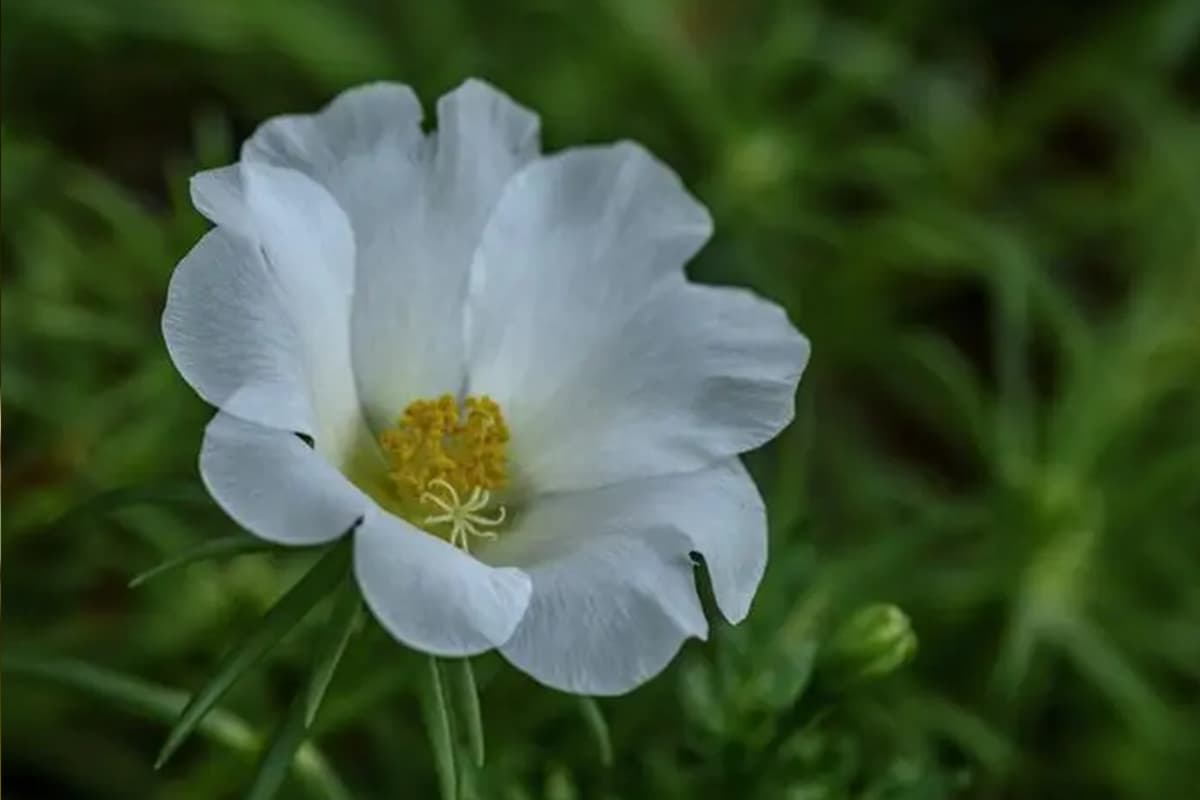
The capsules are nearly elliptical and dehiscent; the seeds are tiny, numerous, round kidney-shaped, and less than 1 millimeter in diameter. The flowering period is from June to September, and the fruiting period is from August to November.
Originally from South America, Brazil, Argentina, Uruguay, and other places, it is now cultivated all over China: it has medicinal properties, used for dispersing blood stasis, relieving pain, clearing heat, detoxifying and reducing swelling, and it is applied to throat swelling and pain, burns, falls and injuries, and abscess swelling and poison.
It has been widely cultivated in various parts of China, suitable for indoor cultivation in buildings, taking advantage of its resistance to early drought and salt-tolerance.
It beautifies balconies and window sills as a potted plant, with its mushroom stalks and trailing stems hanging outside the pot, facing the sun, blooming like a gorgeous embroidery, at its best at noon.
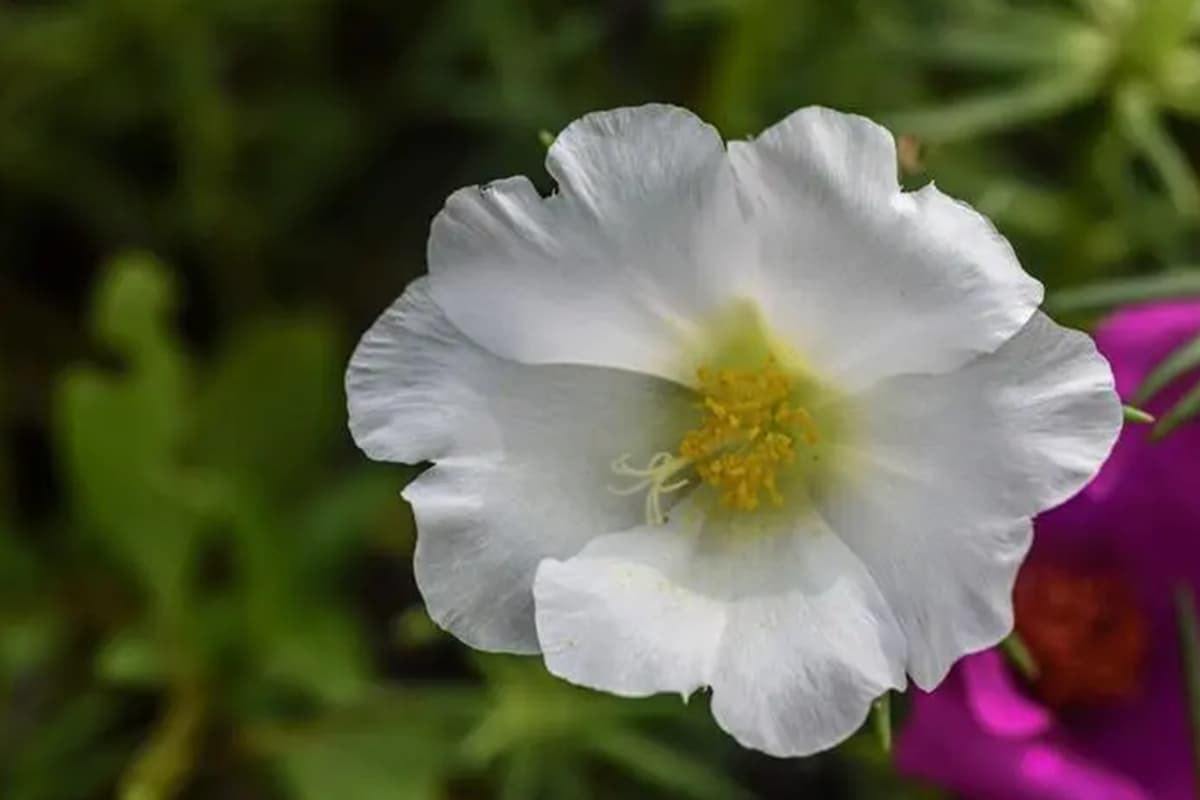
Each flower opens fully, basking in the warmth provided by the sun, adding endless charm to the room, making it uniquely appealing.
The Large-flowered Purslane is an annual herb standing 10-30 cm tall. Its stems are either prostrate or ascending, purplish-red in color, highly branched, and densely hairy at the nodes.
The leaves are clustered at the ends of the branches, with lower leaves spaced apart and arranged irregularly.
The leaf blade is slender and cylindrical, sometimes slightly curved, 1-2.5 cm long, 2-3 mm diameter, with a rounded and blunt tip, and hairless; the leafstalk is extremely short or nearly absent, with a tuft of white long soft hair often growing from the axils.
The flowers are solitary or a few clustered at the end of the branches, 2.5-4 cm in diameter, opening during the day and closing at night.
The involucre consists of 8-9 leaf-like pieces arranged in whorls, with white long soft hair; the calyx has 2 pieces, pale yellow-green, ovate-triangular, 5-7 mm long, with a sharp apex, somewhat keeled, and hairless on both sides.
Petals, which are 5 or double, are inverted ovate, slightly concave at the top, 12-30 mm long, and can be red, purple, or yellow-white.
There are numerous stamens, 5-8 mm long, with purple filaments that are fused at the base. The pistil is nearly as long as the stamens, with a 5-9 segmented, linear stigma.
The capsule is nearly elliptical, dehiscing by a lid; the seeds are tiny, numerous, round-kidney-shaped, less than 1 mm in diameter, lead-gray, gray-brown, or gray-black, with a pearlescent sheen, and with tiny tuberculate protrusions on the surface.
The flowering period is from June to September, and the fruiting period is from August to November.
The newly grown leaves are light green, but after a few days, as the leaves grow larger, they turn dark green, so dark they’re almost black, and glaringly green. From a distance, they look like evenly spaced thorns on tender stems.
But they’re not sharp, and they don’t prick, instead, they’re smooth and juicy. The stems of the sunflower are tender and juicy, with tender red stems extending from the flower pot to the outside; of course, the stems of the sunflower are of different lengths and thicknesses.
The flowers are diverse in appearance: some flowers are fully open, like a smiling face; some petals are half open, while the other half are reluctant to bloom, like a shy girl.
Some are still buds; some… Every day, the soil around the sunflower is loosened and fertilized to make the flowers bloom more beautifully.
Originally native to South America, Brazil, Argentina, Uruguay, etc. It is cultivated all over China, mostly grown on hillsides and in fields.
The plant thrives in warm, sunny environments and does not grow well in dark, damp conditions. It is highly tolerant of poor soils and can adapt to most soil types, but it especially loves well-drained sandy soil.
The flowers bloom in sunlight and close in the early morning, evening, and on cloudy days. Hence, it is also known as the Large-flowered Purslane or the Noon Flower.
The seeds of the large flowered purslane are extremely small, with about 8400 seeds per gram. They are often sowed in seedling trays and lightly covered with tiny particles of vermiculite, or simply pressed slightly after sowing to ensure sufficient moisture.
The germination temperature is 21-24℃, and seedlings appear in about 7-10 days. The seedlings are very delicate, so if a high temperature is maintained, the seedlings grow quickly and can form sturdy, succulent branches and leaves.
At this time, the seedlings can be potted directly in pots with a diameter of about 10 cm, with 2-5 plants per pot. The survival rate is high and the growth is rapid.
Seeding is the main method of propagation, and the plant also has a strong ability to self-seed. Seeds can be sowed in spring, summer, and autumn. When the temperature is above 20℃, the seeds germinate, and buds appear about 10 days after sowing.
The soil should be lightly covered, but the plant can also grow without covering the soil. The seedlings are transplanted with a plant row spacing of 5×6 cm. Liquid fertilizer must be applied several times. Under conditions above 15℃, the plant can flower in about 20 days.
Cutting propagation is often used for double-flowered varieties. In summer, the cut branches are used as cuttings, and wilted stems can also be used.
Once the cuttings take root, flower buds appear. The cutting time is from the beginning of May to the end of August. Cuttings about 5cm long from the tender stem tips can be used.
Cutting method: Smooth the surface of the soil in the container, insert the cuttings of the large flowered purslane into the holes made by bamboo sticks, and the depth into the soil should not exceed 2 cm.
To make the potted flowers take shape and become plump as soon as possible, depending on the size of the flower pot, as long as a distance of 2 cm is maintained, multiple cuttings can be made.
When the seedlings become crowded, they can be transplanted into other pots. Then water thoroughly. New cuttings can be shaded or not shaded, as long as a certain humidity is maintained, they can survive in general 10-15 days and enter normal maintenance.
After harvest in summer, dig out the old clumps, select the ones with good growth, divide them into small clumps, and plant them with a row spacing of 30 cm and a plant spacing of 7-10 cm, then water them with manure water.
For those propagated by division, when new shoots appear after planting, they are removed, fertilized once, and then only weeding and loosening the soil is necessary. After harvest in September and again in November, fertilize once to overwinter.
The key pests to prevent and control are aphids, almond wasps, and apricot scale insects.
Aphids: The key to controlling aphids is to spray pesticides before germination, that is, during the bud swelling period. During this period, imidacloprid can be used at 4000-5000 times dilution.
After germination, use imidacloprid at 4000-5000 times dilution and add lambda-cyhalothrin at 2000-3000 times dilution to kill aphids, which can also control almond wasps. After fruit set, aphids can be eliminated with a 1500 times dilution of aphid-killer.
Scale insects: Spray emulsified kerosene 50-80 times dilution and add lesbon at 1500 times dilution separately before germination and in late May.
This plant can be used for medicinal purposes, possessing the ability to disperse blood stasis, relieve pain, clear heat, detoxify, and reduce swelling. It is applied to treat swollen throats, burns, injuries from falls and blows, and boils.
There are many varieties of Portulaca grandiflora, typically in colors such as peach red, grain red, deep red, purple-red, white, snow blue, pale yellow, and deep yellow. Originally from Brazil and Argentina in South America, it has been widely cultivated throughout China.
It can be grown indoors in apartments, taking advantage of its tolerance to early dryness and salt. The plant beautifies balconies and windowsills when potted. Its mushroom-like stems and drooping trails are visually pleasing.
The flowers bloom towards the sun, creating a tapestry of color. They are most vibrant at noon, opening wide to enjoy the warmth of the sun, adding infinite charm and unique beauty to the room.

Peggie was once a high school mathematics teacher, but she set aside her chalkboard and textbooks to follow her lifelong passion for flowers. After years of dedication and learning, she not only established a thriving flower shop but also founded this blog, “Flowers Library”. If you have any questions or wish to learn more about flowers, feel free to contact Peggie.
 English
  العربية
  Bahasa Indonesia
  Deutsch
  Français
  Italiano
  Nederlands
  Português
  Русский
  日本語
日本語