600+ Types of Flowers A To Z (With Names and Pictures)
Types Of Flowers By Names (A-Z) Types Of Flowers By Color Types Of Flowers By Season Types Of Flowers By Blooming Time 600+ Types of Flowers No. Flower Name No.…

Mayodendron igneum is an evergreen tree of the Bignoniaceae family, with a smooth bark. Its leaves are odd-pinnate and oppositely arranged, featuring ovate or ovate-lanceolate leaflets with acuminate tips and glabrous on both surfaces.
The inflorescences are short panicles, borne on old stems or lateral short branches with long peduncles. The calyces are bracteate, splitting on one side and densely covered with soft hairs.
The corolla is tube-shaped and orange-yellow. The fruit is a linear capsule, glabrous, pendulous, and thin-leathery. The seeds are ovate.
The blooming season is from February to May, and the fruiting season from May to September. Named for its resemblance to a blazing flame, the Flame of the Forest is a sight to behold.
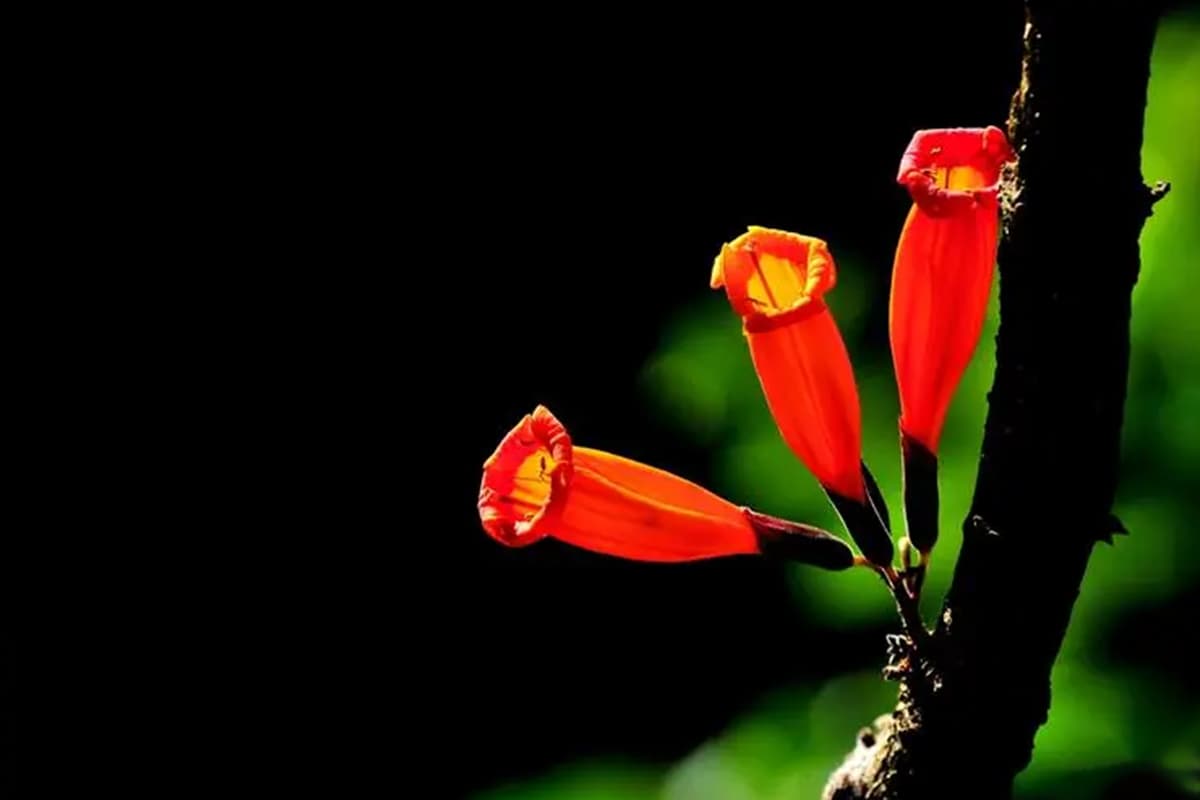
The Flame of the Forest is found in Vietnam, Laos, Myanmar, and India. It thrives in high temperatures, is intolerant of cold, and susceptible to frost.
Preferring moist environments, it is also quite heat-resistant. It is heliophilous, but can tolerate semi-shade and is not salt-alkali tolerant.
It can withstand wet conditions and is somewhat drought-tolerant. Propagation is mainly through seeding, with grafting as a secondary method.
The Flame of the Forest is highly ornamental, with its brilliant colors and the old stems blooming profusely, making it extremely beautiful and of high ornamental value.
Named for its likeness to a fiery blaze, the Flame of the Forest has distinctive characteristics.
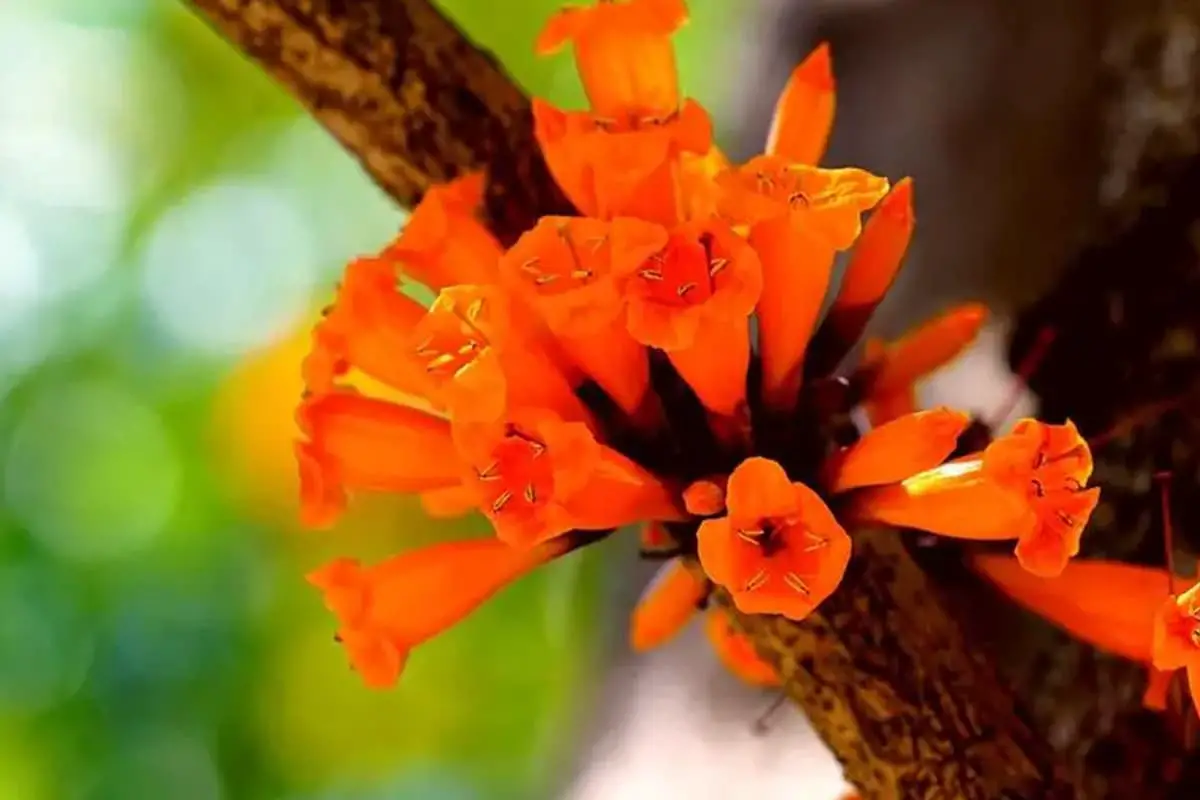
It is an evergreen tree that can grow up to 15 meters in height with a diameter at breast height of 15-20 centimeters. The bark is smooth, and the young branches have long elliptical white lenticels.
Its large, odd bipinnate compound leaves can reach up to 60 centimeters in length, with a terete rachis that is grooved.
The leaflets are ovate to ovate-lanceolate, 8-12 centimeters long and 2.5-4 centimeters wide, with an acuminate apex and a broadly cuneate base that is oblique and entire-margined.
They are glabrous on both sides, with 5-6 pairs of lateral veins. The petiolules of the lateral leaflets are 5 millimeters long, while the terminal leaflet petiolules can reach up to 3 centimeters.
The inflorescence consists of 5-13 flowers in a short panicle, borne on old stems or lateral branches, with peduncles approximately 2.5-3.5 centimeters long; the pedicels are 5-10 millimeters long.
The calyx is about 10 millimeters long and 7 millimeters in diameter, bracteate, and densely covered with soft hairs outside.
The corolla is orange-yellow to golden yellow, tubular, slightly constricted at the base, 6-7 centimeters long and 1.5-1.8 centimeters in diameter, with 5 semicircular lobes about 5 millimeters long and reflexed.
The filaments are approximately 4-5 centimeters long, with fine soft hairs at the base, and the anthers are T-shaped, with two chambers and the connective extending into a mucronate tip.
The anthers and stigma are slightly exserted from the corolla tube. The ovary is cylindrical, and the style is about 6 centimeters long with a bifid stigma and numerous ovules.
The capsule is linear, pendulous, up to 45 centimeters long, and about 7 millimeters thick, with two valves of thin-leather texture and a membranous septum of fine cylindrical form, and corky.
The seeds are ovate, membranous, abundant, with white transparent membranous wings, and together with the wing, are about 13-16 millimeters long. The flowering period is from February to May, and the fruiting period from May to September.
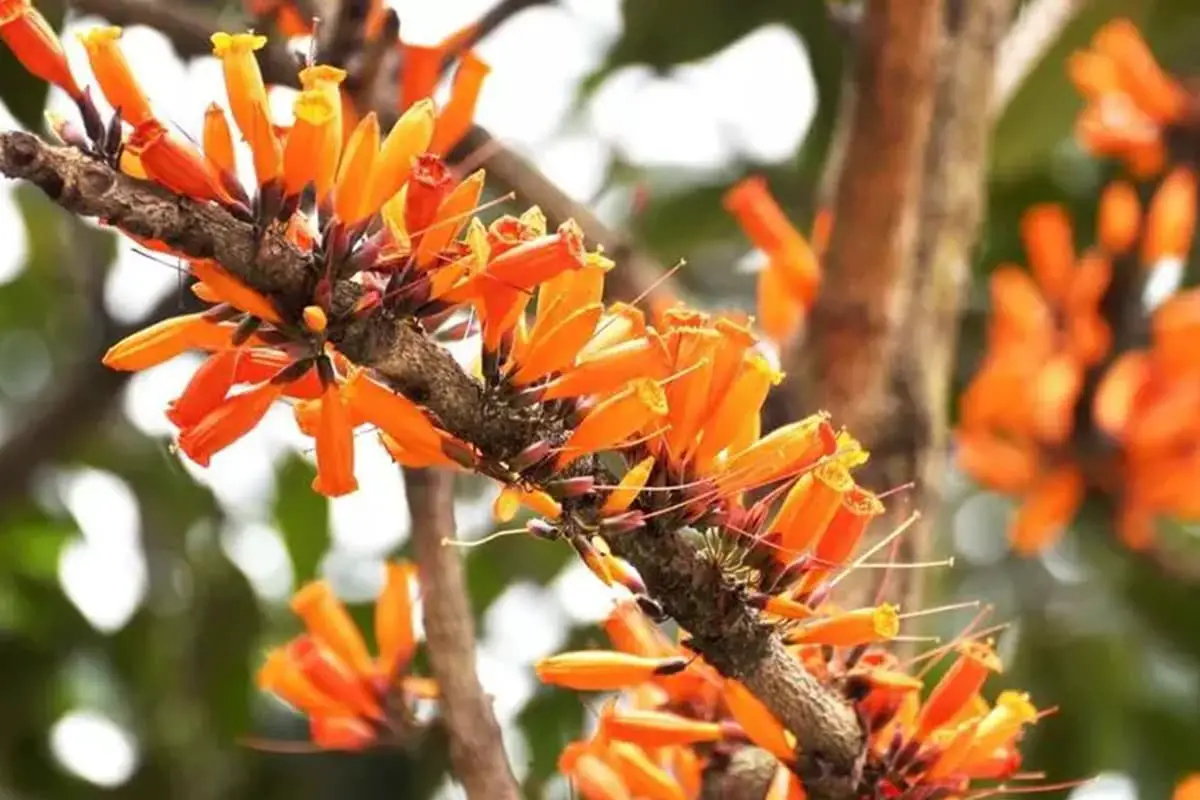
It usually grows in dry hot valleys and low mountain thickets at altitudes of 150-1900 meters. It is distributed in Vietnam, Laos, Myanmar, and India.
The Flame of the Forest is native to tropical regions and favors high temperatures, high humidity, and plenty of sunlight, but it can tolerate dry heat and semi-shade. It is not cold-resistant and is susceptible to frost.
It grows best in temperatures between 23-30°C and can tolerate temperatures around 0°C, but prolonged exposure to low temperatures of 5-6°C can cause damage to the branches.
It prefers deep, moderately fertile, well-drained neutral to slightly acidic soils and does not tolerate saline-alkaline conditions. Growth is slow in dry, infertile soils.
Flame of the Forest can be propagated by seeding and grafting, with seeding being the primary method.
Due to its multi-seasonal flowering, seeds of the Flame of the Forest can be harvested across various seasons, making seeding the main approach for propagating seedlings.
When the capsules mature, changing from green to dark brown, the fruits are harvested, dried in a windless place or sun-dried, and then gently tapped to release the seeds.
These can be sown immediately during the appropriate season or stored during the cold winter months for sowing the following spring. As the seeds are very fine, broadcasting is commonly used, followed by a light covering of soil.
Seedlings typically germinate within about a week at temperatures around 25°C, provided the seedbed is kept moist, with a germination rate of 60%-80%.
After 50-60 days, when the seedling stems begin to harden slightly, they can be transferred to the field for cultivation. Seedlings can be moved out of the nursery after 1-2 years and will flower within 3-5 years.
The survival rate of cuttings from Flame of the Forest is low, but grafting and air layering can improve survival rates and are used for dwarfing, which is suitable for potting. Plants obtained through vegetative propagation generally bloom within 1-2 years.
Flame of the Forest thrives in high-temperature, high-humidity, and sunny environments. It can tolerate dry heat and is cultivated outdoors in Southern China.
In other regions, plants are dwarfed for potting and brought indoors during winter. This plant does not favor heavy fertilization or watering.
Adequate base fertilizer should be applied at planting, followed by only 1-2 applications of compound fertilizer annually for healthy growth.
For potted plants, nitrogen fertilizer should be applied sparingly, watering controlled to prevent excessive growth, and regular pruning conducted to manage height.
Sclerotinia rot mainly occurs during the rainy spring season, affecting both seedlings and mature plants. Infected areas develop dark brown spots and may die off in large patches.
Control methods: Include transplanting with disease-free soil, ensuring fertilizers are fully decomposed, and not using fresh manure. Diseased plants should be removed promptly.
Soil disinfection can be done by applying 40% formaldehyde solution at 50 milliliters per square meter with 6 kilograms of water, or by mixing 70% pentachloronitrobenzene with fine soil at a 1:30 ratio, and spreading it over the seedbed.
A week after spring planting, spray with 70% methylene tobutine at a 1000x dilution or 75% chlorothalonil at a 1000x dilution, repeating every 10 days and alternating products.
Common pests include aphids, geometer moths, yellow underwing moths, cutworms, grubs, and scarab beetles. Aphids affect plant growth and can induce sooty mold.
Geometer and underwing moth caterpillars consume leaves, and severe infestations can strip all shoots within 2-3 days. Cutworms and grubs bore into the root system, with cutworms mainly damaging cuttings and seedlings, while scarab beetles harm seedlings of all sizes.
To control aphids, spray with a 5% diesel oil emulsion or lime-sulfur solution before bud break to kill overwintering adults and eggs. A second treatment is applied after the flowers fall, and a third in October.
For geometer and underwing moth caterpillars, use 50% dimethoate at a 1500x dilution, aiming for early and small infestations.
For subterranean pests like cutworms and grubs, enhance nursery management, avoid uncomposted organic fertilizers, and plow in the winter to expose overwintering larvae to freezing temperatures.
Apply 3% carbofuran granules at 2 kilograms per acre, incorporating them into the soil at a depth of 10-20 centimeters.
Root bark: Used for postpartum weakness and incomplete lochia discharge.
The bark, stem bark, and root bark are used medicinally to treat dysentery and diarrhea.
Flame of the Forest is an excellent landscaping tree for parks, gardens, streets, and scenic areas. It can be planted on lawns, beside ponds, or along main roads as a shade or avenue tree, and is suitable for solitary or group planting for ornamental purposes.
Flame of the Forest typically blooms before leafing out, a characteristic known as flowering on old wood. The flowers are orange-yellow and trumpet-shaped.

Peggie was once a high school mathematics teacher, but she set aside her chalkboard and textbooks to follow her lifelong passion for flowers. After years of dedication and learning, she not only established a thriving flower shop but also founded this blog, “Flowers Library”. If you have any questions or wish to learn more about flowers, feel free to contact Peggie.
 English
  العربية
  Bahasa Indonesia
  Deutsch
  Français
  Italiano
  Nederlands
  Português
  Русский
  日本語
日本語