600+ Types of Flowers A To Z (With Names and Pictures)
Types Of Flowers By Names (A-Z) Types Of Flowers By Color Types Of Flowers By Season Types Of Flowers By Blooming Time 600+ Types of Flowers No. Flower Name No.…

Magnolia liliflora is a deciduous shrub or small tree in the Magnolia family. The bud is oval, and the flower is large and vase-shaped, with the outer petals being purple or reddish-purple, the inner petals being nearly white, and the sepals being purple-green. It blooms between February and March.
Magnolia liliflora is used to treat fish bone throat obstruction and coughs due to cold deficiency. The magnolia flowers bloom in early spring, with large, fragrant, and beautiful flowers, making them suitable for planting in front of courtyards or in clusters at the edge of lawns.
Magnolia liliflora has a long cultivation history and is one of the precious plants in gardens. The buds are as large as pen tips, hence the nickname “wooden pen.”
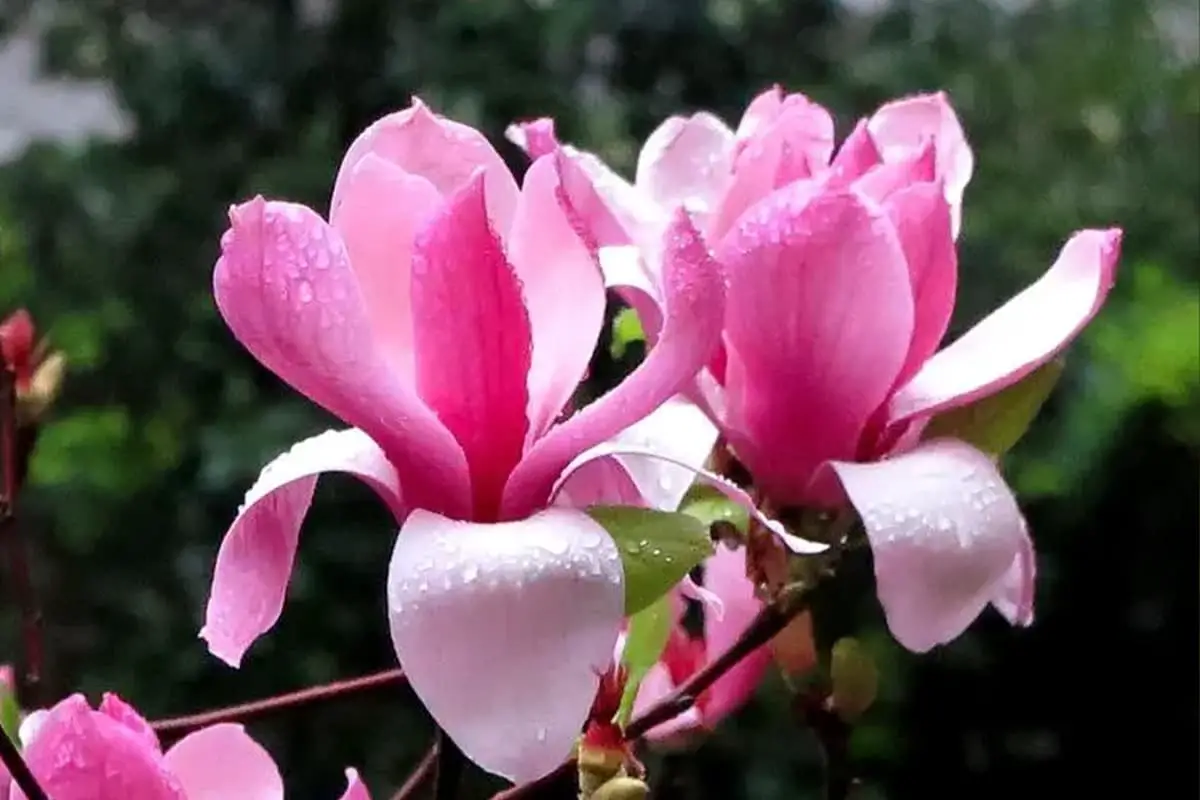
The magnolia tree can grow up to 5 meters tall. The flowers proudly stand on the branches when they bloom, pure and clean white.
As the magnolia flowers bloom first and then the leaves grow after the flowers wither, the tree is completely white when the magnolias bloom, without any other colors, inspiring awe. The flower language of magnolia is a noble soul.
Magnolia liliflora is a deciduous small tree or shrub, 1.5-3m or higher. The bark is light grey-brown; the twigs are slender, sparsely covered with slender hairs, and the young branches are densely covered with short soft hairs.
The winter buds are oval or oblong, covered with shiny brown short hairs. The leaves are single and alternate; the leaf stalk is 1-4cm long; the stipule scar is half the length of the leaf stalk; the leaf blade is lanceolate or inverted egg-shaped, 6-14cm long, 4-10cm wide, the tip is pointed or short and gradually pointed, the base is wedge-shaped.
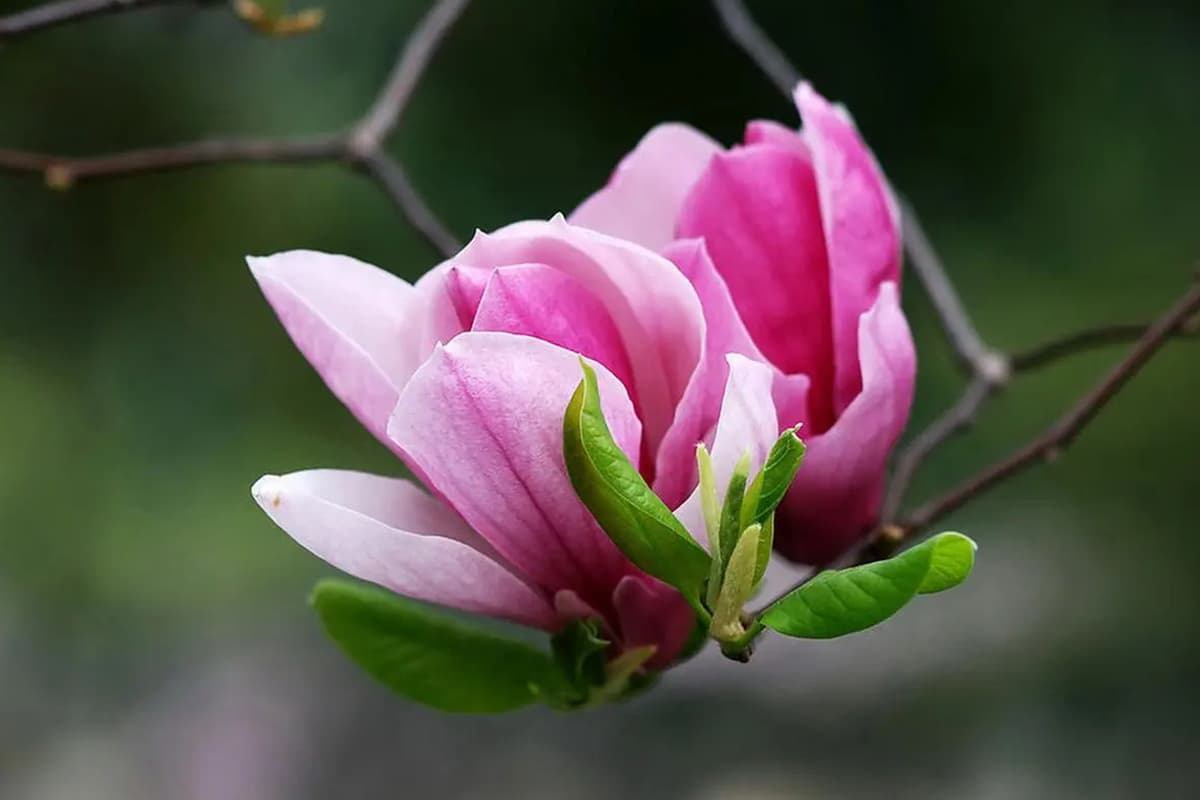
The top is dark green, hairless, the bottom is gray-green, except along the veins sparsely covered with fluff, the rest is hairless.
The flowers and leaves bloom at the same time, are single at the top of the branch, fragrant, cup-shaped, about 6cm in diameter; the flower has 9 petals, fleshy, milky white or light pink to pink, inverted lanceolate or nearly spoon-shaped; there are many stamens, about 1cm long, the filament is about 4mm long, purple-red, the anther sepal tip is yellow; the pistil group is oval.
The pistil stalk is about 5mm long. The stigma is thin and curved. The pistil matures earlier than the stamen, the natural fruiting rate is low, and the tillering ability is strong. This describes the shape characteristics of Magnolia liliflora.
It is native to the mixed forests of central China and the mountain forests, on slopes of mixed forests at altitudes of 700-1800 meters. It likes light and can tolerate a little shade. It prefers a warm, humid climate and can withstand the cold.
It likes fertile, moist, and well-drained sandy soil, is not drought-tolerant, dislikes alkali, and grows poorly on dry, alkaline, and clay soils. The roots are fleshy and fear flooding.
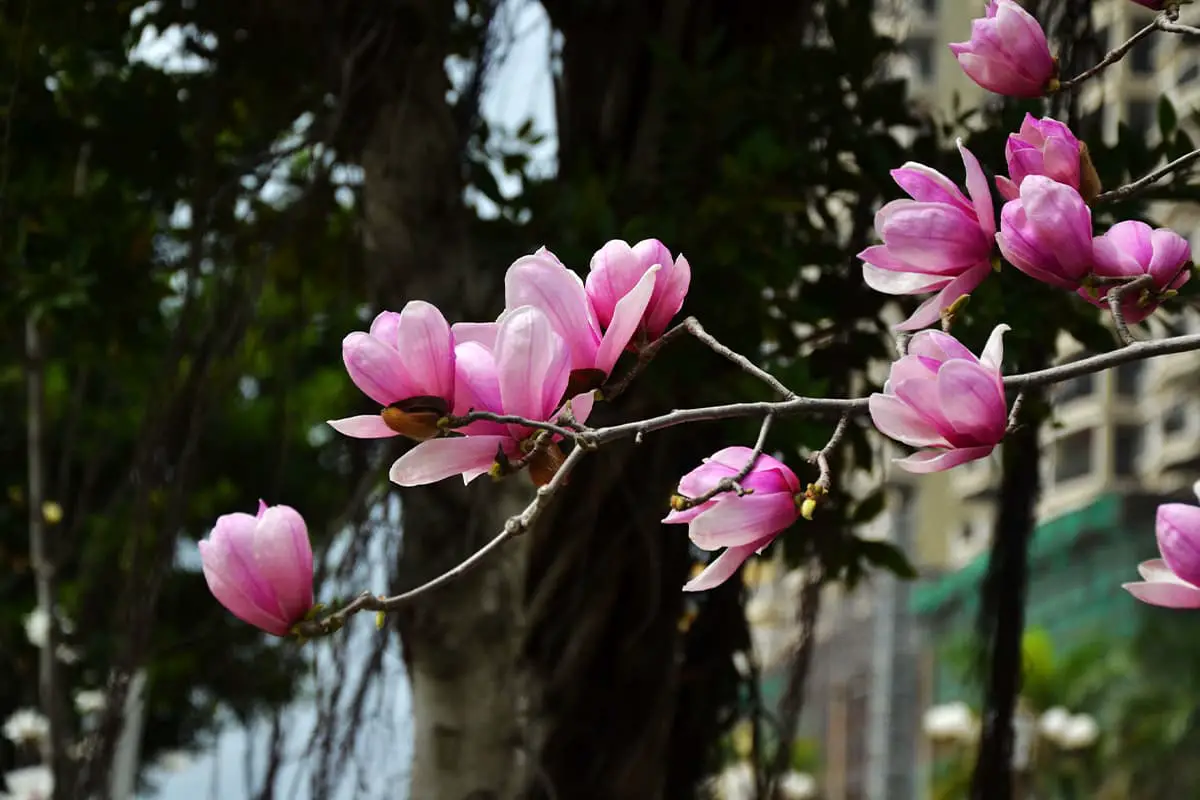
Magnolias are often propagated through layering and division. Sometimes, they are also propagated through seeding. Division can be carried out in both spring and fall seasons.
Mother plants with dense branches are dug out and planted separately, with their roots and short branches pruned. For layering, one or two-year-old branches are selected and propagated either by mound layering or trench layering in early spring.
For seeding, seeds are collected in September, stored in sand during winter, and sown in the following spring. Germination occurs within 20-30 days after sowing.
Cultivation management is simple; it’s important to prevent drought and waterlogging, and to fertilize timely. Transplantation can be performed in fall or before flowering in early spring.
Seedlings are soaked in mud slurry, while larger plants must be moved with a clod of earth. Fertilizer, primarily phosphorus and potassium, should be applied once before and after flowering.
Keep the soil moist during summer heat and fall drought seasons. Prune dead branches, dense branches, and water sprouts before new buds sprout and after flowering.
Magnolias favor light, with slight tolerance to shade. They prefer a warm, moist climate and can withstand cold. They thrive in fertile, moist, and well-drained sandy soils.
They are drought-intolerant, alkali-averse, and grow poorly in dry, alkaline, and clay soils. Their fleshy roots are susceptible to waterlogging, have poor wound healing, and are not easy to survive after transplantation.
They have strong tillering ability. Magnolias can be propagated through division, layering, and cutting.
Transplantation of magnolias is best done before flowering in spring or after leaf fall in autumn. Young and medium-sized seedlings need to be transplanted with the native soil, while larger seedlings should be moved with a clod of earth.
Magnolias prefer fertile conditions. Apply mature compost as a base fertilizer in October or November each year.
After flowering and during the period of bud sprouting and branching, apply 2-3 doses of quick-acting nitrogen fertilizer, cover the roots during drought, and water appropriately. The following year, expect lush flowers and leaves.
For magnolias to grow into a tree shape, it’s necessary to perform tillering, sprouting, and pruning. Root rot, red spider mites, and borers should be timely controlled.
Magnolias love light, have good cold tolerance, but are drought-intolerant. They require fertile sandy soil and can’t tolerate alkalinity. They are susceptible to waterlogging. Magnolia flowers favor a moist, semi-shady climate, fertile soil with good permeability.
Organic fertilizers such as bone meal and cake fertilizer should be applied by digging holes in the winter. Magnolias have strong cold resistance but avoid drought and waterlogging.
Ensure a steady supply of water, regularly spray water on the leaves to increase air humidity, thus preventing leaf yellowing and shedding.
The wax scale insect mainly inflicts damage on flowering plants, with a wide range of hosts and widespread harm. Both adult female and larval insects often congregate on buds, leaves, branches, and stems, sucking sap.
In severe cases, they can completely cover branches, causing leaves to turn yellow, shoots to shorten and deform, leaves to fall, branches to wither, and in some cases, the entire plant to die.
This infestation can also induce sooty mold disease, causing leaves to darken and obstructing photosynthesis, thereby affecting the vitality of the tree and reducing its ornamental value.
The first and second instar nymphs secrete large amounts of honeydew when they feed, which is the main cause of sooty mold disease. Mature female insects often fix themselves in place and become immobile.
Control Methods:
Silvicultural measures: Remove pest-infected plants and prune branches with insects, then promptly remove them from the field for incineration.
Biological control: Protect and introduce Australian ladybugs, large and small red ladybugs.
Chemical control: Spray Bordeaux mixture 1-3 degrees during dormancy; use 40% phoxim emulsifiable concentrate 1000 times plus 10% pirimiphos-methyl wettable powder 1500 times during nymph hatching period. When adults occur, use 800-1000 times of mealybug killer or 40% quick-kill emulsion 1500 times evenly sprayed. When spraying, add a proper amount of diesel to increase its permeability, and the spray must be thorough and uniform. Mealybug killer is particularly effective against scale insects.
Magnolia is a renowned ornamental flowering plant of early spring. In early spring, when the tree is in full bloom with purplish-red flowers, it presents an elegantly modest appearance with a unique charm.
It is suitable for planting in front of halls and behind courtyards in classical gardens, as well as for solitary or scattered planting in small courtyards. The flower buds can be used in herbal medicine, known as “xinyi”.
Flower Language
Symbolizing noble spirits, it is an appropriate gift for Teacher’s Day. It was introduced to Europe in the 17th century (and to Britain in 1790). Due to its large and beautiful flowers, it became widely popular in Europe and America.
An exclusive Magnolia Society was established in the United States, which has cultivated a rich and diverse array of horticultural varieties.
Various Aliases
The Yulan Magnolia has other names such as Yushu, Wangchun, Bai Yulan, Yingchun, Yingchun, and Yutangchun.
The Magnolia (also known as Xin Yi) has alternative names like Linlan, Guilan, Dulan, Mulin, Mubi, Huangxin, Ziyulan, and Nu Lang Hua.
The name “Magnolia” still has divisions and unions in modern times. In botanical records, Yulan and Xin Yi are often distinguished, or Yulan and Magnolia are distinguished, and Magnolia is alternatively known as Xin Yi/Ziyulan.
Botanical Differences
Yulan Magnolias are tall trees while Xin Yi is a shrub or small tree.
The sepals and petals of Yulan Magnolia are often indistinguishable, usually numbering 9, and some horticultural variants have as many as 12-15; in contrast, the sepals and petals of Xin Yi are clearly different with 3 sepals being usually green lanceolate, and 6 petals are purple on the outside and white on the inside.
The blooming period of Yulan Magnolia is earlier than that of Xin Yi, however, the flowering periods vary depending on the region and cannot be solely relied upon for identification.
One type of Yulan Magnolia and Magnolia grows in the south, is an evergreen tree, has small flowers, and a rich aroma. The other type grows in Jiangnan or north, produces large flowers, is not very fragrant, blooms first, then grows leaves after the flowers fall.
The flower buds of Magnoliaceae plants, namely Tianmu Magnolia, Tiannu Magnolia, and Huangshan Magnolia, are used as medicinal material.
The Tianmu Magnolia is a deciduous tree, standing 8-12m tall. Its bark is gray or grayish-white, with longitudinal fissures. Its twigs are thin, with a touch of purple; the terminal buds are covered with white silky hairs.
The leaves are alternate; the petioles are approximately 0.5-2cm long. The leaf blades are obversely lanceolate-elliptical, obversely ovate-elliptical to elliptical, 7-15cm long, 2-7.5cm wide, with a short sharp or tapering tip, a wedge-shaped base, often slightly skewed on one side, with entire margins, and sparse hairs along the veins on the back.
The flowers bloom before the leaves, singly at the branch tips; they are cup-shaped, fragrant, with a diameter of about 6cm. The flower has 9 tepals, fleshy, milky white or pink; numerous stamens, 9-10mm long, the anther connective protrudes into a short point, the filaments are purple-red; the pistils group into a cylindrical shape, about 2cm long, with a straight style.
The aggregate fruit is cylindrical, 4-6cm long, often curved due to the underdevelopment of some carpels. The mericarps are flattened spherically, with a bumpy surface.
The seeds are irregularly flat-rounded, with a fleshy outer seed coat, in a deep red color. The flowering period is from April to May, the fruiting period from September to October.
The Tiannu Magnolia is a deciduous small tree or shrub, 1.5-3m tall or taller. The bark is pale gray-brown; the twigs are slender, sparsely covered with long thin hairs, and the young branches are densely covered with short soft hairs.
The winter buds are elliptical or oblong, covered with short glossy brown hairs. The leaves are alternate; the petioles are 1-4cm long; the stipule scars are half the length of the petioles; the leaf blades are lanceolate-elliptical or obversely ovate-elliptical, 6-14cm long, 4-10cm wide, with a sharp or short tapering tip, a wedge-shaped base, dark green on top, hairless, gray-green underneath, with sparse hairs along the veins, otherwise hairless.
The flowers and leaves bloom at the same time, singly at the branch tips, fragrant, cup-shaped, with a diameter of about 6cm.
The flowers have 9 tepals, fleshy, milky white or light pink to pink, obversely lanceolate or nearly spoon-shaped; numerous stamens, about 1cm long, the filaments about 4mm long, purple-red, the anther connective pointed and yellow at the tip; the pistils group into an elliptical shape. The pistil stalk is about 5mm long. The style is thin and curved.
The Huangshan Magnolia is a deciduous tree, 6-10m tall. The bark is gray-white, almost smooth. The twigs are pale brown, initially hairy, later becoming hairless. The terminal buds are ovate, covered with pale yellow silky hairs.
The leaves are alternate; the petioles are 1-2.5cm long; the leaf blades are obversely lanceolate, obversely lanceolate-elliptical, or elliptical-obversely ovate, 6-14cm long, 3-7cm wide, with a fine pointed or blunt round tip, rarely short tailed blunt pointed, a wedge-shaped base, entire margins, dark green on top, hairless, pale green underneath, covered with extremely fine short hairs, with 7-10 pairs of pinnate lateral veins.
The flowers are white, blooming before the leaves, the flower stalks are thick and long, upright, 1-1.5 cm long, densely covered with pale yellow silky hairs; the flower has 9 tepals, the outer 3 are smaller, membranous, sepal-like, the inner two rounds are white, with a red base; numerous stamens, cylindrical ovate; numerous carpels, each carpel with 2 ovules.
The aggregate fruit is cylindrical, 5-8cm long, 1.8-2.5cm in diameter, hanging down, green when young, slightly purple-red, dark purple-black when ripe, the fruit stalk is about 1cm long, densely covered with yellow long fluffy hairs.
The flowering period is from May to June, the fruiting period from August to September.

Peggie was once a high school mathematics teacher, but she set aside her chalkboard and textbooks to follow her lifelong passion for flowers. After years of dedication and learning, she not only established a thriving flower shop but also founded this blog, “Flowers Library”. If you have any questions or wish to learn more about flowers, feel free to contact Peggie.
 English
  العربية
  Bahasa Indonesia
  Deutsch
  Français
  Italiano
  Nederlands
  Português
  Русский
  日本語
日本語