600+ Types of Flowers A To Z (With Names and Pictures)
Types Of Flowers By Names (A-Z) Types Of Flowers By Color Types Of Flowers By Season Types Of Flowers By Blooming Time 600+ Types of Flowers No. Flower Name No.…

The Kapok tree, a majestic symbol of the South, holds the esteemed position of city flower for Guangzhou, Kaohsiung, and Panzhihua in China. Known as the “Hero Flower,” its blooming coincides with leaf shedding, creating a striking visual display.
The Kapok’s blossoms are vibrant yet elegantly understated. Its robust trunk and towering stature embody a heroic grandeur, while the crimson flowers evoke the noble spirit of a warrior, as if the hero’s blood has stained the treetops. After falling, the flowers create a beautiful carpet beneath the tree, maintaining their color and form in a final, heroic display.
Beyond its ornamental value, the Kapok possesses medicinal properties, including heat-clearing, dampness-eliminating, and detoxifying effects. It’s also utilized in culinary applications for drinks and soups.
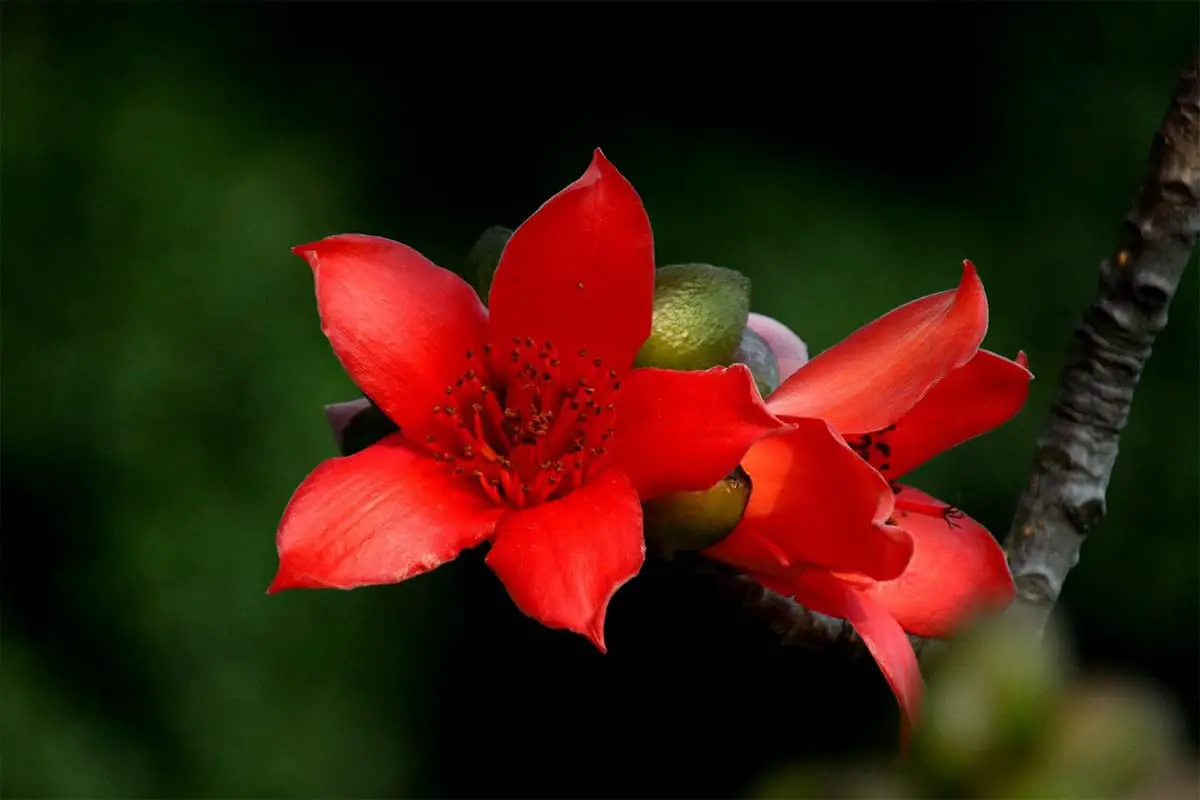
The Kapok (Bombax ceiba) is a deciduous tree that can reach impressive heights of up to 33 meters. Its distinctive upright trunk is adorned with prominent thorns, while its palmate compound leaves are arranged alternately with long petioles.
In early spring, before leaf emergence, clusters of flowers bloom at the branch tips. The corolla, typically red or orange-red, boasts a diameter of about 12cm. The fleshy, elliptical-ovate petals measure approximately 9cm in length, curving outward with inward-rolled edges. Both sides of the petals are covered with stellate trichomes.
The numerous stamens are fused into a tube and arranged in three whorls, with the outermost whorl grouped into five bundles. The fruit is a woody, elliptical capsule reaching 15cm in length. Upon maturity, it splits open, revealing a cotton-like material suitable for stuffing pillows, quilts, and as cross-stitch cotton.
The tree produces numerous ovate, black, smooth seeds nestled within the white fibers. Throughout the year, the Kapok’s appearance transforms: orange-red in spring, lush green in summer, bare in autumn, and stark in winter, each season showcasing a unique charm.
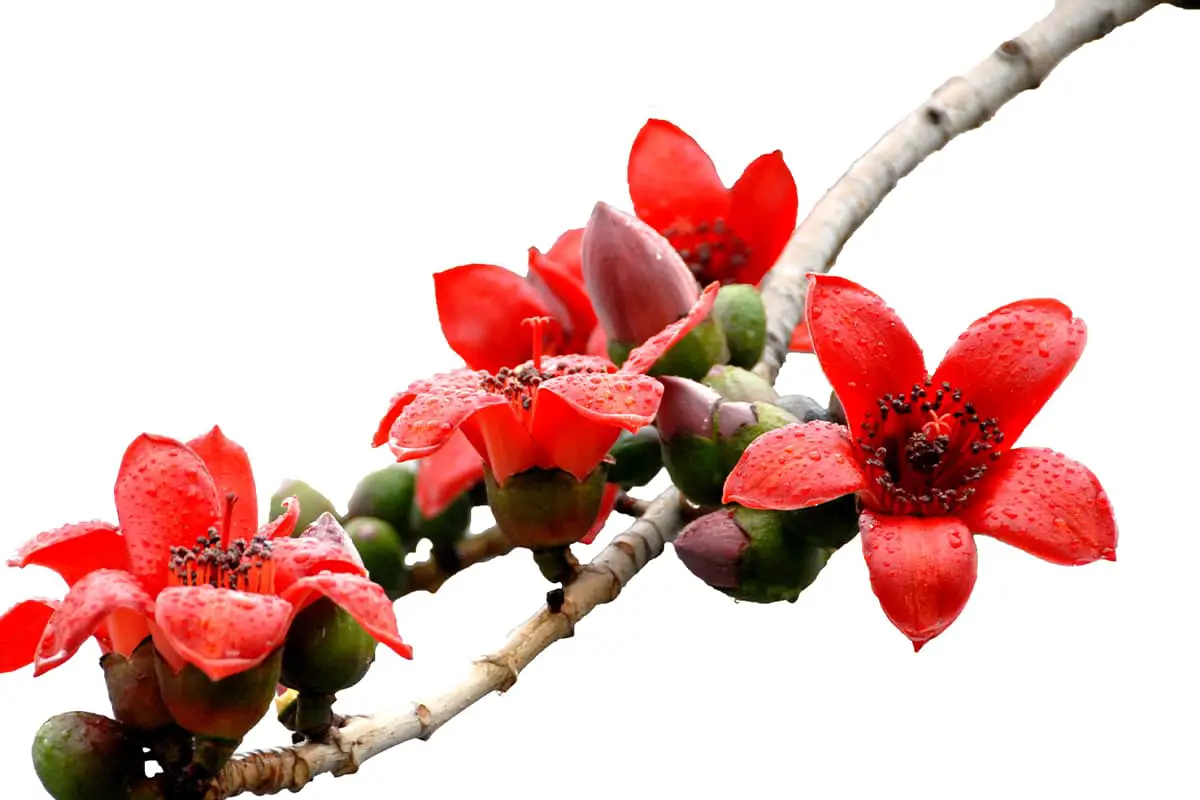
The Kapok is a tropical species that thrives in warm, humid climates. It has low cold tolerance, with prolonged exposure to temperatures of 5-8°C causing cold injury to branches. Frost is particularly detrimental.
In southern regions of South China, such as Guangzhou and Nanning, the tree can typically overwinter outdoors, though frost damage may occur in unusually cold years. In northern parts of South China and throughout North China, pot cultivation is necessary, with winter protection in greenhouses or indoors at temperatures no lower than 10°C.
Kapok trees are heliophiles, requiring full sun exposure and tolerating high temperatures. They should be planted in locations with ample sunlight.
While adaptable to various soil types, from sandy to heavy clay, Kapok trees prefer slightly acidic soil. They exhibit moderate drought tolerance and can withstand brief periods of waterlogging. Though not demanding in terms of soil fertility, they produce more abundant and vibrant blossoms in moderately fertile soil with higher phosphorus and potassium levels. In moist, nitrogen-rich soils, foliage is lush and flower production increases, but bloom color may be less intense.
For optimal growth, apply well-rotted organic matter or compost as a base fertilizer when planting. Supplement with phosphorus and potassium fertilizers before and during peak flowering periods. Although the natural tree shape may not be aesthetically pleasing, Kapok trees respond well to pruning, which can promote a fuller canopy. Planting in groups of 3-5 can enhance their ornamental impact.

While the Kapok’s exact origin is debated, it likely originated in India. It has been widely cultivated throughout South China, Taiwan, the Indochinese Peninsula, and the Malay Archipelago, following historical migration patterns.
Chinese historical records indicate that Zhao Tuo, the King of Nanyue, presented a Kapok tree to the Han court in the 2nd century BC. Both white and red varieties of Kapok flowers exist.
In China, Kapok trees are cultivated in various cities, including Guangzhou, Zhuhai, Kunming, Shenzhen, Quanzhou, Fuzhou, and Xiamen. Guangzhou and Xiamen, in particular, are known for their Kapok-lined streets. The blooming season typically begins just after the Lantern Festival, heralding the arrival of spring with a spectacular floral display.

Peggie was once a high school mathematics teacher, but she set aside her chalkboard and textbooks to follow her lifelong passion for flowers. After years of dedication and learning, she not only established a thriving flower shop but also founded this blog, “Flowers Library”. If you have any questions or wish to learn more about flowers, feel free to contact Peggie.
 English
  العربية
  Bahasa Indonesia
  Deutsch
  Français
  Italiano
  Nederlands
  Português
  Русский
  日本語
日本語