600+ Types of Flowers A To Z (With Names and Pictures)
Types Of Flowers By Names (A-Z) Types Of Flowers By Color Types Of Flowers By Season Types Of Flowers By Blooming Time 600+ Types of Flowers No. Flower Name No.…

The Ipomoea nil, also known as Japanese Morning Glory, Chinese Morning Glory, Morning Glory, and Industrious Lady, among others, is named for its trumpet-shaped flowers. In some regions, it’s also referred to as Trumpet Flower.
It is an annual climbing herbaceous plant belonging to the Convolvulaceae family and Ipomoea nil genus and is a common ornamental plant. The leaves of the Morning Glory are nearly round, usually 3-5 lobed, and range in length from 4-15 cm. Its flowers are either solitary or grouped in pairs, typically growing in the leaf axils.
With rich and varied colors like blue, crimson, peach-red, and purple, or mixed hues, they bloom mostly in the summer and hold high ornamental value.
Ipomoea nil belongs to the Convolvulaceae family and the Ipomoea nil genus, and it’s an annual climbing herb. Its trumpet-shaped flowers are why it’s called Trumpet Flower in some places.
Ipomoea nil seeds are generally sown in spring, and the plant flowers in summer and fall. It comes in many varieties, with flower colors of blue, crimson, peach-red, purple, and mixed colors. The changes in petal edges are quite diverse, making it a common ornamental plant.
The egg-shaped fruit can be used for medicinal purposes. Ipomoea nil leaves are trifurcated with a heart-shaped base. The flowers are white, purplish-red, or purplish-blue, funnel-shaped, and the whole plant is coarsely hairy. The flowering period is most abundant in summer. The seeds have medicinal value.
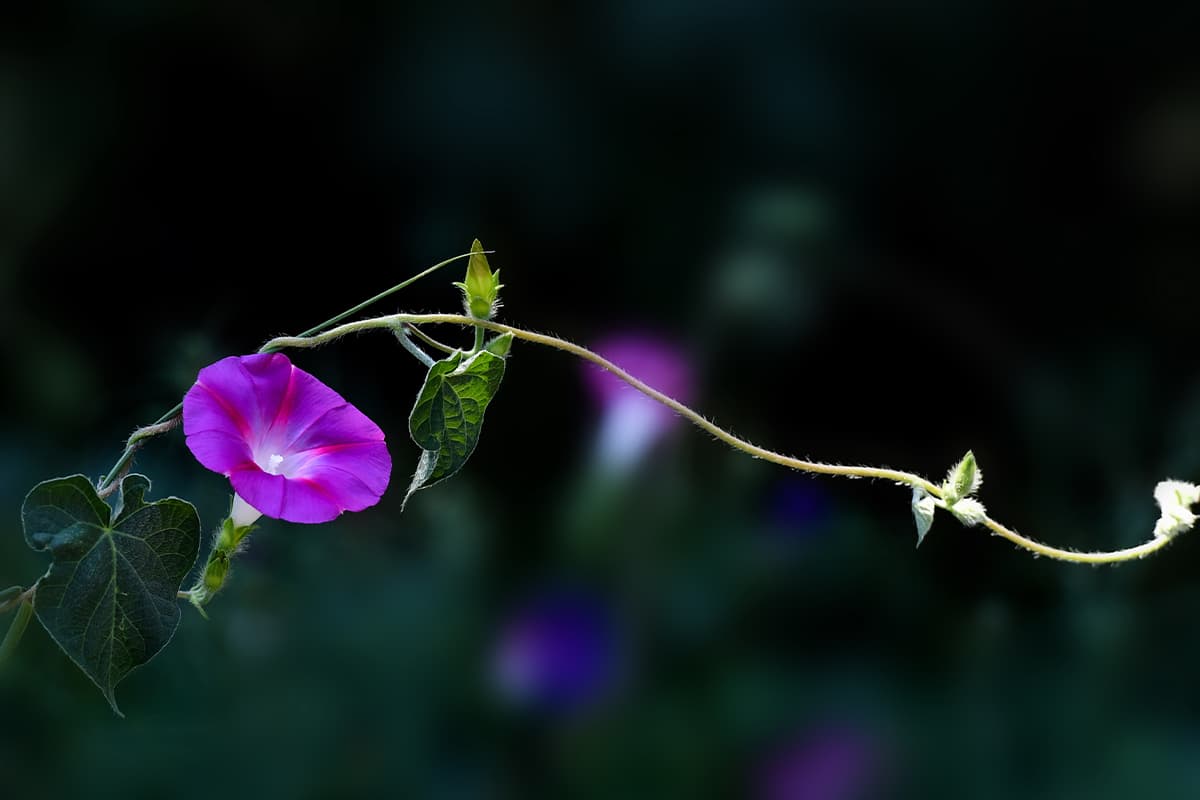
There are many varieties of Ipomoea nil, with more than 60 types worldwide. Common ones include the Split Leaf Ipomoea nil, Large Flower Ipomoea nil, Double Ipomoea nil, Tricolor Ipomoea nil, and so on.
Split Leaf Ipomoea nil: This variety has deeply split leaves, medium-sized flowers in singles or trios, and comes in shimmering blue, rose-red, or white.
Round Leaf Ipomoea nil: The leaves are broad and heart-shaped with smooth edges, and the flowers are small, available in white, rose-red, and shimmering blue.
Large Flower Ipomoea nil: This variety has long-stalked leaves with three lobes, the central lobe being larger, and the leaves often have irregular yellow-white patches. Flowers are single or grow in groups of three in leaf axils, with short stems shorter than the leaf stalk.
The flowers are large, with a diameter of up to 10 cm or more. Originally from the tropics of Asia and Africa, this species is most commonly cultivated in Japan and is known as Asagao. It has been bred into numerous horticultural varieties with a wide range of flower shapes and rich colors and is popular in many places.
Tricolor Ipomoea nil: This type has smooth stems and leaves, large flowers with a vivid sea blue color. The variety also comes in pale red or white, with the inner side of the tube often milky yellow. It’s native to tropical America and occasionally cultivated domestically. The flowers do not wilt until after noon.
Double Ipomoea nil: This type of Ipomoea nil is relatively rare. The leaves
The Ipomoea nil grows in shrubs on slopes at elevations of 100-200 meters (up to 1600 meters), along dry river valleys, by the road, near gardens and houses, or it can be cultivated.
This plant is adaptable and thrives in plenty of sunlight but can also tolerate semi-shade. It enjoys a warm and cool climate, can withstand heat, but is not frost-resistant. It prefers fertile and loose soil, is drought-resistant, and tolerates saline-alkali soil. The ideal temperature for seed germination is 18-23°C, and seedlings can grow at temperatures above 10°C.
Ipomoea nil is found in most regions in China except for some provinces in the northwest and northeast. This species originated in tropical America and is now widely grown in tropical and subtropical regions.
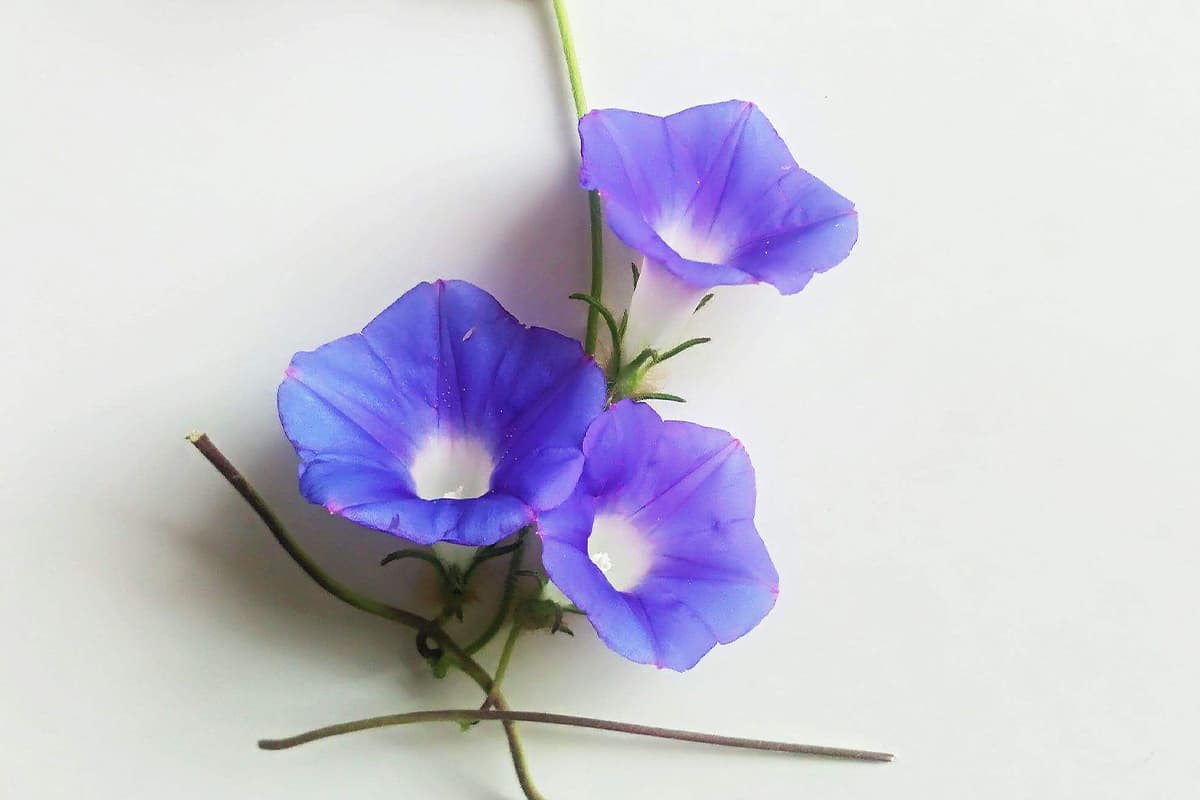
The Ipomoea nil is an annual vine, with stems covered in short downy hair mixed with long hard hair that either points downwards or outwards. Its leaves are broad ovate or nearly round, with deep or shallow three-lobes, occasionally five-lobed, 4-15 cm long, 4.5-14 cm wide.
The base is rounded, heart-shaped, with the central lobe being elongated oval or ovate, gradually or suddenly pointed. The lateral lobes are shorter, triangular, with sharp or rounded edges, and the leaf surface is covered in sparse or dense soft hair. The leaf stalks are 2-15 cm long, with the same hair coverage as the stem.
The flowers grow from the leaf axils, either singly or usually in pairs at the top of the inflorescence stalk. The length of the inflorescence stalk varies, typically shorter than the leaf stalk, sometimes longer, and has the same hair coverage as the stem. The bracts are linear or leaf-like, with spreading soft hair.
The flower stalk is 2-7 mm long. The calyx is almost equal in length, 2-2.5 cm long, and lanceolate-linear, with the inner two pieces slightly narrower. The outside is covered in spreading stiff hair, more densely at the base, sometimes also mixed with short downy hair.
The corolla is funnel-shaped, 5-8 cm long, blue-purple or purplish-red, with a lighter colored corolla tube. The stamens and pistil are enclosed. The stamens vary in length. The filament base is downy. The ovary is hairless, and the stigma is head-shaped.
The fruit is nearly spherical, 0.8-1.3 cm in diameter, and splits into three sections. The seeds are ovoid-triangular, about 6 mm long, dark brown or rice-yellow, covered with short brown velvety hair.
For potting, you can choose sandy loam rich in humus. Mix 4 parts of leaf mold, 5 parts of garden soil, and 1 part of river sand. Apply a small amount of bone meal at the bottom of the pot as base fertilizer.
Start applying dilute liquid fertilizer one week after potting. During the rest of the time, apply a dilute cake fertilizer or compound fertilizer every 2-3 weeks. During the bud-forming period, spray 1-2 times with a 0.2% potassium dichloride water solution to promote larger and brighter flowers.
are no different from other Ipomoea nils, but the petals are multiple and overlap as they grow.
Ipomoea nil thrives in warm temperatures, specifically between 18 and 23 degrees Celsius. It is heat-tolerant, so you generally don’t need to worry about it in the summer. However, it does not tolerate cold well, so you need to protect it from the cold in the winter, preferably keeping it around 10 degrees.
Good light conditions will promote its vigorous growth and good flowering. Therefore, it is best to have ample light. However, it does have some shade tolerance and can be placed in semi-shade. But it should not be completely dark.
Ipomoea nil has good drought and waterlogging tolerance. Although it adapts well to moisture, it is best to provide ample water during its growth period to ensure its vitality. Water frequently, especially in summer, the watering needs to be ample, but water should not accumulate in the pot.
Ipomoea nil is a vine plant with strong branch and leaf reproduction capability. Therefore, after planting, it is best to set up supports. Insert a bamboo pole in the middle of the flower pot, or place the flower pot at the railing, allowing it to twine and grow.
However, this is still not enough, timely pruning is necessary. When the vines grow to 6-7 leaves, pinch off the top tip. This can ensure larger flowers, continuous blooming, and also prevent Ipomoea nil from growing too fast and becoming difficult to control.
As the Ipomoea nil plant grows, its requirements for pot soil also increase. After maintaining for a period of time, it is necessary to replace the pot soil in time. It is best to choose loose, breathable, and nutrient-rich soil, such as: garden soil, peat, perlite, coarse sand, organic fertilizer (slow-release fertilizer). Each component can be selected in equal parts, mixed evenly, and then potted for Morning Glory seedlings.
Clean Water: Do not use fertilizer water or muddy water to irrigate the leaves. Try to avoid getting soil on the leaves when watering.
Pinching Off Flowers: The vines will only flower when they grow vigorously. Ideally, the first leaf of the vine will produce axillary buds, and the second and third leaves will produce flower buds. When flower buds differentiate, you can pinch off some, which is more conducive to flowering.

The most common method of propagating Ipomoea nil is by sowing seeds, as Ipomoea nil is an annual plant. The seeds have a high germination rate and low environmental requirements. Even without any special treatment, the survival and germination rate of the seeds after sowing is quite high, usually sprouting within about a week.
Collecting seeds: The maturation time of seeds varies widely, so seeds need to be collected promptly after maturation. After collecting, seeds should be left to air dry in a cool and ventilated place. If not collected in time, the seeds will fall to the ground, making collection more difficult.
Soaking and sowing: Ipomoea nil seeds can be self-sown after maturation. If you are sowing the seeds yourself, to ensure a better germination rate and survival rate, it’s suggested to cut through the seed coat with a sharp knife first, then soak the seeds in warm water.
After soaking the seeds for a whole day, you can start sowing. Just press the seeds into the soil with your fingers to a depth of about 2 cm. If planted too shallow, it is prone to protuberances, which is not conducive to later growth.
Sowing time: The maturation time of Ipomoea nil seeds is in summer and autumn each year. Seeds can be sown after maturation or in the spring of the following year. If you are in the southern region, sowing in autumn will result in flowering by the next spring.
If sown in the spring, it can flower by summer. In the northern regions due to climate limitations, sowing is generally done in spring, but it will not flower until summer.
Ipomoea nil can also be propagated by cuttings. Press the vine nodes into the soil, and after they develop roots, cut them off and plant them.
Medicinal Value
The medicinal part of Ipomoea nil is its seeds, known as “Qian Niu Zi” in Chinese, also called “Black Ugly”, “White Ugly” or “Double Ugly”.
Ornamental Value
Ipomoea nil, a common vine flower in summer and autumn, can be used for shading in small courtyards and in front of room windows, beautifying small pergolas and fences, and can also be used as ground cover. Among the many flowers and plants in summer, Ipomoea nil can be considered a favorite. Ipomoea nil has a common name called “Diligent Lady”.
As the name implies, it is a very diligent flower. As soon as the rooster has finished crowing, Ipomoea nil flowers, winding around the fence, bloom like trumpets. In the dawn, people breathe in the fresh air while feasting their eyes on the flowers dotted among the green leaves, which is quite a pleasure.
Flower Language of Ipomoea nil
The flower language of Ipomoea nil is eternal love, symbolizing love, calmness, and illusion.
Ipomoea nil is the birthday flower for August 6th. The flower language is honor. You like to imitate the savvy and competent adults, which makes you very interesting. You have a good relationship with the opposite sex and like to pursue mature love from adults.
But how can you, who are not deeply involved in the world, understand the world of adults? Just be natural, your heart will be more comfortable.

Peggie was once a high school mathematics teacher, but she set aside her chalkboard and textbooks to follow her lifelong passion for flowers. After years of dedication and learning, she not only established a thriving flower shop but also founded this blog, “Flowers Library”. If you have any questions or wish to learn more about flowers, feel free to contact Peggie.
 English
  العربية
  Bahasa Indonesia
  Deutsch
  Français
  Italiano
  Nederlands
  Português
  Русский
  日本語
日本語