600+ Types of Flowers A To Z (With Names and Pictures)
Types Of Flowers By Names (A-Z) Types Of Flowers By Color Types Of Flowers By Season Types Of Flowers By Blooming Time 600+ Types of Flowers No. Flower Name No.…

Gazania rigens, commonly known as Treasure Flower, belongs to the daisy family and is a perennial herbaceous plant. It reaches a height of 30-40cm, with lanceolate leaves that are borne on short stems, entire or pinnately lobed.
The upper side of the leaves is green, while the underside is silvery white. The large capitulum inflorescence often features purple-black or purple spots at the base, or dark stripes in the middle.
The flowering season extends from late spring to summer. The plant earned its name due to its resemblance to a medal.
Native to South Africa, the Treasure Flower has also spread to regions like Australia.
It thrives in warm, sunny environments and is sensitive to moisture levels, yet it is drought-resistant, heat-tolerant, and can grow in poor soils, preferring cooler locations while also withstanding some cold.

Common propagation methods include seeding, cuttings, and division.
With its large and beautiful blooms, the Treasure Flower is ideal for beds or lawn edges, and it enhances courtyards. It can also be grown in pots for decorating balconies and windowsills.
Known as the “medal flower,” it symbolizes honor and strength, reflecting the glory and prestige associated with medals.
The Medal Daisy is named for its dark, eye-like center spots that resemble medals.
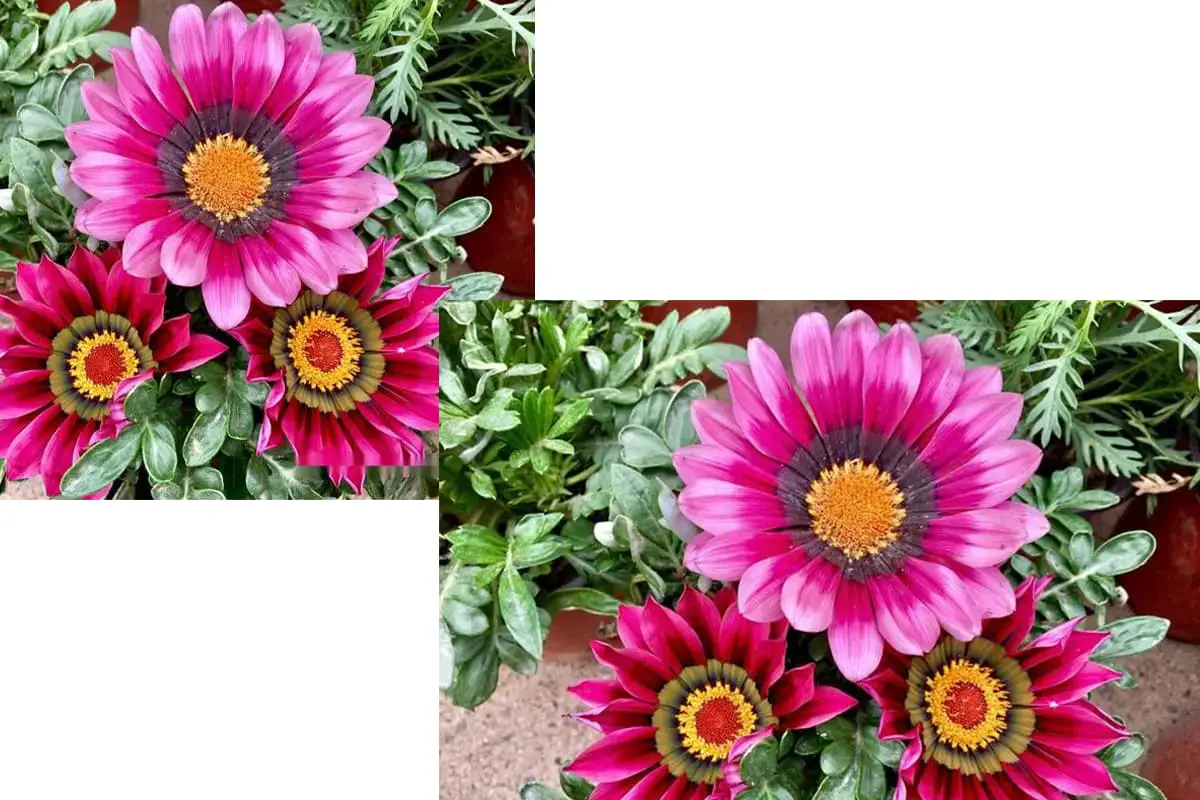
The Medal Daisy is a perennial herbaceous plant standing 20-40 centimeters tall with a rhizome.
It sprouts leaves from the base, which are either lanceolate or inversely lance-shaped, with either entire edges or slightly pinnate lobes, and the underside densely covered with white hairs. The plant offers a rich variety of leaf shapes.
Its capitulum inflorescence stands alone on a long peduncle, with a flower head diameter of 7-12 centimeters, comprising both ray and disc florets.
Ray florets are arranged in one to three whorls, presenting a colorful array of white, yellow, and orange-red hues, with glossy petals, some striped, and the center often featuring black, brown, or white spots.
The plant comes in various heights and can be either bushy or trailing; it blooms from May to October.

The Medal Daisy thrives in sunlight and cooler locations, is drought-tolerant, and can endure poor soil. It prefers temperatures between 15-20°C and can survive winters with temperatures not dropping below 5°C.
Although it can withstand brief periods at 0°C, prolonged exposure can cause frost damage. This daisy prefers fertile, loose, and well-drained sandy loam soil.
It enjoys warm, sunny environments, is sensitive to moisture, and prefers cooler growing conditions, also demonstrating a certain degree of cold resistance.

Native to South Africa.
The Medal Daisy can be propagated by seeds, division, or cuttings.
Sow in April for spring or in September for autumn. For small quantities, pot sowing is possible, with 560-580 seeds per gram, and about 15 grams per square meter in nursery beds. Seeds should be lightly covered with 0.8 centimeters of fine soil.
Optimal germination temperature is 16-18°C, with germination occurring 14-30 days after sowing. Seedlings with a pair of true leaves should be transplanted into 4 cm seedling trays or into furrows spaced 8 cm apart.
During the seedling stage, maintain temperatures between 15-25°C and moderate soil moisture, ensuring adequate light exposure.
Harden off seedlings by lowering temperatures and increasing ventilation 5-7 days before planting out after the last frost. In some regions, seeds have the capacity for self-propagation.
In March or April, before stem and leaf growth, dig out the overwintered mother plants or unpot them, and vertically slice through the crown, ensuring each division has buds and roots, then pot directly.
Typically done in spring or autumn, indoor cultivation allows for year-round cutting, while outdoor cultivation is best during the cooler spring and autumn seasons.
Take cuttings with stem nodes, leaving the top two leaves. If leaves are too large, trim by half to reduce water loss through the leaves.
Plant in a sand bed at room temperatures of 20-24°C, maintaining high humidity. Roots should form within 20-25 days. A 1-2 second treatment with 0.1% indolebutyric acid can hasten rooting.
Plant each bud in well-drained substrate. When cutting, a milky sap exudes; wash thoroughly to ensure the cutting absorbs water before inserting.
Rooting is easy, and after that, the process is similar to division. Start with a small seedling and plant out the following spring. Once rooted, move to an 8 cm diameter container for cultivation.
Explants often use shoot tips and flower buds. After sterilization, shoot tips are inoculated on MS medium supplemented with 6-benzylaminopurine (1-3 mg/L) and naphthaleneacetic acid (0.2 mg/L) to induce callus formation and bud differentiation.
Then, transfer to MS medium with 1 mg/L naphthaleneacetic acid for 30-40 days to allow the young plantlets to root and develop into complete small plants.
Gazania thrives in the sun and prefers cooler locations. It is drought-resistant and tolerant of poor soil. Partially frost-hardy, it overwinters well in areas with milder winters. Adequate sunlight is necessary for growth and flowering.
Insufficient light will result in soft leaves, fewer buds, smaller flowers, and pale colors. In contrast, ample sunlight ensures vibrant colors and continuous blooming.
Gazania grows best at temperatures between 59-68°F (15-20°C). From March to September, 55-75°F (13-24°C) is ideal, and from September to March, 45-55°F (7-13°C).
Gazanias can adapt to temperatures above 86°F (30°C), although leaf growth slows and blooming diminishes. They can survive winter temperatures above 41°F (5°C) and short exposures to 32°F (0°C), but prolonged freezing can cause damage.
Gazanias are sensitive to moisture. During the growing season, moist soil is required, but excessive moisture during the rainy season can cause waterlogging and plant death.
During the hot summer months, high humidity and waterlogged pot soil can negatively affect plant growth and flowering.
Choose fertile, loose, well-drained sandy loam. For potting soil, a mix of equal parts potting soil, leaf mold, and coarse sand is recommended.
Gazanias should be planted in full sun. After fertilizing and tilling the soil, form ridges 0.50-0.53 meters wide or beds 1 meter wide, planting a single row per ridge or two rows per bed, with a plant spacing of 33-40 centimeters.
Water thoroughly after planting. Weed and loosen the soil regularly to maintain a crumbly, weed-free bed. Due to their compact growth habit, pinching is not necessary.
Harvest seeds promptly as they mature; seed production is low. Gazanias are frost-hardy but cannot tolerate prolonged freezing.
In warmer regions, plants may need covering to overwinter, while in the colder northern regions of China, they cannot survive winter outdoors.
Pots with a diameter of 8-12 centimeters are commonly used. Seedlings with 3-4 leaves may be transplanted from 4-centimeter starter trays to 8-12 centimeter pots.
During the growth period, apply a light fertilizer every 15 days and ensure full exposure to light. If not preserving seeds, deadhead after blooming to conserve energy and encourage more buds to form.
Gazanias adapt well to a wide range of temperatures and light conditions, growing well from 50-86°F (10-30°C). In greenhouses, they can bloom all year round.
Common issues include root rot and leaf spot, which can be treated with a fungicide spray of 50% metalaxyl wettable powder diluted 800 times for root rot, and 25% chlorothalonil wettable powder diluted 1000 times for leaf spot.
Pests like red spider mites and aphids can be controlled with a 2.5% rotenone emulsion diluted 1000 times.
Gazania, with its low stature, large flowers, and vibrant colors, has a long blooming period, making it an excellent ornamental plant.
It can adorn gardens and courtyards or be potted for balcony and windowsill decoration. It is a common potted flower and bedding plant in gardens.
Gazania is also known as the “Treasure Flower,” symbolizing honor and strength, reflecting its dazzling glory and prestige.

Peggie was once a high school mathematics teacher, but she set aside her chalkboard and textbooks to follow her lifelong passion for flowers. After years of dedication and learning, she not only established a thriving flower shop but also founded this blog, “Flowers Library”. If you have any questions or wish to learn more about flowers, feel free to contact Peggie.
 English
  العربية
  Bahasa Indonesia
  Deutsch
  Français
  Italiano
  Nederlands
  Português
  Русский
  日本語
日本語