600+ Types of Flowers A To Z (With Names and Pictures)
Types Of Flowers By Names (A-Z) Types Of Flowers By Color Types Of Flowers By Season Types Of Flowers By Blooming Time 600+ Types of Flowers No. Flower Name No.…

Gaillardia pulchella is an annual herbaceous plant in the family Asteraceae. It grows to a height of 20-60 centimeters and has multiple branches. The entire plant is covered in soft hairs.
The leaves are alternate, ranging from rectangular to lanceolate or spoon-shaped, with entire margins or lobed at the base. The terminal inflorescence is a head-like structure with a long stalk.
The ray flowers are yellow with a brownish-purple base and 2-3 toothed lobes at the apex. The flowering period is from July to October.
Indian blanket is native to the western part of North America, but it is cultivated worldwide. It is drought-tolerant and heat-resistant, but not frost-tolerant.
It prefers full sunlight but can also tolerate partial shade. It thrives in well-drained and loose soil. The primary method of propagation is through seed sowing.
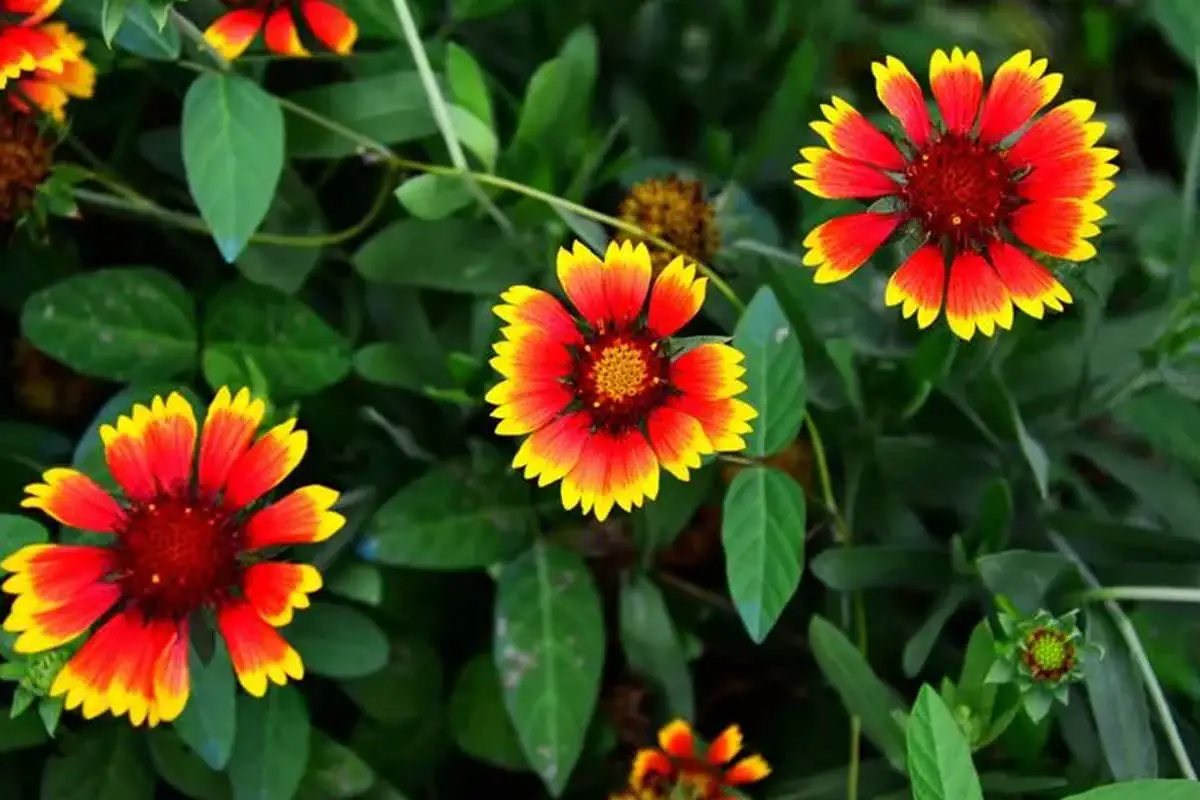
Indian blanket can be used for mass planting or bordering in flower beds and flower borders. It can also be used in wildflower meadows, grassy areas, or container gardening, and it is suitable for cut flowers.
Indian blanket is known for its robust and drought-tolerant nature, making it an environmentally-friendly plant for sand dune stabilization and soil conservation.
In terms of medicinal applications, Indian blanket contains gaillardins, which have anti-cancer properties. In some traditional agricultural regions, people burn Indian blanket at night to repel mosquitoes.
The symbolic meanings of Indian blanket include unity and collaboration. It is the county flower of Penghu County in Taiwan and the state flower of Oklahoma in the United States.

Indian blanket is an annual herbaceous plant that grows to a height of 20-60 centimeters. The stems are branched above the middle, with ascending branches covered in short soft hairs or rusty-colored hairs.
The lower leaves are spoon-shaped or inverted lanceolate, measuring 5-10 centimeters long and 1-2 centimeters wide. They have blunt toothed or shallowly divided margins, acute tips, and almost no petioles.
The upper leaves are elongated elliptical, inverted lanceolate, or spoon-shaped, measuring 3-9 centimeters long. They are either entire or have sparse serrations or three shallow lobes above the middle.
The base is either sessile or heart-shaped and partially clasps the stem. Both sides of the leaves are covered in appressed hairs.
The head-like inflorescence has a diameter of 5 centimeters. The bracts are lanceolate, measuring 1.5 centimeters long, with long marginal hairs and glandular dots on the back, and densely covered in long soft hairs at the base.
The ray flowers are yellow with a purple base. The ray florets are broadly wedge-shaped, measuring 1 centimeter long, with 2-3 lobes at the apex. The disc florets have triangular lobes that gradually taper into awn-like tips and are covered in jointed hairs.
The achene is 2 millimeters long, covered in long soft hairs at the base. The pappus is 5 millimeters long. The flowering and fruiting period is from June to August.
Indian blanket is relatively drought-tolerant and heat-resistant, preferring high temperatures but not tolerating cold temperatures.
It prefers full sunlight but can tolerate partial shade. It can be grown in sandy soil with good drainage. Timely fertilization is necessary during cultivation.
Indian blanket is native to the western part of North America and is cultivated worldwide.
Indian blanket is commonly seeded in the summer. Soak the seeds in warm water for 3-10 hours until they absorb water and swell. After the seedlings emerge, remove the plastic film in a timely manner and expose the seedlings to sunlight before 9:30 am or after 3:30 pm.
Otherwise, the seedlings will grow weak. Once most of the seedlings have grown 3 or more leaves, they can be transplanted into pots.
Propagation of Indian blanket through cuttings is usually done in conjunction with pruning. Use healthy, disease-free, and robust top shoots as cuttings. The ideal temperature for rooting cuttings is 18-25°C.
Pay attention to light management, as stronger light increases the temperature inside the cuttings, enhances transpiration, and increases water consumption, which is not conducive to the survival of the cuttings.
When potting young Indian blanket seedlings, place broken pieces of tile or coarse sand at the bottom of the flower pot as a drainage layer. Apply some well-rotted fertilizer as basal fertilizer, followed by a layer of prepared soil, and finally place the plants.
After potting, water the flower pot thoroughly and keep it in a shaded environment for a period of time.
Indian blanket, like other flowering plants, requires a relatively large amount of fertilizer and water.
However, it is important to follow the principles of “light fertilization, frequent application, small amount, and balanced nutrition” and keep the leaves and flowers dry after fertilization.
Summer and autumn are its peak growth seasons. Reduce fertilization during the flowering period to promote seed maturation.
Indian blanket prefers higher air humidity. Low air humidity accelerates the withering of individual flowers. It is also sensitive to rain and requires dry leaves at night.
The optimal relative humidity is 65-75%. It is heat-tolerant but not frost-tolerant, preferring abundant sunlight and tolerating partial shade.
Pruning is important for the growth of Indian blanket. When the seedlings have grown more than 6 leaves, pinch the tops to promote branching. Subsequently, pinch the tops once during the growth process to shape the ideal plant form and stimulate more flowering.
Indian blanket contains gaillardins, which have anti-cancer properties. In some traditional agricultural regions, people burn Indian blanket at night to repel mosquitoes.
Indian blanket has beautiful flowers, vibrant colors, and a long flowering period, making it suitable for cultivation in flower beds and clusters.
Indian blanket is wind-resistant, moisture-tolerant, and resilient. It is drought-tolerant and the entire plant is covered in soft hairs, preventing water loss. It is a good plant for windbreaks and sand dune stabilization.
Indian blanket is the state flower of Oklahoma, USA, and the county flower of Penghu County, Taiwan. It can be seen everywhere in Penghu, earning it the nickname “Chrysanthemum Island.”
The flower language and symbolic meanings of Indian blanket are cooperation, unity, and working together.

Peggie was once a high school mathematics teacher, but she set aside her chalkboard and textbooks to follow her lifelong passion for flowers. After years of dedication and learning, she not only established a thriving flower shop but also founded this blog, “Flowers Library”. If you have any questions or wish to learn more about flowers, feel free to contact Peggie.
 English
  العربية
  Bahasa Indonesia
  Deutsch
  Français
  Italiano
  Nederlands
  Português
  Русский
  日本語
日本語