Daphne odora “Aureomarginata” is a variant of the Daphne family, a perennial evergreen shrub. It has robust branches, typically bifurcated, with nearly cylindrical twigs that are purplish-red or purplish-brown and hairless.
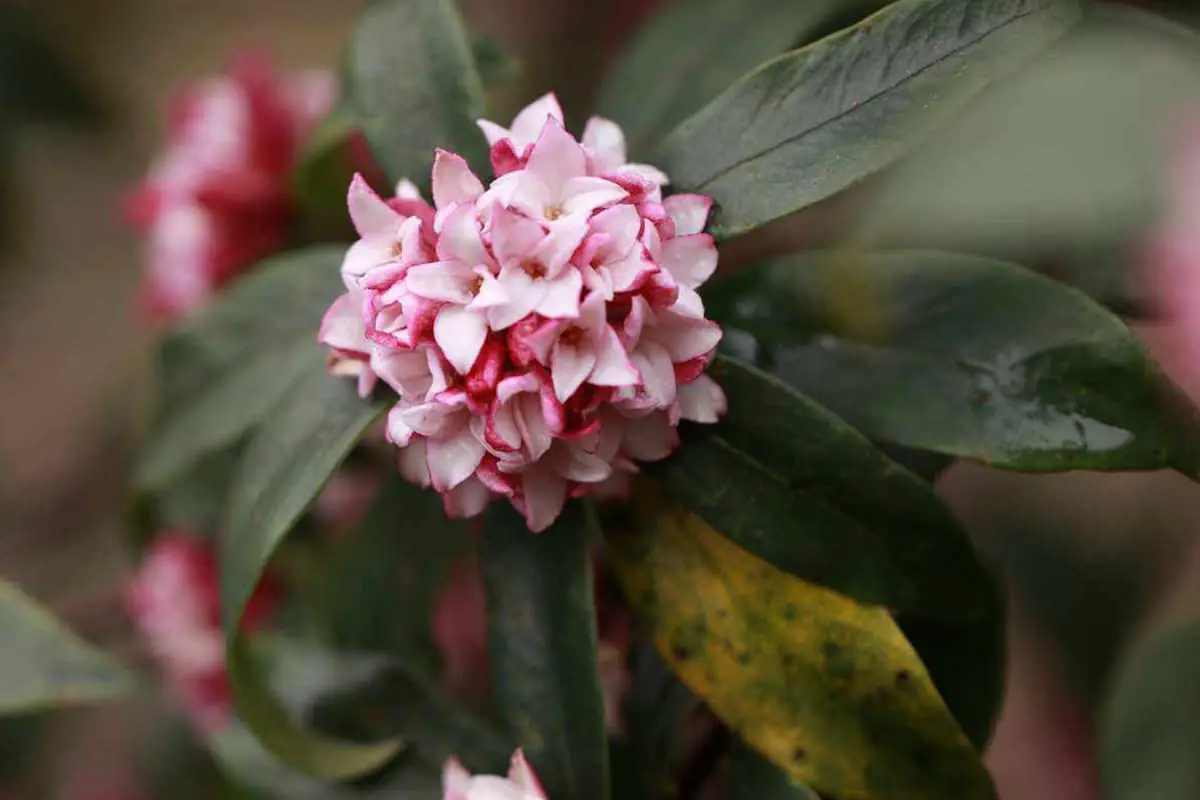
The flowers bloom in terminal inflorescences, with a tubular calyx that splits into four at the top, each measuring approximately 1.5 cm in diameter. Each flower consists of dozens of smaller flowers that bloom from the outside inward.
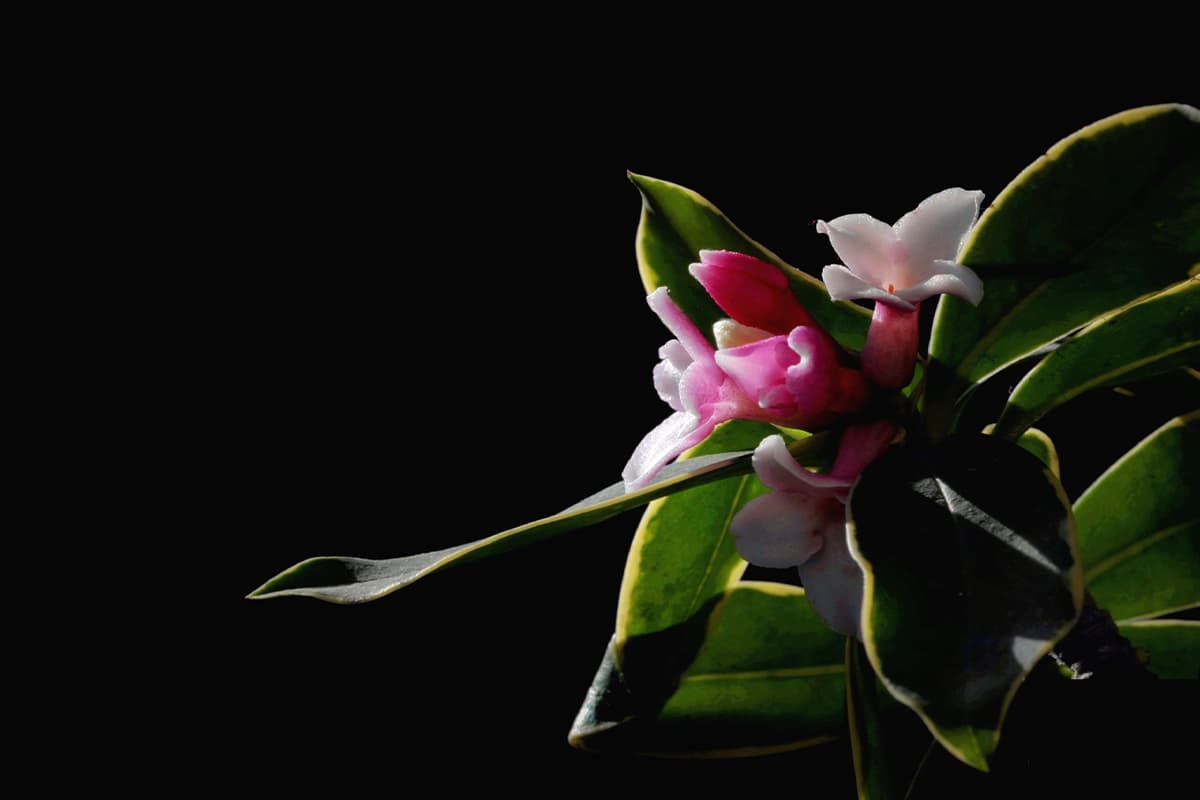
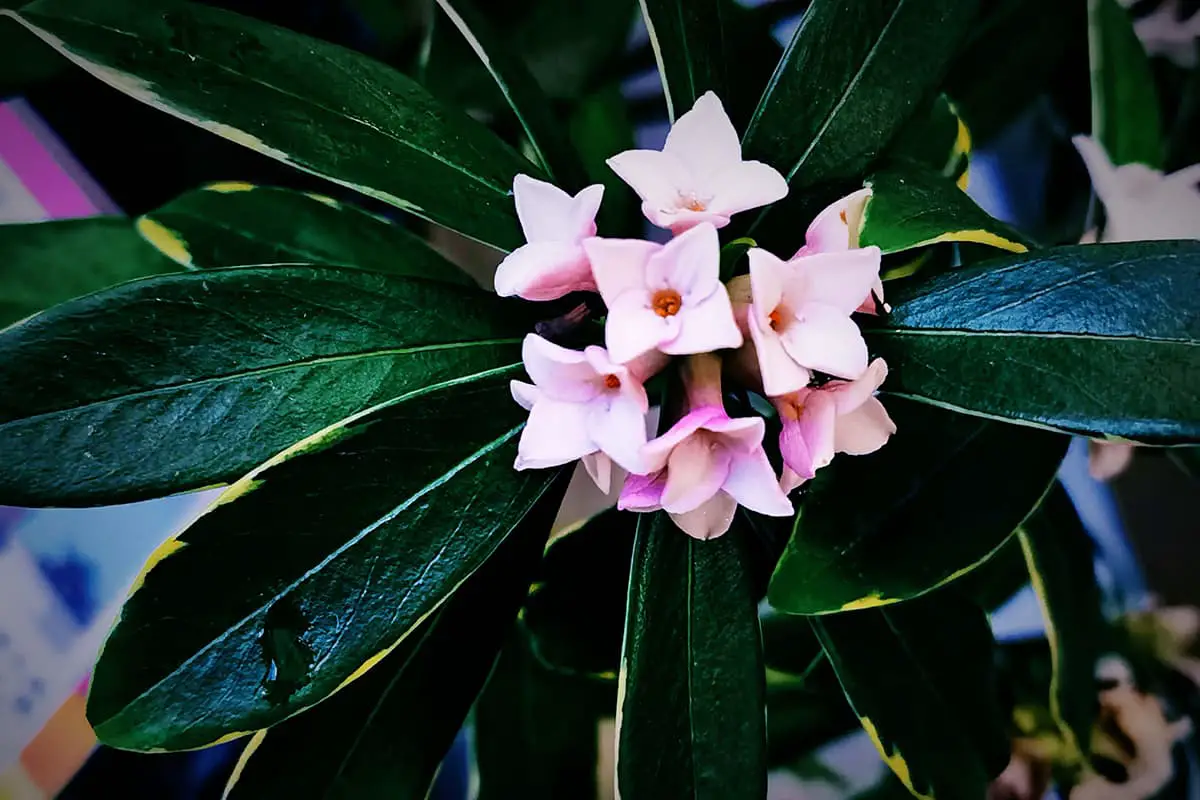
The blooming period lasts over two months, with the peak during the Chinese New Year, displaying vibrant purplish-red flowers with a rich fragrance. The leaves have pale yellow edges and green centers.
This plant, a traditional Chinese flower and a renowned flower worldwide, is native to the Yangtze River region and grows in shady, moist areas of low hills.
Known for its “color, fragrance, form, and charm,” the Golden-edged Daphne has been celebrated as “the peony is the national beauty with heavenly fragrance, but the golden-edged Daphne is the best.”
Besides its ornamental value, its root can be used medicinally, and the bark fibers can be used as raw material for papermaking.
I. Morphological Characteristics
Golden-edged Daphne is an evergreen upright shrub with robust, typically bifurcated branches. The nearly cylindrical twigs are purplish-red or purplish-brown and hairless.
The flowers are in terminal inflorescences, with a tubular calyx that splits into four at the top, each measuring approximately 1.5 cm in diameter. Each flower consists of dozens of smaller flowers that bloom from the outside inward.
The blooming period lasts over two months, peaking during the Chinese New Year, with vibrant purplish-red flowers with a rich fragrance.
The leaves are alternate, papery, oblong or inverted ovate-elliptical, 7-13 cm long and 2.5-5 cm wide. The leaf tip is blunt, the base is wedge-shaped, and the margins are entire.
The topside is green, the underside is pale green, both hairless, with 7-13 pairs of lateral veins that are prominently raised on both sides. The leaf stalks are robust, 4-10 mm long, sporadically having very soft hair or no hair.
The leaf surface is smooth and thick, the top is dark green, the underside is pale green, the edge is golden, and the leaf stalk is short and robust.
The flowers are light purplish-red on the outside and flesh-red on the inside, hairless, and consist of several to 12 flowers in the terminal inflorescence. The bracts are lanceolate or ovate-lanceolate, 5-8 mm long and 2-3 mm wide, hairless, with prominently raised veins.
The calyx is tubular, 6-10 mm long, hairless, with 4 segments that are heart-shaped ovate or ovate-lanceolate, heart-shaped at the base, and either the same length as or longer than the calyx tube.
There are 8 stamens in two circles, with the lower circle attached to the middle or above of the calyx tube, the anthers of the upper circle extend half out of the throat of the calyx tube, the filaments are 0.7 mm long, the anthers are elongated and 2 mm long. The ovary is elongated, hairless, blunt at the top, with a short style and a capitate stigma.
The fruit is red. The flowering period is from March to May, and the fruiting period is from July to August.
II. Growing Environment
The Golden Euonymus, native to the Yangtze River basin, thrives in the damp, shady areas of low hills and mountains. While it prefers partial shade, it should be placed in a sunny environment during winter and spring.
With sufficient light and appropriate fertilization during the growth period, its branches will be lush, leaves dark, and flowers brilliantly scented. In summer, it should be kept in a cool, well-ventilated place, and sprayed with water to cool down during hot weather.
The Golden Euonymus likes fertile soil. During the growing season, it should be watered every 10 days or so with a thin liquid fertilizer. It should receive a diluted cake of fertilizer before and after flowering.
After the first frost, move it to a sunny spot indoors with a room temperature of about 5°C, and control watering; the moisture content of the pot soil should be kept around 45% to survive the winter.
Also, the Golden Euonymus has densely growing branches, strong budding power and is resistant to pruning, and therefore needs to be pruned after flowering.
For potting Golden Euonymus, the potting soil should be fertile, loose, rich in humus, and slightly acidic. It should be mixed with a proper amount of river sand and decayed cake fertilizer.
The Golden Euonymus has fleshy roots, so care must be taken to control watering. Overwatering can cause the potting soil to be overly moist for a long time, leading to root rot. After rain, excess water in the pot should be drained promptly.
III. Distribution Range
G. P. Thunberg, in his “Flora Japonica” published in 1784, recorded Japan as the origin of this species. However, some taxonomists argue that it originated in China, based on the fact that the author first visited Guangzhou, China before going to Japan.
It is found in China and the Indochina Peninsula, with only cultivated specimens in Japan. After examining a large number of specimens from various major museums in China, no wild species were found, only some cultivated in parks or gardens.
Therefore, this species seems to be a cultivated variety, widely grown in both China and Japan, with few found in the wild. It is cultivated in major cities across our country, and also in Japanese gardens.
IV. Growth and Reproduction
The Golden Euonymus, with its pure flowers and rich fragrance, is a top choice for potted plants. The propagation of Golden Euonymus mainly involves using old and young branches for cutting propagation.
This method is characterized by high survival rate, simplicity, and labor-saving. For potting Golden Euonymus, the potting soil should be loose, rich in humus, slightly acidic, and mixed with a proper amount of river sand and decayed cake fertilizer.
Old branch cuttings are taken before the spring sprouts, generally from late March to early April, choosing robust, well-developed, pest-free branches with full buds from the previous year. Young branch cuttings are taken from robust branches of the current year between June and July.
In the spring, take the top 8 to 10 cm of the previous year’s branches, leave the top 2 to 3 leaves, dip in rooting powder, insert into the cutting substrate, the insertion depth should be 1/2 to 2/3 of the cutting, water thoroughly, and keep the cutting substrate moist but slightly dry, roots should appear in about 20 days.
In summer, take cuttings from the current year’s young branches, insert to a depth of about 1/2 of the cutting, water thoroughly after insertion, keep the cutting substrate moist but slightly dry, but the leaf surface needs to be frequently sprayed with water until rooting.
Additionally, grafting and high-pressure propagation methods can also be used in spring, summer, and autumn.
V. Pest and Disease Control
The primary pests that harm the Gold-edged Rue are aphids and scale insects, which appear in hot and dry climates. Early prevention and treatment are necessary.
The main illnesses are caused by viruses, such as the Flower Leaf Disease, which causes spots and deformities on the leaf surface, poor flowering, and growth stagnation. When discovered, the infected plant should be uprooted and burned.
The roots of the Gold-edged Rue are fleshy and aromatic, sweet to taste, and are easily damaged by bacteria, especially earthworms. Disinfectant soil or crushed garlic can be buried in the potting soil to kill them.
In the hot and rainy summers, white mold disease can occur. Placing the pot in a place with good air circulation can prevent the occurrence of white mold disease.
Stem Rot
- The Gold-edged Rue is a precious plant loved by the masses, but it is delicate and difficult to care for. The main cause of this is stem rot, which is not easily detected in the early stages. The first signs of the disease appear on the root stem, where the bark turns black and rots, gradually spreading to the roots. However, the wood appears normal, the leaves stay green and do not fall, and no symptoms are visible on the surface.
- Disease Characteristics: The disease occurs from June to October, with the peak occurring from July to September, a period of high temperatures and intense sunlight. Observations show that plants placed in sunlight all day have a 37.5% rate of infection, while those shaded from 9:00 AM to 4:00 PM only have a 5% infection rate.
Plants between 1 to 5 years old, that grow rapidly in the spring, and have many leaves are primarily infected and have strong infectivity.
Regarding potting soil, pots with soil that dries easily have a significantly higher infection rate than those with better water retention.
Soils with 80% leaf mold and 20% river sand have a significantly lower infection rate than soils with equal proportions of leaf mold and river sand. Soil with 100% compost has a lower infection rate than soil with a high sand content.
Prevention Methods: Based on the disease characteristics of the Gold-edged Rue and three years of practice, the prevention and treatment of stem rot can be approached from five angles:
- Selection of potting soil: Choose soil that has good drainage and water retention properties, and is rich in humus. This kind of soil can be directly taken from the surface of forest areas in the mountains, mixed with a small amount of river sand and mature cake fertilizer. Alternatively, vegetable garden soil mixed with some leaf mold, a small amount of river sand, and mature cake fertilizer can also be used.
- Choice of potted plant environment: The Gold-edged Rue prefers cool, well-ventilated environments. From June to October, from 9:00 AM to 4:00 PM, the potted plants should be placed in a cool place, or a shade shed can be used.
- Timely pruning: In the spring, when the plants are growing vigorously and have many leaves, heart picking, leaf picking, and removal of excessive new shoots should be carried out to control rapid water evaporation.
- Water management: In summer and autumn, the soil must be kept moist. It’s better to be too wet than too dry to ensure the plant’s water supply.
- Treatment of diseased plants: Once a plant is infected, the diseased plant and its potting soil should be disposed of immediately, and the flower pot should be washed and disinfected. Other uninfected plants should be washed and disinfected with a 500 times dilution of a fungicide to prevent the spread of the disease.
In conclusion, for stem rot, comprehensive prevention is key. For 1-5-year-old plants, with the selection of proper potting soil and good summer and autumn shading work, stem rot can generally be prevented effectively.
VI. Primary Value
The Golden Euonymus blooms during the Spring Festival, with a flowering period of 60 days. Its posture is elegant and natural, with neat green leaves edged in gold. Resembling gold and jade, the golden-edged leaves stay lush all year round.
Its blooming period coincides with the celebration of the New Year, when the scent of the flowers mingles with the aroma of wine. The flowers bloom in clusters, creating a tapestry of blossoms with a rich fragrance, adding to the auspiciousness of the new year.
Apart from its ornamental value, its root is used for medicinal purposes, and the fibrous bark can be used as a raw material for paper-making.
Aesthetic Value
Garden Planting
First, it has a beautiful tree shape, with strong branches that curve naturally, full and elegant, full of life.
Second, the leaves are golden-edged, neatly arranged and brightly green, lush all year round and enjoyable in all seasons.
Third, it blooms on time, its peak flowering period at the beginning of the New Year. It celebrates the New Year with people, adding joy to welcoming and seeing off guests. The fragrance of the flowers, accompanied by the aroma of wine, is indeed joyful.
Fourth, the flowering period is long, from bud formation from green to reddish-purple. It blooms from the outside in, creating a flourishing scene with a flowering period of more than two months.
Fifth, the fragrance of the flowers is rich and permeates the room, soothing to the heart and spleen.
It is indeed a precious flower with excellent posture, color, fragrance, and charm, a superior New Year flower, widely favored by flower lovers. More and more people buy Golden Euonymus for the New Year, becoming a new trend.
Medicinal Value
Golden Euonymus contains euonymin. Its roots, stems, leaves, and flowers can be used for medicinal purposes. It is sweet and non-toxic, with the effects of clearing heat, detoxifying, reducing inflammation and relieving pain, promoting blood circulation and removing stasis, and dispersing lumps.
It is commonly used in folk medicine to treat throat swelling, toothache, furuncles, and various skin diseases.
The main medicinal ingredient of Golden Euonymus is “euonymin.”
Its flowers, leaves, bark, and roots can all be used for medicinal purposes. It is sweet, cold, and non-toxic.
It has anti-inflammatory and detoxifying effects, promotes blood circulation, reduces swelling and relieves pain, disperses blood and removes stasis. It can treat unnamed swellings, ulcers, mastitis, ulcers, tooth and throat pain, stomach diseases, etc.


 English
  العربية
  Bahasa Indonesia
  Deutsch
  Français
  Italiano
  Nederlands
  Português
  Русский
  日本語
日本語