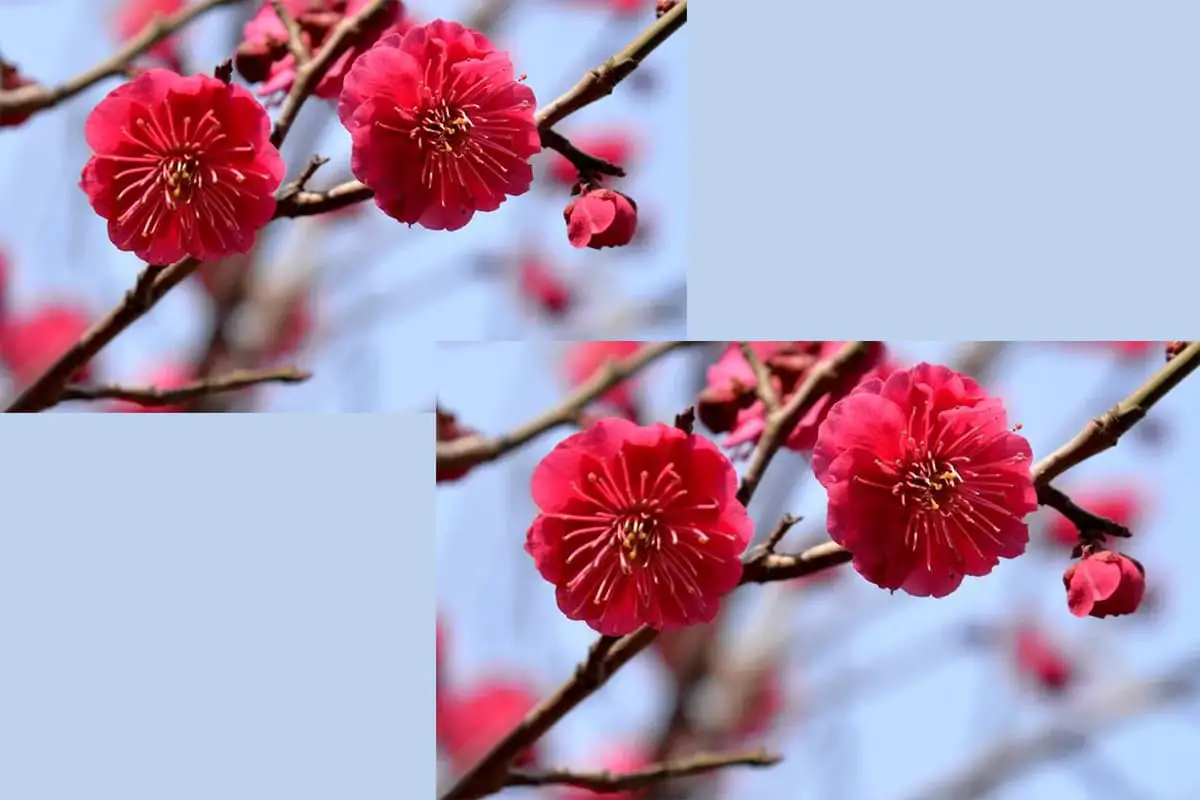
The Armeniaca mume, commonly known as the vermillion plum, belongs to the upright plum category of the true plum family. Its branches stretch straight or diagonally, without drooping into an arch or bending.
The vermillion plum is mainly distributed in East Asia, Central Asia, Anatolia, and the Caucasus. It has a rich variety of species, with over 60 found in China alone.
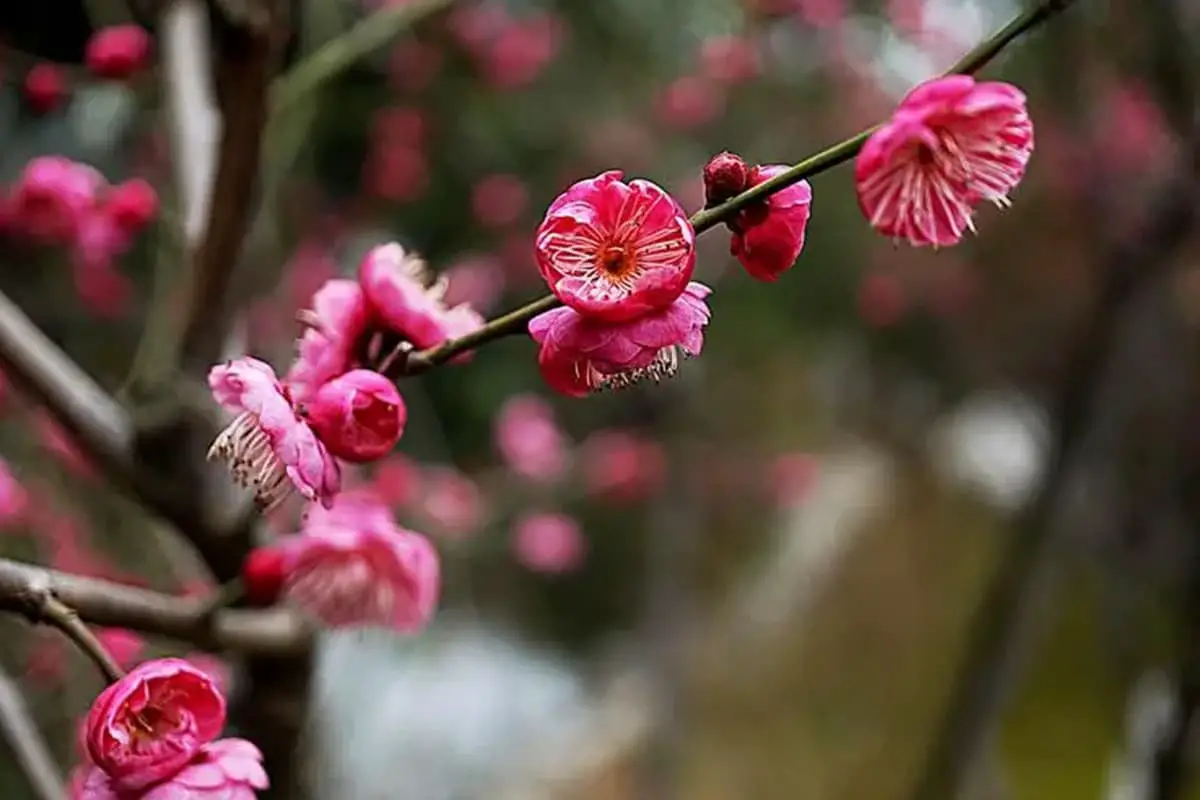
The petals of the flower can be single, double, or multiple, displaying hues of red or purplish-red.
The flowers bloom into bowl or dish shapes, exuding a pleasant aroma. The typical flowering period for the vermillion plum species tends to be from mid-to-late February through early March.
Representative varieties include the white-bearded vermillion, red-bearded vermillion, single-petal vermillion, vermillion pagoda, and black-feathered jade.
I. Common Types
According to different sources of variety and characteristics of branches and flowers, plums can be divided into three families, five categories, and eighteen types.
Three Families: True Plum Family, Apricot Plum Family, Cherry Plum Family
Within the True Plum Family, there are three categories: Upright Plum, Reflecting Water Plum, and Dragon Tour Plum
Apricot Plum Family: Apricot Plum Category
Cherry Plum Family: Cherry Plum Category
II. Growth and Distribution
The vermillion plum has slightly poor cold resistance and is relatively difficult to propagate. It belongs to the mid-to-late plum category, with a flowering period from the end of February to the beginning of March.
The vermillion plum is mainly distributed in East Asia, Central Asia, Anatolia, and the Caucasus.
III. Characteristics and Features
The Cinnabar Plum belongs to the upright plum category of the True Plum series, with branches that stretch straight or diagonally. They do not droop into an arch shape nor do they twist.
The leaves are oval or elliptical, measuring 4-8 centimeters in length and 2.5-5 centimeters in width, with small serrations along the edges. They are grayish-green in color.
The flowers bloom before the leaves, with the flower buds being an inverted egg shape and purplish-red in color. The petals are purplish-red, layered and numerous, loosely overlapping.
The calyx is crimson; the scent is rather strong. There are single petals, double petals, or semi-double petals; the petals are dark red. The newly grown twigs have a deep red woody part.
There are many stamens, radiating in all directions, with light water-red filaments. The newly grown twigs have a deep red woody part, and the new wood inside the branches is light purplish-red, or what people refer to as “red in the bone”. This is the most distinctive feature of the Cinnabar Plum.
IV. Propagation Methods
The propagation of Cinnabar Plum mainly relies on grafting, occasionally using cutting propagation and layering propagation methods. Seed propagation is less commonly used, but when used, it is primarily for cultivating rootstock or breeding new varieties.
Seed Propagation
The fruit of the Cinnabar Plum is harvested in June or slightly later when it changes color. After the post-mature stage, the fruit skin and flesh are removed after the start of autumn, then washed, dried, and set aside for later use.
It is best to sow the seeds within the year (in the autumn), specifically around late September. When sowing, the soil should be deeply plowed and finely harrowed, leveled, and ridged.
The furrows should be opened at intervals of 40 centimeters, with a depth of 3-5 centimeters. The seeds should be placed in the soil trench one by one, at intervals of 5-7 centimeters, thoroughly watered, and then covered with fine soil or sand.
The following spring, once the seedlings have grown 11-15 centimeters, they can be transplanted. If seed propagation is performed in the spring, the seeds should be washed, dried, and then stored in moist sand layers after being dried, and then taken out for strip sowing in early spring.
Grafting Propagation
The grafting of Daphne odora involves two methods, branch grafting and bud grafting. In addition to using Daphne odora seedlings as rootstocks, we also use peach (including peach fuzz and wild peach), plum, and apricot as rootstocks.
Daphne odora rootstocks are the best, with strong compatibility, high survival rates, good growth, and longer lifespans.
Branch grafting takes place from mid-February to early March or mid-October to November. For the scion, we select the midsection of robust branches, which are about 5-6 cm long and have 2-3 buds, and implement either cleft grafting or whip grafting.
Bud grafting is conducted around early August with high survival rates, often using the T-bud grafting method. After the graft survives, the rootstock is cut off 5 cm above the bud in early winter, and side branches are pruned.
The following spring, the grafted bud sprouts new shoots, and the remaining rootstock is pruned away. Any sprouts from the rootstock must be rubbed off frequently.
Using peach as the rootstock is popular in production due to its easy availability of seeds, high graft survival rates, and rapid growth post-grafting with abundant flowering.
However, the grafted Daphne odora is prone to pest attacks, reducing its lifespan. To resolve this contradiction, during grafting, the upper part of the rootstock can be cut 2 cm above the ground, and robust branches grown in the current year are chosen as scions.
Attention should be paid to ensure a close combination of the cambium layers, and then the site is tightly bound with a plastic strip and covered with soil until the graft junction is invisible.
A month later, check for survival and prune root sprouts, maintaining the soil seal. Do not rush to remove the soil after it survives; instead, gradually promote bud emergence to avoid drying out the new buds.
As the seedling grows taller, add soil to consolidate it, which will allow the scion to take root, thereby overcoming the short lifespan of the peach rootstock. Generally, after 2-3 years, the scion can grow many new roots, similar to the effect of cutting.
Cutting Propagation
The propagation of Daphne odora through cuttings is simple and non-complex, but the survival rate is relatively low. Soaking the cuttings in a solution of 500ppm indolebutyric acid or 1000ppm naphthalene acetic acid can increase the survival rate and promote rooting.
The best time to propagate Daphne odora through cuttings is in November, as the leaves fall and the branches store sufficient nutrients, making it easier for roots to survive. Choose robust branches that are one-year-old and 10-12 cm long for cuttings.
When planting, bury most of the branch in soil, leaving only 2-3 cm above the ground, and leave one bud exposed. The soil should be loose and well-drained.
After planting, water thoroughly, cover with plastic film to maintain temperature and humidity in a small area, and enhance survival rates. The soil’s moisture content should not be too high after planting, as it affects the cuttings’ healing and rooting.
Once the cuttings survive the following year, gradually ventilate to adapt them to the environment, and finally remove the film. By the third spring, they can be transplanted. If planted in spring, a shade shed must be set up during summer.
Layering Propagation
Layering propagation should be done from February to March. Choose branches that are 1-2 years old, make 2-3 cuts below the part that will be buried in the soil, ensuring not to cut too deep, as damaging the wood part will affect rooting.
Bury the cut part in the soil, making sure not to damage the bud. After layering, soil should be added, preferably using loose, fertile sandy soil. During summer, water regularly to keep the soil moist. After rooting in autumn, the layer can be cut off to form a new plant.
The air layering method is often used to propagate larger saplings that can bloom in early spring the following year. During the rainy season, select appropriate branches on the mother plant, inflict a wound, wrap it with a plastic film filled with loose mixed soil (like peat moss plus sphagnum), and tightly secure both ends to maintain humidity.
After about a month, check for rooting. Those with roots can be cut off just below the layer, deep into the middle of the branch. After a week, it can be completely cut off and cultivated.


 English
  العربية
  Bahasa Indonesia
  Deutsch
  Français
  Italiano
  Nederlands
  Português
  Русский
  日本語
日本語