600+ Types of Flowers A To Z (With Names and Pictures)
Types Of Flowers By Names (A-Z) Types Of Flowers By Color Types Of Flowers By Season Types Of Flowers By Blooming Time 600+ Types of Flowers No. Flower Name No.…

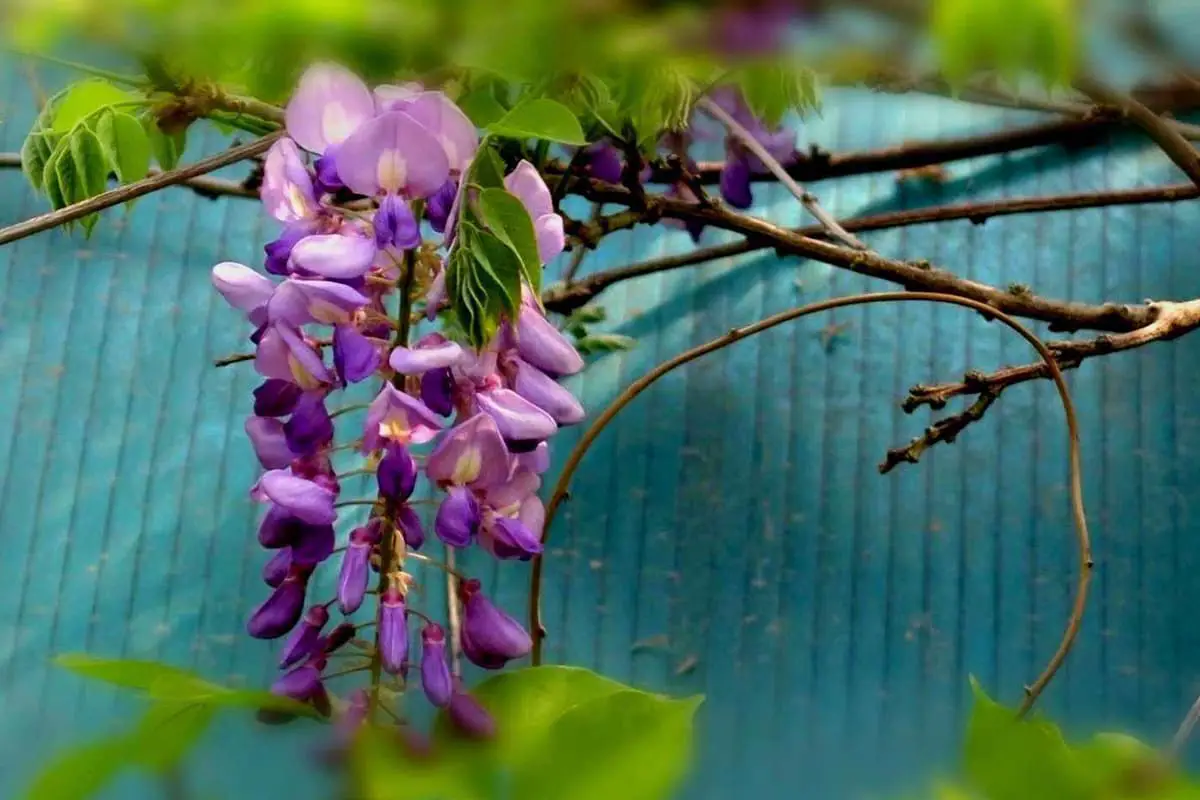
The Creeping Plant, also known as the “Bie Nong Vine,” is a type of plant within the Wisteria family, originating from China and found in both North Korea and Japan.
This tropical and temperate plant exhibits a unique charm, with pod-like fruits appearing after blooming, hanging amidst the branches.
Occasionally, it will bloom again towards the end of summer or the beginning of autumn. The flower spikes and pods create an interesting contrast against the backdrop of emerald-like leaves.

The Creeping Plant, or the Bie Nong Vine, belongs to the Wisteria family. It can be grown in gardens for ornamental purposes. Its flowers can be cooked and its stems and leaves can be used for medicinal purposes.
This plant is native to China with a presence in North Korea, South Korea, and Japan. Its flowers can be cooked while its stems and leaves have medicinal uses.
The flowers stay in bloom for about half a month. Common types include Multiflora Wisteria, Silver Vine, Red Jade Vine, White Jade Vine, and Nanjing Vine.
The Creeping Plant, a tropical and temperate plant, has a strong adaptability to climate and soil. It is frost-resistant and can tolerate waterlogged and infertile soils. It prefers sunlight but can also tolerate shade.
It grows best in deep soils with good drainage and a sunny, wind-protected location. The plant has a deep main root and shallow lateral roots, and it doesn’t tolerate transplantation well.
It is a fast-growing plant with a long lifespan and strong twisting ability, which may strangle other plants. It buds in March, blooms profusely in April, with each axis having 20 to 80 butterfly-shaped flowers.
The plant is commonly found in the wild or cultivated. Its roots and seeds are used for medicinal purposes and have a slight toxicity. The bark contains two classes, the flowers contain volatile oil, and the leaves contain forsythia alkaloids.
The plant has a strong taproot system, so when transplanting, it’s best to dig up as many lateral roots as possible, with soil. Planting is best done in early spring. Before planting, set up a trellis and tie the thick branches to it, allowing the plant to climb.
As the wisteria has a long lifespan and thick branches full of leaves, the trellis material must be sturdy and durable. When young trees are first planted, their branches cannot form flower buds, but will form them later.
If the plant doesn’t flower after several years, it could be due to excessive vigor with too many branches and leaves, or weakened vigor making it difficult to accumulate nutrients.
In the former case, partially cutting the roots and pruning the branches and leaves can help, while in the latter case, adding more fertilizer can promote flowering. Potassium-rich fertilizer should be used in appropriate amounts.
During the growth period, fertilize 2-3 times. After flowering, leave 5-6 buds on the middle branches, cut short, and prune weak branches to promote bud formation.
For potted plants, besides choosing smaller varieties, more pruning and pinching is needed to prevent the plant from growing too large. For bonsai cultivation, shaping and pruning must be intensified, and when necessary, grafting of high-quality varieties can be done.
Choose a deep, fertile, and well-drained soil for planting. Overly damp conditions can cause root rot. Planting time is usually after the leaves fall in autumn until buds sprout in spring. The main vine has long, thick roots and few lateral roots, so it is not tolerant of transplanting.
Therefore, when transplanting, the plant should be moved with a soil ball, or without one, and the stems should be pruned heavily. After planting, water thoroughly.
For larger plants, a sturdy, durable trellis should be set up before planting. After planting, tie the thick branches to the trellis to allow them to climb. Daily management is simple, just manage water and fertilizer according to the soil condition.
Pruning is an important task in management. Pruning should be done during the dormant period, and can be achieved by thinning and manual traction to evenly distribute the branches.
To promote abundant flowers and leaves, reasonable pruning should be done according to its growth habits. As it has strong branching ability and flower buds form at the base of the leaves of the year’s growth, the ends of the growth branches are prone to withering.
Therefore, the new branches of the year should be cut back, cutting off 1/3 to 1/2, and weak branches and dead branches should be pruned at the base.
To control pests and diseases, maintain a clean cultivation environment, regularly clear weeds within and around the greenhouse, promptly check and remove yellow leaf plants, discard and bury heavily diseased plants to prevent them from becoming infection sources, and cut off diseased leaves with scissors, immediately spray the corresponding pesticide, and isolate the plant to control the spread of pests and diseases.
When spraying pesticides, leave no dead corners, especially the backs of leaves, corners of the greenhouse, and the ground should be fully covered. Disinfect the greenhouse once a month.
Common pests include snails, scale insects, and mealybugs. During the rainy season in spring and summer, snails are often active. At this time, lime powder should be regularly spread around the garden and at the base of the trellis.
Poor ventilation often leads to scale insects, which can be killed by spraying with 800-1000 times diluted speed bark or speed imidacloprid. Mealybugs can be killed by spraying with 3000 times diluted speed bark aphid or aphid killer.
After the disease occurs, agricultural streptomycin can be sprayed in the morning or evening for prevention and control, with no more than 3 applications per year.
The main pest is the scale insect. Scale insects parasitize the edges of plant leaves or leaf surfaces, sucking sap and causing the plant to wilt. In severe cases, the entire plant will die.
The pests can be killed by spraying with 1000 times diluted 40% emulsifiable concentrate of imidacloprid or 2000 times diluted 50% emulsifiable concentrate of malathion. The main diseases are soft rot and leaf spot disease.
Leaf spot disease damages the leaves, while soft rot causes the entire plant to die. These can be controlled with 1000 times diluted 50% polyoxin or 800 times diluted 50% methyl tobujin soluble wetting agent.
Fertilizer: Apply nitrogen fertilizer and calcium superphosphate before budding. During the growth period, apply 2-3 times of mature human feces and urine.
Soil: Any soil can be used, but moist, fertile, and well-drained soil is best.
Temperature: The plant likes warmth but can also tolerate cold. It can winter outdoors in most areas of China.
Light: The plant can tolerate some shade but prefers sunlight.
These can be implemented through seeding, cuttings, layering, division, grafting, etc., primarily seeding and cuttings. However, because seedlings take a long time to grow, cuttings are the most commonly used method.
This includes cutting strips and roots. Cutting strips usually use hard branch cuttings. In mid-to-late March, before the branches sprout, select robust branches that are 1-2 years old, cut them into cuttings of about 15 cm, and insert them into a previously prepared nursery.
The depth of the cuttings should be 2/3 of the length of the cuttings. After insertion, water is sprayed, care is intensified, the nursery is kept moist, and the survival rate is very high. The plant height can reach 20-50 cm in the same year, and it can be removed from the nursery after two years.
Root cutting uses the adventitious buds that are easily produced on the roots. In mid-to-late March, dig out roots that are 0.5-2.0 cm thick, cut them into cuttings of 10-12 cm, and insert them into the nursery.
The depth of the cuttings should keep the upper cut of the cuttings level with the ground. Other management measures are the same as branch insertion.
Seed propagation is carried out in March. Seeds are harvested in November, the pod skin is removed, and they are dried and stored in bags. Before sowing, soak the seeds in hot water.
When the boiling water temperature drops to about 30℃, scoop out the seeds and rinse them in cold water for a while, then keep them moist and stacked for a day and night before sowing. Or store the seeds in moist sand, and soak them in clear water for 1-2 days before sowing.
Layering, division, and grafting are all carried out in mid-to-late March.
Here are some simple introductions to several propagation methods:
Decorative Application:
As a long-lived species, it is greatly favored for cultivation. Mature plants have stems that twist and turn, abundant flowers, and clusters of florets hanging among the green vines. The slender pods sway in the wind.
Since ancient times, Chinese literati have admired it, often using it as a subject for poetry and painting. In courtyards, it is used to create trellises and flower galleries, or it can climb over dead trees, symbolizing new life from dead wood.
It can also be made into elegant cliff-style bonsai, placed on high shelves or on top of bookcases. Its abundant flowers, old gnarled trunks, and unique charm are striking.
Garden Application:
It’s an excellent flowering vine plant, generally used for garden trellises. Its purple flowers bloom splendidly in spring, adding a unique charm. It’s suitable for planting by the lakeside, pond edge, rockeries, stone archways, and other places, presenting a unique style.
It’s often used for bonsai as well. After blooming, wisteria produces bean-like pods that hang amongst the branches, adding interest. Sometimes it will bloom again in late summer or early fall.
The flower spikes and pods create a delightful contrast against the feather-like green leaves. Generally, potted plants should have their spent flowers promptly pruned to avoid nutrient depletion.
As a deciduous vine, its layout can be adjusted during the dormant period through pruning, maintaining its elegant posture. It has a long lifespan and requires minimal maintenance.
With enough sunlight and appropriate watering and fertilizing, it will bloom abundantly and have lush foliage each year.
Pharmaceutical Application:
It can be refined into essential oils, and it offers detoxifying, anti-vomiting, and anti-diarrhea effects. The seeds are slightly toxic, contain cyanide, and can be used to treat muscle and bone pain, and prevent wine from spoiling.
Wisteria bark has insecticidal, analgesic, and wind-dispelling effects, and can be used to treat muscle and bone pain, rheumatic pain, and parasitic diseases.
Small Prescription:
Ascites: Use an appropriate amount of flowers, add water to make a concentrated decoction, filter out the dregs, add sugar and simmer into a paste. Take a spoonful each time, dissolve in boiling water and take twice a day.
Gastric Cancer: Use 1-6 grams of vine tumors (if no tumor, use vine stems and leaves), equal parts of Areca nut, Water caltrop, and Chebula fruit, decoct in water, and take in two divided doses per day.
Preservative: Roast and grind seeds, add to wine.
Practical Prescriptions:

Peggie was once a high school mathematics teacher, but she set aside her chalkboard and textbooks to follow her lifelong passion for flowers. After years of dedication and learning, she not only established a thriving flower shop but also founded this blog, “Flowers Library”. If you have any questions or wish to learn more about flowers, feel free to contact Peggie.
 English
  العربية
  Bahasa Indonesia
  Deutsch
  Français
  Italiano
  Nederlands
  Português
  Русский
  日本語
日本語