600+ Types of Flowers A To Z (With Names and Pictures)
Types Of Flowers By Names (A-Z) Types Of Flowers By Color Types Of Flowers By Season Types Of Flowers By Blooming Time 600+ Types of Flowers No. Flower Name No.…

The Brunfelsia latifolia is a perennial evergreen shrub from the Solanaceae family. It is an excellent potted plant for outdoor display in the summer and indoor decoration in winter in North China.
The plant stands between 50 and 100 centimeters tall, with alternate single leaves and flowers that are mostly solitary, though occasionally cluster-borne.
The corolla is cup-shaped with shallow lobes, blooming from April to October, with each flower remaining open for about five days. The flowers open in a deep purple color, gradually turning to a light bluish-green, and finally white.
This process, coupled with the fact that flowers open at different times on the same plant, results in a simultaneous display of purple and white flowers – hence the alternative name, Two-Color Jasmine.
The name also metaphorically represents “Yesterday, Today, and Tomorrow”, depicting its unique color transformation.
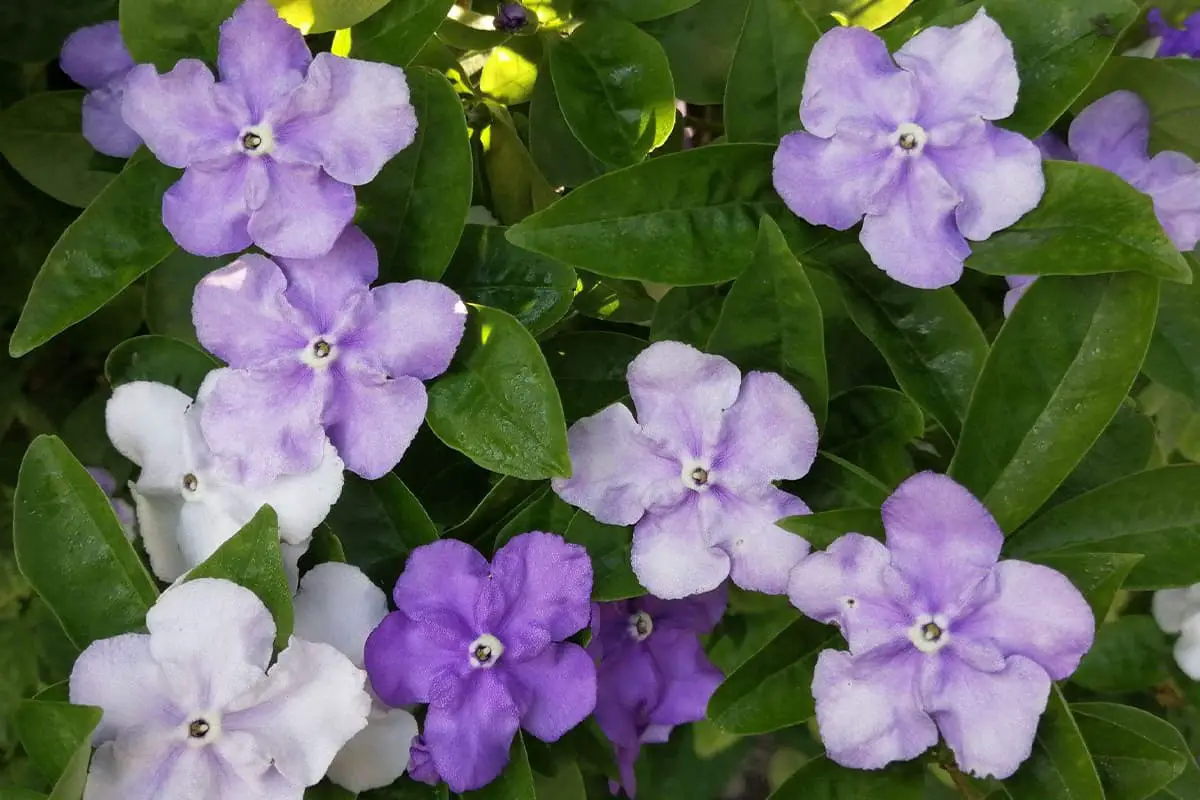
Perennial evergreen shrub, it’s an excellent potted plant for outdoor display in summer and indoor arrangement in winter in North China. The plant stands approximately 70 to 150 centimeters tall, but can be dwarfed to a height of 30 to 60 centimeters when potted.
The stem bark is dark brown or grayish-white, with strong branching and longitudinal cracks in the periderm. The leaves are single, alternate, lanceolate or oval, with pointed tips and short stems, and are a vibrant green.
The leaves measure 5 to 7 centimeters in length and 1.7 to 2.5 centimeters in width, are papery, green on the underside, yellowish-green on the back, and slightly wavy at the edges.
The flowers can be solitary or cluster-borne, sometimes forming umbel inflorescences. The corolla is cup-shaped with shallow lobes, around 4 to 5 centimeters in diameter.
The calyx is simple, with the stamens and pistil located in the small hole at the center of the corolla. The flowers are either solitary or form clusters of 2 to 3 in the leaf axils. The corolla is five-lobed, with clearly serrated petals.
When the flower is about to bloom, it resembles a mushroom and is deep purple in color. As it opens, it turns blue-purple, then light snow-green, and finally white, with each flower lasting for 3 to 5 days. The flower has a rich fragrance, different from the typical jasmine scent.
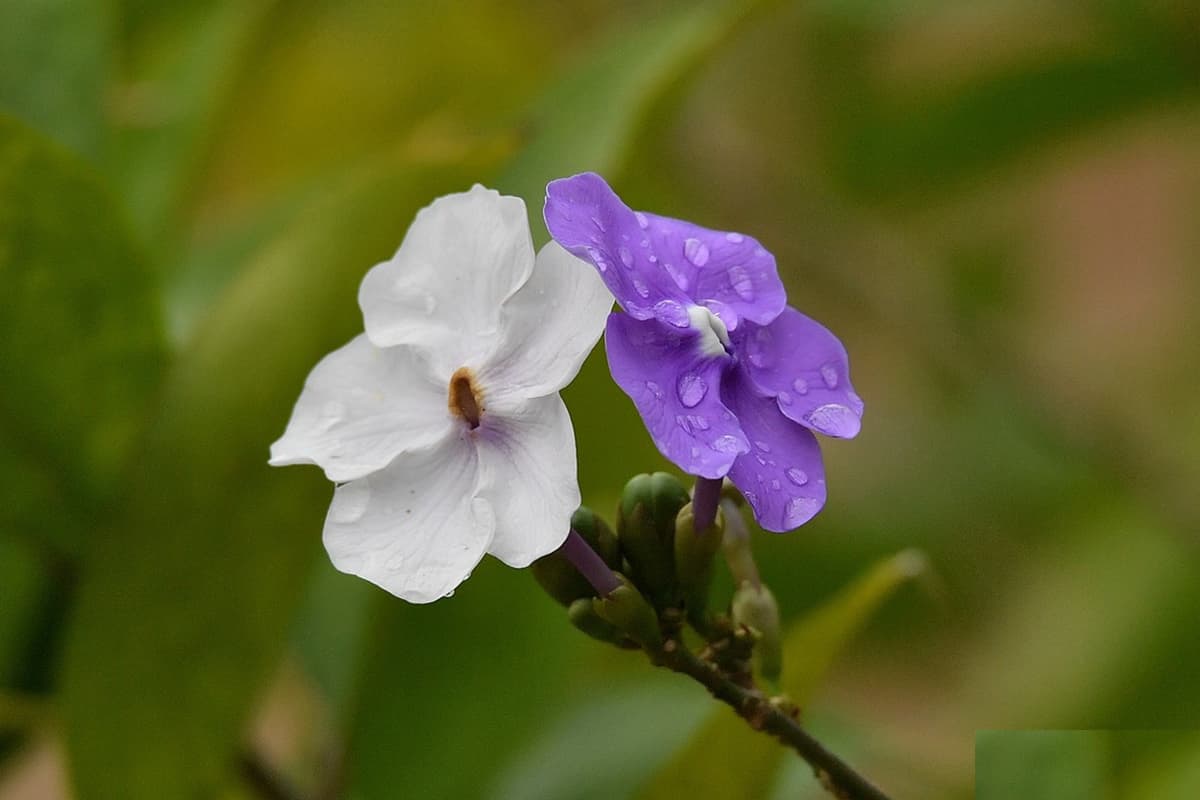
The Mandarin Duck Jasmine, native to Central and South America’s tropics, thrives in warm, moist climates with abundant sunlight. It is not very cold-resistant, preferring temperatures between 18-30°C, and not tolerating any lower than 10°C.
This plant prefers semi-shaded, airy environments, requiring at least four hours of sunlight indoors to bloom profusely under sufficient sunlight conditions. It can withstand partial shade and drought but not waterlogging or impoverishment.
In the Eastern and Northern regions of China, it is grown in greenhouses as a potted plant, requiring fertile, loose, well-drained, slightly acidic soil.
Regularly supplementing it with alum fertilizer water during summer can make its leaves brightly green and promote lush growth and abundant flowering.
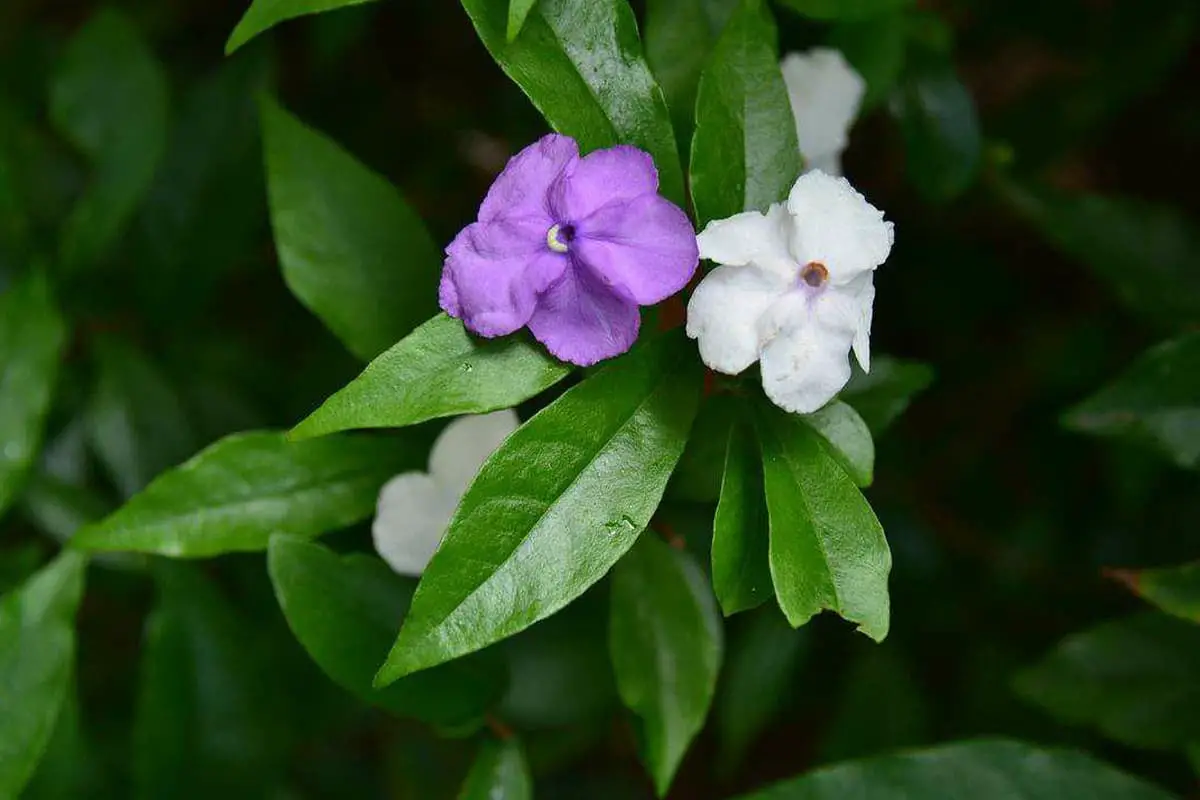
The Mandarin Duck Jasmine is cultivated in India, the Arabian region, with its central production area near the Persian Gulf. It is now widely planted in subtropical areas.
It is mainly distributed in Iran, Egypt, Turkey, Morocco, Algeria, Tunisia, as well as Mediterranean coastal countries like Spain, France, Italy, and cultivated in India and Southeast Asian countries.
The Mandarin Duck Jasmine, with its vibrant colors and fragrant smell, is suitable for planting in garden green spaces or as a potted ornamental plant. It is easy to grow and propagate, with strong ornamental features.
Due to its various blooming periods, it presents two colors on the same tree and has the fragrance of jasmine, making it an important potted ornamental flower.
The leaves of the Mandarin Duck Jasmine are dark green, and the flowers are a mix of purple, blue, and white, emitting a strong fragrance.
It is commonly used to decorate and beautify courtyards, balconies, windowsills, and corridors, providing a refined and pleasant ambiance.
The main pests of the Mandarin Duck Jasmine include mealybugs, leafhoppers, scale insects, and red spiders, with occasional leaf spot disease and powdery mildew.
Generally, spraying with 40% Leoguo emulsion oil or 1000 times diluted Aphid net can prevent pest occurrence. Spraying with 65% Daisen Zinc, 50% Polyram, 75% Carbendazim, or 500-800 times diluted 70% Methotobuzin can prevent disease.

Peggie was once a high school mathematics teacher, but she set aside her chalkboard and textbooks to follow her lifelong passion for flowers. After years of dedication and learning, she not only established a thriving flower shop but also founded this blog, “Flowers Library”. If you have any questions or wish to learn more about flowers, feel free to contact Peggie.
 English
  العربية
  Bahasa Indonesia
  Deutsch
  Français
  Italiano
  Nederlands
  Português
  Русский
  日本語
日本語