600+ Types of Flowers A To Z (With Names and Pictures)
Types Of Flowers By Names (A-Z) Types Of Flowers By Color Types Of Flowers By Season Types Of Flowers By Blooming Time 600+ Types of Flowers No. Flower Name No.…

Bougainvillea glabra, commonly known as Paper Flower, Bougainvillea, Lesser Bougainvillea, or Purple Bougainvillea, is a vine-like shrub belonging to the Nyctaginaceae family.
It features robust stems that droop, either hairless or with sparse soft hairs; its thorns are axillary, measuring 5-15 millimeters.
The leaves are papery, ovate or ovate-lanceolate, and thrive in warm, humid climates; they are not frost-tolerant but prefer ample sunlight.
With a variety of species, the plant is highly adaptable, widely distributed in the southern regions, and can also be cultivated in the colder north.
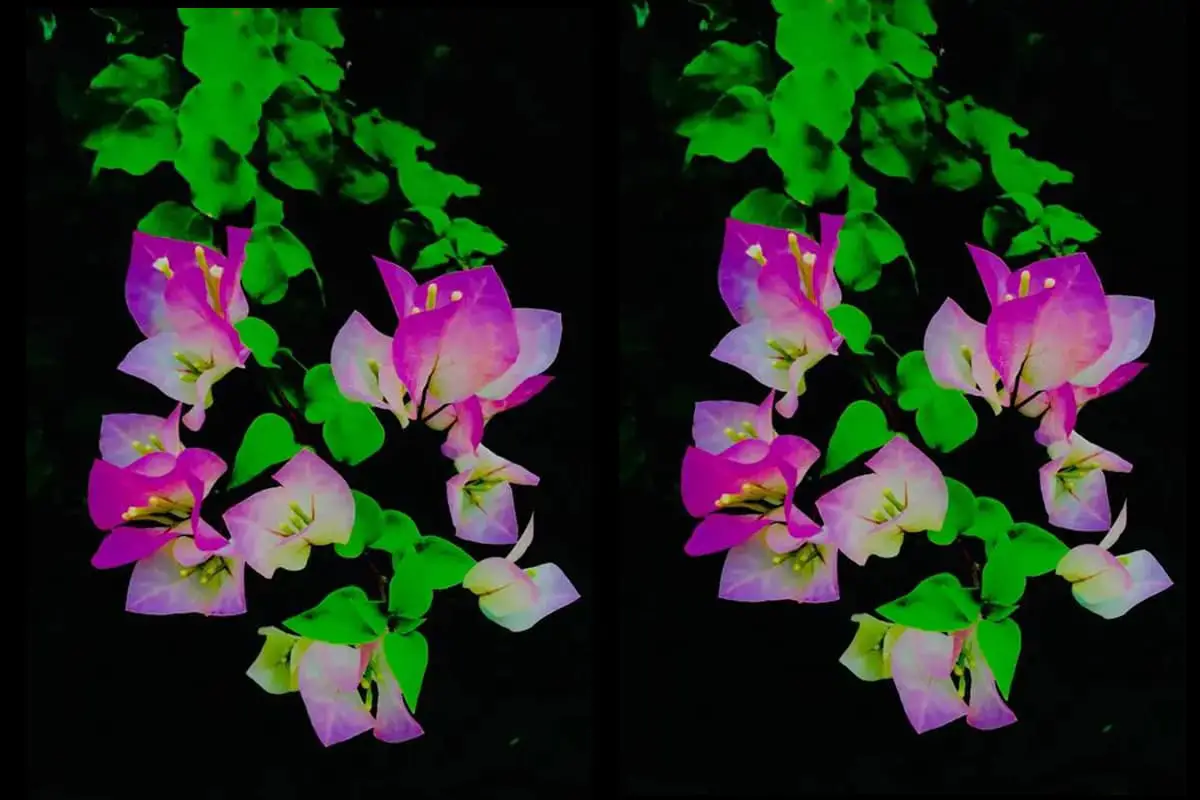
Native to Brazil, it is planted in courtyards and parks in southern China and cultivated in greenhouses in the north, where it is admired as a beautiful ornamental plant.
Its flowers are used medicinally to harmonize the qi and blood, treating leukorrhea and regulating menstruation.
This vine-like shrub has alternate leaves with petioles approximately 1-2.5cm in length; the flowers are terminal, usually in clusters of three within bracts, with the flower stalk fused to the bract’s midvein.
The stems are robust and drooping, hairless or with sparse soft hairs; thorns are axillary and 5-15 millimeters long.
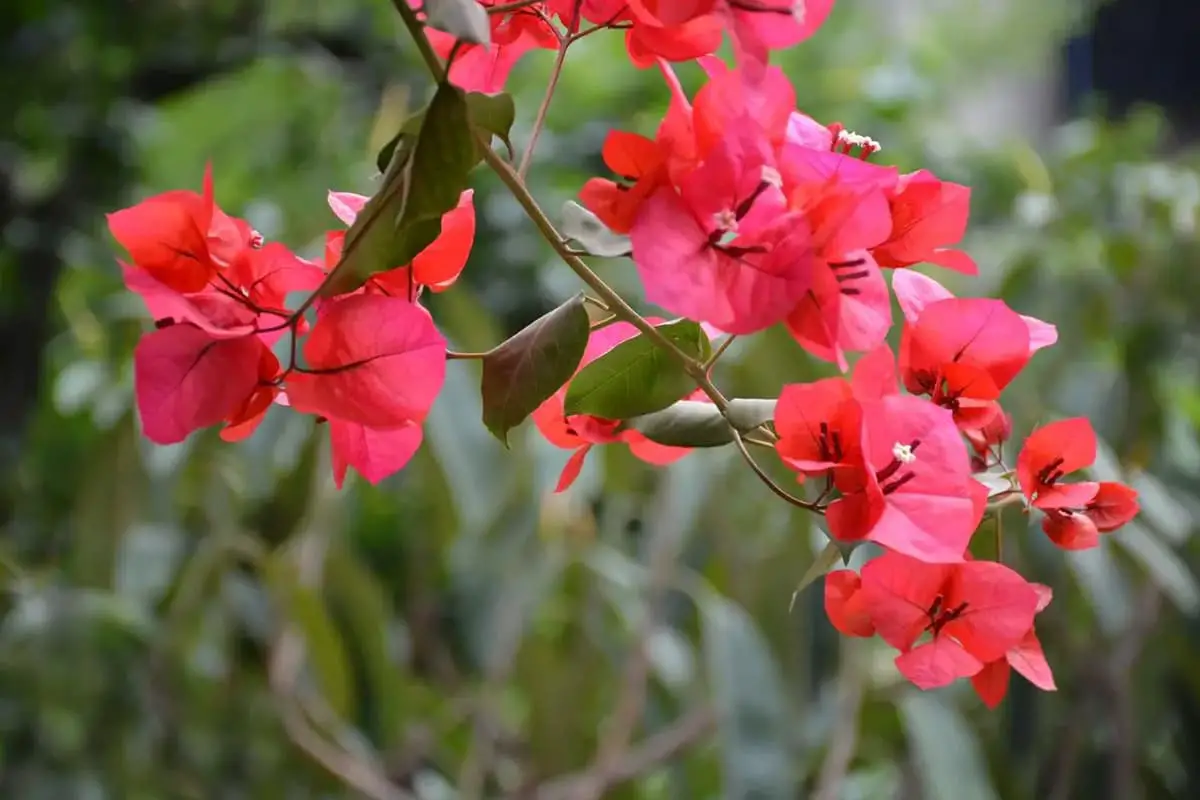
The leaves are papery, ovate or ovate-lanceolate, 5-13 centimeters long and 3-6 centimeters wide, with acute or gradually pointed tips, and a rounded or broadly cuneate base, hairless above and softly hairy beneath; petioles are about 1 centimeter long.
At the tip of the branches, within the three bracts, the flower stalk adheres to the bract’s midvein, with each bract bearing a flower; bracts are leaf-like, purple or magenta, oblong or elliptical, 2.5-3.5 centimeters in length and about 2 centimeters wide, papery in texture; the calyx tube is approximately 2 centimeters long, pale green, sparsely hairy, ridged, with five shallow lobes at the top; there are 6-8 stamens; the pistil is lateral, linear, with edges expanding into a thin flange, and a pointed stigma; the fruit is pentagonal.
The seeds contain endosperm. The floral disk at the base is ring-shaped and torn at the top. The flowering period is in winter and spring, with greenhouse cultivation in the north blooming from March to July.
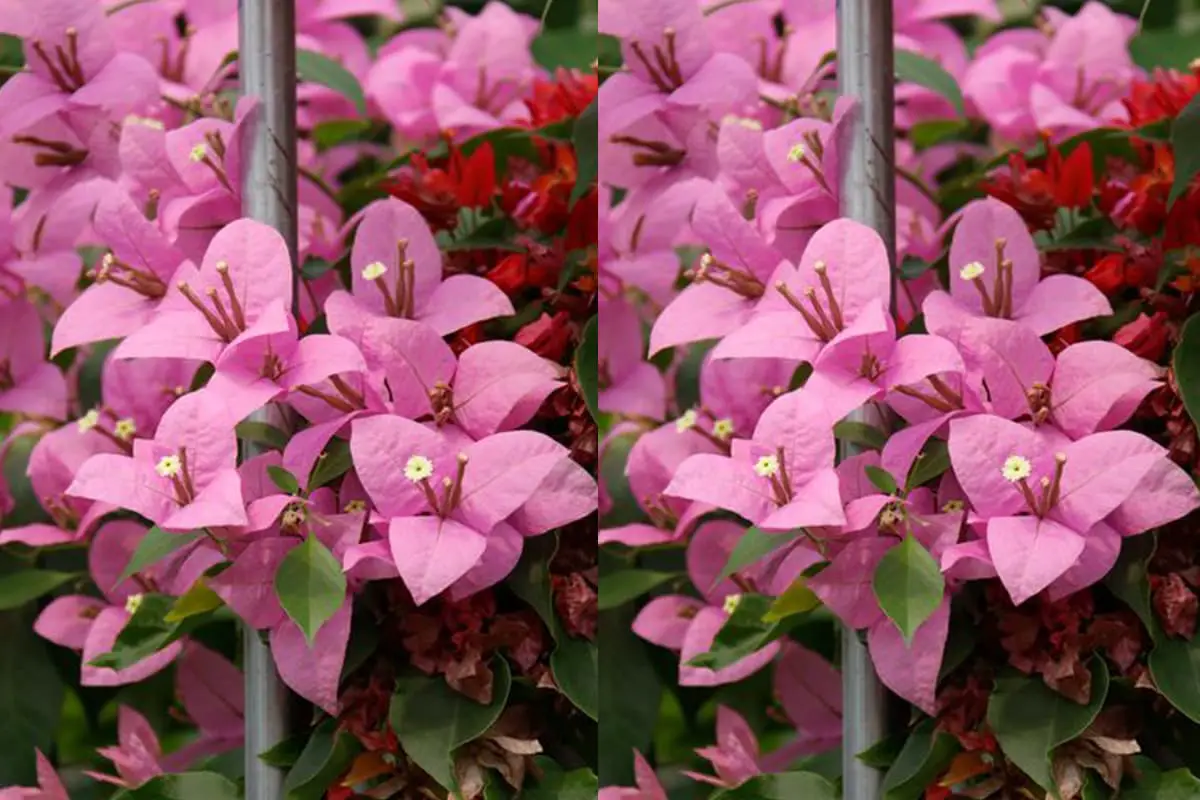
Comparative analyses under varying temperatures, light conditions, and water availability have shown that Paper Flowers enter a dormant state when temperatures drop to a certain level; during non-dormant periods, inadequate light results in abnormal flower drop, and ample water leads to premature wilting.
During dormancy, Bougainvillea is insensitive to light intensity but has an extended lifespan due to low temperatures and reduced water.
It prefers a warm, moist climate, is sensitive to cold, and loves full sun exposure. With a variety of types, the plant adapts well, not only widely distributed in the southern areas but also cultivable in the cold north, albeit with less variety in flower color.
This is not a general statement, but rather one that may vary by region.
Native to Brazil, it is planted in courtyards and parks in southern China and cultivated in greenhouses in the north.
With large, brightly colored bracts that resemble flowers and have a long-lasting appearance, Paper Flowers are suitable for planting in gardens or for pot culture as a decorative display.
They are also used for bonsai, hedges, and topiary art, holding high ornamental value.
In Brazil, women often wear them in their hair as a unique accessory. In Europe and America, they are commonly used as cut flowers.
In southern China, they beautify courtyards and parks, and in the north, they are cultivated in greenhouses as gorgeous ornamental plants.
The leaves can be used medicinally, mashed and applied to bruises and swellings. The flowers of Paper Flower serve as a herbal base, promoting blood circulation and regulating menstruation, and treating conditions such as blood stasis, menstrual disorders, and leukorrhea.
The stems and leaves of Paper Flower are toxic; ingesting 12-20 leaves can cause symptoms like diarrhea and bloody stools.
The flowers are used in traditional medicine to harmonize qi and blood, treat leukorrhea, and regulate menstruation.
Paper Flower is especially suitable for people associated with the fire element in Feng Shui to be planted in the living room.
For homes facing south (associated with the fire element), it is beneficial to plant fire-element Paper Flowers in the living room to help maintain heart and digestive health.
It also offers protection and courage for those who are introverted, timid, or lack confidence and optimism in life.
Peggie was once a high school mathematics teacher, but she set aside her chalkboard and textbooks to follow her lifelong passion for flowers. After years of dedication and learning, she not only established a thriving flower shop but also founded this blog, “Flowers Library”. If you have any questions or wish to learn more about flowers, feel free to contact Peggie.
 English
  العربية
  Bahasa Indonesia
  Deutsch
  Français
  Italiano
  Nederlands
  Português
  Русский
  日本語
日本語