600+ Types of Flowers A To Z (With Names and Pictures)
Types Of Flowers By Names (A-Z) Types Of Flowers By Color Types Of Flowers By Season Types Of Flowers By Blooming Time 600+ Types of Flowers No. Flower Name No.…

The Belamcanda chinensis is a perennial herbaceous plant. It has an irregularly shaped, obliquely extending rhizome that is yellow or yellow-brown in color, with numerous fibrous roots that are also yellow.
The stem is erect, ranging in height from 1 to 1.5 meters, and is solid within. The rhizome is used medicinally, characterized by a bitter taste, a cold nature, and slight toxicity.
It is effective in clearing heat and detoxifying, dispersing lumps and reducing inflammation, alleviating swelling and pain, and relieving coughs and transforming phlegm. It is used to treat conditions such as tonsillitis and lower back pain.
The leaves are arranged alternately in an overlapping pattern, shaped like swords, with lengths ranging from 20 to 60 centimeters and widths from 2 to 4 centimeters.
Each leaf clasps the stem with a sheath-like base, tapering to a pointed tip, lacking a central vein.
The inflorescence is terminal, with dichotomous branching, and several flowers clustered at the end of each branch.
The flower stalks are slender, about 1.5 centimeters long, and both the stalks and the branches of the inflorescence are enclosed by membranous bracts, which are lanceolate or ovate in shape.
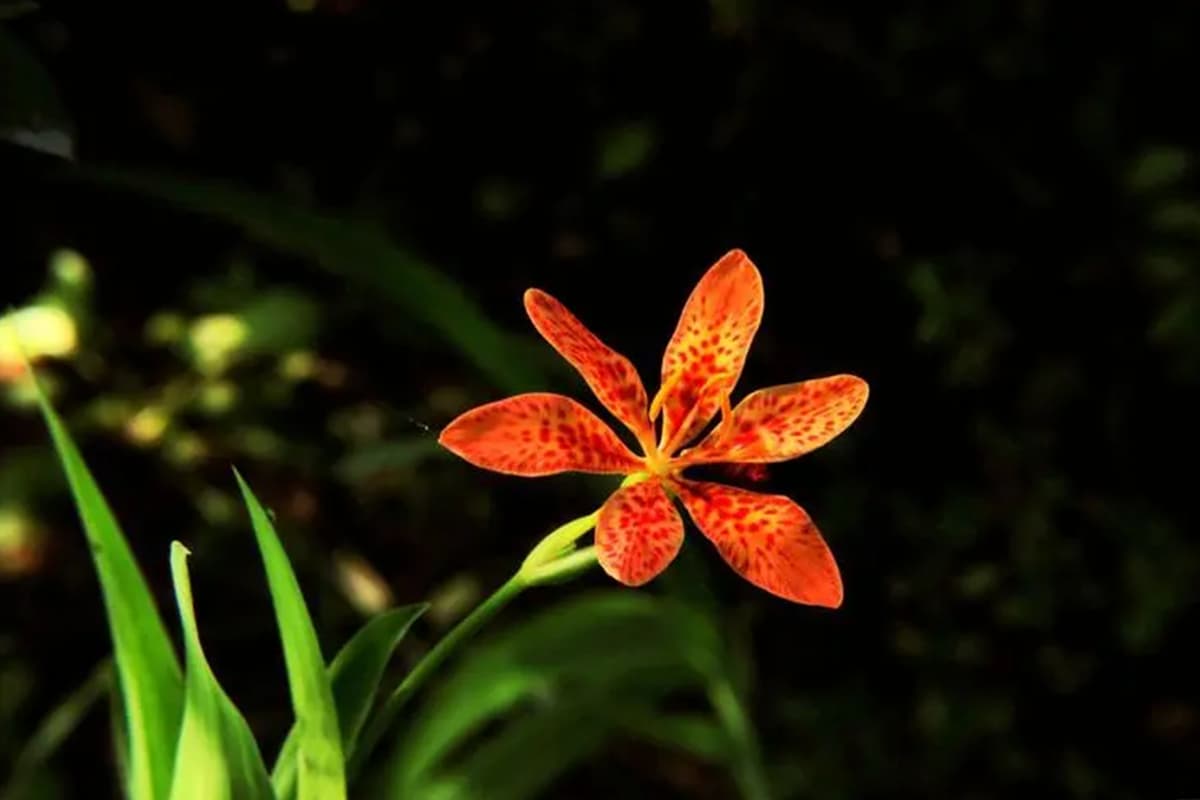
The flowers are orange-red with scattered purple-brown spots, measuring 4 to 5 centimeters in diameter.
There are six perianth segments arranged in two rows; the outer perianth segments are obovate or elongated elliptical, about 2.5 centimeters long and 1 centimeter wide, with blunt, rounded, or slightly indented tips, and wedge-shaped bases.
The inner segments are slightly shorter and narrower than the outer ones. There are three stamens, each 1.8 to 2 centimeters long, attached at the base of the outer perianth segments.
The anthers are bar-shaped, opening outward, with almost cylindrical filaments that are slightly flattened and widened at the base.
The style is somewhat flattened at the top, with three lobes that curl outward marginally, featuring fine, short hairs. The ovary is inferior, inverted egg-shaped, with three chambers and a central placenta bearing numerous ovules.
The capsule is inverted egg-shaped or elongated elliptical, yellow-green, 2.5 to 3 centimeters long, with a diameter of 1.5 to 2.5 centimeters.
The capsule lacks a beak at the top, often retaining the withered perianth, and splits open dorsally when mature, with the valves turning outward and a central erect fruit axis.
The seeds are spherical, blackish-purple, glossy, about 5 millimeters in diameter, attached to the fruit axis. The flowering period is from June to August, and the fruiting period is from July to September.
This plant thrives on forest edges or grassy slopes, primarily found at lower altitudes, although it can also grow at elevations of 2,000 to 2,200 meters in the southwestern mountains.
It favors warm conditions and sunlight, is drought-resistant and cold-hardy, and is not particular about soil types. It can be cultivated on hillside dry lands, but thrives best in fertile, loose soil.
Sandy loam with good drainage situated at higher elevations is ideal. It does well in neutral loam or slightly alkaline soil, but should be avoided in low-lying or saline-alkaline areas.
This species is distributed across tropical, subtropical, and temperate regions around the world, with its distribution center in Southern Africa and the tropical Americas. It is found in Korea, Japan, India, Vietnam, and the former Soviet Union.
This plant is used to treat symptoms such as sore throat and swelling caused by wind-heat or phlegm-heat congestion. It is also applied in cases of excessive phlegm, coughing, and asthma.
It’s beneficial for severe sore throat, aphonia, constipation, when other treatments fail, abdominal water retention, skin darkening, and the initial stages of breast abscess.
With its elegant and intriguing flowers, the plant is well-suited for creating floral pathways in gardens.

Peggie was once a high school mathematics teacher, but she set aside her chalkboard and textbooks to follow her lifelong passion for flowers. After years of dedication and learning, she not only established a thriving flower shop but also founded this blog, “Flowers Library”. If you have any questions or wish to learn more about flowers, feel free to contact Peggie.
 English
  العربية
  Bahasa Indonesia
  Deutsch
  Français
  Italiano
  Nederlands
  Português
  Русский
  日本語
日本語