600+ Types of Flowers A To Z (With Names and Pictures)
Types Of Flowers By Names (A-Z) Types Of Flowers By Color Types Of Flowers By Season Types Of Flowers By Blooming Time 600+ Types of Flowers No. Flower Name No.…

The Amethyst Wisteria is a variety of wisteria, a deciduous vine, with flower clusters that measure 60-80cm in length. The flowers are a beautiful shade of purple, with a fragrant aroma.
The blooming period is long, producing numerous, lengthy clusters of flowers, giving it an ethereal, dream-like quality, akin to amethyst crystals. The clusters sway gently in the breeze. The stems of this variety twist to the left, with relatively thick branches.
The young branches are covered with white soft hairs, which eventually shed. The winter buds are oval in shape, and the odd-pinnate compound leaves measure 15-25 cm in length.
The inflorescences originate from the axillary buds or terminal buds of the previous year’s short branches, measuring 15-30 cm in length and 8-10 cm in diameter. The flowering period is from April to June, and the fruiting period from May to August.
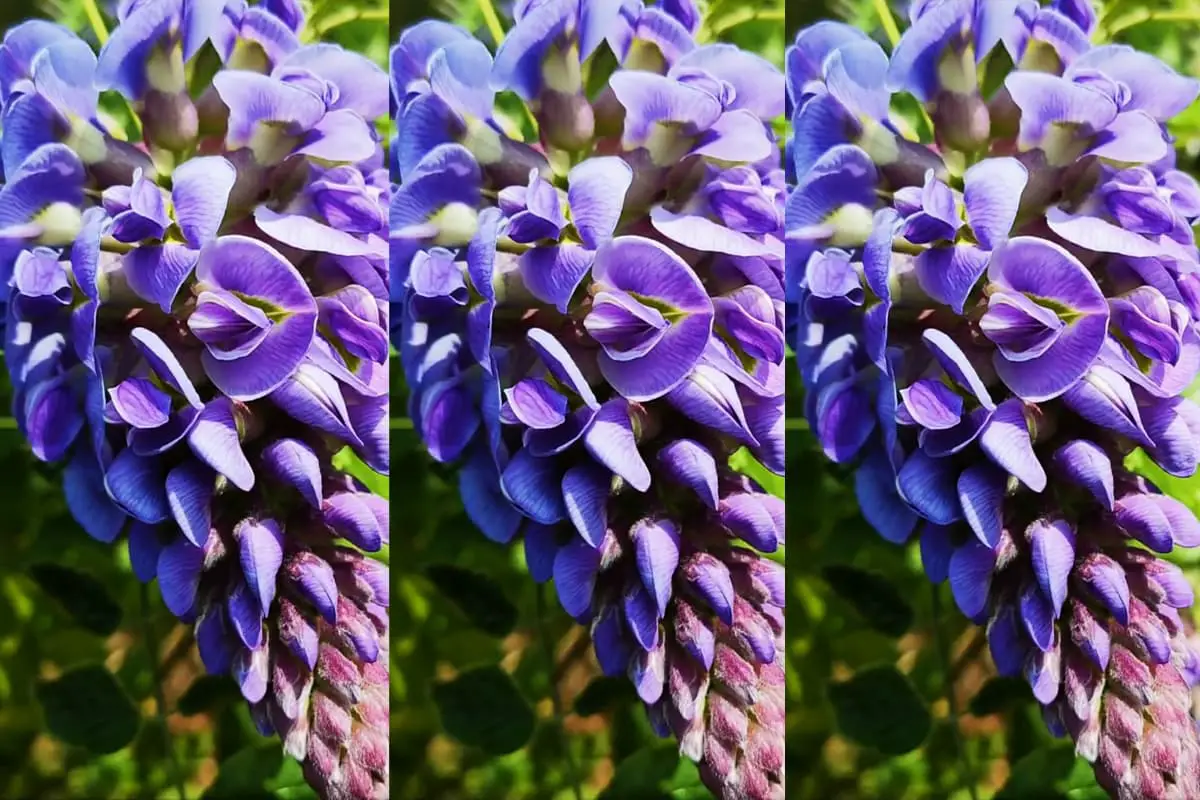
The Amethyst Wisteria, with its 60-80cm long flower clusters, is characterized by its purple flowers. It is a deciduous vine with stems that twist to the left, and branches that are relatively thick.
The young branches are covered with white soft hairs, which eventually shed. The winter buds are oval in shape. The odd-pinnate compound leaves measure 15-25 cm in length.
The inflorescences originate from the axillary buds or terminal buds of the previous year’s short branches, measuring 15-30 cm in length and 8-10 cm in diameter. The fruiting period is from May to August.
This variety has been cultivated in China since ancient times as a garden trellis plant. It blooms before the leaves appear, the purple clusters hanging full and adorned with sparse tender leaves, presenting an extremely elegant sight.
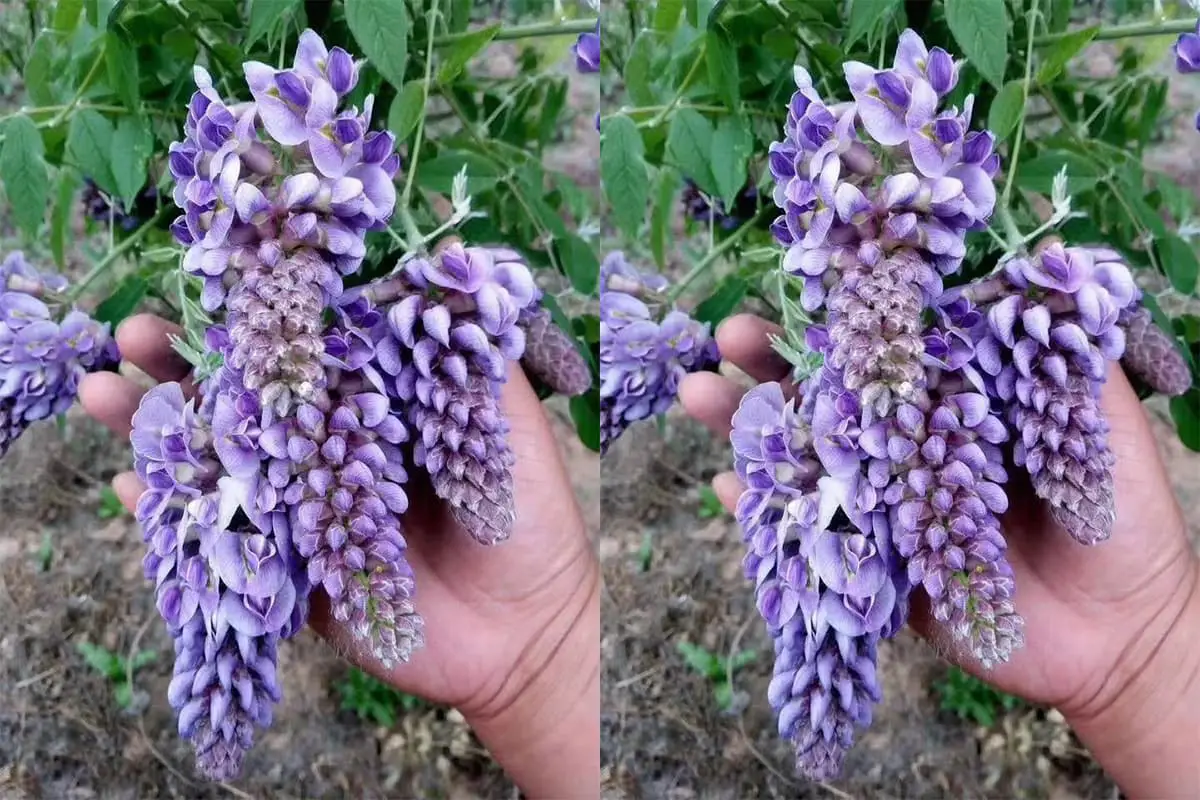
Deciduous vine. The stem twists to the left, with relatively thick branches. The tender branches are covered in white soft hair, which eventually disappears; the winter buds are oval-shaped.
The odd-pinnate compound leaves are 15-25 cm long. The stipules are linear and drop early. The leaflets are in 3-6 pairs, papery, ovate-elliptic to ovate-lanceolate. The upper leaflets are larger, with the base pair being the smallest, 5-8 cm long, 2-4 cm wide.
The tips taper to a point, the base is bluntly round or wedge-shaped, or skewed. The tender leaves are covered with flat hair on both sides, which later disappears. The leaflet stems are 3-4 mm long and covered with soft hair. The stipels are bristle-shaped, 4-5 mm long, and persistent.
The racemes blossom from the axillary buds or terminal buds of last year’s short branches, 15-30 cm long, 8-10 cm in diameter, the rachis covered with white soft hair. The bracts are lanceolate and drop early.
The flowers are 2-2.5 cm long, fragrant. The flower stalks are thin, 2-3 cm long. The calyx is cup-shaped, 5-6 mm long, 7-8 mm wide, densely covered with fine silky hairs. The wing petals are oblong, with a round base.
The keel petals are shorter than the wing petals, broad-sickle shaped. The ovary is linear, densely covered with fluffy hair. The pistil is hairless, curved upward, with 6-8 ovules.
The pods are inverted lanceolate, 10-15 cm long, 1.5-2 cm wide, densely covered with fluffy hair. They hang on the branches without falling off, containing 1-3 seeds.
The seeds are brown, shiny, round, 1.5 cm wide, and flat. The flowering period is from mid-April to early May, and the fruiting period is from May to August.
Planting: The Amethyst Wisteria is a rigid root plant with few lateral roots. It’s not particular about soil type but thrives best in moist, fertile soil with good drainage. During transplantation, it is best to dig as many lateral roots as possible and retain the root ball.
Transplanting usually occurs in early spring. Before transplanting, a support frame should be set up, and the thick branches should be tied separately to the frame to enable them to climb. Considering the longevity and robust branches of the Amethyst Wisteria, the frame material must be solid and durable.
When using thin wooden poles or steel pipes, they should be painted for corrosion protection. Alternatively, cement or stone pillars can be used as supports.
Watering and Fertilizing: The main root of the Amethyst Wisteria is deep, giving it strong drought resistance. Overwatering can cause root rot. In a garden setting, watering is only necessary during dry seasons.
Young plants cannot form flower buds in the year of planting, and only start to flower thereafter. If the plant does not bloom after several years, it may be due to excessive vegetative growth, too much foliage, or because the plant’s vitality is weak and it struggles to accumulate nutrients.
For overgrown plants, partial root pruning and foliage thinning can help. For weak plants, adding more fertilizer to supplement nutrients can promote blooming.
During cultivation, organic fertilizer, superphosphate, and wood ash are generally applied to the planting hole as base fertilizer, and additional phosphate and potassium fertilizers are applied 2-3 times during the growth period.
This includes stem cuttings and root cuttings. For stem cuttings, hardwood cuttings are generally used. This is done in the fall or before buds sprout in March-April of the second year.
Choose 1-2-year-old robust twigs, cut them into 10-15 cm long cuttings, and insert them directly or diagonally into a prepared nursery bed, with the cutting depth being 2/3 of the cutting length.
After inserting, spray water to keep the nursery bed moist, and strengthen the care. The survival rate is high, and the plant height can reach 20-50 cm in the first year, and they can be moved out of the nursery in the second year.
Root cuttings make use of the adventitious buds easily produced on the roots of the multiflowered wisteria. Generally, in mid to late March, 0.5-2 cm thick roots are dug up, cut into 10-12 cm long cuttings, and inserted into the nursery bed.
The cutting depth should keep the upper cut of the cutting level with the ground. After inserting, make sure to keep the nursery bed moist.
This is usually used for the propagation of superior varieties, which can be grafted onto ordinary rootstocks. Grafting can be done before the buds sprout in spring, with both stem and root grafting being feasible.
Generally, one or two-year-old branches are grafted onto the roots of another plant. Root grafting is most suitable for potted plants.
The primary diseases are soft rot and leaf spot. Soft rot can cause the entire plant to die, while leaf spot damages the leaves of the purple wisteria. Both diseases can be treated with a 1000-fold dilution of 50% carbendazim or an 800-fold dilution of 50% methoxyacrylate soluble wetting agent.
Common pests include snails, scale insects, and mealybugs. Snails are more active during the rainy seasons of spring and summer. During these times, lime powder should be regularly sprinkled around the planting area or at the base of the cultivation frame.
Poor ventilation in the wisteria’s growing environment often leads to scale insects, which parasitize the edges or surfaces of leaves, drawing sap and causing the plant to wilt. In severe cases, the entire plant may yellow and die.
A 1000-fold dilution of 40% parathion emulsion, a 2000-fold dilution of 50% malathion emulsion, or an 800-1000-fold dilution of insecticide can be sprayed to kill the pests. Mealybugs can be killed by spraying a 3000-fold dilution of insecticide.

Peggie was once a high school mathematics teacher, but she set aside her chalkboard and textbooks to follow her lifelong passion for flowers. After years of dedication and learning, she not only established a thriving flower shop but also founded this blog, “Flowers Library”. If you have any questions or wish to learn more about flowers, feel free to contact Peggie.
 English
  العربية
  Bahasa Indonesia
  Deutsch
  Français
  Italiano
  Nederlands
  Português
  Русский
  日本語
日本語