600+ Types of Flowers A To Z (With Names and Pictures)
Types Of Flowers By Names (A-Z) Types Of Flowers By Color Types Of Flowers By Season Types Of Flowers By Blooming Time 600+ Types of Flowers No. Flower Name No.…

The Adonis amurensis, a perennial herbaceous plant from the Ranunculaceae family, features a short and thick rhizome with sparse, soft hairs at the top or is sometimes hairless.
It may branch occasionally, and the base is adorned with several membranous scales. Leaves grow larger after flowering with the lower stem leaves having long petioles and being hairless.
The leaves are a true triangular shape, with sepals often displaying a pale greyish-purple hue, oblong or ovate-oblong in shape, and as long or slightly longer than the petals.
The petals are yellow, in an inverted ovate-oblong or narrowly inverted ovate shape, and the ovary is short-haired. The plant bears fruit in an inverted ovoid shape, flowering from March to April.
It is found in China and also occurs in Korea, Japan, and the Far East region of Russia, thriving on grassy mountain slopes or under forests.
This species contains cardiac glycosides such as adonitoxin and other compounds in its roots and whole plant, making it toxic but also usable for medicinal purposes.
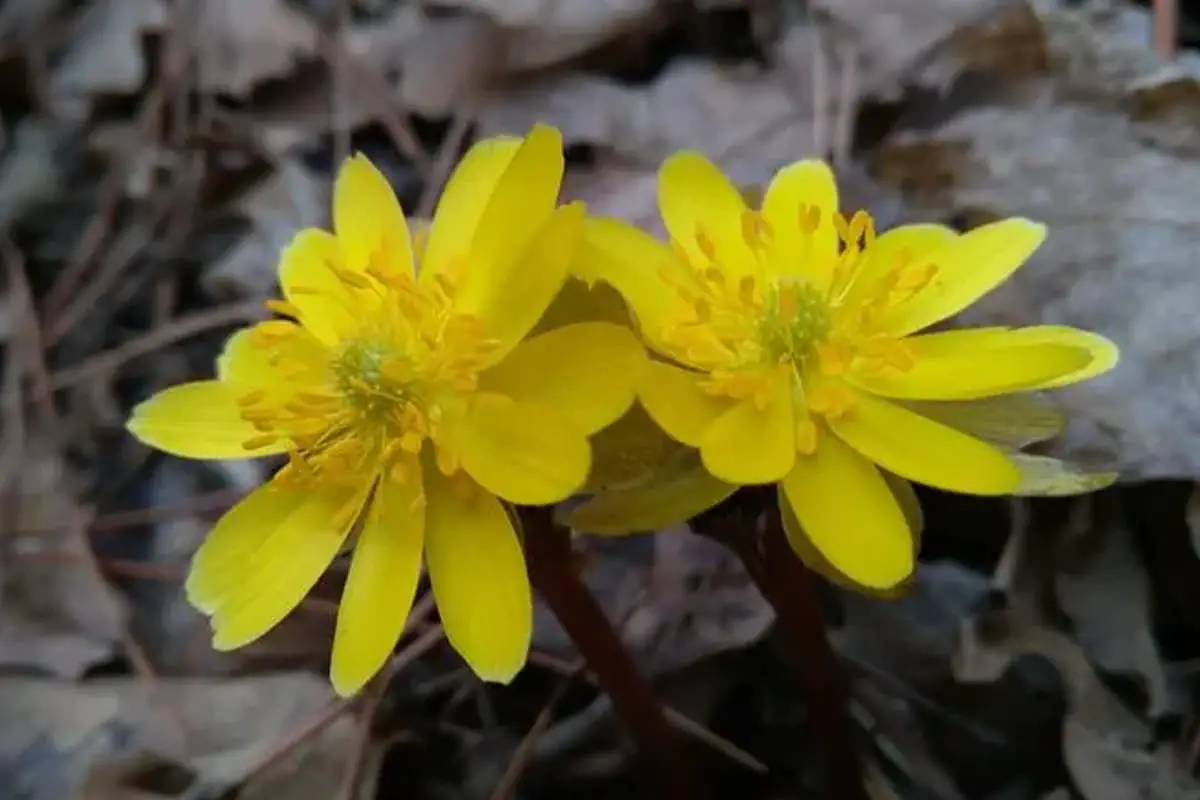
The plant is a perennial herb with a short and thick rhizome and numerous fibrous roots.
During the flowering period, the stem is 5-15 centimeters tall, later growing up to 30 centimeters, with sparse, soft hairs at the top or sometimes hairless, and may branch occasionally.
The base is adorned with several membranous scales. After flowering, the leaves grow larger, with the lower stem leaves having long petioles and being hairless.
The leaf blades are a true triangular shape, up to 7.5 centimeters long and 9 centimeters wide, with three complete divisions.
The divisions are long-petioled, bi- to tri-pinnately divided, with the final division segments being narrow ovate to lanceolate with short pointed tips. The petioles can be up to 6.5 centimeters long.
The flowers have a diameter of 2.8-3.5 centimeters; there are about nine sepals, often with a pale greyish-purple tint, oblong or ovate-oblong in shape, equal in length or slightly longer than the petals which measure 14-18 millimeters, and are hairless or with sparse, soft hairs near the margin.
There are about ten petals, yellow, inverted ovate-oblong or narrowly inverted ovate in shape, 1.4-2 centimeters long and 5-7 millimeters wide, hairless.
The stamens are about 3 millimeters long and hairless; there are many carpels with short-haired ovaries, and the styles are about 0.8 millimeters long, curving outward with a small, spherical stigma.
The fruit is an inverted ovoid shape, about 3.8 millimeters long, covered with short soft hairs, and has a short persistent style.
Adonis amurensis
Golden Marigold
Found in China, Adonis amurensis is also present in North Korea, Japan, and the Russian Far East. It thrives on grassy slopes and forest understories.
Commonly found among shrubs on hillsides or at the base of mountains, under deciduous forests, along forest edges, on slopes, and in moist, humus-rich soils.
Adonis amurensis is cold-tolerant and thrives in areas with significant diurnal temperature variation, preferring neutral to slightly alkaline, humus-rich, moist soils.
Seed propagation is the primary method for mass reproduction, but it has a lengthy cycle. The “seeds” are technically achenes with a slightly fleshy outer pericarp that’s pale green and a bony, black inner pericarp containing a single seed with a membranous, white seed coat.
Mature from mid-May to early June, they are prone to shedding and should be harvested accordingly. Once collected, seeds can be sown directly in nursery beds, sparingly, to facilitate transplanting.
Cover with 1 cm of soil, maintaining moisture. After sowing, seeds undergo after-ripening and winter dormancy, germinating the following spring.
Seedlings produce only two cotyledons in the first year and gradually develop 1-3 normal foliage leaves annually, typically flowering after five years.
This method yields fewer plants but results in blooming the following year. Division can be done in spring, summer, or fall, with late autumn being optimal.
Select plants with multiple stems (indicating a well-branched rhizome), excavate the root system, distinguish between the rhizome’s branches and dormant buds, and break or cut the rhizome so that each section has a dormant bud.
After division, plant in nursery beds, though those with terminal buds can be planted directly in the garden.
This method allows for rapid mass propagation but is more complex.
Experiments have shown that within a suitable medium, dormant buds can be stimulated to grow, and callus tissues can be induced on segments of the vegetative body to differentiate into multiple shoots. This area requires further research for optimization.
Choosing the Plot
Select a flat terrain with fertile soil, where intensive cultivation hasn’t exceeded two years, and irrigation is available.
Saline-alkali soils, low-lying flooded areas, and fields sprayed with pre-emergence herbicides in the previous year are unsuitable for planting.
Land Preparation and Bed Formation
From late March to early April, begin land preparation. Deep plowing and fine harrowing are required to ensure the soil is finely broken, loose, and the surface is level. Beds and ridges should be made according to local conditions, ensuring straight ridges and flat beds.
Sowing
In the Tongliao region, sowing takes place from April 1-15, using 1.5-2 kilograms of seeds per 667 square meters. Sow in small ridges on raised beds manually, adopting garden-like planting.
For 4-meter-wide beds, plant 8-12 ridges, creating shallow furrows and covering lightly with soil about 1 centimeter thick. After sowing, press down and water.
Fertilizing
Field experiments indicate that phosphorus is essential in planting fertilization (base fertilizer), and organic fertilizer guarantees high yields, increasing production by 14.4% when combined with N, P, K. With additional organic fertilizer, yields can increase by 70.6%.
Topdressing should be nitrogen-focused to facilitate bud formation and promote blooming, accompanied by frequent watering and disease prevention.
Base Fertilizer
For the base fertilizer, a mixture of 1500 kilograms of well-rotted farmyard manure and 15 kilograms of NPK compound fertilizer per 667 square meters has shown good results.
Topdressing
Apply topdressing in mid-July, preferably with NPK compound and other phosphorus and potassium fertilizers, using 10-15 kilograms of compound fertilizer plus 5-8 kilograms of urea per 667 square meters, applied all at once during soil consolidation, followed by watering.
If possible, apply a second topdressing during mid-bloom. Spray foliar fertilizer every 10 days during the flowering period until the end, using potassium dihydrogen phosphate, Golden Leaf Prosperity, or Robust Prosperity.
Watering
Pre-emergence watering can be done before or after sowing. Post-sowing watering should be followed by timely soil loosening to prevent crusting.
During the growing period, water multiple times with a low flow to avoid soil erosion and seedling smothering, combining watering with fertilization.
Seedling Acclimatization: Early growth of seedlings is slow, hence intensive field management, frequent hoeing, and treading are necessary.
Thinning and Setting Seedlings: After acclimatization and before bolting, thin and set seedlings with a spacing of 3-5 centimeters, leaving about 35,000-40,000 plants per 667 square meters.
Bolting Period: To encourage bolting and budding, spray a 0.001% GA3 solution on the leaves when the Adonis amurensis enters the rosette initial phase in early July.
Weeding: Manual weeding is generally preferred, avoiding herbicides when possible. If used, apply pre-emergent herbicides at 150 milliliters per 667 square meters before sprouting; for post-emergence grassy weed control, use 80 milliliters of Napropamide per 667 square meters, diluted with 25-40 kilograms of water, sprayed after seedlings emerge.
Observations show that both wild and cultivated Adonis amurensis have no significant pests, although ants can consume the seeds once they fall.
During the flowering and vegetative growth periods, scorching of flowers and leaves may occur due to dry, hot weather, strong sunlight, or dry winds. The solution is timely shading or watering.
Landscaping: Adonis amurensis with its small stature, large, brightly colored flowers, and resilience against frost and snow, is suitable for planting in rock gardens, crevices, and at the base of mountains, or for decorating flower beds, borders, and lawns. Potted arrangements beautify living spaces with elegance.
Medicinal: Adonis amurensis contains a variety of cardiotonic glycosides recognized in many national pharmacopeias. Traditional Chinese Medicine refers to it as the “herb of longevity and happiness.”
It has cardiotonic, diuretic, sedative, and heart rate reducing properties, lowering excitability of the nervous system and hyperactive spinal reflexes.
It’s used for acute diseases and chronic heart failure, mainly treating congestive heart failure, cardiac edema, and atrial fibrillation, enhancing the treatment of epilepsy when combined with silver bromide.
Japanese and Canadian merchants purchase the flowers annually from China for pharmaceutical extraction.
The language of Adonis amurensis flowers: Reminiscence, endurance, and perseverance!

Peggie was once a high school mathematics teacher, but she set aside her chalkboard and textbooks to follow her lifelong passion for flowers. After years of dedication and learning, she not only established a thriving flower shop but also founded this blog, “Flowers Library”. If you have any questions or wish to learn more about flowers, feel free to contact Peggie.
 English
  العربية
  Bahasa Indonesia
  Deutsch
  Français
  Italiano
  Nederlands
  Português
  Русский
  日本語
日本語