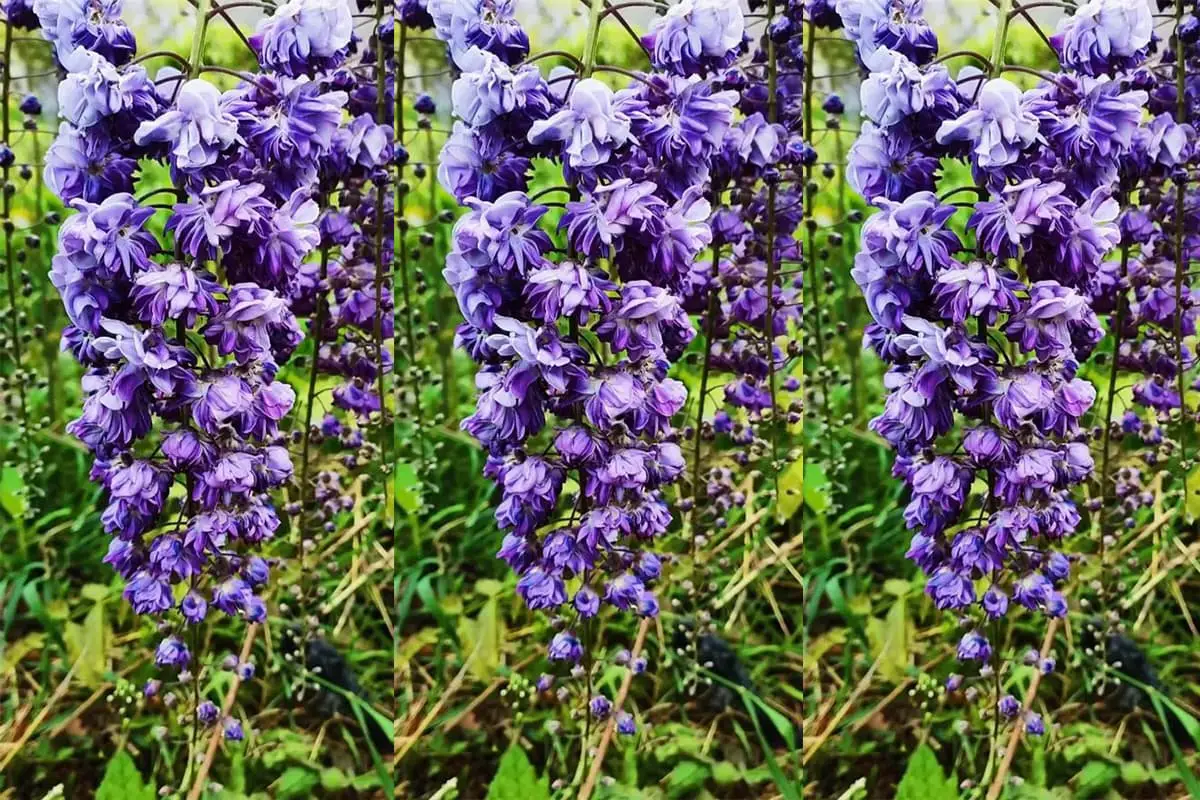
The Wisteria floribunda “Violacea Plena”, also known as the “Double Black Dragon Wisteria”, is a type of deciduous vine. It blossoms beautifully in the spring, with flower clusters measuring 50-80 centimeters in length.
Its flowers are deep purple or blackish-purple, creating a striking display with a pleasant fragrance. Its flowers, resembling a string of mature grapes up close and a black dragon from afar, are particularly spectacular and beautiful.
The Double Black Dragon Wisteria blooms between April and May, with its fruits maturing between September and November.
I. Basic Introduction
The flower clusters of the Double Black Dragon Wisteria measure 50-80cm in length. Its deep purple flowers are strikingly beautiful and fragrant. The wisteria hangs like a cloud, and the flower vines are fond of the spring sun. The fragrance lingers beautifully.
II. Characteristics
The Double Black Dragon Wisteria is a type of deciduous vine. Its bark is a deep gray color and does not crack. It blossoms beautifully in spring, with flower clusters measuring 50-80cm in length.
Its deep purple flowers are strikingly beautiful and fragrant. The wisteria hangs like a cloud, and the flower vines are fond of the spring sun. The fragrance lingers beautifully.
III. Cultivation Method
Planting: The Double Black Dragon Wisteria is a plant with strong vertical roots and few lateral roots. It can grow in any type of soil but prefers moist, fertile, well-drained soil. When transplanting, dig as many lateral roots as possible and bring the soil ball with it.
Transplanting is mostly done in early spring. Before moving the plant, set up a scaffolding and tie the thick branches to it so they can climb. Since Double Black Dragon Wisteria has a long lifespan and thick branches, the material for the scaffold must be strong and durable.
Use painted fine wooden poles or steel pipes as the scaffolding to prevent corrosion, or cement or stone pillars can be used.
Water and Fertilizer: The main root of the Double Black Dragon Wisteria is very deep, so it has strong drought resistance. Overwatering can lead to root rot. Watering is only needed during dry seasons when cultivating in courtyards.
Young trees cannot form flower buds in their first year after planting, but will start to flower and bud in the following years. If the plant doesn’t flower after several years, it might be due to either excessive vegetative growth or weakened vitality, making it difficult to accumulate nutrients.
When the vegetative growth is excessive, part of the root can be cut and leaves pruned. When the vitality is weak, additional fertilizer can be added to promote flowering.
Organic fertilizer, superphosphate, and wood ash can be used during the planting process. During the growth period, apply phosphorus and potassium fertilizer 2-3 times.
IV. Propagation Methods
Cutting: Cutting includes both stem and root cuttings. Stem propagation typically uses hardwood cuttings. This is done in the fall or before the branches sprout in March to April of the second year.
During operation, select strong young branches that are one to two years old, cut into cuttings that are 10-15 cm long, and insert them directly or obliquely into a pre-prepared nursery bed.
The cutting depth should be 2/3 of the cutting length. After insertion, spray water to keep the nursery bed moist, strengthening care results in a high survival rate. The plant can reach a height of 20-50 cm within the year, and can be transplanted out of the nursery after two years.
Root cuttings use the fact that the roots of Wisteria floribunda ‘Violacea Plena’ easily produce adventitious buds. Normally, roots that are 0.5-2 cm thick are dug up in mid to late March, cut into cuttings that are 10-12 cm long, and inserted into the nursery bed.
The cutting depth should be such that the upper cut of the cutting is level with the ground. After insertion, it is important to keep the nursery bed moist.
Grafting: This is generally used for the propagation of superior varieties, which can be grafted onto common rootstocks. Grafting can be done before budding in the spring, both branch and root grafting are possible.
When root grafting, branches that are one to two years old are generally grafted onto the roots of another plant, root grafting is most suitable when potting.
V. Disease and Pest Control
Diseases: The main diseases are soft rot and leaf spot. Soft rot can cause the entire plant to die, while leaf spot damages the leaves of Wisteria floribunda. Both diseases can be controlled by using a 1000-fold solution of 50% carbendazim or an 800-fold solution of 50% methyl tobujin wettable powder.
Pests: The common pests are snails, scale insects, and whiteflies. Snails are often active in the rainy seasons of spring and summer, at this time lime powder should be regularly spread around the planting garden or at the base of the support frame.
A poorly ventilated environment can often lead to scale insects on Wisteria floribunda ‘Violacea Plena’, scale insects often parasitize the edges or leaf level surfaces of the plant, sucking out the sap and causing the plant to wilt, in severe cases, the entire plant can die.
They can be eliminated by spraying a 1000-fold solution of 40% oxydemeton-methyl emulsion, or a 2000-fold solution of 50% malathion emulsion, or an 800-1000-fold solution of dimethoate or imidacloprid. Whiteflies can be controlled by spraying a 3000-fold solution of pirimicarb or aphid eliminator.



 English
  العربية
  Bahasa Indonesia
  Deutsch
  Français
  Italiano
  Nederlands
  Português
  Русский
  日本語
日本語