600+ Types of Flowers A To Z (With Names and Pictures)
Types Of Flowers By Names (A-Z) Types Of Flowers By Color Types Of Flowers By Season Types Of Flowers By Blooming Time 600+ Types of Flowers No. Flower Name No.…

Pontederia cordata is a perennial aquatic or wetland herbaceous plant in the Pontederiaceae family. It can grow up to 150 centimeters tall and has a clump of rhizomatous leaves.
The leaf stalks are cylindrical and green, while the leaves themselves are large, dark green, smooth, and mostly ovate-lanceolate in shape. The flower stems are erect and usually taller than the leaves.
The inflorescence is spike-like and borne at the top, with each spike densely packed with dozens to hundreds of small, round, blue-purple flowers.
The upper two petals have two yellow-green spots, and the texture is semi-transparent. The flowering and fruiting period is from May to October.
It is distributed in both tropical and temperate regions of the Americas, and has been introduced and cultivated in northern China and other areas.
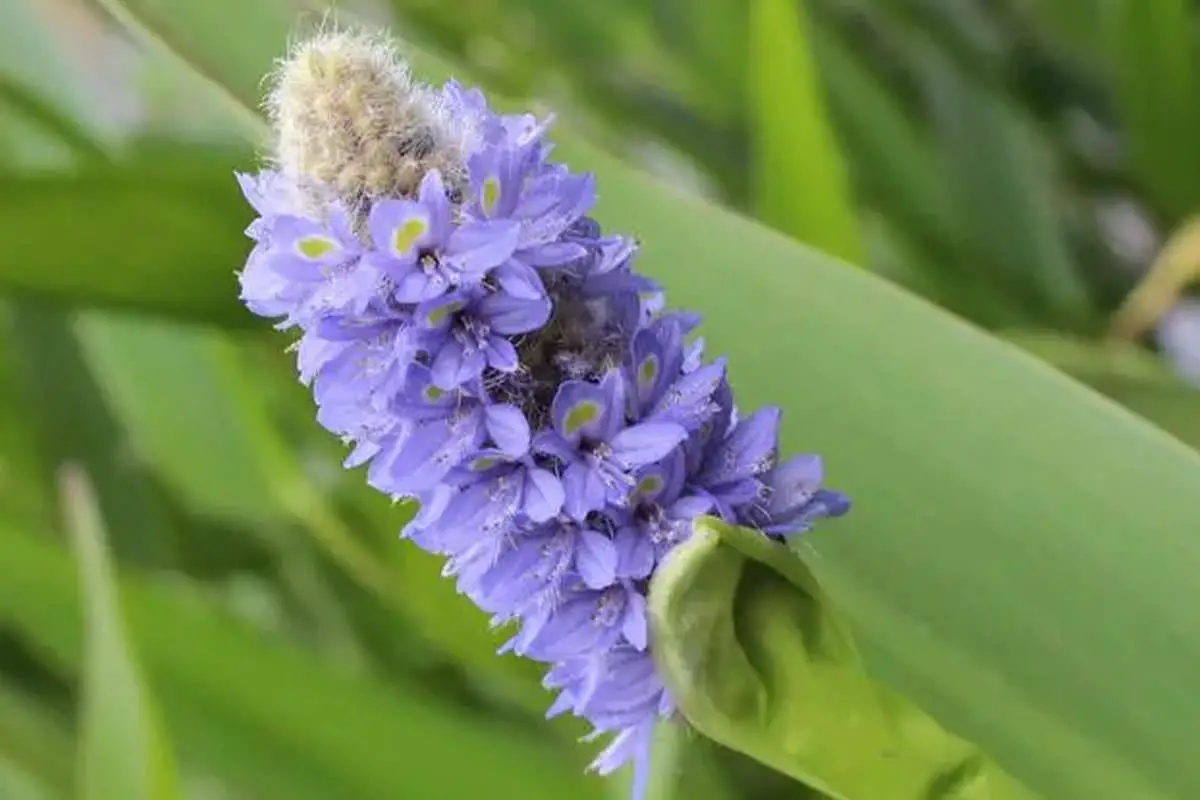
Pickerelweed can be used for home potting and pond planting, as well as widely used for landscaping in gardens.
It can be planted along riverbanks, around ponds, and in artificial wetlands, alternating with other plants such as water chestnut, flowering rush, water onion, and water hyacinth, adding ornamental value.
The leaves are lush green, the flowers are charming, and the flowering period is relatively long. The clusters of purple flowers against the green leaves have a unique charm.
It can be used for landscaping wetlands, water edges, pond greening, as well as for potted ornamental purposes.
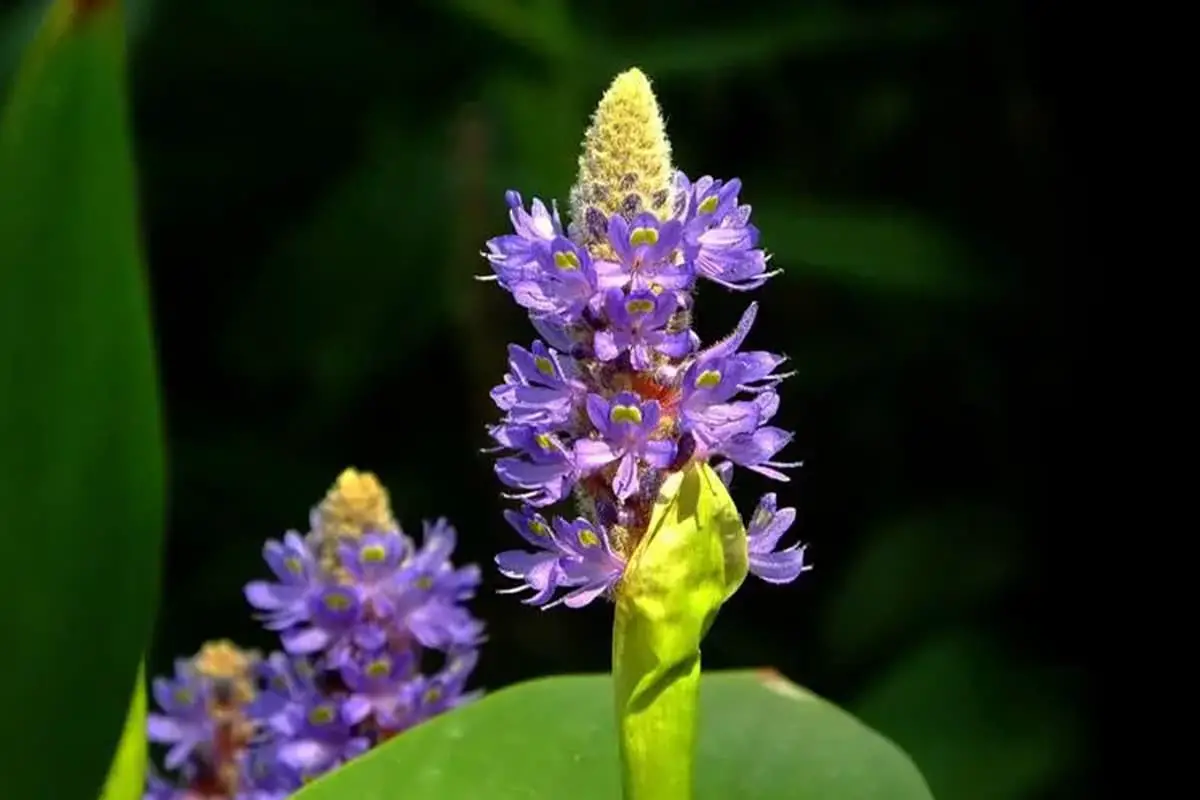
Pickerelweed is a perennial aquatic or wetland herbaceous plant. The leaf stalks are cylindrical and green. The leaves are relatively large, reaching up to 25 centimeters in length and 15 centimeters in width.
They are dark green and have various shapes, mostly ovate-lanceolate, about 10-20 centimeters long. The upper two petals have two yellow-green spots. The flower stems are erect and usually taller than the leaves.
The rhizomes are fibrous and indeterminate, ranging from 15 to 30 centimeters in length, with numerous root hairs. The underground stems are stout, brownish-yellow, with buds, and the clumps of leaves grow to a height of 80-150 centimeters.
The leaf stalks are cylindrical and green, with a membranous substance on the cross section. The leaf blades are smooth, olive-colored, and ovate-lanceolate. The leaf base is broadly heart-shaped, gradually tapering to a pointed tip.
The spike-like inflorescence is borne at the top, ranging from 5 to 20 centimeters in length. There are more than 200 densely packed small flowers, blue-purple in color with yellow spots, with a diameter of about 10 millimeters.
The flower has 6 lobes, nearly circular, with the lobes at the base fused into a tubular shape. The fruit is initially green and turns brown when mature.
The fruit skin is hard, and the seeds are elliptical, with a diameter of 1-2 millimeters. The flowering and fruiting period is from May to October.
Temperature: Pickerelweed prefers ample sunlight and thrives in temperatures between 18-35℃. It grows best within a warm range, with growth slowing down below 18℃ and ceasing below 10℃.
Water and Fertilizer: Pickerelweed enjoys moist conditions and requires sufficient water and nutrients for cultivation. It is suitable for growth in still water, with shallow water below 20 centimeters being ideal. When potted, the pot should be filled with water, maintaining a certain water level.
Overwintering: Pickerelweed is not cold-resistant, so precautions should be taken during periods of low temperatures. Potted plants can be watered and brought indoors for overwintering, maintaining a temperature above 5℃ to ensure safe wintering.
Pickerelweed can be used for home potting and pond planting, as well as widely used for landscaping in gardens.
It can be planted along riverbanks, around ponds, and in artificial wetlands, alternating with other plants such as water chestnut, flowering rush, water onion, and water hyacinth, adding ornamental value.
Pickerelweed thrives in warm, moist, and well-lit environments. It is commonly planted in shallow water pools or near ponds.
With its lush green leaves and charming flowers, it has a relatively long flowering period and can be used for home potting and pond planting.
It is also widely used for landscaping in gardens, planted along riverbanks, around ponds, and in artificial wetlands, alternating with other plants such as water chestnut, flowering rush, water onion, and water hyacinth.
When the flowers bloom, the clusters of purple flowers against the green leaves create a unique charm. It is a promising aquatic ornamental plant.
Pickerelweed is a water plant and is relatively resistant to pests and diseases. However, precautions should be taken during cultivation to prevent the occurrence of pests and diseases.
Pickerelweed is distributed in both tropical and temperate regions of the Americas, and it has been introduced and cultivated in northern China and other areas.
Pickerelweed prefers warmth, sunlight, fertility, moisture, and is sensitive to wind and cold. It can grow in still water or slow-flowing water. It thrives in shallow water below 20 centimeters.
The suitable temperature range is 15℃ to 30℃, and it should not be exposed to temperatures below 5℃ during winter. Pickerelweed grows rapidly and has strong reproductive abilities. Under suitable conditions, it can quickly cover large areas of water.
Division: Pickerelweed can be divided and propagated during spring and summer. This involves digging up the rhizomes, removing old roots, and cutting them into small sections with 3-4 buds for planting.
Seeding: Pickerelweed can be propagated from seeds in spring. The optimal germination temperature for the seeds is around 25℃.

Peggie was once a high school mathematics teacher, but she set aside her chalkboard and textbooks to follow her lifelong passion for flowers. After years of dedication and learning, she not only established a thriving flower shop but also founded this blog, “Flowers Library”. If you have any questions or wish to learn more about flowers, feel free to contact Peggie.
 English
  العربية
  Bahasa Indonesia
  Deutsch
  Français
  Italiano
  Nederlands
  Português
  Русский
  日本語
日本語