Enkianthus quinqueflorus, also known as the Lantern flower or Hanging Bell Apple, is a perennial semi-shrub with upright stems. It grows to a height of 50-200 centimeters and has a diameter of 6-20 millimeters.
The stems are branched and covered with short soft hairs and glandular hairs, becoming hairless as they age. The young branches have a reddish color.
The leaves are opposite, ovate or narrowly ovate, measuring 3-9 centimeters in length and 2.5-5 centimeters in width. It prefers cool and moist environments, and is sensitive to high temperatures and strong light.
It thrives in fertile, loose, slightly acidic soil. The winter temperature should not drop below 5℃. It is native to Mexico and widely cultivated worldwide.
It is suitable for indoor decoration, flower racks, and desk adornment. By placing it in a vase with clear water, it can be enjoyed and propagated by rooting.
I. Morphological characteristics
Enkianthus quinqueflorus is a semi-shrub with upright stems that grow to a height of 50-200 centimeters and have a diameter of 6-20 millimeters.
The stems are branched and covered with short soft hairs and glandular hairs, becoming hairless as they age. The young branches are reddish in color.
The leaves are opposite, ovate or narrowly ovate, measuring 3-9 centimeters in length and 2.5-5 centimeters in width. The larger leaves are in the middle, gradually tapering towards the tip, with a shallow heart-shaped or bluntly rounded base.
The edges have shallow teeth or tooth-like projections that are spaced apart. The veins are often red in color, with 6-11 pairs of lateral veins arranged in a loop near the margin. The lower surface of the leaf is particularly hairy with short soft hairs.
The leaf stalk is 2-3.5 centimeters long and often reddish in color, covered with short soft hairs and glandular hairs. The stipules are narrowly ovate to lanceolate, about 1.5 millimeters long and fall off early.
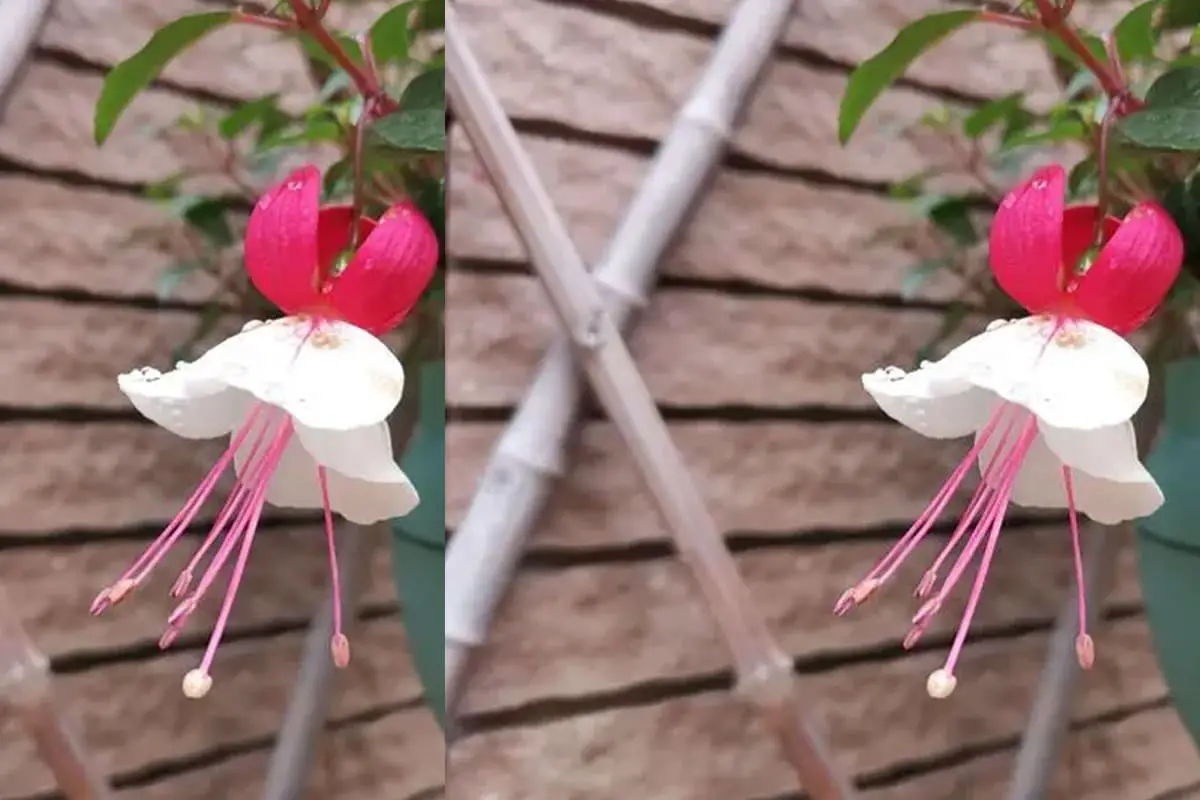
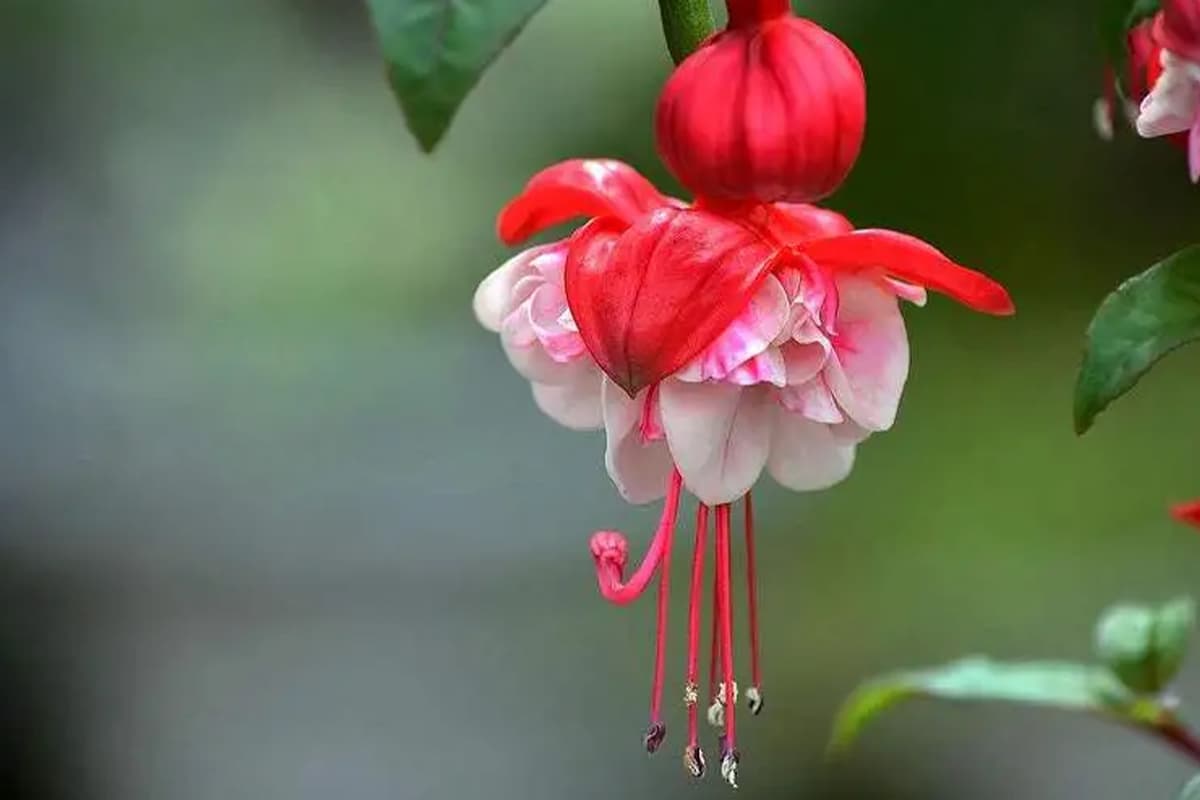
The flowers are bisexual, solitary or occasionally paired, hanging from the leaf axils at the top of the stems. The pedicels are slender, pale green or reddish, measuring 3-7 centimeters in length.
The corolla tube is red, tubular, with the upper part larger, measuring 1-2 centimeters in length and 3-5 millimeters in diameter. The corolla tube, including the pedicel, is sparsely covered with short soft hairs and glandular hairs.
There are 4 red sepals, which are elongated or triangular-lanceolate in shape, measuring 2-3 centimeters in length and 4-8 millimeters in width. The sepals fold back when fully open.
The petals vary in color, ranging from purple-red, red, pink to white. They are arranged in an overlapping pattern, with a wide inverted ovate shape, measuring 1-2.2 centimeters in length, and a slightly concave tip.
There are 8 stamens, with the outer ones longer. The filaments are red and extend 1.8-3 centimeters outside the corolla tube. The anthers are purple-red, elongated oval in shape, measuring 2-3 millimeters in length and approximately 1 millimeter in diameter.
The pollen is pink. The ovary is inverted ovate, measuring 5-6 millimeters in length and 3-4 millimeters in diameter. It is sparsely covered with soft hairs and glandular hairs and has 4 chambers, each containing several ovules.
The stigma is red and measures 4-5 centimeters in length. The base is surrounded by a shallow cup-shaped floral disc in green.
The stigma is club-like and brown, measuring about 3 millimeters in length and approximately 1.5 millimeters in diameter, with 4 shallow splits at the top.
The fruit is purple-red, inverted ovate in shape, measuring about 1 centimeter in length. The flowering period is from April to December.
II. Distribution
Native to countries in Central and South America such as Peru, Chile, Argentina, Bolivia, and Mexico. Widely cultivated in China, especially in the northern regions or in greenhouses on the northwest and southwest plateaus. It has become an important ornamental plant.
III. Growing Environment
Prefers a cool and moist environment, sensitive to high temperatures and strong light. Avoid hot and humid conditions as well as heavy rain and direct sunlight. It thrives in fertile, loose, slightly acidic soil with good drainage and rich in organic matter.
In winter, it requires warm and humid conditions, ample sunlight, and good air circulation. In summer, it prefers dry, cool, and partially shaded conditions, while maintaining a certain level of humidity.
It grows extremely slowly when the temperature reaches 30℃ and experiences mass withering and death at 35℃. The winter temperature should not drop below 5℃, as it is susceptible to frost damage if it falls below this threshold.
IV. Main Value
Enkianthus quinqueflorus has a unique and elegant flower shape. It is commonly used as a potted plant to decorate balconies, windowsills, and study rooms. It can also be hung on anti-theft nets, pergolas, and other locations for viewing.
V. Plant Culture
The flower language of Enkianthus quinqueflorus: Belief in love and passionate heart.


 English
  العربية
  Bahasa Indonesia
  Deutsch
  Français
  Italiano
  Nederlands
  Português
  Русский
  日本語
日本語