Dianthus chinensis, also known as Xing’an Carnation, Northern carnation, Diamond-leaf carnation, Mongolian carnation, Silk-leaf carnation, Alpine carnation, Liaodong carnation, Long-sepal carnation, Long-bract carnation, Forest carnation, and Three-vein carnation.
Its Latin name is Dianthus chinensis L. It belongs to the Caryophyllaceae family and the Dianthus genus. This perennial herb grows to a height of 30-50 cm, is hairless, and has a powdery green color.
The stem grows from the root neck, is sparsely clustered, erect, and branches at the top. The leaves are linear-lanceolate, gradually tapering at the top, slightly narrow at the base, with an entire or minutely toothed margin, and a prominent midrib.
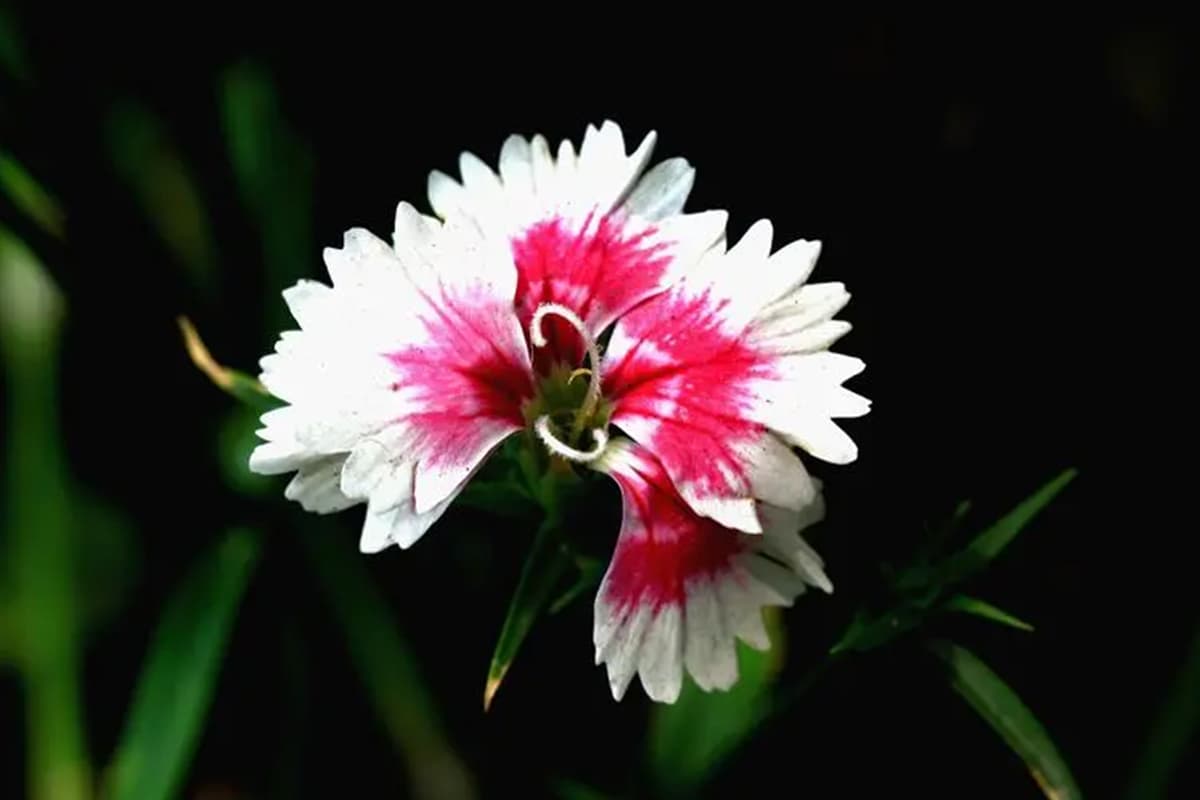
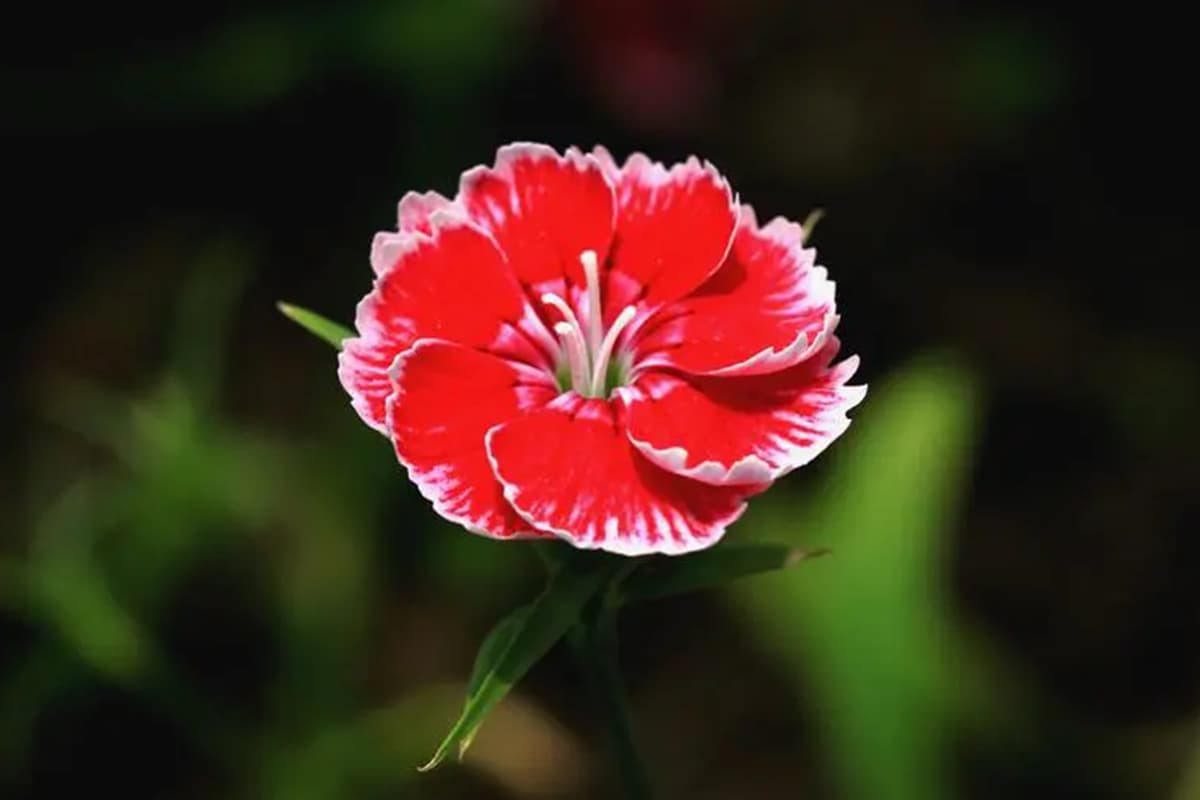
Flowers grow singly at the branch ends or several flowers gather into an umbel. They are purple-red, pink, bright red, or white, with irregularly toothed edges, spots in the throat, and sparse beards.
The stamens protrude from the throat, and the anthers are blue. The ovary is oblong, and the style is linear. The fruit is a cylindrical capsule, enclosed in the persistent calyx, and the seeds are black and flattened.
The flowering period is from May to June, and the fruiting period is from July to September.
I. Morphological features
This perennial herb grows to a height of 30-50 cm, is hairless, and has a powdery green color. The stem grows from the root neck, is sparsely clustered, erect, and branches at the top.
The leaves are linear-lanceolate, 3-5 cm long, 2-4 mm wide, gradually tapering at the top, slightly narrow at the base, with an entire or minutely toothed margin, and a prominent midrib.
Flowers grow singly at the branch ends or several flowers gather into an umbel. The flower stalk is 1-3 cm long. There are 4 bracts, which are ovate, with a long tapering top, reaching over half the length of the calyx, membranous at the edges, and with marginal hairs.
The calyx is cylindrical, 15-25 mm long, 4-5 mm in diameter, with longitudinal stripes, and calyx teeth are lanceolate, about 5 mm long, straight, pointed at the top, and with marginal hairs.
The petals are 15-18 mm long, the petal pieces are inversely ovate-triangular, 13-15 mm long, and are purple-red, pink, bright red, or white. The top edge is irregularly toothed, there are spots in the throat, and sparse beards.
The stamens protrude from the throat, and the anthers are blue. The ovary is oblong, and the style is linear. The fruit is a cylindrical capsule, enclosed in the persistent calyx, and the top is 4-lobed. The seeds are black and flattened.
The flowering period is from May to June, and the fruiting period is from July to September.
II. Growth Environment
This plant is cold and drought-tolerant, but intolerant to extreme heat. In summer, it often grows poorly or wilts. When cultivating, it is important to provide shade to cool the plant. It thrives in sunny, dry, ventilated, and cool moist climates.
It requires fertile, loose soil with good drainage and a lime or sandy soil content. It dislikes waterlogged conditions but favors fertilization. The plant is native to grasslands and hillside meadows.
III. Distribution Range
It can be found in Siberia, Russia, and North Korea.
IV. Disease and Pest Control
Common threats include rust disease and red spiders.
Rust Disease
After pruning diseased branches in the garden, apply preventive sprays promptly. Use a 2-5 degree lime sulfur compound or a solution of 200-300 times diluted sodium pentachlorophenate.
To control rust on host plants, spray 1-2 times in early to mid-March to kill overwintering fungal spores. During the growing season, once new leaves unfold, choose a 1500-2000 times diluted 25% rust inhibitor, a 500 times diluted 50% mancozeb-zinc, or an 800 times diluted 25% copper oxychloride wettable powder spray.
Apply every 7-10 days, for 2-3 continuous treatments. A 1500 times diluted 50% rust spirit wettable powder spray can be used.
Red Spiders
Before the hatching of overwintering eggs, scrape off the tree bark and incinerate it. After scraping, whitewash the tree trunk (with lime water) to kill most overwintering eggs.
Based on the hatching habits of red spiders and their tendency to feed and reproduce on weeds after hatching, turn the soil in early spring, clear the ground weeds, and ensure no weeds are present during the egg hatching period, causing the red spiders to starve to death.
For chemical control, apply a uniform spray of 4000-5000 times diluted acaricide, 1000-1500 times diluted 40% trichlorfon emulsion, 2000 times diluted 20% mite-clear wettable powder, 2000 times diluted 15% dicofol emulsion, or 6000-8000 times diluted 1.8% abamectin emulsion. All can achieve ideal control effects.
V. Primary Value
Medicinal Use
The roots and the whole plant are used for medicinal purposes, serving to clear heat, promote diuresis, break blood stasis, and alleviate swelling.
Carnation can be used either as a whole plant or just the root for medicinal purposes.
Taste and Meridian Tropism: Bitter, cold. It enters the heart and small intestine meridians.
Main Functions: Promotes diuresis and clears strangury, breaks the blood and regulates menstruation.
Chemical Composition: The whole plant contains saponins and volatile oil, the oil mainly consists of eugenol, phenylethanol, benzyl benzoate, benzyl salicylate, and methyl salicylate.
Ornamental Value
Carnations have been widely cultivated. Many varieties have been bred, making it a great ornamental flower.
Carnations are low-growing plants with bamboo-like stems and lush green leaves. Their natural blooming period is from May to September, from late spring to mid-autumn, but they can bloom all year round when grown in a greenhouse.
The flowers grow at the top of the stem, either singly or in pairs, or in a conical corymb; the flowers are not large, only 2 to 3 centimeters in diameter, but they are abundant and bloom successively, providing a long viewing period.
The flowers come in a variety of colors including white, pink, red, dark red, purple, light purple, yellow, and blue, offering a vibrant and ever-changing display.
In gardens, they can be used in flower beds, flower borders, flower platforms, or as potted plants. They can also be used to embellish rock gardens and lawn edges. When planted in large patches, they can serve as landscape ground cover.
In addition, carnations have the ability to absorb sulfur dioxide and chlorine gas, so they can be planted in areas with toxic gases. They also make excellent cut flowers.
VI. Plant Culture
Flower Language
The flower language of carnations signifies pure love, talent, boldness, and feminine beauty.


 English
  العربية
  Bahasa Indonesia
  Deutsch
  Français
  Italiano
  Nederlands
  Português
  Русский
  日本語
日本語