Iris Tectorum: The Ultimate Guide
Iris (scientific name: Iris tectorum Maxim.) is a perennial herb of the Iridaceae family and the genus Iris. It is also known by various names such as Lao Gua Suan,…

The Clematis courtoisii, a woody climbing vine that reaches lengths of approximately 2-4 meters, has tawny roots with a slightly spicy taste when fresh.
Its stems are cylindrical, initially covered with sparse, soft hairs that fade to nearly hairless over time, displaying shades of reddish-brown or dark brown. This plant blooms from May to June and fruits from June to July.
It is commonly found on hillsides, stream banks, and roadside mixed forests and shrubs at elevations of 200-500 meters, where it climbs trees.
With a wide variety of types and a rich palette of colors including rose-red, pink, purple, and white, it is an excellent material for vertical greening in gardens.
It can also be potted for home use, providing not only direct visual enjoyment but also serving as material for cut flowers or dried flower arrangements.
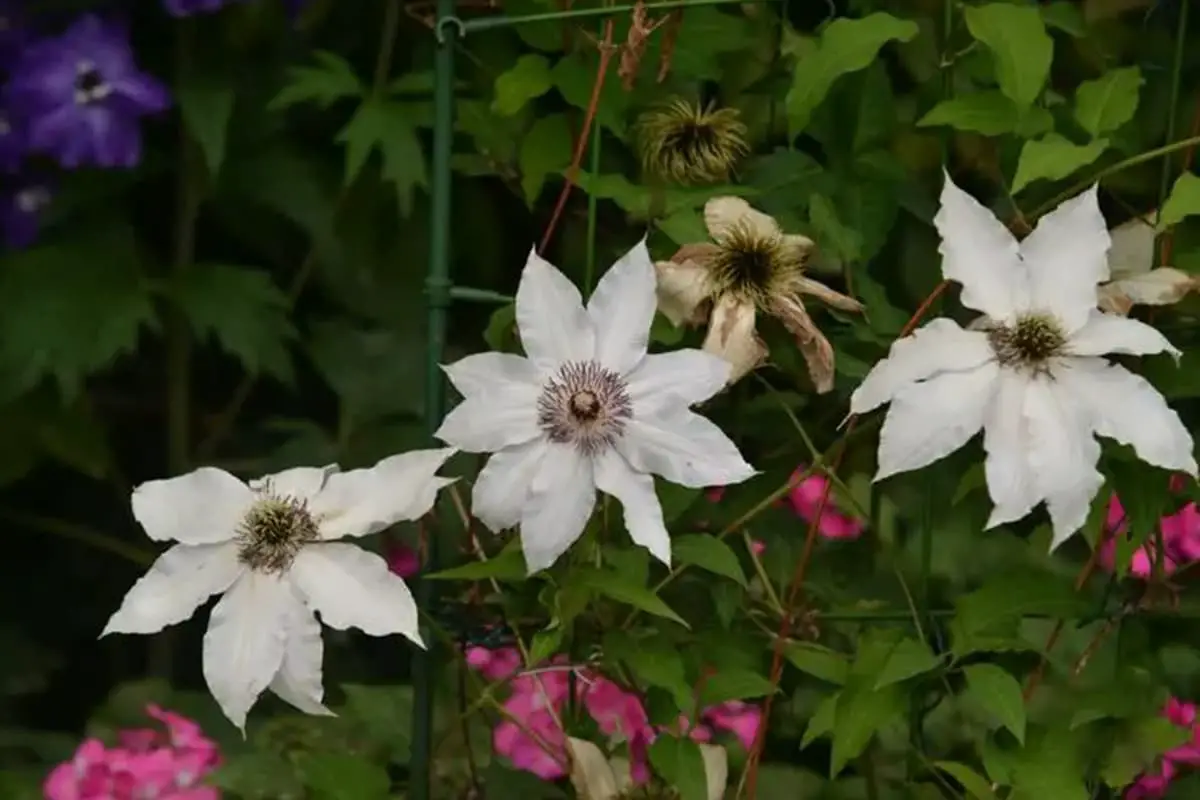
The Large-Flowered Clematis is a perennial vine, reaching lengths of 2-4 meters. Its adventitious roots are yellowish-brown and slightly spicy when freshly cut.
The stems are cylindrical, a reddish-brown or dark brown, initially covered with spreading soft hairs, which later fall off, leaving them nearly hairless.
The leaves are oppositely arranged, forming trifoliate or bipinnately compound structures; the petioles are 6-11 cm long, slightly swollen at the base.
Leaflets are thin, papery, or sub-leathery, oblong or ovate-lanceolate, 5-7 cm long, 2-3.5 cm wide, tapering to a pointed tip, with a broad cuneate base, entire margins, and short soft hairs along the main veins on the upper surface, while the underside is softly hairy.
The petiolules are short or 1-2 cm long, also softly hairy. The flowers are bisexual and solitary in leaf axils; peduncles are 12-18 cm long, covered with short soft hairs, with a pair of leaf-like bracts at the middle, ovate, 4.5-7 cm long, 2.5-4.5 cm wide, with a sharp tip, a purplish band formed along three central veins on the outer side, softly hairy, glabrous inside, with distinct venation.
The petals are absent; there are numerous stamens, dark purple, up to 1.5 cm long, with outer filaments longer than the anthers, which are 5 mm long.
There are many carpels, with the ovary and base of the style covered with long soft hairs, and the upper part of the style with short soft hairs, the stigma enlarged.
The achene is inverted ovate, about 5 mm long, sparsely soft-haired, with persistent feathery styles, and the stigma remains, measuring 1.5-3 cm. The flowering period is from May to June, and the fruiting period is from June to July.
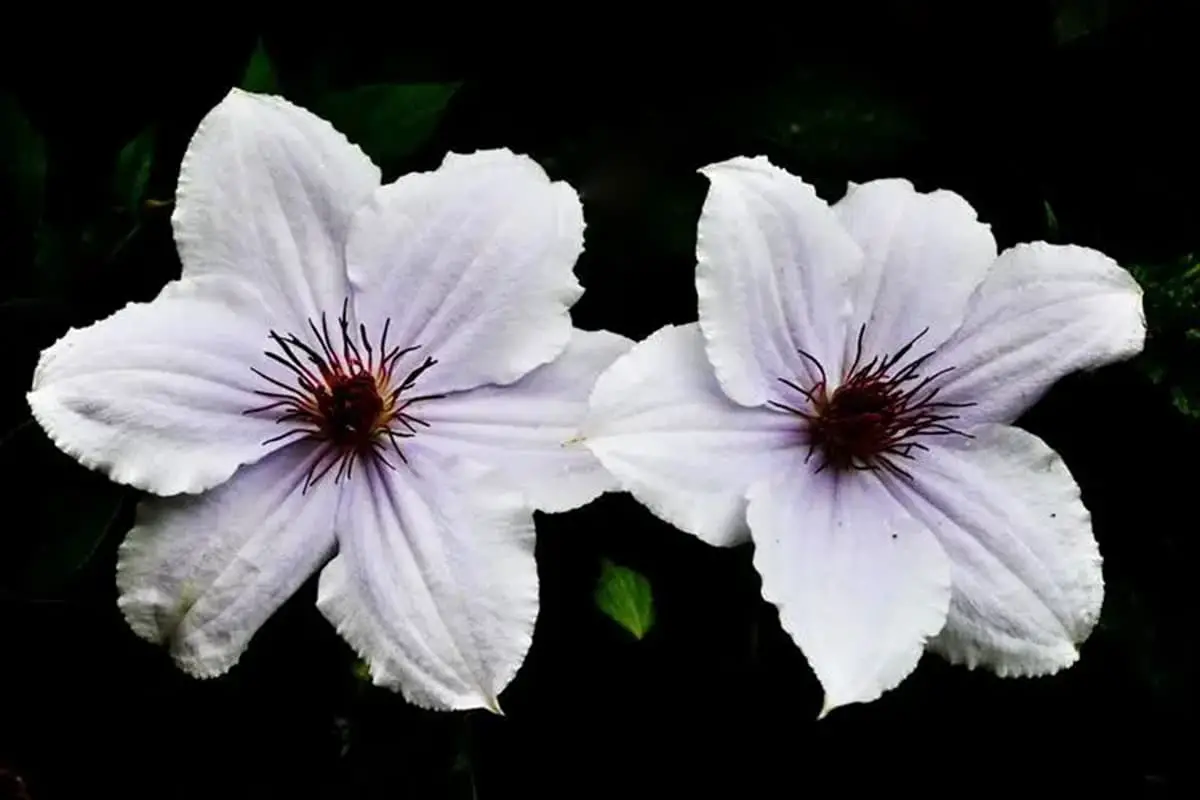
Commonly found at elevations of 200-500 meters on hillsides, stream banks, and roadside mixed woodlands or shrubberies, it climbs on trees.
With a wide variety of species and a rich palette of flower colors, including rose-red, pink, purple, and white, the Large-Flowered Clematis is an excellent material for vertical greening in gardens and can also be potted for home use.
In addition to direct viewing, it can be cut for use as fresh or dry floral arrangements.

Peggie was once a high school mathematics teacher, but she set aside her chalkboard and textbooks to follow her lifelong passion for flowers. After years of dedication and learning, she not only established a thriving flower shop but also founded this blog, “Flowers Library”. If you have any questions or wish to learn more about flowers, feel free to contact Peggie.
 English
  العربية
  Bahasa Indonesia
  Deutsch
  Français
  Italiano
  Nederlands
  Português
  Русский
  日本語
日本語