The Oenothera rosea is a perennial herbaceous plant from the Onagraceae family. It has a robust taproot with stems that often grow in clusters, rising 30-50 centimeters high, branching frequently, and covered with curly soft hairs.
The upper parts are densely hairy in youth and sometimes mixed with long soft hairs, while the lower parts are often purplish-red.
The basal leaves hug the ground, are inversely lance-shaped with a pointed or rounded tip, gradually narrowing from the middle or abruptly so, and irregularly pinnately deeply lobed extending to the petiole.
Petioles are pale purplish-red with a bluntly acute tip at the lower end, becoming sharper or gradually pointed toward the middle and upper parts, and are broadly wedge-shaped at the base abruptly narrowing down to the petiole.
The edges have tooth-like projections with fine feather-like lobes at the base. The fruit is a rod-shaped capsule with ridged wings and a short beak at the top; seeds are numerous in each chamber, nearly horizontally clustered, and are long oval-shaped to inversely ovate.
Native to the southern part of Texas, USA, to Mexico, the Pink Evening Primrose is also found in the warm temperate mountainous regions of the Southwestern United States, Central America, and South America.
It is cultivated in Eurasia, South Africa, and elsewhere, sometimes escaping to become wild. It thrives at altitudes of 1000-2000 meters on wastelands, sunny slopes, edges of secondary forests, roadside, riverbanks, gaps in residential areas, and semi-shaded ditches.
The Pink Evening Primrose is suitable for embellishing nocturnal scenes, used in gardens, courtyards, flower beds, and roadside greening, offering significant ornamental value, as well as economic and medicinal worth.
Its roots are used in herbal medicine for their anti-inflammatory and blood pressure-lowering effects.
I. Botanical History
Commonly known as “Evening Fragrance” in folk tradition, the Evening Primrose is so named for its habit of blooming at night and emitting a faint, enchanting fragrance that wafts through the air.
II. Morphological Characteristics
The perennial herb has a thick main root (up to 1.5 centimeters in diameter); the stems are usually clustered, ascendant, 30-50 centimeters tall, highly branched, and covered with curly soft hairs, with the upper parts densely hairy when young, sometimes mixed with long soft hairs, and the lower parts often purplish-red.
The basal leaves are ground-hugging, inversely lance-shaped, 1.5-4 centimeters long, 1-1.5 centimeters wide, with a pointed or rounded tip, narrowing from the middle or abruptly, and irregularly pinnately deeply lobed extending to the petiole.
Petioles are pale purplish-red and 0.5-1.5 centimeters long, with basal leaves withering during flowering.
Stem leaves are grey-green, lanceolate or oblong-ovate in profile, 3-6 centimeters long, 1-2.2 centimeters wide, with a bluntly acute tip at the lower end, becoming sharper or gradually pointed toward the middle and upper parts, and broadly wedge-shaped at the base abruptly narrowing down to the petiole.
The edges have tooth-like projections with fine feather-like lobes at the base, and the leaves have 6-8 pairs of lateral veins, covered with curly soft hairs on both surfaces; petioles are 1-2 centimeters long.
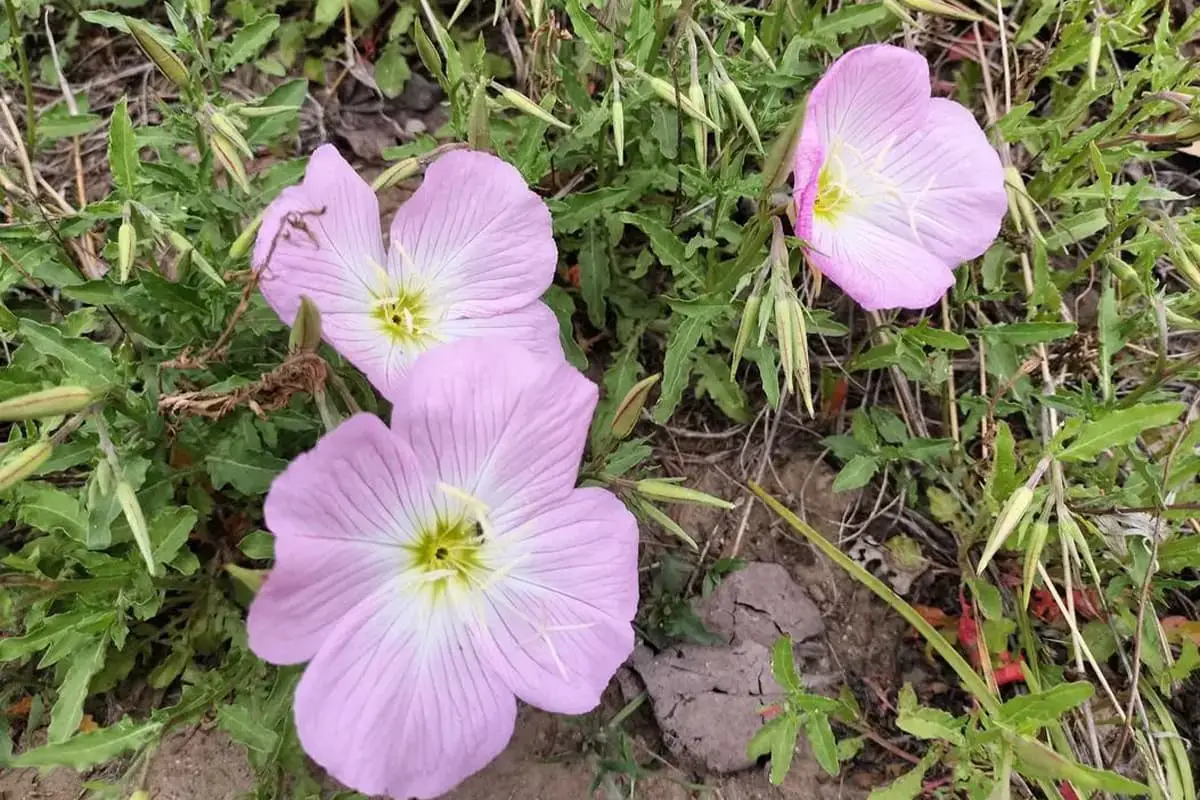
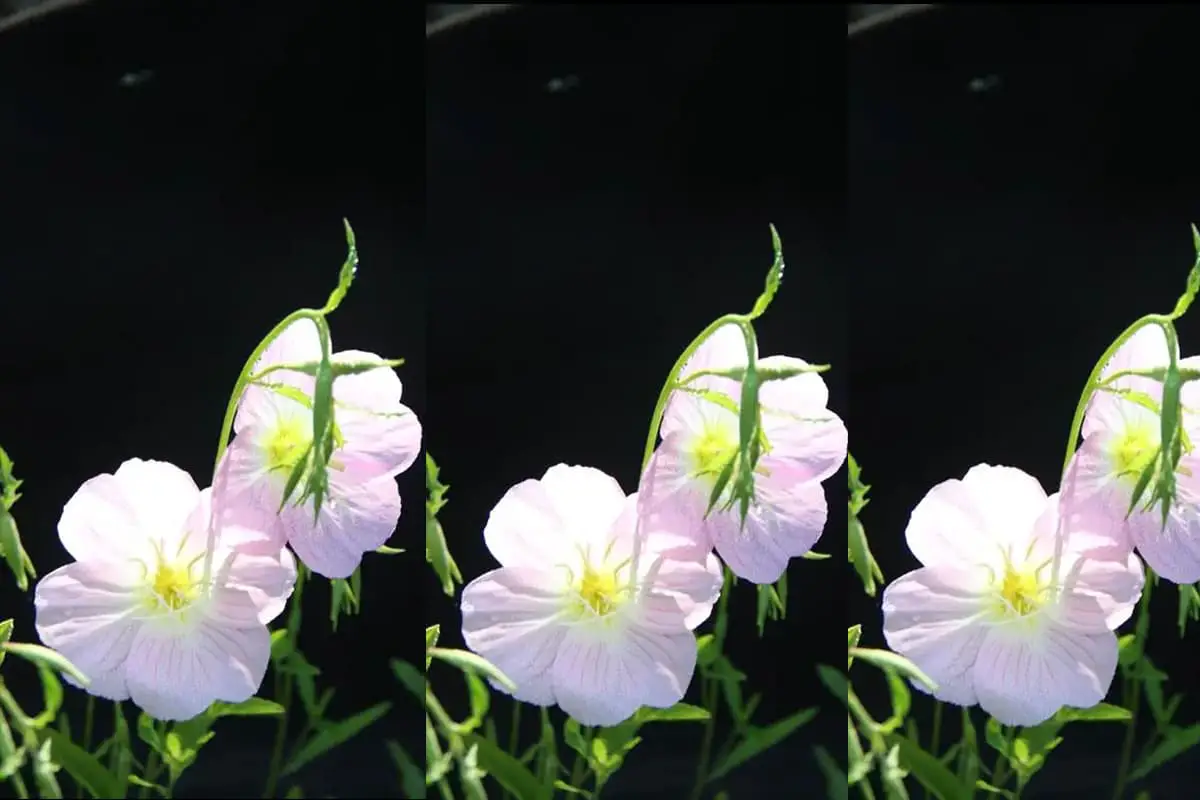
The flowers are solitary at the top of the stem and branch leaf axils, blooming near sunrise. The flower buds are green, conical-cylindrical, 1.5-2.2 centimeters long, with the calyx teeth tightly constricted into a beak at the top.
The floral tube is pale red, 5-8 millimeters long, covered with curly soft hairs, with green sepals tinged with red, lanceolate, 6-9 millimeters long, 2-2.5 millimeters wide, with calyx teeth 1-1.5 millimeters long, and the back covered with curly soft hairs, which reflex and then turn upwards during blooming.
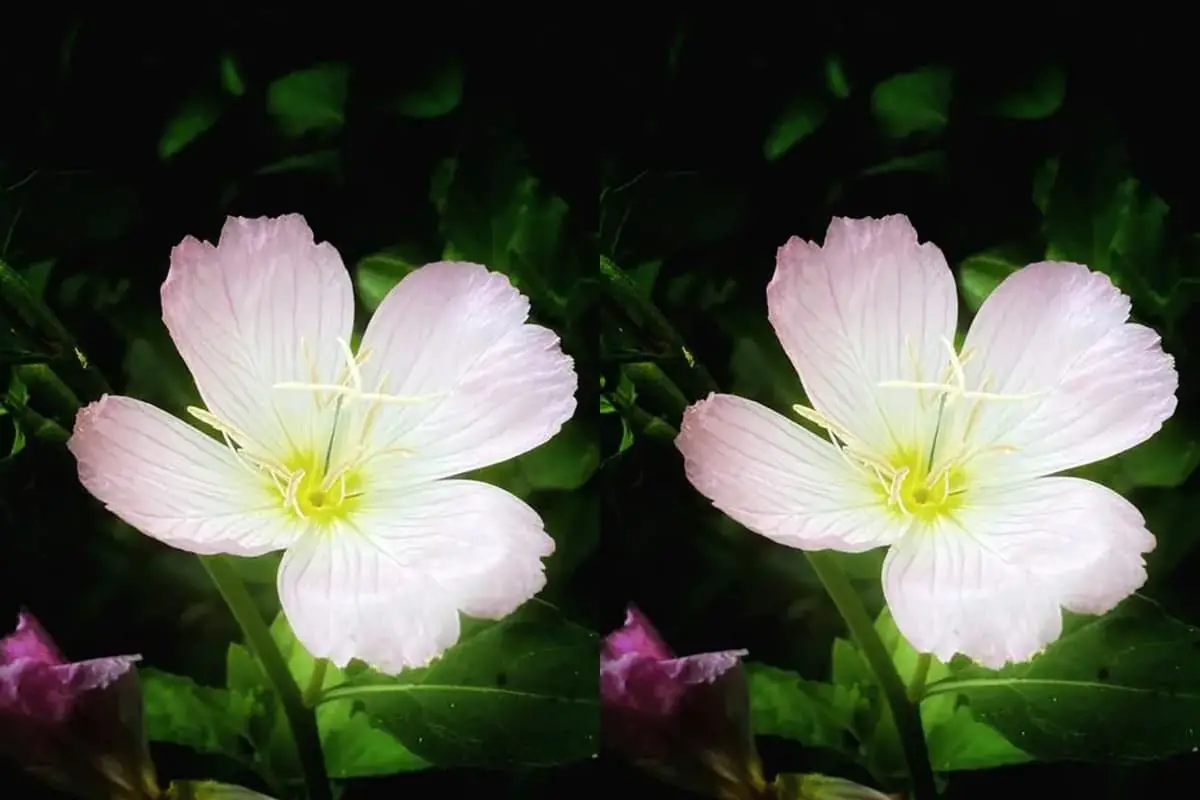
The petals are pink to purplish-red, wide ovate, 6-9 millimeters long, 3-4 millimeters wide, with a bluntly rounded tip and 4-5 pairs of pinnate veins.
The filaments are white to pale purplish-red, 5-7 millimeters long; anthers are pink to yellow, oblong-linear, about 3 millimeters long, with approximately 50% of the pollen developed.
The ovary during flowering is narrowly elliptical, about 8 millimeters long, including the pedicel 6-10 millimeters long, densely covered with curly soft hairs.
The style is white, 8-12 millimeters long, with the portion extending out of the floral tube 4-5 millimeters long; the stigma is red, surrounded by anthers, with lobes about 2 millimeters long, and pollen is directly deposited on the lobes.
The fruit is a rod-shaped capsule, 8-10 millimeters long, 3-4 millimeters in diameter, with 4 longitudinal wings and ridged in between, and a short beak at the top; the pedicel is 6-12 millimeters long.
Seeds are numerous in each chamber, nearly horizontally clustered, long oval-shaped to inversely ovate, 0.7-0.9 millimeters long, 0.3-0.5 millimeters in diameter.
III. Growth Environment
Pink evening primrose thrives at altitudes ranging from 1000 to 2000 meters, commonly found in wastelands, sunny hillsides, the edges of secondary forests, roadside areas, riverbanks, vacant spaces around homes, and semi-shaded ditches.
IV. Distribution
Native to the southern region of Texas in the United States down to Mexico, the pink evening primrose has also been spotted throughout the mountainous zones of the warm temperate areas in the southwestern United States, Central and South America.
It has been cultivated and naturalized in Eurasia (including the Himalayan region of Asia, India, Nepal, Myanmar, etc.) and South Africa.
V. Growth Habits
Phenological Phase
Pink evening primrose’s perennial shoots sprout in late February, entering the initial flowering stage by late March. Seed propagation begins with germination in early March, and the plant transitions to the reproductive growth phase after developing 12 leaves.
Each flower blooms for a single day; they open around 6:30 AM and close by 6:30 PM, with the entire blooming period lasting about 50 days. Fruits begin to mature in early May, naturally splitting open to disperse seeds in humid conditions.
In arid and poor environments, the vegetative growth phase is brief, quickly moving to the reproductive phase, exhibiting a more uniform maturation period with the plants withering away by late May.
In contrast, with better water and nutrient availability, plants continue to grow through spring, summer, and fall, conducive to expansion and a prolonged growth and fruiting period.
Seed Germination
The thin seed coat of pink evening primrose facilitates easy germination with high germination rates of up to 85%. Germination begins on the fourth day and can continue for up to 20 days.
After storing at 4°C for six days, germination rates can reach approximately 91.7%, starting on the second day and lasting for 15 days.
If stored for ten days at 4°C, seeds germinate more rapidly, with a germination rate near 91%, beginning on the second day and lasting for 13 days.
The hastened germination following cold treatment indicates that the seeds require a period of after-ripening dormancy, which can be quickly overcome with short-term cold stratification.
VI. Principal Value
The pink evening primrose is ideal for adorning nocturnal landscapes and is widely used in gardens, courtyards, flower beds, and roadside greenery, offering significant ornamental value.
Additionally, it holds considerable economic and medicinal value. Its roots are used in traditional medicine for their anti-inflammatory and blood pressure-lowering properties.


 English
  العربية
  Bahasa Indonesia
  Deutsch
  Français
  Italiano
  Nederlands
  Português
  Русский
  日本語
日本語