Top 10 Rarest Flowers in China
China is home to a rich variety of plant and animal resources, boasting an exceptional botanical diversity that includes numerous rare and endemic species. However, a number of these rare…

The Lycoris aurea, also known as the Golden Spider Lily, Surprise Lily, or Hurricane Lily, is a perennial herbaceous plant native to China. It is primarily found in provinces along the Yangtze River Basin, often growing on moist, shady slopes.
The bulb of the Golden Spider Lily is large, almost spherical, with a diameter of about 5 centimeters, covered by dark brown scales. Its basal leaves are thick and wide, tapering towards the top, glossy and yellow-green on top and gray-green below.
The plant flowers before it sprouts leaves, with a flower stalk ranging from 30-60 centimeters in height, featuring an umbel with 5-10 blooms. Its flowers, either yellow or orange, are slightly symmetrical, and they bloom without leaves, which grow when the plant is not flowering.
This species closely resembles the Red Spider Lily (Lycoris radiata), but differs in the curling and wrinkling of its petals and leaves, as they are closely related but different species.
The Golden Spider Lily symbolizes happiness, and its blooms represent joy, delight, and pleasure, conveying any positive and happy emotions.
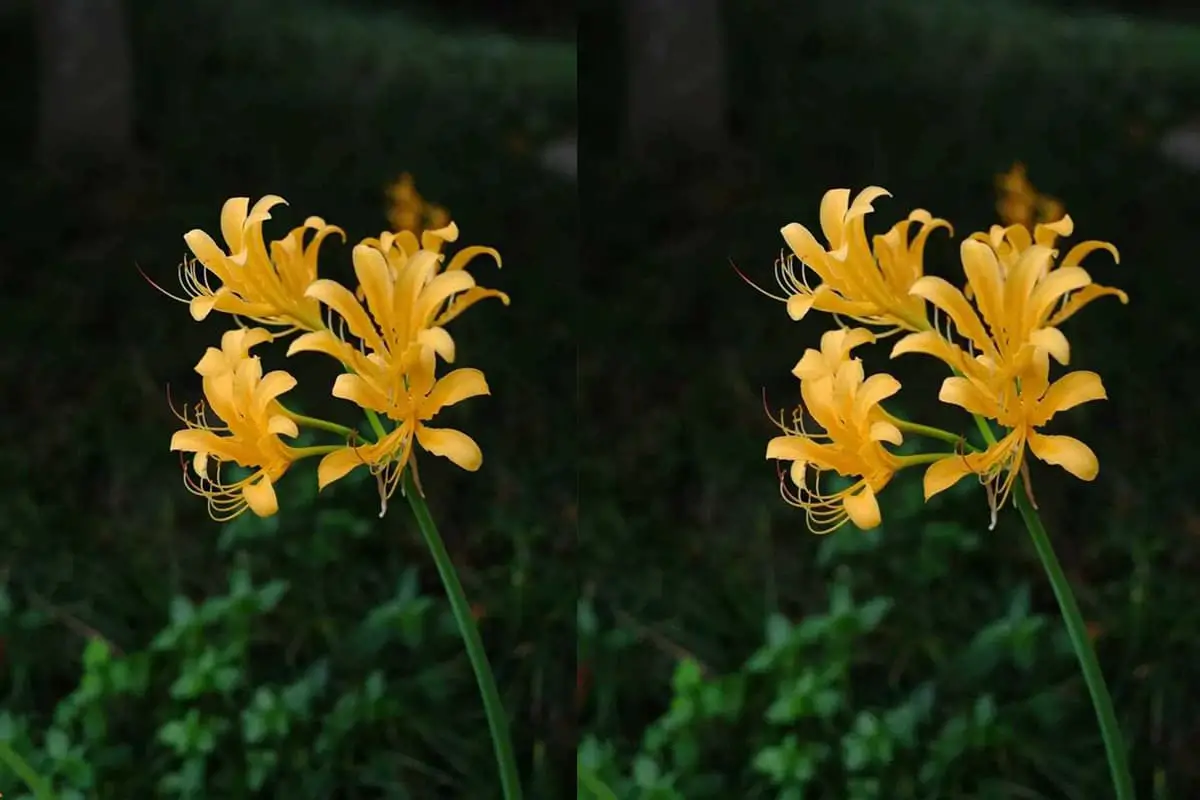
The Golden Spider Lily is a plant of unique beauty and peculiarity. Its lush green leaves wither silently and completely disappear at the onset of early summer.
Then, in midsummer, its flower stalk suddenly shoots up, blooming into distinctive, radiant golden flowers, bringing people joy and surprise, hence its name.
Given the entire plant of Golden Spider Lily is highly toxic, the folklore and symbolism associated with it are shrouded in mystery.
Legend has it that the Golden Spider Lily is the tenderness of the devil, a flower voluntarily cast into hell from heaven, yet sent back by the demons. Unable to return to heaven, it lingers on the path of the underworld.
Out of compassion, the demons agreed to let the Golden Spider Lily bloom on this ordinary path, providing guidance and comfort to the departed souls. Thus, its flower language signifies the love for death and the pain of love.
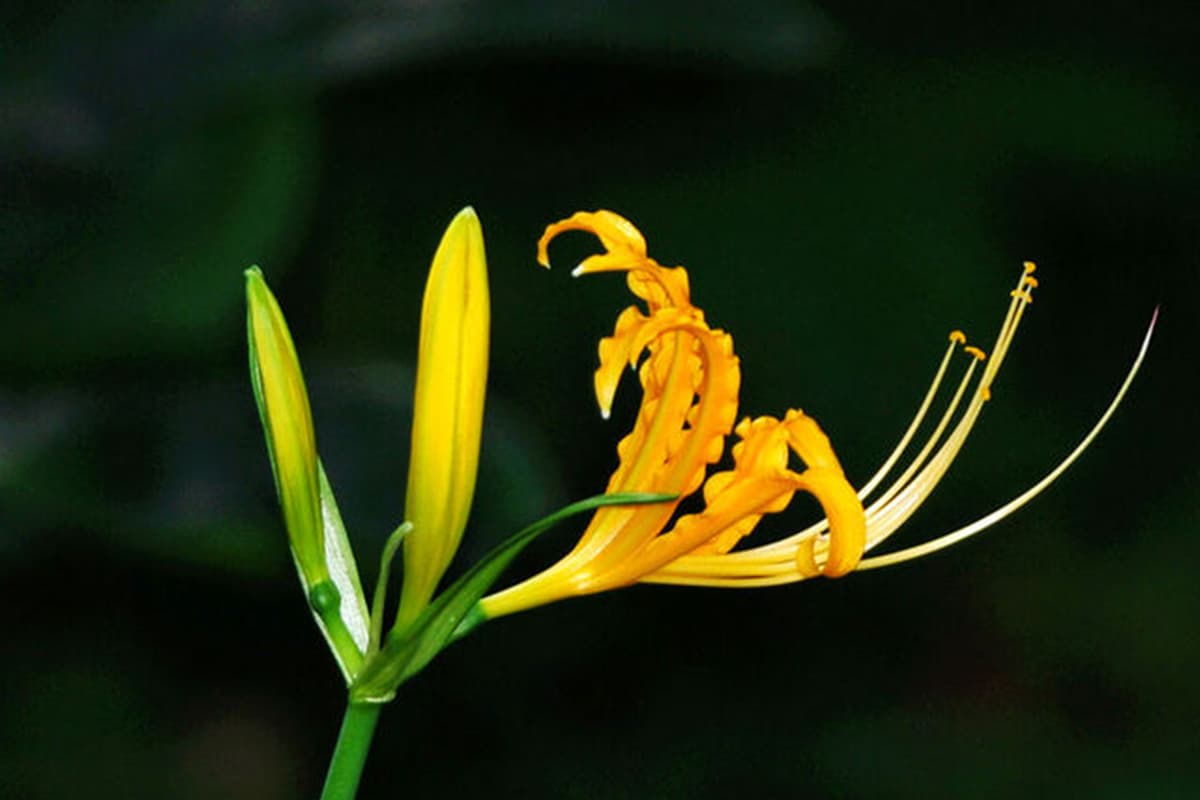
The Golden Spider Lily, native to moist mountainsides and stream banks, is often referred to as the Yellow Spider Lily or Yellow Cockroach Flower due to its color.
Its Latin scientific name, Lycoris aurea (L’Her.) Herb, reflects its splendid golden blossoms which bring joy and surprise, hence its name. Its symbolism represents happiness, and its floral language is joyous, cheerful, and happy, referring to any beautiful and joyful mood.
It resembles the Red Spider Lily in appearance, but there are certain differences in the degree of curling and wrinkling of the petals and leaves, as they belong to the same family but are different species.
It grows at altitudes from 600 meters to 2,300 meters, found on damp slopes, not yet cultivated by humans. The bulb is oval, and the plant height is 50-60 cm. The leaves are linear. In the Guangzhou area, leaves appear first in May and June, followed by flowers.
The flower stalk is upright, with 5-10 flowers, each 5-7 cm in diameter, bright yellow, with curled back petals and protruding stamens and pistils.
It prefers warm, humid, semi-shaded environments, is somewhat cold-tolerant, but does not tolerate drought and fears waterlogging and strong sunlight. The soil requirement is not strict. The plant is dormant in both winter and summer.
Its management is extensive, keeping the soil moist during the growing period, controlling watering during the dormant period, and paying attention to drainage during the rainy season to prevent bulb rot caused by waterlogged soil.
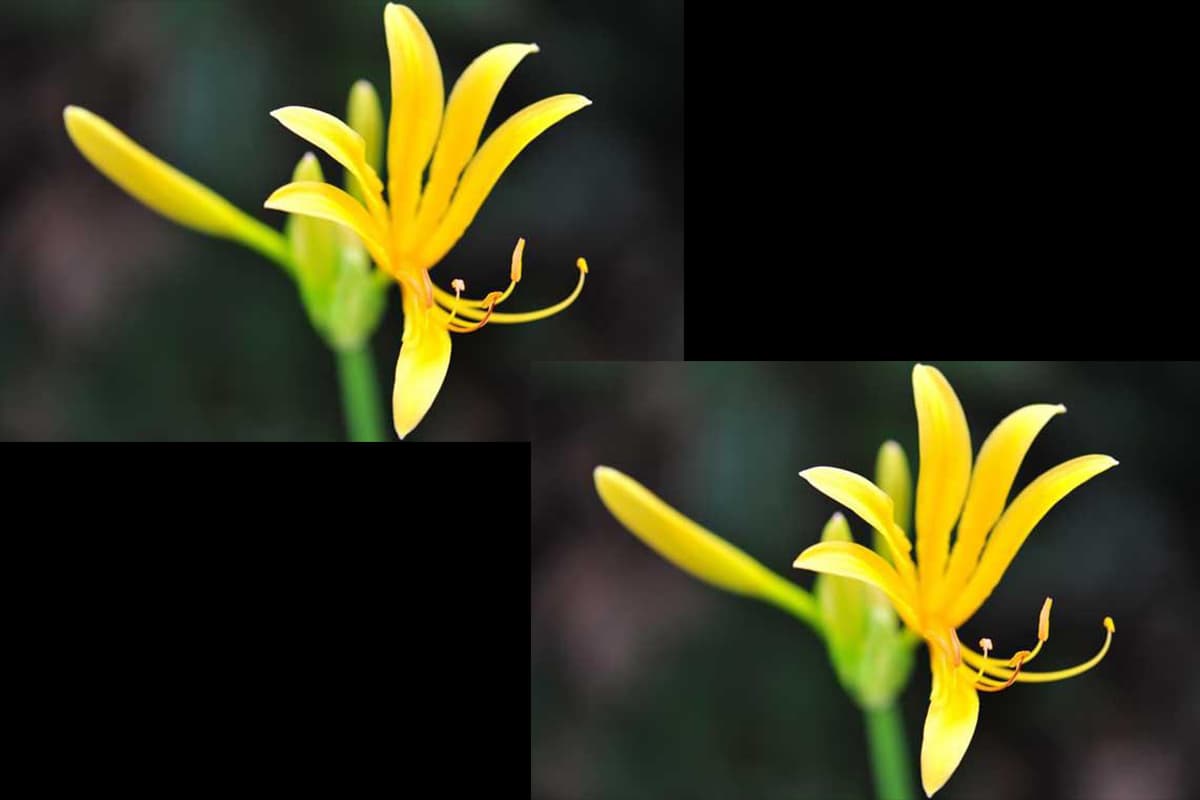
This perennial herb has a large, nearly spherical bulb, about 5 cm in diameter, with a dark brown outer skin.
The leaves are basal, thick, wide-linear, gradually narrowing at the top, up to 60 cm long, about 1.5 cm wide, yellow-green on top, glossy, grey-green underneath, with a sunken midrib on top and raised on the underside, with purple-red leaf veins and base.
The flowers come before the leaves, with a flower stalk 30-60 cm high, and an umbel with 5-10 flowers; the yellow or orange flowers, slightly bilateral, are about 7 cm long; the perianth tube is less than 2 cm long, with 6 slightly wrinkled segments, each about 1 cm wide; there are 6 stamens that extend out of the perianth along with the pistil; the ovary is inferior, with 3 chambers.
The capsule fruit contains several seeds per chamber. The plant flowers without leaves and grows leaves without flowering.
The flowering period is from late July to early September, and the fruiting period is in October.
The bulb can be used to produce alcohol, extract lycorine, and also be used as a pesticide.
The propagation of Lycoris radiata, also known as Red Spider Lily, is predominantly through bulb division. The optimal time for this is between April and June, during which the mature bulb is in its dormant state with a relatively loose outer skin.
Choose a robust perennial plant with numerous small bulbs, break off these bulbs, and try to take as many roots as possible to facilitate flowering within the year.
Choose to plant in a semi-shaded area with good drainage and fertile soil, or in nutrient-rich potting soil. The planting depth should be roughly 2/3 to 3/4 of the bulb diameter.
The spacing between plants in the ground should be about 10 to 15 cm, while potted plants should be 3 to 5 per pot. After planting, thoroughly water the plants and maintain a consistently moist soil without waterlogging.
The optimal temperature for new root growth is between 22℃ to 30℃, generally, new leaves can sprout 15 to 20 days after planting.
Red Spider Lily is highly adaptable, preferring a moist and shady environment, fertile loamy soil rich in humus, and limestone soil. It is tolerant of cold, saline-alkali conditions, but not drought, flooding, or exposure to intense sunlight.
When planted outdoors, regular watering is required without the need for excessive fertilization. If fertilizing, use some fast-acting chemical fertilizers to promote leaf nutrient growth.
From March to April, a small amount of additional fertilizer can be applied to promote bulb enlargement. During the plant’s dormant period from June to July, a small amount of organic fertilizer can be used.
If dry weather is encountered before flowering in summer, continue watering 2 to 3 times and apply a diluted mature phosphorus and potassium fertilizer when the flower stalk starts to shoot out.
As the dormancy period approaches, gradually reduce watering and stop fertilizing. The bulb can be left in the ground over winter.
Red Spider Lily can also be grown hydroponically for ornamental purposes. The method is as follows: Every year after June, when the above-ground leaves of the Red Spider Lily have completely fallen off, dig out the bulb from the soil, taking care to keep the root system intact as much as possible.
Soak the roots in water at 25℃ to 30℃ with a little potassium permanganate for 24 to 36 hours, then place them in a water-filled container, secure with pebbles, and place in a well-ventilated and well-lit indoor area.
Generally, the plant should bloom within 10 to 15 days. During the blooming period, aside from timely water replenishment, fertilization is generally not required. After the flowers wither, the flower stalk can be cut off and the bulb replanted in the soil for care until the following year.
The main disease and pest of Red Spider Lily is anthracnose. It is important to promptly prune diseased leaves and spray with a 500-fold solution of 50% tobuconazole for prevention and control.
Red Spider Lily can be used as ground cover under sparse forests, planted in flower beds, near rocks, along the edges of lawns, and can also be grown in pots for ornamental purposes.
Red Spider Lily is a traditional topical medicine. Its bulb has heat-clearing and detoxifying effects, reduces swelling and dissolves lumps. It can be used to treat toxic sores, snake bites, and rheumatoid arthritis.

Peggie was once a high school mathematics teacher, but she set aside her chalkboard and textbooks to follow her lifelong passion for flowers. After years of dedication and learning, she not only established a thriving flower shop but also founded this blog, “Flowers Library”. If you have any questions or wish to learn more about flowers, feel free to contact Peggie.
 English
  العربية
  Bahasa Indonesia
  Deutsch
  Français
  Italiano
  Nederlands
  Português
  Русский
  日本語
日本語