600+ Types of Flowers A To Z (With Names and Pictures)
Types Of Flowers By Names (A-Z) Types Of Flowers By Color Types Of Flowers By Season Types Of Flowers By Blooming Time 600+ Types of Flowers No. Flower Name No.…

Lagerstroemia indica, also known as Crepe Myrtle, Itchy Tree, or Purple Gold Flower, is a deciduous shrub from the Lythraceae family and Lagerstroemia genus.
Crepe Myrtle can grow up to approximately 7 meters, with its bark exhibiting grey or brown hues and a smooth texture. With many twisted branches and slender twigs, its leaves are ovate, elliptical or broadly rectangular, and papery.
The diameter of the Crepe Myrtle flower is about 3-4 centimeters, presenting a rich range of colors such as deep rose, deep pink, and white. Its blooming season lasts from June to September, a period with relatively few other flowering plants, earning it the nickname “Hundred Days Red”.
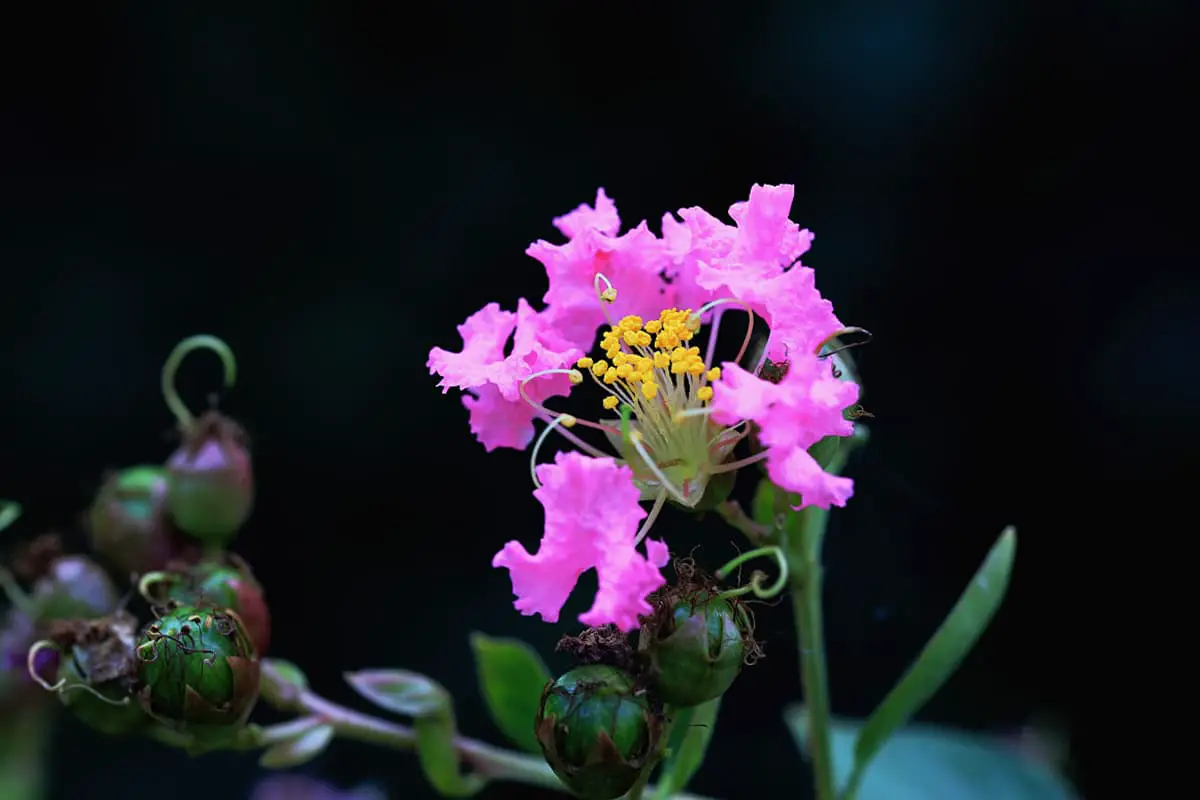
Lagerstroemia indica, also known as Itchy Flower, Itchy Tree, Purple Gold Flower, Purple Orchid Flower, Mosquito Flower, Western Poplar, Hundred Days Red, or Skinless Tree, is a deciduous shrub or small tree that can reach a height of 7 meters.
With twisted branches and fine twigs, its bark is smooth, grey or grey-brown in color. The leaves are alternate or sometimes opposite, papery, elliptical, broadly rectangular or ovate.
When young, the leaves are green to yellow, turning purple-black when mature or dry, and the chambers open fissured. The flowers bloom from June to September and fruit ripens from September to December.
Known for its beautiful figure, clean and smooth trunk, and vibrant flowers, Crepe Myrtle is praised as “Hundred Days Red”. It serves as excellent material for bonsai viewing for its flowers, dry branches, and roots. Its roots, bark, leaves, and flowers are all used in traditional medicine.
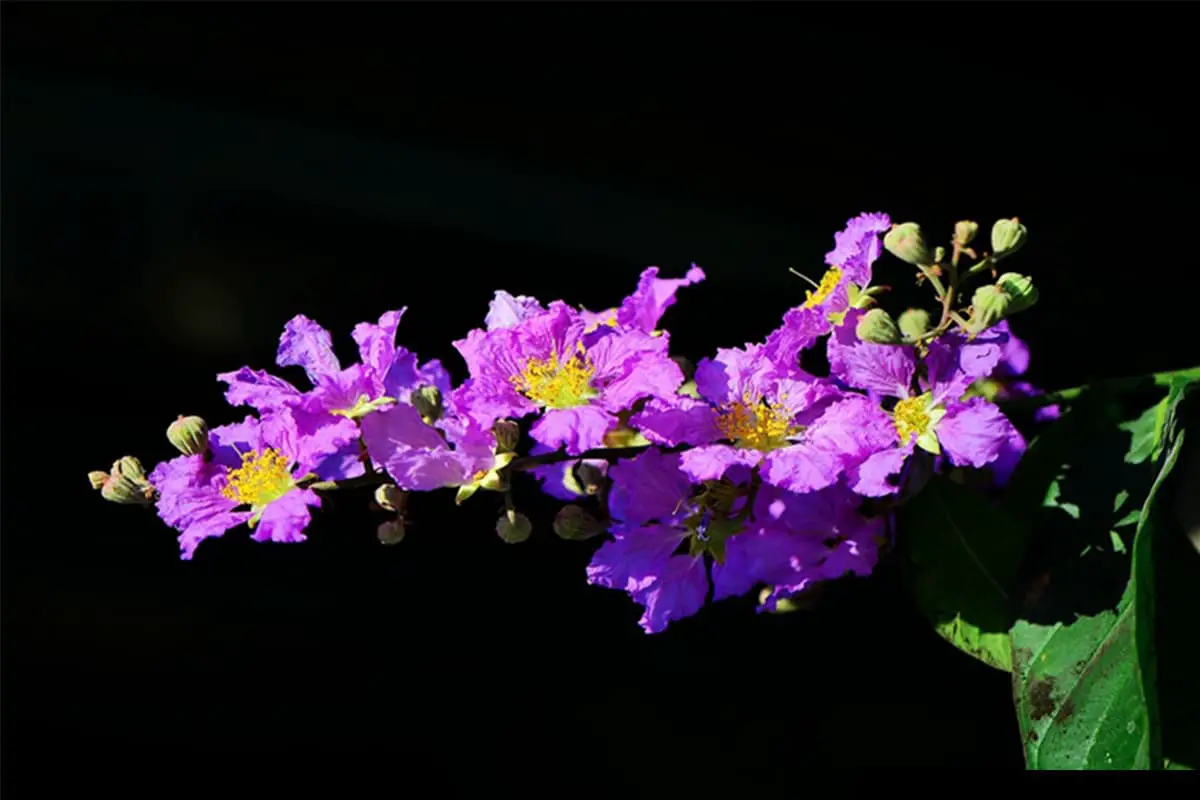
The varieties of Crape Myrtle include Chiwei (Red Myrtle), Yinwei (Silver Myrtle), and Cuiwei (Blue Myrtle).
Blue Myrtle flowers are bluish-gray, with dark green leaves. The best Blue Myrtle has blue petals, arranged in a conical inflorescence on new branches, up to 20 cm long. Each flower has six petals, many of which are wrinkled, resembling a disc.
When the flowers bloom, the tree is as beautiful as a cloud at dawn, hence it’s also known as “Full House Red”. The fruit is a capsule, shaped like a soybean, and contains many seeds which mature in November.
Blue Myrtle is light purple, with abundant branches and leaves. The color of the leaves is not as bright green as other leaves, but a little darker. It thrives in comfortable, warm sunlight, is drought-resistant, but fears flooding.
The trunk is light brown, and the branches are smooth, usually used for ornamental purposes.
Silver Myrtle, as the name suggests, has white flowers that bloom on new branches, arranged in a conical inflorescence, with wavy edges. Silver Myrtle prefers a semi-shaded environment and requires fertile, moist soil.
The trunk of the Silver Myrtle is often twisted, with very smooth bark. Its overall appearance is quaint and unique, suitable for garden viewing and bonsai creation.
Red Myrtle, true to its name, has fiery red flowers. It loves sunshine, warm climates, and fertile soil with good drainage. It grows slowly, but the flowers bloom brightly and beautifully, providing high ornamental value.
Red Myrtle blooms in the summer, with a long flowering period, hence it’s also known as “Hundred-day Red”. It’s often used for garden viewing and bonsai creation.
The Crape Myrtle prefers a warm and humid climate, enjoys sunlight, slightly tolerates shade, and favors rich, particularly deep and fertile sandy loam. It grows well in slightly damp places and is also drought-tolerant.
It does not thrive in waterlogged conditions or areas with a high water table. While the plant prefers warmth, it can withstand cold and exhibits strong sprouting ability.
The Crape Myrtle also has a strong resistance to pollution, with a high tolerance to substances like sulfur dioxide, hydrogen fluoride, and chlorine. It can exist in semi-shade and prefers growing in fertile, moist soil. It can also withstand drought and grows well in both calcareous and acidic soils.
Originally from Asia, the Crape Myrtle is widely planted in tropical regions.
The Crape Myrtle is a deciduous shrub or small tree that can reach up to 7 meters in height. It has smooth, gray or gray-brown bark, and its branches are often twisted. The twigs are slender, four-angled, and slightly winged.
The leaves are alternately arranged or sometimes opposite, papery, oval, broadly rectangular, or inversely egg-shaped, 2.5-7 cm long, 1.5-4 cm wide, with a short pointed or blunt tip, sometimes slightly concave, and a broad wedge-shaped or nearly round base.
It is glabrous or has soft hairs along the midrib on the underside. The lateral veins are 3-7 pairs, and the minor veins are not noticeable. It is either sessile or has very short petioles.
The flowers are rose-red, bright red, deep pink, pale red, purple, or white, with a diameter of 3-4 cm, often forming 7-20 cm terminal conical flower clusters. The flower stalk is 3-15 mm long, and both the axis and the flower stalk are covered with soft hairs.
The calyx is 7-10 mm long, smooth on the outside without angles, but when fresh, the calyx tube has slightly protruding short angles, glabrous on both sides, with 6 lobes, triangular, upright, and without appendages.
The petals are 6 in number, wrinkled, 12-20 mm long, and have long claws. There are 36-42 stamens, the outer 6 of which grow on the calyx and are much longer than the rest. The ovary is 3-6 chambered, glabrous.
The fruit is oval or broadly oval, 1-1.3 cm long, green to yellow when young, and turns purple-black when mature or dry. It splits along the back of the chambers.
The seeds are winged and approximately 8 mm long. The flowering period is from June to September, and the fruiting period is from September to December.
Crape Myrtle has a strong adaptability to various environments and can generally be grown in common potting soil. If possible, choose to cultivate it in deep, fertile, sandy soil, which is most conducive to its growth.
Crape Myrtle is drought-resistant but dislikes waterlogging. Water it once before the buds sprout in spring, and once after the leaves fall in autumn. At other times, follow the rule: “do not water if not dry”.
Water it 1-3 times during spring drought; take good care of flood drainage during the rainy season to avoid root rot caused by water accumulation; watering is generally not needed in autumn.
Crape Myrtle needs ample sunlight for growth, otherwise, it may result in fewer flowers or even no flowers during the blooming period, and more seriously, it can weaken the growth of the entire plant.
Mature Crape Myrtle plants are highly resistant to cold, but care must be taken to protect the seedlings from cold. After the plant has been cultivated for more than three years, it is no longer necessary to keep it warm.
Much like watering, fertilize once before the buds sprout in spring and once after the leaves fall in autumn. You can use human manure or sesame paste residue, which can promote more vigorous growth of the plant and more vibrant and abundant flowering in the coming year.
As the flowers of Crape Myrtle grow on the new branches of the current year, it’s important to significantly cut back one-year-old branches to concentrate nutrients and promote more robust growth.
Unsupported branches, drooping branches, pest-infected branches, dead branches, slender branches, and inward-growing branches should all be pruned.
During the sapling period, lateral branches growing on the lower part of the main trunk should also be cut off in time to reduce nutrient consumption and ensure a good crown formation on the upper part of the main stem.
For potted Crape Myrtle, replace the potting soil every 2 to 3 years. Use a mixture of 5 parts loose mountain soil, 3 parts garden soil, and 2 parts fine river sand.
When repotting, organic fertilizers such as bone meal and soybean cake powder can be used as base fertilizers, but they should not come directly into contact with the roots to avoid damaging them and affecting plant growth.
Crape myrtle can be easily propagated through seeding, cuttings, layering, division, and grafting.
Seeds are harvested from November to December each year and sown in sandy loam in March of the following year, either in rows or scattered. Prior to sowing, the soil is disinfected with an 800-fold liquid of either Baiking Clear or potassium permanganate.
A granulated 50% Phoxim is uniformly sprayed on the bed surface to kill underground pests. The seeds are soaked in 50°C warm water for 2 to 4 hours.
For row planting, the spacing is 30cm, the depth is 2cm, and the ground is trodden after covering with soil. For scattering, the seeds are mixed with fine sand in a 1:3 ratio, uniformly sprinkled on the seedbed, covered with about 0.5cm thick soil, and then covered with straw.
Water is applied once in the morning and once in the evening every day after sowing to keep the soil loose and moist. Healthy growing plants may bloom in the same year, but the flower spikes should be promptly pruned to prevent affecting future growth.
Crape myrtle cutting propagation is an important asexual propagation method, effectively maintaining the growth characteristics and ornamental features of the crape myrtle plants.
This can be done during the growing season, preferably in March-April. For air layering, choose one or two-year-old branches, cut with a sharp knife and peel off about 1.5cm wide bark, exposing the xylem.
Apply rooting powder solution (diluted as per instructions) about 3cm above the cut area. Once dry, position a plastic tube over the wounded area, tie it at the bottom, fill with loose garden soil, and water.
Tie the top tightly after watering. Check after a month, add water if the soil is too dry. Once rooted, cut and plant separately.
Before the onset of spring or in autumn, dig out the root sprouts of the plant, trim the root system and branches appropriately, and plant separately. Small seedlings can be bare-rooted, while larger ones should be dug up with a ball of soil.
During the nurturing process, frequent pruning and shaping should be conducted to maintain a beautiful tree shape and promote dense flowering branches.
From late February to early March, grafting should be carried out before the Crape Myrtle branches sprout. During grafting, choose robust seedlings as rootstocks and branches of the desired flower color as scions, adopting a cleft grafting method.
First, make a vertical split about 3 to 4 cm deep at the top of the rootstock. Then, insert a wedge-shaped scion, about 5 to 8 cm long with 2 to 3 buds, into the split of the rootstock, aligning it with the cambium.
Next, use a plastic film to wrap the entire grafting area and the scion, leaving only the bud head exposed. Using this method, graft branches of different colors on the same rootstock to create a multicolored tree.
Two to three months after grafting, the wrap can be loosened, and at this point, the scion can grow up to 50 to 80 cm long. It should be trimmed timely to prevent wind damage and can be trained into a robust branch.
Comprehensive measures should be taken against diseases. Emphasis should be placed on managing fertilization and watering to promote healthy growth of Crape Myrtle and enhance its disease resistance.
Proper fertilization should be carried out, paying attention to the coordinated application of nitrogen, phosphorus, potassium, and other element fertilizers to avoid the excessive use of nitrogen fertilizers.
Reasonable irrigation, ensuring timely watering in droughts and drainage during floods. Appropriate pruning promotes ventilation and light penetration.
Timely and thorough cleanup of diseased branches and leaves, with centralized incineration to eradicate the source of disease.
Powdery Mildew
This disease is a fungal infection that chiefly damages leaves, with young branches and leaves more prone to infection than older ones. In the early stages of the disease, white powdery spots appear on the leaves, covered with a layer of white powdery mold which later turns gray.
Prevention method: Spray with 500 times diluted solution of 80% zinc dimethyldithiocarbamate or 800 times diluted solution of 50% carbendazim at the onset of the disease.
Sooty Mold
The pathogen of this disease belongs to fungi, with multiple types of pathogens possible, resulting in several infections simultaneously. Its key feature is a black mold layer or soot layer, mainly damaging leaves and branches.
It can be treated with a 600 times diluted solution of 50% carbendazim or a 500 times diluted solution of 70% methyl tobujin.
For Crape Myrtle that was severely diseased last year, spraying with 200-300 times diluted solution of sodium abietate before spring budding can eradicate overwintering pathogens.
As aphids, scale insects, and mealybugs secretion forms the basis for sooty mold fungus, timely prevention of these pests is crucial.
Leaf Spot
The pathogen of this disease is a fungus predominantly damaging leaves, usually starting from lower old leaves and gradually spreading to upper new leaves.
This disease prefers high temperature and humidity, with disease spots being purplish-black to black of varying sizes and round or nearly round.
It can be treated with a 1000 times diluted solution of 65% zinc dimethyldithiocarbamate or an 800 times diluted solution of 75% chlorothalonil.
Crape Myrtle is prone to aphids, scale insects, thorns moths, leaf roller moths, and leaf cutter bees during its growth period, mainly damaging the leaves. It’s crucial to observe and prevent in time.
If an infestation occurs, use a 1000 times diluted solution of 40% lepestcide to spray and kill scale insects and aphids.
Use a 1500 times diluted solution of 80% dichlorvos to spray and kill thorns moths and leaf roller moths, and remove overwintering cocoons on branches during winter. For leaf cutter bees, use insect nets to catch adult insects at the onset.
If a large infestation occurs, spray with a 1500 times diluted solution of 2.5% cyhalothrin or a 1000 times diluted solution of 80% dichlorvos at the peak of adult emergence.
Economic Value
The wood of the Crape Myrtle is hard and decay-resistant, making it suitable for agricultural tools, furniture, and construction materials.
Medicinal Value
The bark, leaves, and flowers of the Crape Myrtle can be used as potent laxatives; a decoction made from its roots and bark can treat hemoptysis, hematemesis, and rectal bleeding.
Ornamental value
The Crape Myrtle, with its vibrant and beautiful flowers, has a long blooming period and lifespan. Some have lived up to 200 years. In tropical regions, it is widely grown as a garden ornamental tree and sometimes used for bonsai.
Floral Language of the Lagerstroemia indica
The floral language of the Crape Myrtle symbolizes independence. The Crape Myrtle blooms at the transition of summer and autumn, avoiding the bustling spring when all flowers bloom.
This gives the impression of solitary beauty, making it an appropriate gift to praise a friend’s quality of independence. It also signifies an obsessive love, good luck, eloquence, and peace.

Peggie was once a high school mathematics teacher, but she set aside her chalkboard and textbooks to follow her lifelong passion for flowers. After years of dedication and learning, she not only established a thriving flower shop but also founded this blog, “Flowers Library”. If you have any questions or wish to learn more about flowers, feel free to contact Peggie.
 English
  العربية
  Bahasa Indonesia
  Deutsch
  Français
  Italiano
  Nederlands
  Português
  Русский
  日本語
日本語